Logo - Life.Understood.

Category: Sovereignty

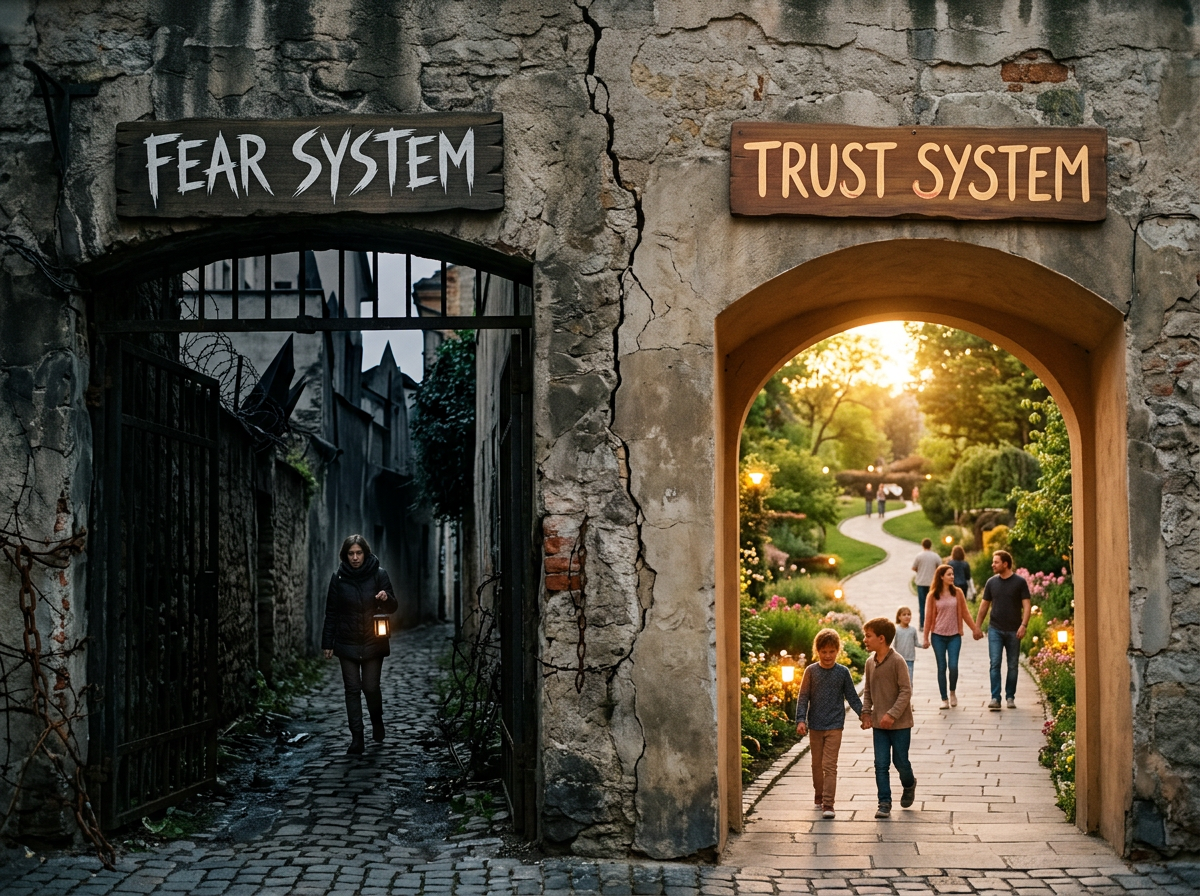
  • Fear-Based Systems vs Trust-Based Systems: Two Civilizational Architectures

    Fear-Based Systems vs Trust-Based Systems: Two Civilizational Architectures


    Why the Future May Depend Less on Technology and More on the Social Operating Systems We Choose


    Meta Description

    Explore the differences between fear-based and trust-based systems and how these competing civilizational architectures shape governance, economics, leadership, institutions, and human development in an era of uncertainty.


    Throughout history, societies have faced a recurring challenge:

    How should human beings organize themselves in the presence of uncertainty?

    • Every civilization confronts risks.
    • Resources may become scarce.
    • Conflicts may emerge.
    • Institutions may fail.
    • External threats may appear.
    • Economic disruptions may occur.

    The question is not whether uncertainty exists.

    The question is how societies respond to it.

    Across cultures, political systems, organizations, and institutions, two broad patterns repeatedly emerge.

    • One organizes primarily around fear.
    • The other organizes primarily around trust.

    These approaches represent more than policy differences.

    • They reflect fundamentally different assumptions about human nature, cooperation, risk, and social order.
    • In many respects, they function as competing civilizational architectures.

    Understanding the distinction helps illuminate why some societies generate resilience and adaptability while others repeatedly reproduce instability despite efforts to maintain control.


    Fear as a Coordinating Mechanism

    Fear is a powerful social force.

    • From an evolutionary perspective, it serves an essential function.
    • Fear directs attention toward threats.
    • It motivates protective action.
    • It helps individuals survive dangerous situations.

    Problems arise when fear evolves from an adaptive response into a primary organizing principle.

    Fear-based systems often assume:

    • People cannot be trusted.
    • Resources are fundamentally scarce.
    • Compliance is preferable to initiative.
    • Control creates stability.
    • Authority should flow primarily from the top down.

    Under these assumptions, institutions frequently emphasize surveillance, enforcement, hierarchy, and risk avoidance.

    • These approaches can generate short-term order.
    • In certain circumstances they may even be necessary.
    • Yet systems organized primarily around fear often struggle to sustain long-term adaptability.

    As explored in The Psychology of Scarcity: Why Fear-Based Systems Reproduce Instability, chronic fear narrows attention, discourages experimentation, and reinforces short-term thinking.

    The result is frequently a system that becomes increasingly fragile while attempting to appear strong.


    Trust as a Coordinating Mechanism

    Trust operates differently.

    • Trust does not eliminate risk.
    • Nor does it assume that all people will behave responsibly.
    • Instead, trust-based systems recognize that cooperation becomes more effective when individuals possess meaningful agency and shared accountability.

    Trust-based systems often assume:

    • Most people can develop responsibility.
    • Cooperation can generate mutual benefit.
    • Information should circulate.
    • Participation improves adaptation.
    • Institutions should cultivate legitimacy rather than rely solely on authority.

    These assumptions encourage different forms of social organization.

    Rather than maximizing control, trust-based systems seek to strengthen relationships, transparency, competence, and accountability.

    As social scientist Robert Putnam (2000) observed, trust functions as a form of social capital that enables cooperation and collective action.

    Trust is not merely a moral virtue.

    It is operational infrastructure.

    One way to understand the difference between fear-based and trust-based systems is to examine how coherence emerges within complex societies.

    Trust does not function as an isolated virtue. It influences information flows, participation, adaptability, learning, accountability, and collective resilience. When these reinforcing processes strengthen one another, societies often become more capable of responding constructively to uncertainty.

    The framework below illustrates how coherence develops through interconnected feedback loops that support long-term stability without requiring excessive control.

    Figure 1. Coherence as the Foundation of Trust-Based Systems.

    Download Reference Map 006: The Coherence Cycle

    Fear-based systems often seek stability through control, restriction, and centralized authority. Trust-based systems generate resilience through feedback, participation, learning, accountability, and adaptive cooperation.

    The Coherence Cycle illustrates how these reinforcing dynamics help societies maintain stability while remaining responsive to changing conditions.


    Governance and Human Nature

    Every governance system encodes assumptions about human nature.

    • Some systems assume individuals are fundamentally self-interested and must therefore be controlled.
    • Others assume individuals possess developmental potential that can be cultivated through education, participation, and responsibility.

    Neither assumption is entirely correct or entirely incorrect.

    • Human beings are capable of cooperation and exploitation.
    • Compassion and selfishness.
    • Wisdom and shortsightedness.

    The challenge lies in determining which qualities institutions encourage.

    As explored in Every Governance System Encodes a Model of Human Consciousness, governance systems do not merely manage populations.

    They reflect underlying beliefs about what people are capable of becoming.

    • Fear-based architectures often emphasize compliance.
    • Trust-based architectures often emphasize development.
    • This distinction shapes everything from education to leadership to civic participation.

    Information Flows and System Health

    One of the clearest differences between fear-based and trust-based systems concerns information.

    Fear-based systems frequently seek to control information flows.

    • Information becomes concentrated.
    • Feedback becomes restricted.
    • Dissent becomes risky.
    • Transparency declines.

    Initially, this may appear efficient.

    However, systems depend upon accurate feedback to adapt.

    When information becomes distorted, leaders lose visibility into emerging problems.

    Errors compound.

    Blind spots expand.

    Trust-based systems generally encourage greater information circulation.

    • Feedback is more likely to reach decision-makers.
    • Problems become visible sooner.
    • Mistakes can be corrected before they become crises.

    As systems theorist Donella Meadows (2008) noted, feedback loops play a critical role in determining how systems behave over time.

    Healthy feedback is difficult to maintain when fear discourages honest communication.


    Leadership Beyond Control

    Leadership provides another useful lens.

    • Fear-based leadership often relies upon authority, compliance, and positional power.

    Its central question is:

    How do I maintain control?

    Trust-based leadership asks a different question:

    How do I cultivate capacity?

    This distinction influences organizational culture, innovation, and resilience.

    • Fear-based environments frequently discourage experimentation because mistakes carry significant consequences.
    • Trust-based environments are more likely to support learning, adaptation, and responsible risk-taking.

    As discussed in Leadership Beyond Control, modern leadership increasingly involves creating conditions in which others can contribute effectively rather than simply directing behavior through authority.

    The shift is subtle but profound.

    Control seeks predictability.

    Capacity seeks resilience.


    Economics and Social Coordination

    Economic systems also reveal the contrast between these architectures.

    • Fear-based economic environments often emphasize extraction.
    • Competition becomes dominant.
    • Short-term incentives proliferate.
    • Trust declines.
    • Protective behaviors increase.

    As explored in From Extraction to Circulation: The Systems Logic of Ethical Abundance, extractive systems frequently consume the resources upon which they depend.

    Trust-based economic environments do not eliminate competition.

    Instead, they balance competition with cooperation, stewardship, and long-term renewal.

    Economic resilience depends not only upon production but also upon maintaining the conditions that allow prosperity to continue.

    • This includes trust.
    • Social cohesion.
    • Institutional legitimacy.
    • And the capacity for collective problem-solving.

    Technology and Amplification

    Technology does not determine whether a society becomes fear-based or trust-based.

    • It amplifies existing tendencies.

    A fear-based system equipped with advanced technologies may increase surveillance, information control, and behavioral management.

    A trust-based system equipped with the same technologies may improve transparency, participation, collaboration, and access to knowledge.

    The technology itself remains neutral.

    The governing assumptions shape its application.

    As explored in Informational Sovereignty: Staying Psychologically Grounded in Machine Environments, technological systems increasingly influence how information is encountered, interpreted, and shared.

    The question is not whether technology will become more powerful.

    The question is whether human agency will develop alongside it.


    The Resilience Advantage

    Fear-based systems often appear stronger than they actually are.

    • They may project stability through control, hierarchy, and centralized authority.
    • However, this stability can prove fragile when conditions change rapidly.

    Trust-based systems frequently appear messier.

    • They allow greater participation.
    • Greater disagreement.
    • Greater experimentation.
    • Yet these qualities often improve adaptability.
    • Resilience depends not on eliminating uncertainty but on responding effectively when uncertainty emerges.

    As explored in Resilience Beyond Survival: Psychological Models for Transitional Eras, resilient systems possess the capacity to absorb disruption, learn from experience, and continue evolving.

    Trust supports these capacities because it enables cooperation under conditions where complete certainty is impossible.


    The Developmental Challenge

    Perhaps the most important distinction between these architectures is developmental.

    • Fear-based systems primarily manage behavior.

    Trust-based systems cultivate capacity.

    • The difference reflects two fundamentally different views of human potential.

    One assumes that order emerges primarily through control.

    The other assumes that order emerges through development.

    Development is slower.

    More complex.

    Less predictable.

    It requires investment in education, institutions, relationships, and culture.

    Yet many of humanity’s greatest advances emerged not from tighter control but from expanded capacity.

    • Scientific inquiry.
    • Democratic participation.
    • Civic cooperation.
    • Innovation.
    • Learning.
    • These developments depend upon trust.
    • Not blind trust.

    Earned trust supported by accountability and competence.


    Conclusion

    The future will undoubtedly bring new technologies, new challenges, and new uncertainties.

    Yet beneath these developments lies a deeper question.

    What kind of social architecture will guide our response?

    Fear-based systems and trust-based systems represent different answers to the problem of uncertainty.

    One seeks security primarily through control.

    The other seeks resilience through cooperation, accountability, and development.

    Neither architecture eliminates risk.

    Both confront the realities of human limitation.

    Yet history suggests that societies capable of generating trust, maintaining healthy feedback, cultivating responsibility, and strengthening human capacity often prove more adaptable over the long term.

    In this sense, the future may depend less upon the technologies humanity creates and more upon the assumptions humanity embeds within the systems that use them.

    The challenge is not choosing between fear and trust entirely.

    Both have legitimate roles.

    The challenge is determining which principle serves as the foundation.

    Because the principle at the foundation tends to shape everything built upon it.


    Crosslinks


    References

    Meadows, D. H. (2008). Thinking in systems: A primer. Chelsea Green Publishing.

    Putnam, R. D. (2000). Bowling alone: The collapse and revival of American community. Simon & Schuster.

    Senge, P. M. (1990). The fifth discipline: The art and practice of the learning organization. Doubleday.

    The Living Archive is designed to be explored through pathways, categories, and search. If you’re looking for a specific idea, question, or theme, AI Search can help surface relevant connections across the archive.


    Attribution

    The Living Archive
    Integrative Frameworks for Regenerative Civilization

    © 2026 Gerald Daquila. All rights reserved.
    Part of the Life.Understood. knowledge ecosystem and Stewardship Institute initiative.

    This article is intended for educational, research, and civic inquiry purposes.
    Readers are encouraged to engage critically, verify sources independently, and explore related knowledge hubs for broader systems context.

  • Stewardship vs Management vs Leadership

    Stewardship vs Management vs Leadership


    Understanding the Differences Between Guidance, Coordination, and Long-Term Responsibility


    Meta Description

    Explore the differences between stewardship, management, and leadership through systems thinking, organizational psychology, and long-term governance. Learn why healthy institutions require all three — and why stewardship is essential for sustainable human flourishing.


    Introduction

    The terms leadership, management, and stewardship are often used interchangeably.

    However, they represent fundamentally different orientations toward:

    • responsibility,
    • power,
    • coordination,
    • decision-making,
    • and long-term human systems.

    Confusing these roles can create major institutional problems.

    Organizations may:

    • prioritize charisma over competence,
    • optimize short-term efficiency while weakening resilience,
    • or pursue growth without long-term responsibility.

    Healthy systems require all three capacities:

    • leadership,
    • management,
    • and stewardship.

    But they serve different functions.

    Understanding the distinction is increasingly important in an era shaped by:

    • institutional distrust,
    • organizational fragility,
    • governance failures,
    • burnout,
    • ecological strain,
    • and short-term incentive structures.

    At its core, the distinction concerns one essential question:

    What is the purpose of power within a human system?


    What Is Leadership?

    Leadership primarily concerns:

    • direction,
    • influence,
    • vision,
    • and mobilization.

    Leaders help groups:

    • orient toward goals,
    • navigate uncertainty,
    • coordinate action,
    • and sustain momentum during change.

    Leadership often emerges during:

    • crisis,
    • transformation,
    • innovation,
    • or periods of instability.

    Effective leadership may involve:

    • communication,
    • strategic vision,
    • inspiration,
    • courage,
    • emotional intelligence,
    • and decision-making under uncertainty.

    Leadership is fundamentally relational.

    It shapes:

    • morale,
    • alignment,
    • trust,
    • and collective movement.

    However, leadership alone is insufficient for sustaining healthy systems over long periods of time.

    Charismatic leadership without structural wisdom can become unstable, centralized, or extractive.

    As organizational theorist Ronald Heifetz (1994) notes, leadership is not merely authority — it is the adaptive capacity to help groups navigate complex realities.


    What Is Management?

    Management primarily concerns:

    • coordination,
    • execution,
    • organization,
    • and operational stability.

    Managers focus on:

    • processes,
    • logistics,
    • resource allocation,
    • accountability,
    • timelines,
    • and system functionality.

    While leadership often emphasizes direction, management emphasizes implementation.

    Management helps transform:

    • goals into procedures,
    • plans into operations,
    • and vision into repeatable systems.

    Healthy management creates:

    • consistency,
    • reliability,
    • operational clarity,
    • and organizational continuity.

    Without management:

    • systems become chaotic,
    • responsibilities become unclear,
    • and institutional effectiveness declines.

    However, management can also become excessively rigid when systems prioritize:

    • bureaucracy,
    • metrics,
    • efficiency,
    • and procedural control
      over human well-being and long-term adaptability.

    Management optimizes systems.
    But optimization alone does not guarantee wisdom.


    What Is Stewardship?

    Stewardship concerns long-term responsibility for the health, continuity, and integrity of a system.

    While leadership focuses on direction and management focuses on execution, stewardship focuses on maintaining the conditions that allow systems to remain healthy across time.

    The framework below illustrates stewardship as a field of interconnected responsibilities, showing how trust, resilience, regeneration, accountability, and long-term flourishing reinforce one another within healthy human systems.

    Download Reference Map 007: The Stewardship Field Map

    A systems framework illustrating how stewardship operates across trust, resilience, regeneration, responsibility, and long-term flourishing.

    Unlike leadership or management alone, stewardship asks:

    What must be protected, sustained, cultivated, and responsibly transmitted across time?

    Stewardship emphasizes:

    • care,
    • accountability,
    • resilience,
    • continuity,
    • ethical responsibility,
    • and long-horizon thinking.

    A steward recognizes that:

    • institutions outlive individuals,
    • ecosystems require regeneration,
    • trust must be preserved,
    • and power carries obligations beyond personal gain.

    Stewardship is therefore fundamentally custodial rather than extractive.

    It evaluates decisions not only through:

    • efficiency,
    • popularity,
    • or short-term success,
      but through:
    • sustainability,
    • resilience,
    • ethical consequences,
    • and future impact.

    Stewardship asks:

    • Will this strengthen or weaken the system over time?
    • Are we preserving the conditions necessary for future flourishing?
    • Are incentives aligned with long-term health?
    • Does this decision increase fragility or resilience?

    This orientation becomes especially important in:

    • governance,
    • education,
    • ecology,
    • institutional design,
    • community systems,
    • and civilization-scale decision-making.

    Leadership Without Stewardship Becomes Dangerous

    Leadership without stewardship can become:

    • ego-driven,
    • performative,
    • centralized,
    • or short-sighted.

    History repeatedly demonstrates that charismatic leadership alone does not guarantee healthy outcomes.

    Leaders may successfully:

    • mobilize attention,
    • inspire followers,
    • and accelerate growth,
      while simultaneously:
    • weakening institutions,
    • concentrating power,
    • exhausting communities,
    • or destabilizing long-term resilience.

    This occurs because leadership often prioritizes movement,
    while stewardship prioritizes continuity.

    Healthy systems require both:

    • adaptive movement,
    • and structural preservation.

    Without stewardship, institutions may become optimized for:

    • visibility,
    • expansion,
    • or short-term success,
      while quietly undermining their long-term viability.

    Management Without Stewardship Becomes Extraction

    Management systems focused solely on efficiency often drift toward extraction.

    This can manifest as:

    • burnout culture,
    • hyper-optimization,
    • rigid bureaucracy,
    • excessive surveillance,
    • or purely metric-driven decision-making.

    When institutions prioritize measurable output above all else, human systems may gradually weaken despite apparent productivity.

    This is one reason modern organizations sometimes experience:

    • declining morale,
    • institutional distrust,
    • disengagement,
    • and psychological exhaustion despite operational growth.

    Systems thinking demonstrates that:

    optimization without regeneration eventually creates fragility.

    Stewardship introduces balancing principles:

    • sustainability,
    • human well-being,
    • resilience,
    • adaptability,
    • and ethical responsibility.

    Stewardship Operates Across Time Horizons

    Leadership often focuses on:

    • immediate direction.

    Management often focuses on:

    • operational cycles.

    Stewardship focuses on:

    • intergenerational continuity.

    A steward asks:

    • What are the second-order effects of this decision?
    • What hidden costs are accumulating?
    • What kind of culture are we reinforcing?
    • What vulnerabilities are emerging beneath short-term success?

    This long-horizon orientation is essential for:

    • healthy governance,
    • resilient institutions,
    • regenerative economics,
    • ecological sustainability,
    • and civilization-scale coordination.

    Without stewardship, systems frequently drift toward:

    • short-termism,
    • extraction,
    • and eventual instability.

    Stewardship and Systems Thinking

    Stewardship naturally aligns with systems thinking because both emphasize:

    • interdependence,
    • feedback loops,
    • long-term consequences,
    • and structural health.

    Stewards recognize that:

    • incentives shape behavior,
    • systems produce emergent outcomes,
    • and unmanaged fragility accumulates over time.

    For example:

    • short-term profit extraction may weaken long-term institutional trust,
    • ecological depletion may generate delayed civilizational instability,
    • unchecked centralization may reduce adaptive resilience,
    • and poorly designed incentives may unintentionally undermine cooperation.

    Stewardship therefore requires the ability to perceive systems beyond immediate appearances.


    The Difference Between Ownership and Stewardship

    Modern cultures often frame power primarily through ownership and control.

    Stewardship reframes power as responsibility.

    A steward understands:

    • possession is temporary,
    • influence carries ethical obligations,
    • and systems must remain viable beyond individual lifespans.

    This principle appears throughout:

    • indigenous traditions,
    • ecological philosophy,
    • regenerative economics,
    • and long-term governance models.

    The steward mindset shifts the question from:

    “What can I extract?”

    to:

    “What must I preserve and responsibly cultivate?”


    Why Modern Institutions Often Lack Stewardship

    Many contemporary systems are structurally optimized for:

    • short-term metrics,
    • quarterly growth,
    • political cycles,
    • algorithmic attention,
    • and rapid extraction.

    These incentive systems often weaken stewardship because:

    • long-term consequences remain delayed,
    • regenerative behavior may appear less immediately profitable,
    • and institutional continuity becomes secondary to immediate performance.

    As a result, societies may experience:

    • ecological depletion,
    • institutional distrust,
    • social fragmentation,
    • and declining resilience despite technological advancement.

    The absence of stewardship is therefore not merely an individual moral failure.
    It is often a systemic design problem.


    Healthy Systems Require All Three

    Healthy organizations and civilizations require:

    • leadership,
    • management,
    • and stewardship working together.

    Leadership provides:

    • direction,
    • vision,
    • adaptation,
    • and movement.

    Management provides:

    • coordination,
    • execution,
    • organization,
    • and operational continuity.

    Stewardship provides:

    • long-term responsibility,
    • ethical orientation,
    • resilience,
    • and regenerative continuity.

    When balanced properly, these functions strengthen one another.

    When separated:

    • leadership may become reckless,
    • management may become mechanical,
    • and stewardship without adaptability may become stagnant.

    The challenge is integration.


    Conclusion

    Leadership, management, and stewardship are not interchangeable.

    They represent different relationships to:

    • power,
    • responsibility,
    • coordination,
    • and time.

    Leadership mobilizes.
    Management organizes.
    Stewardship preserves and regenerates.

    Modern societies often overvalue:

    • visibility,
    • speed,
    • optimization,
    • and short-term growth,
      while undervaluing:
    • resilience,
    • continuity,
    • trust,
    • and long-term systemic health.

    Yet civilizations ultimately survive not through charisma or efficiency alone,
    but through their capacity for responsible stewardship across generations.

    In increasingly complex systems, stewardship may become one of the most essential forms of intelligence humanity can cultivate.


    Suggested Crosslinks


    References

    Heifetz, R. A. (1994). Leadership without easy answers. Harvard University Press.

    Meadows, D. H. (2008). Thinking in systems: A primer. Chelsea Green Publishing.

    Senge, P. M. (2006). The fifth discipline: The art and practice of the learning organization (Rev. ed.). Doubleday.

    The Living Archive is designed to be explored through pathways, categories, and search. If you’re looking for a specific idea, question, or theme, AI Search can help surface relevant connections across the archive.


    Attribution

    The Living Archive
    Integrative Frameworks for Regenerative Civilization

    © 2026 Gerald Daquila. All rights reserved.
    Part of the Life.Understood. knowledge ecosystem and Stewardship Institute initiative.

    This article is intended for educational, research, and civic inquiry purposes.
    Readers are encouraged to engage critically, verify sources independently, and explore related knowledge hubs for broader systems context.

  • Poka-yoke for the Diaspora: Error-Proofing Your Heritage Retrieval

    Poka-yoke for the Diaspora: Error-Proofing Your Heritage Retrieval


    For the Filipino diaspora, the quest for “roots” often feels like trying to download a massive, ancient file over a dial-up connection.

    The signal is weak, the data is corrupted by colonial interference, and the “user interface” of modern culture—festivals, food-vlogging, and tribal-patterned streetwear—often feels like a shallow skin for a deep, missing body.

    In Lean manufacturing, Poka-yoke is the practice of “error-proofing.” It’s about designing a system so that a mistake becomes impossible to make.

    When it comes to reclaiming your heritage, most of us are currently operating in a high-defect environment. We fall into the “Waste” (Muda) of performative culture, mistaking the aesthetic of being Filipino for the sovereignty of being an ancestor-in-training.

    If we are to build the Philippine Ark—a coherent, systemic container for our collective future—we must error-proof our retrieval process.


    1. Identifying the “Muda” (Waste) of Performative Culture

    In the “Architect’s” view, waste is any activity that consumes resources but creates no value for the end-state (Sovereignty). In heritage retrieval, this looks like:

    • The “Selfie-Stick” Spirituality: Engaging in rituals or “indigenous” practices primarily for the visual signal. This is a “Defect” because it prioritizes external validation over internal resonance.
    • Aesthetic Appropriation: Wearing the patterns of a tribe whose history, struggles, and current systemic constraints you haven’t studied. This is “Over-processing”—adding a finish to a product that has no structural integrity.
    • Ancestor-Larping: Invoking the “spirit of the Babaylan” to avoid the hard, material work of Philippine Systems reform. This is “Motion without Progress.”

    When we engage in these wastes, we aren’t retrieving heritage; we are consuming a “Filipino-themed” product.

    This keeps us in a state of Fractured Survival, forever hungry for a connection that never quite satisfies because it isn’t grounded in Keystone References.


    2. Poka-yoke: Error-Proofing the Retrieval

    To move from performance to presence, we need “error-proofing” mechanisms. These are filters that ensure your connection to the “Records” is authentic and high-fidelity.


    The “Nervous System” Sensor

    An error-proofed retrieval starts with the body. If a “cultural practice” makes you feel high-strung, performative, or superior to others, it’s a defect.

    Authentic retrieval feels like “The Long Exhale.” It is the sensation of a system (you) finally finding its proper “ground.”


    The “Sovereignty” Check

    Ask yourself: Does this knowledge make me more dependent on an external “guru,” or does it provide me with the “Standard Work” to govern my own life?

    True heritage retrieval is an upgrade to your internal operating system, not an app you buy from someone else.


    3. The “Standard Work” for the Philippine Ark

    Reconnecting to the Philippine Ark isn’t a weekend workshop; it is the implementation of Sovereign Protocols. This is the “Standard Work” that bridges the gap between your corporate skills and your soul’s mission.


    Phase 1: The Audit of Displacement

    Before you can retrieve what was lost, you must map what was taken.

    • Identify the “Bugs”: Where did your lineage trade sovereignty for survival? (e.g., “I must be a nurse/engineer to be worthy.”)
    • Clean the Data: Separate the “Colonial Noise” (guilt, shame, subservience) from the “Ancestral Signal” (stewardship, resilience, systems-thinking).

    Phase 2: Systematic Immersion

    Instead of “Batching” your culture (attending one festival a year), move to Continuous Improvement (Kaizen). * Study the Living Archive of your own family patterns.

    • Apply the logic of the Stewardship Institute to your daily professional life. If you are a coder, code with the ethics of an “Oracle.” If you are a manager, lead with the “Biopsychosocial Architecture” of a Babaylan.

    4. Why This is “High-Efficiency” Heritage

    The diaspora often feels guilty for not being “Filipino enough.” Poka-yoke removes this guilt by revealing that “being Filipino” isn’t a performance—it’s a Functional Output.

    When your internal system is error-proofed, your heritage retrieval becomes a source of Leverage. You stop “searching” for your roots and realize you are the root.

    You are the “Standard Work” of ten thousand years of survival, now updated for a high-tech, globalized era.

    The Philippine Ark is not a boat in the ocean; it is the coherent field created when the diaspora stops “larping” and starts Stewardship.

    It is the moment we realize that our corporate efficiency and our ancestral wisdom are the same “Tech Stack.”


    The Call to the Architect

    If you are tired of the “Waste” of performative culture and are ready for the “Rigor” of true sovereignty, your path is clear.

    This is not about “nursing” your wounds forever; it is about error-proofing your recovery so you can eventually take your seat as a Custodian of the Grid.

    Explore the Stewardship Pathways and begin the “Standard Work” of your own homecoming. The Ark is waiting for its engineers.


    The Sovereign Professional: A structural map of power, systems thinking, and personal autonomy—dedicated to helping the independent professional navigate complexity and own their value stream.


    Note from the Architect: I use these Lean principles because they are the only way I found to keep my energy from leaking while building in the physical world. It’s not about productivity; it’s about protection.

    ©2026 Gerald Daquila • Life.Understood. • Systems Thinking, Leadership Architecture, and Applied Coherence

  • The Sovereign Return Blueprint: A Step-by-Step Plan for OFWs

    The Sovereign Return Blueprint: A Step-by-Step Plan for OFWs


    A structured roadmap for Overseas Filipino Workers to transition from overseas labor to local sovereignty, stability, and reintegration


    Meta Description

    Discover a practical step-by-step blueprint for OFWs planning their return to the Philippines—covering financial readiness, asset building, identity reintegration, and long-term stability.


    The Sovereign Return Blueprint: A Step-by-Step Plan for OFWs

    Returning Home Is Not the End—It’s the Design

    For many Overseas Filipino Workers (OFWs), “going home” is the dream.

    But for thousands each year, return is not a triumph—it is a disruption.

    Income stops.
    Roles shift.
    Savings deplete faster than expected.

    Without preparation, return can feel like starting over.

    This reveals a critical truth:

    Return is not an event. It is a system.

    And like any system, it must be designed.


    Why Most Returns Fail

    Despite years—sometimes decades—of overseas work, many OFWs struggle to sustain financial stability upon returning home.

    Research from the Philippine Institute for Development Studies highlights that reintegration challenges include:

    • Lack of sustainable income sources
    • Poor business outcomes due to limited planning
    • Family dependency on remittance continuing post-return

    These patterns mirror what we explored in The OFW Financial Exit Strategy—income without asset conversion leads to fragility.

    Return fails not because of lack of effort, but because of lack of structure.


    The Sovereign Return Framework

    The Sovereign Return Blueprint is a four-stage system:

    1. Preparation (While Abroad)
    2. Positioning (Pre-Return Setup)
    3. Transition (First 12 Months Back)
    4. Stabilization (Long-Term Sovereignty)

    Each stage builds on the previous—skipping one creates risk.


    Stage 1: Preparation (While Abroad)

    Timeline: 2–5 Years Before Return

    This is the most critical—and most overlooked—phase.

    Key actions:

    • Build a 12-month financial runway (living expenses covered post-return)
    • Eliminate high-interest debt
    • Begin asset acquisition (rental property, small business, financial instruments)
    • Track all finances using tools like GCash or Maya

    The goal is simple:

    Return with income streams—not just savings.

    Savings deplete.
    Assets sustain.


    Stage 2: Positioning (Pre-Return Setup)

    Timeline: 6–12 Months Before Return

    Here, the focus shifts from accumulation to alignment.

    Key actions:

    • Identify your primary income source post-return
    • Secure or test business operations remotely
    • Align family expectations (critical but often avoided)
    • Establish local networks and partnerships

    This is where many OFWs underestimate complexity.

    A business that “looks good on paper” often fails without operational testing.


    Stage 3: Transition (First 12 Months Back)

    Timeline: 0–12 Months After Return

    This is the most volatile phase.

    Common challenges:

    • Cultural readjustment
    • Income instability
    • Family pressure to resume financial support

    To navigate this:

    • Stick to a structured monthly budget
    • Avoid large, emotional financial decisions
    • Maintain at least one stable income stream
    • Use digital banking tools to track flows and prevent leakage

    This stage requires discipline.

    Not expansion.
    Not risk.
    Stability.


    Stage 4: Stabilization (Long-Term Sovereignty)

    Timeline: 1–5 Years After Return

    Once stability is achieved, the focus shifts to growth.

    Key actions:

    • Scale income-generating assets
    • Diversify investments
    • Reduce dependency on any single income source
    • Participate in community-level economic systems

    This aligns with models in Ark 1: The 50-Person Resource Loop, which emphasize resilient, localized economies over fragile, centralized ones.

    At this stage, the OFW is no longer a returning worker—but a local economic node.


    The Identity Dimension of Return

    Return is not just financial—it is psychological.

    As explored in The Diaspora Wound, OFWs often experience:

    • Loss of identity tied to overseas roles
    • Difficulty reintegrating into local culture
    • Shifts in family dynamics

    Without addressing this, even financially successful returns can feel disorienting.

    Thus, the blueprint includes:

    • Reconnecting with local community
    • Reframing identity beyond “provider”
    • Rebuilding a sense of belonging

    The Family System Factor

    Return also reshapes family structures.

    From Breaking the Cycle of Generational Scarcity, we know that:

    • Family expectations can quickly absorb financial gains
    • Lack of boundaries leads to regression into old patterns

    To prevent this:

    • Establish clear financial roles
    • Shift from reactive support → structured contribution
    • Align on long-term goals (education, assets, business)

    Return must be a family-level transition, not just an individual one.


    Common Mistakes to Avoid

    Across all stages, several patterns consistently lead to failure:

    • Returning without income streams
    • Overinvesting in a single, untested business
    • Ignoring family dynamics
    • Treating return as a “rest phase” instead of a strategic phase

    Each of these reflects the same issue:

    Hope without structure.


    From Worker to Builder

    The Sovereign Return Blueprint reframes the OFW journey:

    • From labor exporterasset builder
    • From remittance providersystem designer
    • From temporary migrantlocal stabilizer

    This shift is not just personal—it has national implications.

    If scaled, it could:

    • Reduce dependency on overseas employment
    • Strengthen local economies
    • Build resilient, community-based systems

    Conclusion: Designing the Return

    Returning home is one of the most significant transitions an OFW can make.

    Handled passively, it leads to instability.
    Handled intentionally, it becomes transformation.

    The difference is design.


    Action: Begin Your Return Blueprint

    Start today—no matter where you are in the journey:

    1. Define your target return date
    2. Calculate your 12-month runway
    3. Identify one asset that can generate income before you return

    That’s it.

    One step.
    Then another.

    Return is not a leap.
    It is a sequence.


    References

    Philippine Institute for Development Studies. (2022). Reintegration challenges of returning OFWs.

    Schumacher, E. F. (1973). Small is beautiful: Economics as if people mattered. Harper & Row.


    Suggested Crosslink


    The Sovereign Professional: A structural map of power, systems thinking, and personal autonomy—dedicated to helping the independent professional navigate complexity and own their value stream.Ask


    ©2026 Gerald Daquila • Life.Understood. • Systems Thinking, Leadership Architecture, and Applied Coherence

  • The “Silent Withdrawal”: A Lean Audit of Corporate Identity and Soul Governance

    The “Silent Withdrawal”: A Lean Audit of Corporate Identity and Soul Governance


    By Spring 2026, a new class of high-performer has emerged in the shadows of the global finance and tech sectors.

    You won’t see them on LinkedIn announcing their “Open to Work” status, and you certainly won’t see them participating in the loud, performative “quiet quitting” trends of years past. Instead, these individuals are practicing what we call the Silent Withdrawal.

    They are the Silent Professionals—the architects, the engineers, and the strategists who have realized that the legacy corporate system is no longer a vehicle for growth, but a waste-stream for the soul.

    In 2026, discretion is not just a virtue; it is the better part of sovereignty. If you are currently “voting with your feet” while maintaining a flawless professional exterior, this audit is for you.


    Discretion as the Ultimate Signal

    In an era of hyper-transparency and digital surveillance, your silence is your most valuable asset.

    The modern corporation is designed to harvest your identity, your energy, and your “Thumos” (your spirited drive).

    When you loudly resist or publicly exit, you provide the system with the “Noise” it needs to categorize and neutralize you.

    However, when you withdraw your internal allegiance while continuing to deliver high-quality output, you are performing a Lean Audit of the Self.

    You are reclaiming your “Soul Governance” by refusing to let your identity be consumed by a dying machine.

    As explored in The Discipline of Inner Sovereignty, the first step to freedom is not a change in job title, but a change in internal architecture.


    The Lean Audit: Identifying “Identity Muda”

    In Lean manufacturing, “Muda” is waste. In the corporate world, the greatest waste is the “Over-processing of Identity.”

    This happens when a company asks you to “bring your whole self to work,” essentially demanding a free upgrade to their extractive operating system.

    From a Sovereign perspective, your “whole self” belongs to your own value stream. Giving it to a corporation that optimizes for short-term dividends is a systemic defect.

    The Silent Professional performs a Soul Audit to identify where their energy is being siphoned off:

    • The Waste of Motion: Attending “culture-building” workshops that offer zero ROI for your actual craft.
    • The Waste of Over-processing: Agonizing over corporate jargon or office politics that have no bearing on your Sovereign Resource Pipeline.
    • The Waste of Talent: Allowing your highest-level reasoning to be used to “patch” a sinking ship.

    By identifying these as waste, you can begin to quietly bypass them. You aren’t being “disengaged”; you are being Lean. You are preserving your cognitive resources for the work that actually matters.


    Poka-Yoke for the Soul: Error-Proofing Your Energy

    In Lean, Poka-yoke is a technique used to “error-proof” a process—making it impossible for a defect to occur.


    For the Silent Professional, Poka-yoke is a tool for Discernment. It is a mental filter that automatically flags which corporate initiatives are worth your energy and which are “Noise.”

    The Poka-yoke Protocol for 2026:

    1. The Incentive Check: Before committing to a new project, ask: What behavior does this incentive truly drive? As established in Incentives Drive Behavior: Why Good Intentions Fail in Systems, if the system is rigged for extraction, no amount of “good work” will change the outcome. If the incentive is a defect, the Poka-yoke response is a “Discreet Bypass.”
    2. The “Noise” Filter: If an initiative is purely performative (e.g., “AI-readiness” seminars that offer no actual technical depth), it is a defect. You attend the meeting to satisfy the “Motion” waste, but you keep your internal processor focused on your own Signal vs Noise architecture.
    3. The Value Trap: If the work requires you to sacrifice your “Root” (your health, family, or ancestral connection), it is a catastrophic failure. The Poka-yoke mechanism triggers an immediate withdrawal of emotional investment.

    The Sovereignty of the Exit Ramp

    The Silent Professional understands that Why Hard Work Alone Doesn’t Make You Valuable is the ultimate realization of the 2026 landscape. Value is created through Positioning.

    While the “Loud Professionals” are fighting for a seat at a table that is literally disintegrating, you are quietly building your own table.

    You are “voting with your feet” by diversifying your revenue streams, investing in your “Dry Powder” (liquid capital), and retrieving the “Ark Codes” of your own lineage.

    You remain a “model employee” on paper, which provides you with the stability and resources to fund your transition. This isn’t deception; it is Agentic Stewardship.

    You are stewarding your own life back into a generative state. You are realizing that How Systems Shape Behavior (And Why It Feels Personal) is a structural law you can use to your advantage.

    By appearing to follow the system’s rules, you gain the “Lead Time” necessary to exit it entirely.


    Conclusion: The Quiet Revolution

    The “Silent Withdrawal” is the most powerful protest of 2026. It is the refusal to give the corporate waste-stream the one thing it needs to survive: your soul.

    By conducting a Lean audit of your identity and installing “Poka-yoke” filters for your energy, you transform from a “unit of labor” into a Sovereign Professional.

    You stop being a component in a machine and start becoming the architect of a new Earth.

    The exit ramp is open. It doesn’t require a loud announcement. It only requires the quiet, relentless pursuit of your own sovereignty.


    The Sovereign Professional: A structural map of power, systems thinking, and personal autonomy—dedicated to helping the independent professional navigate complexity and own their value stream.


    ©2026 Gerald Daquila • Life.Understood. • Systems Thinking, Leadership Architecture, and Applied Coherence

  • A Life Lived in Stewardship

    A Life Lived in Stewardship

    Returning to the Beginning

    Human Condition Series — Essay 24 of 24


    Every human life begins with questions.

    As children, we ask about the world around us. As we grow older, those questions evolve.


    What does it mean to live well?


    What responsibilities do we hold toward others?


    How should we navigate a world filled with uncertainty and change?


    Throughout this series, we have followed a journey that many people experience in different ways.

    It begins with the foundations of ordinary life — identity, belonging, and the structures we inherit from society.

    Over time, friction appears. Success may fail to satisfy. Meaning becomes uncertain. Life introduces disruptions that challenge familiar assumptions.

    From this friction emerges a deeper search.

    People begin questioning inherited narratives, exploring new perspectives, and recognizing patterns that once remained hidden.

    Awareness expands.

    Yet awakening is not the end of the journey.


    The Work of Integration

    After insight comes integration.

    Individuals learn to live with greater discernment, rebuild their lives in alignment with their evolving understanding, and take responsibility for the quality of their own consciousness.

    They cultivate inner sovereignty — the ability to think clearly and act thoughtfully even within complex and uncertain environments.

    Over time, awareness expands outward.

    People begin recognizing that their actions influence others.

    Leadership, influence, and responsibility enter the picture.

    Awareness becomes stewardship.


    The Quiet Maturity of Wisdom

    As this process continues, individuals often discover something unexpected.

    The goal of development is not perfect certainty.

    It is not complete control over life’s unfolding.

    Instead, maturity often brings a quieter understanding.

    Life remains complex. Questions remain open. Human knowledge continues to evolve.

    Yet wisdom emerges through how individuals respond to these conditions.

    They learn to live with questions rather than rushing toward premature answers.

    They practice meaning through relationships, commitments, and contributions.

    They serve others without needing recognition.

    This stage of life reflects a deeper integration of humility and responsibility.


    Stewardship as a Way of Living

    Stewardship is not a title or a role reserved for a particular group of people.

    It is a way of relating to the world.

    A steward recognizes that life is shared.

    The communities we inhabit, the institutions we build, and the environments we depend upon all require care and attention.

    Stewardship asks individuals to consider how their actions affect these shared systems.

    It encourages people to use their knowledge, abilities, and influence thoughtfully.

    It reminds us that the well-being of future generations is shaped by the decisions made today.

    In this sense, stewardship becomes an expression of maturity.

    It reflects the understanding that human lives are part of a larger unfolding story.


    Living Within the Mystery

    Even as individuals strive to act responsibly, they eventually recognize that life retains an element of mystery.

    Not every question can be answered fully. Not every outcome can be predicted.

    But this mystery does not diminish the value of human effort.

    On the contrary, it invites a deeper form of engagement.

    People continue learning. They continue contributing. They continue refining their understanding.

    They act with care while recognizing the limits of their knowledge.

    This combination of responsibility and humility allows individuals to participate in the world with wisdom rather than certainty.


    The Human Journey Continues

    The journey explored in this series does not end with a final conclusion.

    Each generation encounters its own challenges, asks its own questions, and develops its own understanding of what it means to live well.

    Yet the themes explored here remain remarkably consistent across cultures and eras.


    Human beings seek meaning.


    They wrestle with uncertainty.


    They grow through reflection, responsibility, and care for others.


    This journey — from questioning to stewardship — represents one of the enduring patterns of human development.

    It reminds us that wisdom is not a destination reached once and for all.

    It is a way of participating thoughtfully in the ongoing story of human life.


    Take a moment to notice where this reflection touches your own life.


    Human Condition Series

    A Developmental Exploration of Being Human

    This essay is part of The Human Condition, a 24-part exploration of the psychological and existential forces that shape human life.

    The series traces a developmental arc from the foundations of ordinary experience to awakening, integration, and stewardship.

    You may read the essays sequentially or begin with whichever condition most closely reflects your present questions.

    Each essay explores:

    • how the condition appears in everyday life
    • why humans experience it
    • what it reveals when seen consciously
    • how it can transform when integrated

    The series is not intended as a doctrine, but as a framework for reflection and sensemaking.

    Explore the Human Condition Series Map


    Gerald Alba Daquila
    ©2026 Life. Understood. A Living Archive for Sovereign Sensemaking & Stewardship