
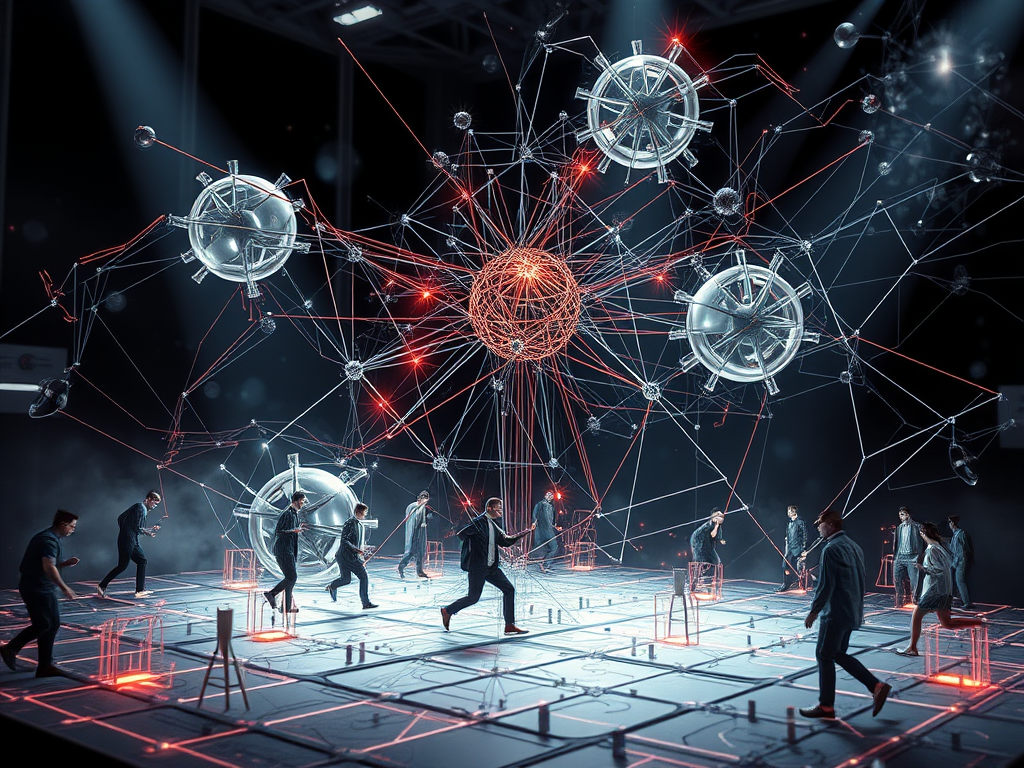
Action vs Consequence
A structural simulation of delayed feedback, overcorrection, and system instability over time.
Meta Description:
Explore how delayed feedback distorts decisions. The Feedback Delay simulation reveals overreaction, oscillation, and instability in dynamic systems.
Why This Simulation Exists
Most systems do not fail immediately.
They fail slowly—then suddenly.
Actions are taken.
Adjustments are made.
Corrections are applied.
Yet outcomes worsen.
Why?
Because the consequences of actions are not immediate.
They are delayed, partial, and often misinterpreted.
By the time feedback arrives, the system has already changed.
The Feedback Delay reveals how time distorts decision-making.
What This Simulation Models
Participants operate within a system defined by:
- delayed feedback on decisions
- incomplete visibility into outcomes
- continuous need for adjustment
- pressure to act before consequences are known
Each participant acts based on what they believe is happening—while the system responds later.
What It Reveals
This simulation surfaces the hidden dynamics of time-delayed systems:
- Overreaction to incomplete feedback
- Oscillation caused by delayed response
- Instability from repeated correction cycles
- Misinterpretation of cause and effect
Participants experience firsthand how:
Systems with delay cannot be managed through immediate reaction.
What Participants Experience
- uncertainty about whether actions are working
- pressure to adjust before results are visible
- cycles of correction and overcorrection
- difficulty linking actions to outcomes
No participant sees real-time system response.
Only the facilitator reveals how the system evolved over time.
Who This Is For
This simulation is designed for:
- leaders and decision-makers
- facilitators and educators
- policy and strategy practitioners
- organizations operating over time horizons
- systems thinkers
Editions Available
🧾 Student Edition — $9
A focused, accessible version for learning and exposure.
Includes:
- simulation scenario
- role structure
- guided experience
- basic debrief prompts
🧠 Professional Edition — $49
A complete facilitation and systems-learning toolkit.
Includes everything in Student Edition, plus:
- facilitator setup and deployment guide
- advanced role cards and delay dynamics
- event injections and time-based effects
- full debrief architecture
- facilitator cheat sheet (key behaviors + insights)
- Structural Systems Field Guide
- Everything you need to run a high-impact systems training session—out of the box.
Core Insight
When feedback is delayed, reaction becomes distortion.
Frequently Asked Questions
How long does the simulation run?
Typically 45–90 minutes, depending on group size and depth of debrief.
How many participants are required?
Works best with 5–12 participants, plus 1 facilitator.
Do participants need prior knowledge?
No. The simulation is designed to reveal insights through experience.
What is the difference between Student and Professional Editions?
- Student Edition → learning and participation
- Professional Edition → facilitation, teaching, and deeper system analysis
Can this be used in organizations or classrooms?
Yes. It is designed for both educational and professional environments.
Experience the System
You don’t understand time in systems by observing outcomes.
You understand it by seeing how delay distorts decisions.
👉 Explore Simulation No. 12 — The Feedback Delay (Student Edition)
👉 Explore Simulation No. 12 — The Feedback Delay (Professional Edition)
Part of the Structural Simulation Library
This simulation is part of the Structural Simulations (SRI) series—a growing library of experiential models designed to reveal how real systems behave.
Explore more:
- The Interdependence Loop → system consequences
- The Signal Field → information dynamics
- The Incentive Engine → behavior and rewards
- The Shift Directive → change systems
Structural Simulations (SRI)
Experiential system models for understanding complexity, behavior, and real-world dynamics.
Not theory. Not abstraction.
Lived system insight.
© 2026 Stewardship Readiness Institute • Discernment in Complex Human Systems