Logo - Life.Understood.

Category: Governance Nodes

  • How the Prototype Community Functions Day-to-Day

    How the Prototype Community Functions Day-to-Day


    A Barangay-Scale Stewardship Framework for Regenerative Living, Economic Circulation, and Distributed Leadership


    Meta Description

    Explore the operational blueprint behind a regenerative barangay-scale prototype community in the Philippines, including governance, stewardship systems, local economics, conflict resolution, and resilient day-to-day living without centralized debt dependency.


    Introduction

    Many intentional communities fail not because their vision lacks inspiration, but because their operational systems remain vague.

    Noble ideals alone cannot sustain land stewardship, shared infrastructure, financial resilience, or human relationships over time.

    The Prototype Community proposed within the SHEYALOTH stewardship architecture is therefore designed not merely as a philosophical experiment, but as an operationally grounded living system.

    This document outlines how the prototype community functions on a day-to-day basis.

    Its purpose is to answer the practical questions donors, collaborators, future residents, and governance advisors will inevitably ask:

    • How is the community structured?
    • Who makes decisions?
    • How does money circulate?
    • How are conflicts handled?
    • How are members selected?
    • What prevents leadership abuse?
    • How does the community remain financially viable?
    • How does the model scale without collapsing?

    This is not a utopian blueprint.

    It is a systems-informed prototype designed for gradual implementation, adaptation, and resilience.


    1. Core Design Philosophy

    The prototype community is built around five foundational principles:

    1. Stewardship Over Ownership

    Land, infrastructure, knowledge, and resources are treated primarily as stewarded assets rather than speculative commodities.

    The objective is long-term regenerative use rather than extraction.


    2. Distributed Responsibility

    The community avoids over-centralization of authority.

    Leadership functions are distributed through councils, working groups, rotating stewardship roles, and transparent governance structures.

    This reduces fragility and dependency on charismatic leadership.


    3. Regenerative Economics

    The node is designed to retain and circulate value locally whenever practical.

    Priority is placed on:

    • local production,
    • skill development,
    • cooperative purchasing,
    • resilient infrastructure,
    • and ethical enterprise creation.

    4. Human-Scale Governance

    The community is intentionally kept within a manageable relational scale.

    Research in social cohesion repeatedly suggests that trust and accountability degrade when communities become too large or overly bureaucratic (Ostrom, 1990).

    The prototype therefore prioritizes:

    • relational governance,
    • participatory decision-making,
    • and face-to-face accountability.

    5. Adaptive Evolution

    The operating model is not static.

    The prototype is designed to learn through implementation.

    Systems are expected to evolve based on:

    • ecological realities,
    • member feedback,
    • financial conditions,
    • and operational experience.

    2. Community Structure

    Initial Prototype Size

    The recommended initial scale is:

    • 12–20 founding adults
    • small family clusters
    • rotating retreat participants
    • local collaborators and trainees

    This allows sufficient diversity of skills while maintaining manageable governance complexity.

    Expansion beyond 50–70 residents should occur only after:

    • governance stabilization,
    • infrastructure maturity,
    • financial resilience,
    • and conflict systems have proven functional.

    Physical Layout

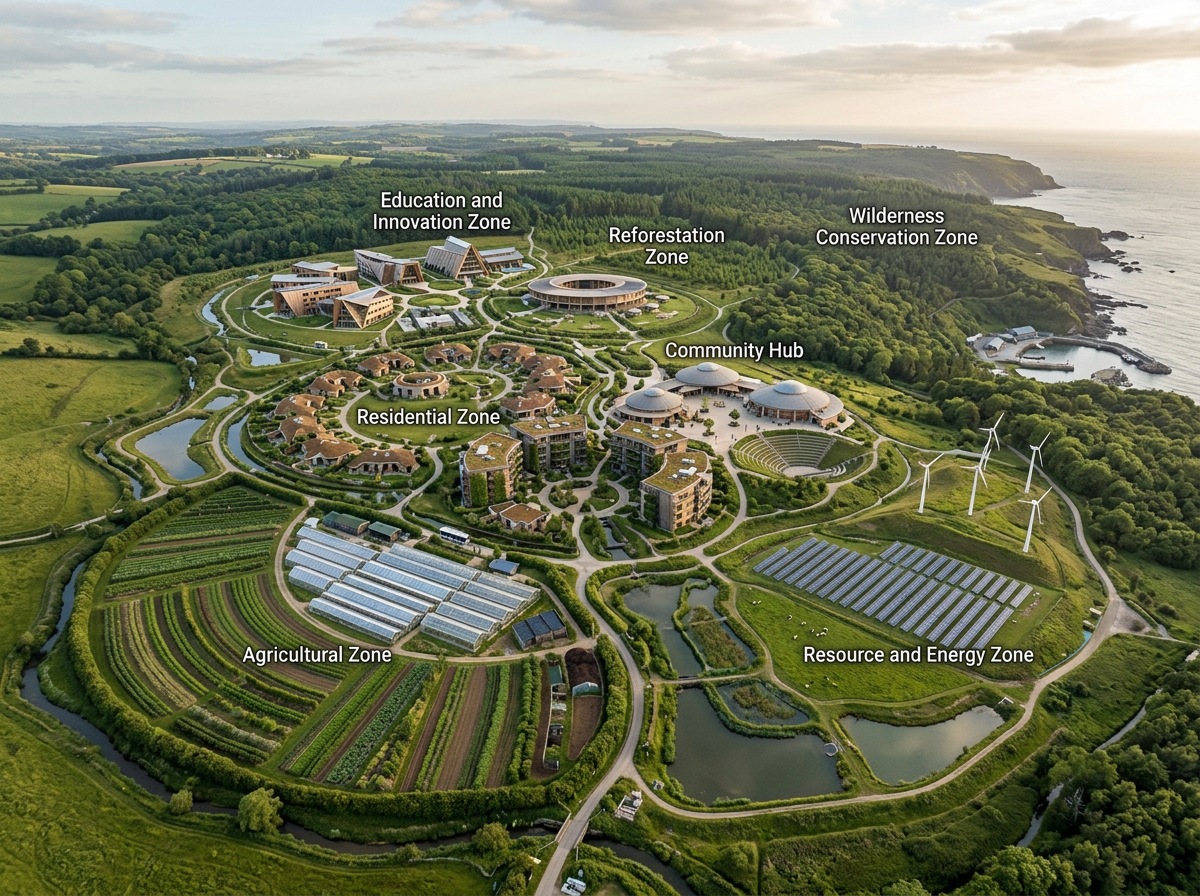
    The community is organized into interconnected functional zones:

    A. Residential Zone

    • private sleeping quarters
    • small family dwellings
    • shared housing clusters
    • co-living options

    B. Productive Agriculture Zone

    • food forests
    • gardens
    • regenerative farming plots
    • seed stewardship
    • compost systems
    • water capture systems

    C. Commons Zone

    Shared community infrastructure:

    • kitchen
    • dining space
    • workshop
    • learning spaces
    • meditation/reflection areas
    • meeting spaces

    D. Enterprise Zone

    Micro-enterprise and livelihood activities:

    • fabrication
    • media production
    • retreats
    • training programs
    • crafts
    • processing facilities
    • digital workspaces

    3. Membership Model

    The prototype uses a layered participation structure.

    Not all participants carry identical responsibilities or privileges.


    Tier 1 – Visitors

    Short-term participants:

    • retreat guests
    • volunteers
    • educational participants
    • researchers

    No governance authority.


    Tier 2 – Apprentices

    Longer-term immersion participants learning stewardship systems.

    Responsibilities include:

    • contribution hours
    • training participation
    • collaborative work
    • community integration

    Limited governance participation.


    Tier 3 – Resident Stewards

    Core long-term members.

    Responsibilities include:

    • operational stewardship
    • governance participation
    • financial contribution
    • skill-sharing
    • mentorship
    • infrastructure care

    These members hold voting participation in major community decisions.


    Tier 4 – Custodian Council

    A rotating stewardship council responsible for:

    • legal oversight
    • financial transparency
    • conflict facilitation
    • systems coordination
    • external partnerships
    • continuity planning

    The council does not function as permanent rulers.

    Term limits and rotation structures reduce power concentration.


    4. Governance Architecture

    Governance is one of the most critical systems within the prototype.

    Most intentional communities fail from unresolved governance weaknesses rather than resource scarcity.


    Decision-Making Structure

    The community uses a hybrid governance model combining:

    • consensus-seeking,
    • delegated authority,
    • and operational autonomy.

    Not every decision requires full-community deliberation.

    Examples:

    Decision TypeGovernance Layer
    Daily operationsWorking groups
    Budget allocationsStewardship council + community review
    Land use changesFull steward vote
    Conflict mediationDesignated mediation circle
    Legal complianceCustodian council

    Transparency Systems

    Transparency is mandatory.

    Members have access to:

    • budget summaries
    • project spending
    • governance notes
    • operational reports
    • stewardship agreements

    Opaque governance breeds distrust.


    Conflict Resolution Process

    Conflict is treated as inevitable rather than abnormal.

    The prototype therefore institutionalizes conflict support mechanisms.

    The escalation structure includes:

    1. Direct dialogue
    2. Facilitated mediation
    3. Stewardship review circle
    4. Temporary cooling-off agreements
    5. Membership reassessment if necessary

    The objective is restoration whenever possible.

    However, persistent abuse, manipulation, violence, or severe boundary violations may result in removal.

    Community safety takes priority over ideological purity.


    5. Financial Operating Model

    The prototype community is not designed as an anti-market commune.

    It operates as a hybrid regenerative economy.

    External revenue remains important.

    However, the objective is to progressively increase internal resilience while minimizing extractive leakage.


    Primary Revenue Streams

    A. Retreats and Trainings

    • stewardship intensives
    • regenerative living workshops
    • leadership immersions
    • wellness retreats
    • systems-thinking seminars

    B. Agricultural Production

    • fresh produce
    • seedlings
    • preserved foods
    • herbal products
    • value-added goods

    C. Digital and Educational Media

    • online courses
    • publications
    • consulting
    • media production
    • educational content

    D. Ethical Enterprise Incubation

    Members may operate aligned micro-enterprises that:

    • contribute to the node,
    • employ local participants,
    • and strengthen community resilience.

    Community Contribution System

    Resident stewards contribute through combinations of:

    • financial contribution,
    • labor contribution,
    • skill contribution,
    • or operational stewardship.

    Contribution expectations are calibrated realistically.

    The objective is participation—not coercion.


    Reserve Funds

    The prototype maintains reserve allocations for:

    • emergency resilience,
    • medical support,
    • infrastructure maintenance,
    • climate disruptions,
    • and operational continuity.

    Communities collapse quickly without reserves.


    6. Work Rhythm and Daily Life

    The prototype avoids both extremes:

    • hyper-capitalist overwork,
    • and unsustainable idealistic leisure culture.

    Instead, it seeks balanced contribution rhythms.


    Daily Structure Example

    Morning

    • food systems work
    • maintenance
    • infrastructure tasks
    • operational coordination

    Afternoon

    • enterprise work
    • training
    • educational programs
    • remote/digital work

    Evening

    • shared meals
    • reflection circles
    • cultural activities
    • governance meetings when necessary

    Weekly Rhythm

    The weekly cycle includes:

    • stewardship days
    • enterprise days
    • learning days
    • rest periods
    • governance review periods

    Intentional rest is considered infrastructure.

    Burnout destroys communities.


    7. External Partnerships

    The prototype does not isolate itself.

    It actively collaborates with:

    • local barangays
    • farmers
    • NGOs
    • educators
    • regenerative design experts
    • universities
    • ethical businesses
    • public agencies where aligned

    This reduces ideological isolation and improves practical resilience.


    8. Risk Factors and Safeguards

    The prototype acknowledges several major risks.


    Risk 1 – Leadership Centralization

    Safeguards:

    • rotating councils
    • transparent finances
    • distributed authority
    • written governance protocols

    Risk 2 – Financial Fragility

    Safeguards:

    • diversified revenue streams
    • reserve funds
    • phased growth
    • low-debt strategy

    Risk 3 – Social Fragmentation

    Safeguards:

    • conflict mediation
    • onboarding processes
    • mentorship systems
    • cultural rituals
    • shared meals

    Risk 4 – Ideological Rigidity

    Safeguards:

    • adaptive review cycles
    • evidence-based assessment
    • external advisors
    • community feedback structures

    Risk 5 – Burnout

    Safeguards:

    • workload balancing
    • rotating responsibilities
    • rest periods
    • emotional support systems

    9. Long-Term Vision

    The prototype is not intended to become a giant centralized settlement.

    Instead, the long-term model resembles:

    • interconnected stewardship nodes,
    • distributed regenerative communities,
    • local training hubs,
    • and collaborative barangay-scale ecosystems.

    Replication occurs horizontally rather than through top-heavy expansion.

    This creates resilience through decentralization.


    Conclusion

    The Prototype Community is ultimately an experiment in practical regeneration.

    Its purpose is not to escape society.

    Its purpose is to test whether human communities can once again organize around:

    • stewardship instead of extraction,
    • participation instead of passivity,
    • resilience instead of dependency,
    • and relational wealth instead of perpetual debt.

    The operating model therefore serves as both:

    • a practical governance framework,
    • and a living systems laboratory.

    If successful, the prototype may provide evidence that localized regenerative communities are not merely idealistic visions, but viable social infrastructure for an increasingly unstable world.


    Crosslinks

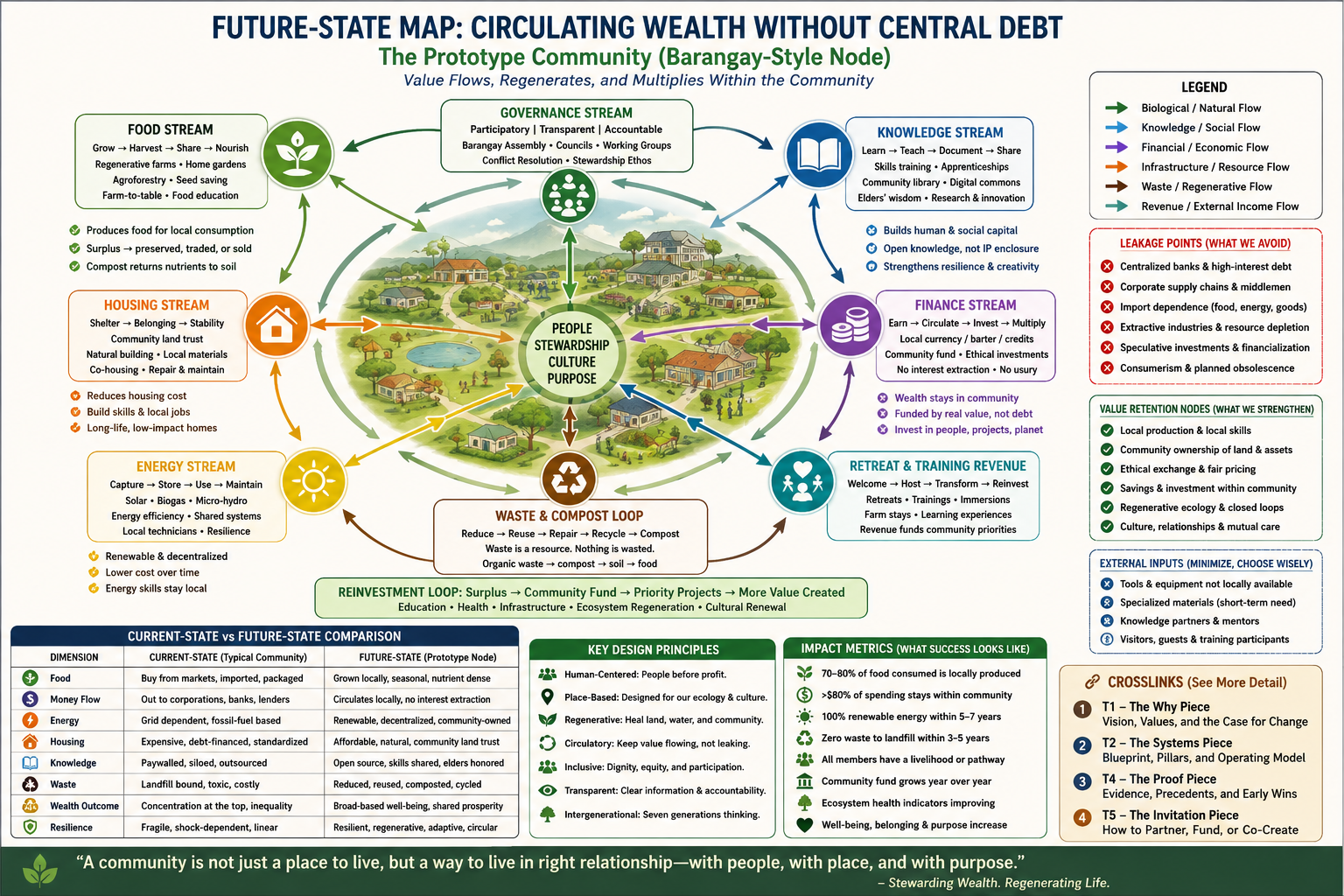
    Value Stream Mapping the Prototype Community: Circulating Wealth Without Central Debt – Maps how food, labor, finance, governance, infrastructure, and knowledge circulate within the prototype community while minimizing extractive leakage into centralized debt systems.

    Agentic Systems and the End of Passive Labor – Analyzes how AI, automation, and decentralized production systems are reshaping the future of work, stewardship, and local economic resilience.

    The Sovereign Prompt: How to Use AI Without Outsourcing Discernment – Discusses the ethical integration of AI within regenerative systems while preserving human discernment, accountability, and stewardship responsibility.

    Why the Global Reset Requires an Internal Reboot: The Role of Shadow Work in NESARA/GESARA – Explores the psychological and cultural dimensions of systemic transformation, emphasizing that sustainable external reform requires internal ethical and relational maturity first.


    References

    American Society for Quality. (n.d.). Value stream mapping tutorial – What is VSM? ASQ. ASQ Value Stream Mapping Tutorial

    Centre for Local Economic Strategies. (n.d.). Community wealth building. CLES. CLES Community Wealth Building

    Lean Enterprise Institute. (n.d.). Value-stream mapping. Lean Enterprise Institute Value Stream Mapping

    Lucid Software Inc. (n.d.). What is value stream mapping? Lucidchart. Lucidchart Value Stream Mapping Guide

    Elinor Ostrom. (1990). Governing the commons: The evolution of institutions for collective action. Cambridge University Press.

    Preston City Council. (n.d.). What is community wealth building? Preston Community Wealth Building Overview

    Purdue University. (2024, November 7). Value stream mapping. Purdue Lean Six Sigma Online. Purdue Lean Six Sigma Value Stream Mapping

    United Nations Development Programme. (2022). Local governance and resilient communities. UNDP Official Website

    Transition Network. (n.d.). What is transition? Transition Network Official Website

    Permaculture Research Institute. (n.d.). Principles of permaculture. Permaculture Research Institute


    The Sovereign Professional: A structural map of power, systems thinking, and personal autonomy—dedicated to helping the independent professional navigate complexity and own their value stream.


    ©2026 Gerald Daquila • Life.Understood. • Systems Thinking, Leadership Architecture, and Applied Coherence

  • [VSM-002] Value Stream Mapping the Prototype Community: Circulating Wealth Without Central Debt

    [VSM-002] Value Stream Mapping the Prototype Community: Circulating Wealth Without Central Debt


    Reimagining the Flow of Value


    Protocol Status: Version 1.0 (Initial Release)

    Process Owner: Individual Steward / Head of Household

    Revision Date: May 2026


    Modern economies are structured around extraction.

    Wealth produced by local labor, land, and relationships is routinely siphoned outward through debt servicing, speculative finance, centralized supply chains, and dependency on distant institutions.

    In contrast, resilient communities historically survived by increasing the velocity of local exchange—keeping food, labor, knowledge, and stewardship circulating within the village itself.

    This principle can still be observed in many Philippine barangays where informal reciprocity, mutual aid, cooperative purchasing, and relationship-based trust continue to function beneath the surface of the formal economy.

    The prototype intentional community proposed within the SHEYALOTH stewardship architecture is not merely a housing experiment. It is an economic systems prototype.

    Its core purpose is to demonstrate that a localized node can generate, circulate, retain, and regenerate wealth without depending entirely on centralized debt structures.

    This is where Value Stream Mapping (VSM) becomes essential.

    Value Stream Mapping is a Lean systems methodology used to visualize how materials, information, labor, and value move through a process in order to identify waste, inefficiencies, and leakage points (Lean Enterprise Institute, n.d.).

    Rather than viewing the community as a collection of isolated activities, VSM allows us to see the community as an interconnected living organism.

    Within a stewardship-based prototype community, the question is not simply “How do we earn money?”

    The deeper question is:

    How does value circulate—and where does it leak?

    When mapped correctly, a regenerative community begins to resemble a closed-loop ecosystem rather than a consumer settlement.


    From Linear Extraction to Circular Stewardship

    The dominant economic model is fundamentally linear:

    Labor → Income → Debt → Consumption → External Leakage

    In this arrangement, most value exits the local ecosystem almost immediately. Mortgage payments go to banks. Food purchases go to multinational supply chains. Energy payments leave the region. Educational costs reinforce dependency on centralized credentialing systems. Even charitable giving often exits the local area.

    A regenerative prototype community must invert this structure.

    Instead, the community operates through circular value retention:

    Stewardship → Local Production → Internal Exchange → Community Regeneration → Expanded Capacity

    This approach closely mirrors principles found within Community Wealth Building frameworks such as the Preston Model, which emphasizes local procurement, cooperative ownership, anchor institutions, and democratic circulation of wealth (Preston City Council, n.d.).

    Community Wealth Building seeks to increase the local retention and circulation of economic value instead of allowing capital to continuously drain outward (CLES, n.d.).

    The proposed prototype community applies these same principles within a barangay-scale stewardship node.


    Mapping the Community Value Streams

    Every intentional community contains multiple overlapping value streams. Most fail because these streams remain invisible, fragmented, or dependent on external debt.

    Download your copy of the Value Stream Map here

    The prototype community instead maps and integrates five primary streams:

    1. Food and Agricultural Stream

    Food is typically the largest leakage point in urbanized communities. Even rural settlements increasingly depend on externally produced food shipped through centralized logistics systems.

    The prototype model reverses this dependency by prioritizing:

    • Regenerative agriculture
    • Shared food production
    • Local seed stewardship
    • Cooperative kitchens
    • Preservation and storage systems
    • Community-supported agriculture (CSA)

    In Value Stream terms, the goal is to shorten the distance between production and consumption.

    Waste outputs from one subsystem become inputs for another:

    • Food scraps become compost.
    • Compost feeds gardens.
    • Gardens feed kitchens.
    • Kitchens feed residents and retreat participants.
    • Retreat revenue reinvests into food resilience.

    This transforms food from a constant expense into a regenerative asset stream.

    Importantly, local food production also stabilizes communities during periods of inflation, supply disruption, or currency volatility.


    2. Housing and Infrastructure Stream

    Conventional housing systems are debt engines. Mortgages frequently lock individuals into decades of extraction where large portions of lifetime income are redirected toward financial institutions.

    The prototype community instead explores phased infrastructure models:

    • Incremental construction
    • Shared utility systems
    • Cooperative ownership structures
    • Local material sourcing where possible
    • Hybrid live-work spaces
    • Modular expansion rather than speculative overbuilding

    The goal is not luxury accumulation. The goal is resilient sufficiency.

    In Value Stream Mapping language, unnecessary overproduction is considered waste (ASQ, n.d.). Large debt-financed infrastructure projects often create financial fragility before the community has stabilized its internal productive capacity.

    The prototype therefore prioritizes:

    1. Productive infrastructure first
    2. Aesthetic expansion second
    3. Debt minimization throughout

    This dramatically changes the risk profile of the community.


    3. Skills, Education, and Knowledge Stream

    Most educational systems train individuals to exit communities in search of employment elsewhere.

    A stewardship-oriented node instead treats education as local capacity building.

    Residents are encouraged to develop skills that strengthen the resilience of the whole ecosystem:

    • Agriculture
    • Conflict mediation
    • Renewable systems maintenance
    • Holistic health support
    • Cooperative administration
    • Media and communications
    • Construction and fabrication
    • Teaching and facilitation

    Knowledge becomes a circulating asset rather than a privatized credential.

    This aligns with the broader Lean understanding that information flow is as important as material flow within any value stream (Lean Enterprise Institute, n.d.). Communities collapse when critical knowledge becomes centralized in a few individuals.

    Therefore, cross-training and distributed competency are essential.

    The healthiest communities are anti-fragile because knowledge redundancy exists throughout the network.


    4. Financial and Exchange Stream

    This is the most sensitive and misunderstood layer.

    The prototype community is not anti-money. It is anti-extractive dependency.

    Money remains necessary. However, the objective is to reduce involuntary external leakage while increasing internal circulation velocity.

    Several mechanisms support this:

    • Cooperative purchasing
    • Shared tools and equipment
    • Internal service exchanges
    • Member contribution systems
    • Ethical microenterprise incubation
    • Local reinvestment pools
    • Community emergency reserves

    A peso that circulates ten times locally creates significantly more resilience than a peso immediately extracted into debt servicing or multinational supply chains.

    Community Wealth Building models have repeatedly demonstrated that local procurement and local ownership strengthen regional resilience and increase local multiplier effects (CLES, n.d.).

    The prototype community therefore functions as a local economic circulation engine.

    External capital is ideally used for:

    • Infrastructure seeding
    • Productive asset acquisition
    • Training systems
    • Renewable systems
    • Water resilience
    • Soil regeneration

    It is not primarily used to inflate lifestyles.

    This distinction is critical.


    5. Cultural and Relational Stream

    Most modern economic systems ignore relational health because it cannot easily be quantified.

    Yet relational fragmentation creates enormous hidden costs:

    • Burnout
    • Mental health deterioration
    • Social distrust
    • Legal conflict
    • Isolation
    • Governance breakdown

    The prototype community therefore treats culture itself as infrastructure.

    This includes:

    • Shared rituals
    • Stewardship circles
    • Community meals
    • Transparent governance
    • Conflict resolution processes
    • Intergenerational mentorship
    • Shared narratives and mission coherence

    In Lean systems language, friction within information and coordination flows creates waste (Lucidchart, n.d.). The same principle applies socially.

    Communities with high trust require fewer enforcement systems, lower transaction costs, and less bureaucratic overhead.

    Trust itself becomes economic infrastructure.


    The Barangay as a Regenerative Node

    The barangay model contains ancient intelligence often overlooked by centralized development frameworks.

    Historically, barangays functioned through:

    • Shared labor
    • Kinship accountability
    • Localized governance
    • Distributed stewardship
    • Cooperative resilience
    • Embedded reciprocity

    While imperfect, these systems possessed adaptive strengths modern urban systems frequently lack.

    The prototype community does not romanticize the past. Instead, it extracts viable principles from historically resilient local systems and integrates them with modern regenerative design.

    The resulting node becomes:

    • Economically localized
    • Technologically adaptive
    • Ecologically regenerative
    • Socially participatory
    • Financially resilient
    • Spiritually coherent

    This is not isolationism.

    The node still interacts with broader markets, donors, digital infrastructure, and external trade. However, it does so from a position of increasing sovereignty rather than permanent dependency.


    Why This Matters to Donors and Partners

    Most charitable models unintentionally reinforce dependency.

    Funds enter communities temporarily but leak outward almost immediately through imported goods, debt obligations, centralized vendors, and unsustainable operational costs.

    The prototype community instead functions as a regenerative multiplier.

    A properly designed stewardship node can:

    • Reduce long-term dependency
    • Increase local resilience
    • Create replicable frameworks
    • Demonstrate ethical economic circulation
    • Lower operating fragility
    • Train future stewardship leaders
    • Serve as a scalable proof-of-concept

    In systems language, donors are not merely funding a project.

    They are helping seed a self-reinforcing value ecosystem.

    This is fundamentally different from charity.

    It is regenerative systems investment.


    References

    American Society for Quality. (n.d.). Value stream mapping tutorial – What is VSM? ASQ. https://asq.org/quality-resources/value-stream-mapping

    Centre for Local Economic Strategies. (n.d.). Community wealth building. CLES. https://cles.org.uk/expertise/community-wealth-building/

    Lean Enterprise Institute. (n.d.). Value-stream mapping. https://www.lean.org/lexicon-terms/value-stream-mapping/

    Lucid Software Inc. (n.d.). What is value stream mapping? Lucidchart. https://www.lucidchart.com/pages/value-stream-mapping

    Ostrom, E. (1990). Governing the commons: The evolution of institutions for collective action. Cambridge University Press.

    Preston City Council. (n.d.). What is community wealth building? https://www.preston.gov.uk/article/1335/What-is-Community-Wealth-Building

    Purdue Lean Six Sigma Online. (2024, November 7). Value stream mapping. Purdue University. https://www.purdue.edu/leansixsigmaonline/blog/value-stream-mapping/

    United Nations Development Programme. (2022). Local governance and resilient communities. https://www.undp.org/


    [DOCUMENT CONTROL & STEWARDSHIP]

    Standard Work ID: VSM-002

    Baseline Version: v1.5.2026

    Classification: Open-Access Archive / Systemic Protocol

    The Sovereign Audit: Following this protocol is an act of internal quality control. Verification of this standard does not happen here; it happens at your Gemba—the actual place where your life and leadership occur. No external validation is required or offered.

    Next in Sequence: [View VSM-001: Mapping the Sovereign Household Value Stream]

    Return to Archive: [Standard Work Knowledge Hub: The Terrain Map]


    © 2026 Gerald Daquila • Life.Understood Systemic Stewardship • Non-Autocratic Architecture • Process over Persona

  • [SWI-003] Standard Work for Sovereign Wealth: A Protocol for Transitioning from Digital Fiat to Crystalline Assets

    [SWI-003] Standard Work for Sovereign Wealth: A Protocol for Transitioning from Digital Fiat to Crystalline Assets


    Protocol Status: Version 1.0 (Initial Release)

    Process Owner: Individual Steward / Head of Household

    Revision Date: May 2026


    Reframing Wealth in an Age of Institutional Fracture

    The 21st century global economy is entering a period of profound transition.

    Across multiple regions, trust in institutions is being tested by debt expansion, inflationary pressure, widening inequality, ecological instability, geopolitical fragmentation, and the accelerating digitization of money itself.

    Sovereign wealth, once understood primarily as state-controlled reserves and financial instruments, is now increasingly being reconsidered through the lenses of resilience, transparency, ethics, locality, and long-term stewardship.

    At the same time, new conversations are emerging around alternative forms of value storage and exchange. These include decentralized financial systems, tokenized assets, renewable energy-backed economies, cooperative ownership structures, data sovereignty, and emerging concepts sometimes described metaphorically as “crystalline assets.”

    Within this framework, the term crystalline assets should not be interpreted as mystical currency or magical material wealth. Rather, the phrase can serve as a symbolic and systems-oriented metaphor for assets characterized by:

    • transparency;
    • structural integrity;
    • traceability;
    • ethical coherence;
    • long-term resilience;
    • low corruption entropy;
    • regenerative value creation; and
    • alignment between human, ecological, and institutional systems.

    In this sense, crystalline assets stand in contrast to extractive or opaque financial structures that depend heavily on speculative leverage, institutional opacity, or unsustainable debt expansion.

    This article proposes a “standard work” framework — a practical protocol for individuals, communities, organizations, and emerging sovereign networks seeking to transition portions of their economic orientation away from fragile digital fiat dependency and toward resilient, transparent, and regenerative asset ecosystems.


    Understanding Digital Fiat Systems

    Modern fiat currencies derive value primarily from government backing, taxation authority, and collective trust rather than direct commodity convertibility (Mishkin, 2022).

    Over the past several decades, digital banking infrastructure and electronic monetary systems have further abstracted money away from tangible assets and local production.

    Digital fiat systems offer many advantages:

    • liquidity;
    • scalability;
    • rapid transaction capability;
    • international interoperability; and
    • institutional coordination.

    However, they also introduce vulnerabilities when detached from productive, ecological, and social realities.

    Critics of highly financialized economies note that excessive speculative expansion can produce systemic fragility, debt dependence, asset bubbles, and wealth concentration (Piketty, 2014).

    In emerging economies and post-colonial societies, these dynamics can become even more pronounced when external debt structures, currency instability, or institutional capture weaken local sovereignty.

    As a result, many communities worldwide are exploring hybrid models that combine digital systems with more grounded forms of value:

    • local production;
    • cooperative infrastructure;
    • renewable energy systems;
    • land stewardship;
    • food resilience;
    • distributed ownership;
    • transparent ledgers;
    • ethical enterprise;
    • knowledge commons; and
    • community trust networks.

    The transition described here is therefore not a rejection of modern finance entirely, but an attempt to rebalance economic systems toward durability, accountability, and real-world value generation.


    Defining Crystalline Assets

    Crystalline assets may be understood as assets that exhibit structural coherence across multiple dimensions:

    DimensionCrystalline Characteristic
    EconomicDurable, productive, low-speculation value
    EcologicalRegenerative rather than extractive
    SocialCommunity-benefiting and trust-building
    InformationalTransparent and verifiable
    InstitutionalResistant to corruption and opacity
    PsychologicalReduces fear-based scarcity behavior
    CulturalPreserves identity, continuity, and stewardship

    Examples may include:

    • regenerative agricultural land;
    • renewable energy infrastructure;
    • community-owned utilities;
    • ethical cooperative enterprises;
    • educational archives and knowledge systems;
    • decentralized but transparent financial ledgers;
    • resilient local supply chains;
    • open-source technological ecosystems;
    • culturally rooted production networks; and
    • tokenized systems backed by real-world productive assets.

    Importantly, not every digital asset qualifies as crystalline merely because it is decentralized or blockchain-based.

    Many speculative digital assets replicate the same extractive behaviors present within traditional financial systems.

    The critical distinction lies not in technological novelty alone, but in whether the asset structure contributes to long-term resilience, accountability, and regenerative capacity.


    Why Sovereign Wealth Must Evolve

    Traditional sovereign wealth models often focus heavily on:

    • foreign currency reserves;
    • bonds;
    • extractive resource exports;
    • centralized investment vehicles; and
    • large-scale institutional capital deployment.

    While these tools remain important, the global environment is changing rapidly.

    The World Bank (2024) notes that climate instability, supply chain fragmentation, and geopolitical shifts are increasingly influencing economic resilience. Meanwhile, technological acceleration is redistributing power away from exclusively centralized institutions toward hybrid public-private-community ecosystems.

    In this context, sovereign wealth may need to evolve beyond purely financial metrics toward broader measures of societal resilience, including:

    • food security;
    • energy independence;
    • digital sovereignty;
    • educational capacity;
    • ecological stability;
    • community trust;
    • transparent governance; and
    • adaptive infrastructure.

    Countries and communities that fail to diversify beyond fragile financial abstractions may become increasingly vulnerable during periods of global instability.


    A Standard Work Protocol for Transition

    The following framework is not a rigid doctrine but a practical orientation model.


    1. Conduct a Sovereign Asset Audit

    The first step is identifying what forms of value already exist.

    Many societies underestimate their true wealth because they measure only financial liquidity rather than:

    • ecological assets;
    • human capability;
    • cultural continuity;
    • local knowledge;
    • agricultural productivity;
    • diaspora networks;
    • social trust; and
    • cooperative capacity.

    An asset audit should therefore include:

    • land and ecological resources;
    • energy infrastructure;
    • educational systems;
    • digital infrastructure;
    • food production capacity;
    • institutional integrity;
    • cultural archives;
    • public trust metrics; and
    • local enterprise ecosystems.

    This creates a broader picture of sovereign resilience.


    2. Reduce Dependency Concentration

    Systems become fragile when too much value depends on a single point of failure.

    Communities and institutions should evaluate overdependence on:

    • external debt systems;
    • imported essentials;
    • centralized digital platforms;
    • speculative asset exposure;
    • monopolized supply chains; and
    • unstable geopolitical arrangements.

    Resilience emerges through diversification and redundancy.

    This may include:

    • local agriculture initiatives;
    • distributed energy systems;
    • cooperative manufacturing;
    • community finance structures;
    • open-source technologies; and
    • local knowledge preservation.

    3. Anchor Value to Real Production

    One of the central critiques of hyper-financialized economies is the detachment of wealth accumulation from productive contribution.

    Crystalline-oriented systems seek stronger alignment between:

    • value creation;
    • labor;
    • ecological regeneration;
    • social benefit; and
    • tangible production.

    This does not eliminate digital systems. Rather, it reconnects them to measurable real-world outputs.

    Potential examples include:

    • tokenized renewable energy production;
    • agricultural cooperatives;
    • ethical manufacturing;
    • knowledge infrastructure;
    • distributed educational platforms; and
    • regenerative land stewardship systems.

    4. Build Transparent Ledger Systems

    Transparency is foundational to trust.

    Emerging ledger technologies can improve:

    • accountability;
    • traceability;
    • anti-corruption measures;
    • public auditing; and
    • participatory governance.

    However, transparency alone is insufficient without ethical governance and informed civic participation.

    Technology cannot substitute for stewardship.

    The strongest systems combine:

    • transparent infrastructure;
    • ethical leadership;
    • institutional checks;
    • civic literacy; and
    • distributed accountability.

    5. Develop Regenerative Wealth Metrics

    Gross Domestic Product (GDP) remains a dominant economic metric globally, yet many economists argue that GDP alone fails to capture societal wellbeing, ecological health, or long-term resilience (Stiglitz et al., 2010).

    A crystalline wealth framework may therefore incorporate broader indicators such as:

    • ecological restoration;
    • educational access;
    • food resilience;
    • local ownership ratios;
    • trust indices;
    • corruption reduction;
    • renewable energy capacity;
    • mental health outcomes; and
    • intergenerational sustainability.

    These metrics help align economic systems with human flourishing rather than pure extraction.


    6. Preserve Human Meaning and Cultural Continuity

    Economic systems are not merely transactional structures. They shape identity, meaning, belonging, and collective direction.

    Communities undergoing rapid digitization or financial transition often experience psychological fragmentation when cultural continuity is lost.

    Therefore, sovereign wealth transition should also preserve:

    • language;
    • memory;
    • ancestral knowledge;
    • local traditions;
    • ethical frameworks; and
    • community cohesion.

    In post-colonial societies especially, economic sovereignty and cultural sovereignty are deeply intertwined.


    The Philippine Context

    The Philippines occupies a uniquely complex position within the global transition landscape.

    It is simultaneously:

    • deeply integrated into global labor migration;
    • highly digitized in communication culture;
    • vulnerable to climate instability;
    • shaped by colonial history;
    • rich in human adaptab

    References

    Mishkin, F. S. (2022). The economics of money, banking, and financial markets (13th ed.). Pearson.

    Piketty, T. (2014). Capital in the twenty-first century. Harvard University Press.

    Stiglitz, J. E., Sen, A., & Fitoussi, J.-P. (2010). Mismeasuring our lives: Why GDP doesn’t add up: The report by the Commission on the Measurement of Economic Performance and Social Progress. The New Press.

    World Bank. (2024). Global economic prospects: Broadening the scope of debt sustainability. World Bank Publications.


    Crosslinks


    [DOCUMENT CONTROL & STEWARDSHIP]

    Standard Work ID: SWI-003

    Baseline Version: v1.5.2026

    Classification: Open-Access Archive / Systemic Protocol

    The Sovereign Audit: Following this protocol is an act of internal quality control. Verification of this standard does not happen here; it happens at your Gemba—the actual place where your life and leadership occur. No external validation is required or offered.

    Next in Sequence: [SWI-002: The 72-Hour Protocol]

    Return to Archive: [Standard Work Knowledge Hub: The Terrain Map]


    © 2026 Gerald Daquila • Life.Understood Systemic Stewardship • Non-Autocratic Architecture • Process over Persona

  • ARK-001: The Philippine Ark – A Sovereign Blueprint for Systemic Transformation

    ARK-001: The Philippine Ark – A Sovereign Blueprint for Systemic Transformation


    Meta Description

    A practical field manual outlining how a 50-person community maintains continuous access to food, water, and essential resources through a structured resource loop.


    Introduction

    Most conversations about resilience remain abstract.

    They speak in terms of “systems change,” “community strength,” or “self-sufficiency,” but rarely define the smallest unit at which these ideas can be tested.

    Without a defined unit, there is no way to observe whether a system works.

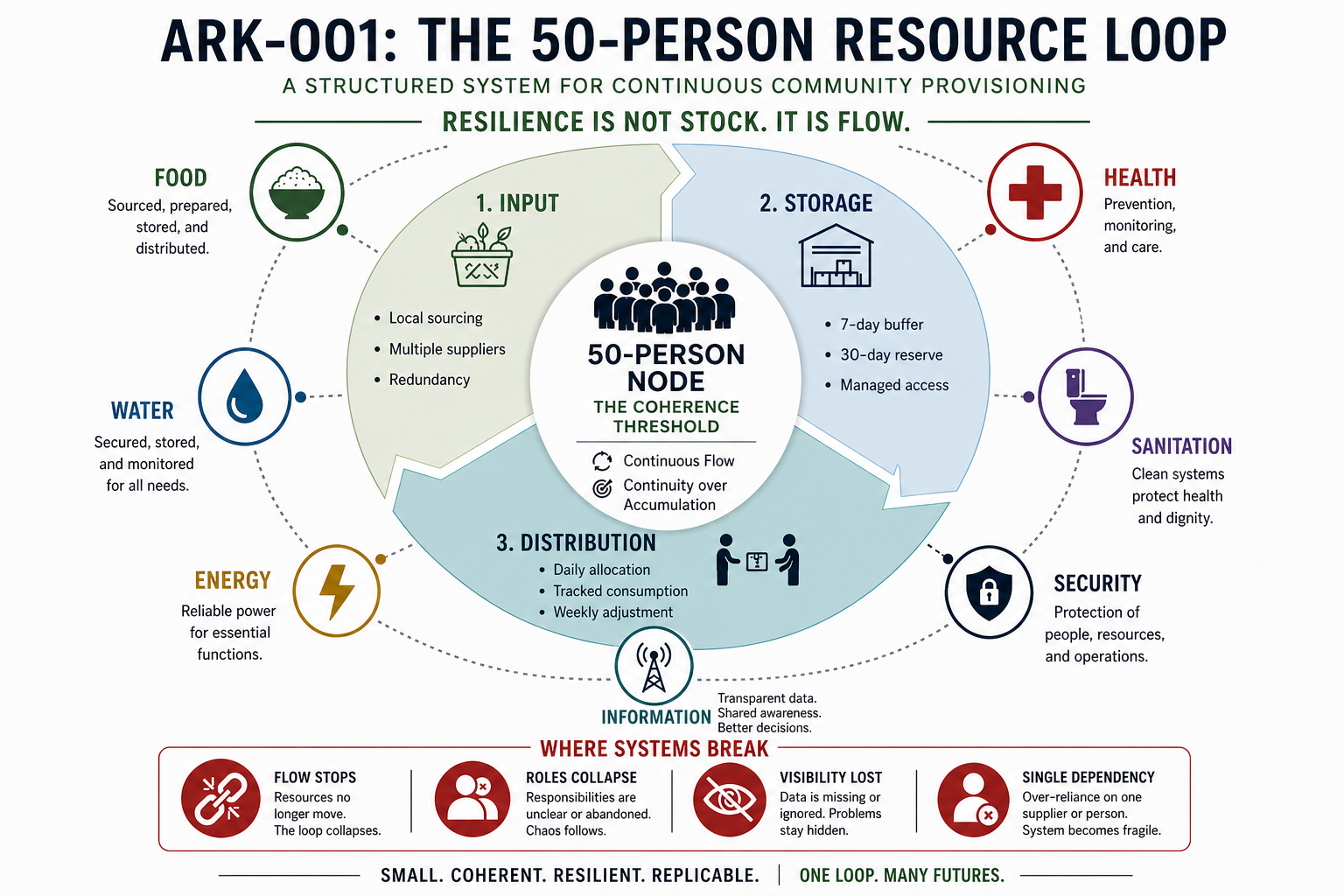
    The 50-Person Resource Loop establishes that unit.

    It does not begin with ideology.
    It begins with constraint.

    What happens when fifty people must ensure that food, water, and basic needs continue to flow—regardless of external disruption?

    What structures would need to exist?
    What rhythms would need to be maintained?
    What failures would immediately become visible?

    This manual is not a theory of resilience.

    It is a framework for operational continuity at a human scale.


    Why Fifty People?

    The number is not symbolic. It is functional.

    Below fifty:

    • insufficient role distribution
    • over-reliance on individuals

    Above fifty:

    • coordination begins to fragment
    • visibility declines
    • decision-making slows

    At fifty, a system can still:

    • remain relational rather than bureaucratic
    • assign clear responsibility
    • maintain shared awareness

    It is the largest size at which coherence can still be directly managed.


    The Core Principle: Flow Over Stock

    Most people assume resilience is about having enough.
    It is not.

    It is not.

    A system fails when:

    • resources stop moving
    • information becomes unclear
    • responsibilities dissolve

    The loop exists to ensure one condition:

    Nothing stops moving.

    Food is not just stored—it is cycled.
    Water is not assumed—it is measured.
    Roles are not implied—they are assigned.


    The Three Layers of the Loop


    1. Input

    Resources enter the system through:

    • local procurement
    • distributed sourcing
    • redundancy (multiple suppliers)

    2. Storage

    • short-term buffer (active use)
    • longer-term reserve (protected)

    3. Distribution

    • daily allocation
    • predictable release cycles
    • monitored consumption

    These layers are not separate—they are interdependent.
    A failure in one propagates through all.


    Role Structure

    Every participant is part of the system.

    Not symbolically—operationally.

    Core roles typically include:

    • coordination of resources
    • food sourcing and preparation
    • water management
    • health oversight
    • infrastructure and energy
    • logistics and movement

    The critical point is not the titles.
    It is that:

    No function is left without ownership.


    The Importance of Visibility

    Most systems degrade quietly.

    The loop prevents this through constant visibility:

    • how much food remains
    • how much water is available
    • where pressure is building

    When everything is visible:

    • small problems are corrected early
    • large failures are avoided

    What This System IS — and IS NOT

    It is not:

    • a survivalist model
    • an isolationist structure
    • a replacement for broader systems

    It is:

    • a stabilizing layer
    • a coordination mechanism
    • a way to reduce fragility at the local level

    It does not reject larger systems.
    It simply does not depend on them for continuity.


    Failure Points

    Most loops fail in predictable ways:

    • roles become unclear
    • tracking becomes inconsistent
    • participation declines
    • reliance on a few individuals increases

    When this happens, the loop stops functioning as a system
    and becomes a burden.


    Why This Matters Now

    Urban environments depend on systems that are:

    • efficient
    • tightly coupled
    • fragile under disruption

    The resource loop introduces:

    • slack
    • redundancy
    • and local awareness

    Not at scale.
    But at a level where it can actually function.


    Toward Replication

    The objective is not to grow one loop indefinitely.

    It is to:

    • stabilize one
    • understand its behavior
    • replicate it

    Multiple loops can later connect.

    But coherence must exist first at the unit level.


    Closing

    The question is not whether large systems will hold.

    The question is whether smaller, coherent systems exist beneath them.

    The 50-person loop is one such unit.

    Not as a solution to everything—
    but as a place where continuity can still be maintained.


    Crosslinks

    👉 Download ARK-001 (Printable SOP Version)

    👉 Download ARK-001-A (Poster Version)

    👉 Download ARK-001-B (Dashboard / Templates)

    The concepts outlined here are designed for real-world execution. For a complete set of ready-to-use documents—including governance templates, resource tracking sheets, and operational SOPs—explore the 55 Editable Applied Stewardship Toolkit (Complete Set).

    For a broader systems context that situates localized resilience within national and multi-scalar transformation frameworks, explore The Philippine Ark: A Sovereign Blueprint for Systemic Transformation.


    Continue Through the ARK Series

    This framework is designed as a complete system. You can explore it sequentially or move directly to the layer most relevant to your work:

    Foundations

    Design + Build

    Systems Layer

    Scaling


    Suggested Pathways

    New to the framework?

    Start with ARK-001 ARK-008ARK-011


    Designing a physical site?

    Begin with ARK-007ARK-008ARK-009


    Preparing for real-world deployment?

    Focus on ARK-011ARK-012ARK-013


    Thinking long-term scale?

    Move to ARK-010


    [DOCUMENT CONTROL & STEWARDSHIP]

    Standard Work ID: [ARK-001]

    Baseline Version: v1.5.2026

    Classification: Open-Access Archive / Systemic Protocol

    The Sovereign Audit: Following this protocol is an act of internal quality control. Verification of this standard does not happen here; it happens at your Gemba—the actual place where your life and leadership occur. No external validation is required or offered.

    Next in Sequence: [ARK-002: The Babaylan Arc – Institutional Curriculum]

    Return to Archive: [Standard Work Knowledge Hub: The Terrain Map]


    © 2026 Gerald Daquila • Life.Understood Systemic Stewardship • Non-Autocratic Architecture • Process over Persona

  • ARK-003: Jurisdictional Sovereignty — Legal Standard Work

    ARK-003: Jurisdictional Sovereignty — Legal Standard Work


    Operationalizing Local Authority in a Fragmented System


    Meta Description:

    A field-oriented framework for jurisdictional sovereignty, outlining how local units can establish legal standard work to maintain coherence, accountability, and operational continuity in decentralized systems.


    Introduction: Sovereignty Without Structure Is Noise

    “Sovereignty” is one of the most misused terms in contemporary discourse.

    It is invoked in political rhetoric, personal development, and alternative governance models, yet rarely defined in operational terms.

    The result is predictable: fragmentation, inconsistency, and the illusion of autonomy without actual control.

    At the level of implementation, sovereignty is not a declaration.
    It is a function of jurisdiction + process + enforcement.

    Without these three elements, sovereignty collapses into symbolic language.

    This piece extends the logic introduced in ARK-001: The 50-Person Resource Loop and the emerging architecture of localized resilience systems.

    If ARK-001 defines the minimum viable unit of survival, ARK-003 defines the legal-operational layer that stabilizes it.

    Because no system—no matter how well-designed—can sustain itself without clear rules, repeatable procedures, and recognized authority boundaries.


    Defining Jurisdictional Sovereignty

    Jurisdictional sovereignty refers to the practical authority of a defined unit to create, interpret, and enforce rules within its boundary.

    This is not absolute independence from higher structures such as the nation-state. Rather, it is the localized capacity to maintain operational coherence without constant external intervention.

    In systems theory, this aligns with the concept of subsidiarity—the principle that decisions should be made at the lowest level capable of resolving them effectively (Ostrom, 1990).

    In the Philippine context, this is partially reflected in the powers granted to Local Government Units (LGUs) under the Local Government Code of 1991, which decentralized governance to improve responsiveness and accountability (Brillantes & Moscare, 2002).

    Yet, in practice, decentralization alone does not produce sovereignty.

    What is often missing is standard work.


    What Is Legal Standard Work?

    Borrowed from industrial systems (particularly the Toyota Motor Corporation Production System), standard work refers to the documented, repeatable process required to achieve consistent outcomes.

    Translated into governance, legal standard work is:

    A defined set of procedures that specify how rules are created, applied, and enforced within a jurisdiction.

    This includes:

    • Decision-making protocols
    • Conflict resolution pathways
    • Resource allocation rules
    • Enforcement mechanisms
    • Documentation and record-keeping standards

    Without standard work, even well-intentioned governance devolves into:

    • Case-by-case improvisation
    • Personality-driven decision-making
    • Inconsistent enforcement
    • Loss of institutional memory

    These are not abstract risks—they are observable patterns across many decentralized systems, particularly where governance relies on informal norms rather than structured processes (North, 1990).


    The Failure Mode: Informal Sovereignty

    Many communities operate under what can be called informal sovereignty:

    • Authority exists, but is not clearly defined
    • Rules exist, but are inconsistently applied
    • Enforcement exists, but depends on relationships

    This creates three systemic distortions:

    1. Authority Drift

    Power accumulates in individuals rather than roles.


    2. Rule Ambiguity

    Interpretation becomes situational rather than consistent.


    3. Enforcement Fatigue

    Without clear procedures, enforcement becomes emotionally and politically costly.

    These distortions reduce trust, slow decision-making, and ultimately degrade system resilience.

    As explored in The Architecture of Silence, unresolved structural ambiguity often becomes internalized at the social level, manifesting as avoidance, indirect communication, and conflict suppression rather than resolution.


    Building Legal Standard Work: The Four Layers

    To operationalize jurisdictional sovereignty, legal standard work must be constructed across four layers:


    1. Boundary Definition (Where Authority Applies)

    Every system requires a clearly defined jurisdiction:

    • Geographic (e.g., barangay, district)
    • Functional (e.g., food distribution, water access)
    • Membership-based (e.g., the 50-person loop unit)

    Without boundaries, there is no jurisdiction—only overlap and confusion.

    Boundary clarity ensures that:

    • Responsibility is assigned
    • Authority is recognized
    • External interference is minimized

    2. Rule Codification (What Governs Behavior)

    Rules must be:

    • Written
    • Accessible
    • Specific

    This does not mean complexity. In fact, effective systems rely on minimal but precise rule sets.

    For example:

    • Resource distribution schedules
    • Contribution requirements
    • Escalation thresholds

    Codified rules reduce interpretation variance and create a shared baseline for action.


    3. Process Standardization (How Decisions Are Made)

    This is the core of standard work.

    Processes must define:

    • Who decides
    • How decisions are made
    • What inputs are required
    • What timelines apply

    For instance:

    • A resource shortage triggers a predefined allocation protocol
    • A conflict triggers a structured mediation sequence

    Standardization transforms governance from reactive to predictable and scalable.


    4. Enforcement Protocols (What Happens When Rules Are Broken)

    This is where most systems fail.

    Enforcement must be:

    • Consistent
    • Depersonalized
    • Documented

    Without enforcement protocols, rules lose legitimacy.

    Elinor Ostrom’s research on commons governance highlights that successful systems maintain graduated sanctions—clear, proportional consequences for rule violations (Ostrom, 1990).

    This prevents both:

    • Overreaction (which destabilizes trust)
    • Underreaction (which erodes authority)

    Integration with the ARK Framework

    Within the ARK system, legal standard work acts as the stabilization layer.

    • ARK-001 (Resource Loop) → Defines material continuity
    • ARK-003 (Legal Standard Work) → Defines behavioral and operational continuity

    Together, they form a closed loop:

    • Resources flow
    • Rules stabilize behavior
    • Enforcement maintains integrity
    • Feedback informs adjustment

    This aligns with broader resilience literature, which emphasizes that systems must balance flexibility with structure to remain adaptive under stress (Folke et al., 2010).


    Why This Matters Now

    We are entering a period where large-scale systems are increasingly strained:

    • Supply chains are volatile
    • Governance trust is uneven
    • Institutional response times are slowing

    In this context, local systems cannot rely solely on centralized correction.

    They must develop internal coherence.

    Jurisdictional sovereignty, properly implemented, does not fragment society.

    It reduces systemic load by enabling smaller units to resolve issues locally before they escalate.

    This is not ideological decentralization.

    It is functional load distribution.


    From Principle to Practice

    ARK-003 establishes the legal architecture of sovereignty—clear jurisdiction, codified rules, and consistent enforcement.

    But architecture alone does not produce coherence.
    It must be translated into repeatable tools.

    This is where the Applied Stewardship Toolkit (55-Template Set) becomes operational.

    The Toolkit converts legal standard work into ready-to-use formats:

    • Decision logs that prevent authority drift
    • Conflict protocols that remove ambiguity from enforcement
    • Resource allocation sheets aligned with defined jurisdiction
    • Governance templates that preserve institutional memory beyond individuals

    Each template functions as a container for consistency—ensuring that rules are not just defined, but applied the same way over time.

    If ARK-003 answers “What must exist for sovereignty to hold?”

    The Toolkit answers “How is that executed—daily, repeatably, without degradation?”

    This is the difference between:

    • A system that works once
    • And a system that continues to work under pressure

    Explore the Applied Stewardship Toolkit (55-Template Set) to implement these standards directly within your local unit.


    Conclusion: Sovereignty as Discipline

    Sovereignty is often framed as freedom.

    In practice, it is closer to discipline.

    • Discipline to define boundaries
    • Discipline to codify rules
    • Discipline to follow process
    • Discipline to enforce consistently

    Without discipline, sovereignty collapses into inconsistency.

    With discipline, it becomes operational stability at scale.

    ARK-003 does not propose a new political theory.

    It proposes a repeatable standard for how local systems can function coherently within larger structures.

    Because in the end, sovereignty is not proven by what a system claims.

    It is proven by what it can consistently sustain.


    References

    Brillantes, A. B., & Moscare, D. (2002). Decentralization and federalism in the Philippines: Lessons from global community. Philippine Journal of Public Administration.

    Folke, C., Carpenter, S. R., Walker, B., Scheffer, M., Chapin, T., & Rockström, J. (2010). Resilience thinking: Integrating resilience, adaptability and transformability. Ecology and Society, 15(4).

    North, D. C. (1990). Institutions, institutional change and economic performance. Cambridge University Press.

    Ostrom, E. (1990). Governing the commons: The evolution of institutions for collective action. Cambridge University Press.

    The concepts outlined here are designed for real-world execution. For a complete set of ready-to-use documents—including governance templates, resource tracking sheets, and operational SOPs—explore the 55 Editable Applied Stewardship Toolkit (Complete Set).

    For a broader systems context that situates localized resilience within national and multi-scalar transformation frameworks, explore The Philippine Ark: A Sovereign Blueprint for Systemic Transformation.


    Continue Through the ARK Series

    This framework is designed as a complete system. You can explore it sequentially or move directly to the layer most relevant to your work:

    Foundations

    Design + Build

    Systems Layer

    Scaling


    Suggested Pathways

    New to the framework?

    Start with ARK-001 ARK-008ARK-011


    Designing a physical site?

    Begin with ARK-007ARK-008ARK-009


    Preparing for real-world deployment?

    Focus on ARK-011ARK-012ARK-013


    Thinking long-term scale?

    Move to ARK-010


    [DOCUMENT CONTROL & STEWARDSHIP]

    Standard Work ID: [ARK-003]

    Baseline Version: v1.4.2026

    Classification: Open-Access Archive / Systemic Protocol

    The Sovereign Audit: Following this protocol is an act of internal quality control. Verification of this standard does not happen here; it happens at your Gemba—the actual place where your life and leadership occur. No external validation is required or offered.

    Next in Sequence: [ARK-004: Post-Fiat Trade: The Community Ledger SOP]

    Return to Archive: [Standard Work Knowledge Hub: The Terrain Map]


    © 2026 Gerald Daquila • Life.Understood • Systemic Stewardship • Non-Autocratic Architecture • Process over Persona

  • Sovereignty & Governance

    Sovereignty & Governance


    Creating Systems That Support the Human Journey Toward Self-Responsibility

    4–5 minutes

    Governance, at its healthiest, is not about control.

    It is about creating conditions where human beings can mature into responsible, self-governing participants in collective life.

    When governance forgets this role, it begins to treat people as problems to manage rather than agents to empower.

    Sovereignty does not disappear in these systems.
    It becomes dormant, outsourced, or obscured by fear.


    Did We Lose Our Sovereignty?

    Sovereignty is not something that can be removed. It can only be:

    ignored
    forgotten
    suppressed
    or handed over in exchange for security

    Over time, many societies drifted into models where authority centralized and individuals traded responsibility for predictability.

    This shows up in quiet beliefs like:

    “Someone else will fix it.”
    “I have no real choice.”
    “That’s just how the system works.”

    But sovereignty never leaves. It waits beneath compliance, ready to be reclaimed through conscious participation.


    Is Life a Journey Back to Sovereignty?

    This is a meaningful and grounded way to understand human development.

    A child begins dependent.
    A mature adult grows into self-authorship.

    At the collective level, societies move through a similar arc:

    From rule imposed externally
    toward governance that reflects the inner maturity of its people.

    Sovereignty does not mean isolation or rebellion. It means:

    the capacity to choose consciously and carry the consequences of those choices.

    Seen this way, governance is not meant to replace sovereignty — but to support its development.


    The True Role of Governance

    In a sovereignty-aware paradigm, governance exists to:

    • protect basic safety and dignity
    • provide stable frameworks for cooperation
    • ensure fairness in shared systems
    • reduce unnecessary obstacles to growth

    It is not meant to control thought, manufacture dependency, or concentrate power for its own sake.

    Governance becomes:

    scaffolding for maturity, not a substitute for it.


    Where Change Actually Begins

    Large systems can feel immovable. But every institution is made of people, and people carry their level of sovereignty into the structures they create.

    So real governance reform begins at the smallest scale:

    the individual

    Not in isolation, but as the foundational unit of any collective system.


    Layer One: Inner Governance

    Before people can participate in sovereign governance externally, they must develop internal governance:

    Can I regulate my emotions?
    Can I tell the truth without aggression?
    Can I take responsibility for my impact?
    Can I think beyond immediate self-interest?

    A population without inner governance will repeatedly recreate outer control systems, because external authority compensates for internal instability.

    Emotional maturity, ethical literacy, and dialogue skills are not just personal virtues — they are civic capacities.


    Layer Two: Local Structures

    Transformation stabilizes first in smaller systems:

    families
    schools
    neighborhoods
    local organizations

    These are training grounds for sovereignty. Here people practice:

    shared decision-making
    conflict resolution
    mutual responsibility
    transparent communication

    When these capacities grow locally, larger governance systems eventually begin to reflect them.


    Layer Three: Institutional Design

    As sovereignty matures within the population, institutions can evolve to match.

    Governance begins to emphasize:

    • transparency over secrecy
    • participation over passivity
    • accountability over impunity
    • long-term stewardship over short-term control

    Leaders shift from rulers to stewards of collective coherence.

    Policies become less about controlling behavior and more about removing distortions that prevent people from standing in responsibility.


    If We Were to Start From Scratch

    If sovereignty were the organizing principle from the beginning, foundational priorities would include:

    1. Education that develops self-regulation and ethical reasoning, not just information recall
    2. Civic systems that invite participation, not just compliance
    3. Leadership development rooted in psychological maturity, not dominance or charisma
    4. Transparent decision-making structures that allow trust to grow
    5. Cultural narratives that emphasize responsibility alongside rights

    This is not about idealism. It is about alignment between human development and system design.


    The Cascade Effect

    When individuals reclaim inner sovereignty, they:

    parent differently
    lead differently
    work differently
    vote differently
    participate differently

    Culture shifts.
    Culture reshapes institutions.
    Institutions influence future generations.

    Governance reform that skips inner maturity tends to collapse back into control. Reform that includes the inner dimension becomes more stable.


    A Grounded Truth

    Sovereignty is not granted by governments. It is expressed through them when people are ready to carry it.

    Governance can suppress sovereignty, distort it, or support it — but it cannot manufacture it.

    The journey begins in homes, conversations, classrooms, and inner decisions long before it appears in law.

    The starting point is not revolution.

    It is maturation.

    One person at a time.
    One relationship at a time.
    One community at a time.

    From there, governance slowly begins to reflect the sovereignty that was always present — waiting to be lived.


    Light Crosslinks for Continued Reading

    If this reflection resonates, you may also find support in:

    Leading Among Sovereigns – on leadership as coherence rather than control
    Sovereignty at Work – on how self-governance reshapes organizations
    When the Ego Fights Back – on the inner integration required to live responsibly


    About the author

    Gerry explores themes of change, emotional awareness, and inner coherence through reflective writing. His work is shaped by lived experience during times of transition and is offered as an invitation to pause, notice, and reflect.

    If you’re curious about the broader personal and spiritual context behind these reflections, you can read a longer note here.