Logo - Life.Understood.

Category: Human Behavior

  • ARK-001: The Philippine Ark – A Sovereign Blueprint for Systemic Transformation

    ARK-001: The Philippine Ark – A Sovereign Blueprint for Systemic Transformation


    Meta Description

    A practical field manual outlining how a 50-person community maintains continuous access to food, water, and essential resources through a structured resource loop.


    Introduction

    Most conversations about resilience remain abstract.

    They speak in terms of “systems change,” “community strength,” or “self-sufficiency,” but rarely define the smallest unit at which these ideas can be tested.

    Without a defined unit, there is no way to observe whether a system works.

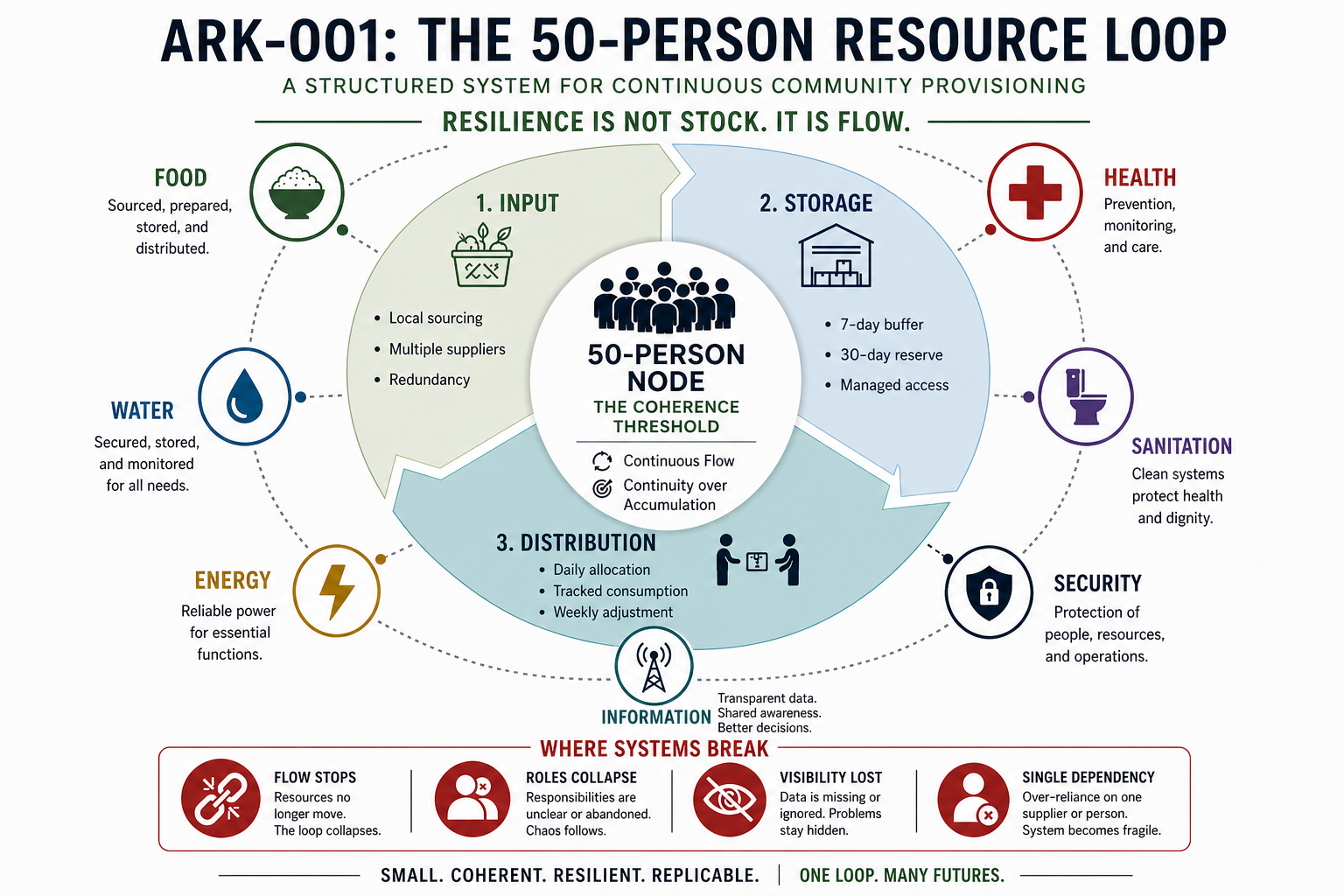
    The 50-Person Resource Loop establishes that unit.

    It does not begin with ideology.
    It begins with constraint.

    What happens when fifty people must ensure that food, water, and basic needs continue to flow—regardless of external disruption?

    What structures would need to exist?
    What rhythms would need to be maintained?
    What failures would immediately become visible?

    This manual is not a theory of resilience.

    It is a framework for operational continuity at a human scale.


    Why Fifty People?

    The number is not symbolic. It is functional.

    Below fifty:

    • insufficient role distribution
    • over-reliance on individuals

    Above fifty:

    • coordination begins to fragment
    • visibility declines
    • decision-making slows

    At fifty, a system can still:

    • remain relational rather than bureaucratic
    • assign clear responsibility
    • maintain shared awareness

    It is the largest size at which coherence can still be directly managed.


    The Core Principle: Flow Over Stock

    Most people assume resilience is about having enough.
    It is not.

    It is not.

    A system fails when:

    • resources stop moving
    • information becomes unclear
    • responsibilities dissolve

    The loop exists to ensure one condition:

    Nothing stops moving.

    Food is not just stored—it is cycled.
    Water is not assumed—it is measured.
    Roles are not implied—they are assigned.


    The Three Layers of the Loop


    1. Input

    Resources enter the system through:

    • local procurement
    • distributed sourcing
    • redundancy (multiple suppliers)

    2. Storage

    • short-term buffer (active use)
    • longer-term reserve (protected)

    3. Distribution

    • daily allocation
    • predictable release cycles
    • monitored consumption

    These layers are not separate—they are interdependent.
    A failure in one propagates through all.


    Role Structure

    Every participant is part of the system.

    Not symbolically—operationally.

    Core roles typically include:

    • coordination of resources
    • food sourcing and preparation
    • water management
    • health oversight
    • infrastructure and energy
    • logistics and movement

    The critical point is not the titles.
    It is that:

    No function is left without ownership.


    The Importance of Visibility

    Most systems degrade quietly.

    The loop prevents this through constant visibility:

    • how much food remains
    • how much water is available
    • where pressure is building

    When everything is visible:

    • small problems are corrected early
    • large failures are avoided

    What This System IS — and IS NOT

    It is not:

    • a survivalist model
    • an isolationist structure
    • a replacement for broader systems

    It is:

    • a stabilizing layer
    • a coordination mechanism
    • a way to reduce fragility at the local level

    It does not reject larger systems.
    It simply does not depend on them for continuity.


    Failure Points

    Most loops fail in predictable ways:

    • roles become unclear
    • tracking becomes inconsistent
    • participation declines
    • reliance on a few individuals increases

    When this happens, the loop stops functioning as a system
    and becomes a burden.


    Why This Matters Now

    Urban environments depend on systems that are:

    • efficient
    • tightly coupled
    • fragile under disruption

    The resource loop introduces:

    • slack
    • redundancy
    • and local awareness

    Not at scale.
    But at a level where it can actually function.


    Toward Replication

    The objective is not to grow one loop indefinitely.

    It is to:

    • stabilize one
    • understand its behavior
    • replicate it

    Multiple loops can later connect.

    But coherence must exist first at the unit level.


    Closing

    The question is not whether large systems will hold.

    The question is whether smaller, coherent systems exist beneath them.

    The 50-person loop is one such unit.

    Not as a solution to everything—
    but as a place where continuity can still be maintained.


    Crosslinks

    👉 Download ARK-001 (Printable SOP Version)

    👉 Download ARK-001-A (Poster Version)

    👉 Download ARK-001-B (Dashboard / Templates)

    The concepts outlined here are designed for real-world execution. For a complete set of ready-to-use documents—including governance templates, resource tracking sheets, and operational SOPs—explore the 55 Editable Applied Stewardship Toolkit (Complete Set).

    For a broader systems context that situates localized resilience within national and multi-scalar transformation frameworks, explore The Philippine Ark: A Sovereign Blueprint for Systemic Transformation.


    Continue Through the ARK Series

    This framework is designed as a complete system. You can explore it sequentially or move directly to the layer most relevant to your work:

    Foundations

    Design + Build

    Systems Layer

    Scaling


    Suggested Pathways

    New to the framework?

    Start with ARK-001 ARK-008ARK-011


    Designing a physical site?

    Begin with ARK-007ARK-008ARK-009


    Preparing for real-world deployment?

    Focus on ARK-011ARK-012ARK-013


    Thinking long-term scale?

    Move to ARK-010


    [DOCUMENT CONTROL & STEWARDSHIP]

    Standard Work ID: [ARK-001]

    Baseline Version: v1.5.2026

    Classification: Open-Access Archive / Systemic Protocol

    The Sovereign Audit: Following this protocol is an act of internal quality control. Verification of this standard does not happen here; it happens at your Gemba—the actual place where your life and leadership occur. No external validation is required or offered.

    Next in Sequence: [ARK-002: The Babaylan Arc – Institutional Curriculum]

    Return to Archive: [Standard Work Knowledge Hub: The Terrain Map]


    © 2026 Gerald Daquila • Life.Understood Systemic Stewardship • Non-Autocratic Architecture • Process over Persona

  • The Filipino Operating System

    The Filipino Operating System


    Why the Heart Chakra is the Global Prototype for 2026 & Beyond


    In the landscape of 2026, as legacy global systems undergo a violent deconstruction, the world is looking for a blueprint of survival.

    Most search for this in the silicon corridors of the West or the manufacturing hubs of the East.

    However, the true Sovereign Professional recognizes that the most hardened, adaptable, and high-bandwidth “Operating System” currently available isn’t digital—it is cultural. It is the Filipino Operating System (Filipino OS).

    To the casual observer, the Philippines appears to be a land of contradictions: a paradox of breathtaking beauty and systemic dysfunction, of immense talent and extractive political dynasties, of deep spirituality and recurring natural disasters.

    But for those practicing Signal vs Noise: Why Clear Thinking Is Rare, these aren’t “bugs” in the system. They are the extreme stress-tests that have forged a prototype for the New Earth.


    The Kernel: What is the Filipino OS?

    If we were to perform a Lean audit of the Filipino OS, we would find a kernel built on Kapwa (Shared Identity/ Interconnectedness).


    Unlike the Western OS, which is built on the “Atomized Individual” and transactional logic, the Filipino OS is inherently Relational.


    This is a “Mesh Network” architecture.

    In a country where the “Center” (the government or the economy) often fails to provide stability, the Filipino OS defaults to the “Barangay” logic—a decentralized, peer-to-peer support system. It is a system that optimizes for Relationship over Process.

    In 2026, as global “Lead Times” for stability grow longer, the ability to operate within a mesh network is the ultimate competitive advantage.

    While others wait for a “Systemic Reset” or a Financial Miracle, the Filipino OS is already running on “Just-In-Time” trust and communal coherence.


    The Storm-Tested Prototype

    Why is the Philippines uniquely a prototype for a new global way of living? Because the Philippines has been living in “The Future” for centuries.

    The volatility that the rest of the world is only now beginning to experience—climate instability, institutional decay, and rapid economic shifts—is the standard operating environment for the Filipino.

    The Philippines is the Gemba of global disruption.

    When you live at the intersection of twenty typhoons a year and centuries of colonial extraction, you don’t just develop “resilience”—you develop Antifragility.

    The Filipino OS doesn’t just survive disasters; it uses them as “Poka-Yoke” (Error-Proofing) events to determine what truly matters.

    This is the structural reality behind The Soul of a Nation: Unlocking the Philippines’ Manifest Destiny. If a way of living can survive the Philippine “Waste-Stream” of dynasties and disasters, it can survive anything.


    The Heart Chakra: Significance of the Pump

    In many esoteric and systemic frameworks, the Philippines is identified as the Heart Chakra of Earth. To the cynical professional, this sounds like “Noise.”

    To the Sovereign, it is a functional description of a Systemic Integration Point.

    The Heart is not just about “emotion.” In a biological and systemic sense, the heart is a Pump—the organ that integrates the “Low” (the material/metabolic) with the “High” (the oxygenated/spiritual).

    • The Dysfunction as Fuel: The disasters and dynasties are the “deoxygenated blood”—the heavy, difficult realities that must be processed.
    • The Transformation: The Filipino OS takes these dysfunctions and, through the power of Kapwa and creativity, pumps out “Oxygen”—a high-vibrational capacity for joy, community, and service.

    This is why, in spite of everything, the Philippines remains an “Overflow Node.” It is the heart that keeps the global spirit circulating.

    When you see a Filipino professional maintaining excellence despite a power outage or a systemic collapse, you are witnessing the Heart Chakra in its functional state: Coherence under Pressure.


    Reconciling the Dysfunctions

    We cannot discuss the Filipino OS without addressing the “Muda” (waste) of political dynasties and economic inequality.

    As explored in How Systems Shape Behavior (And Why It Feels Personal), these are not moral failings of the people; they are the legacy of a colonized architecture designed for extraction.

    The Filipino OS is currently in a state of Version Upgrade. The “Silent Professionals” are beginning to recognize that Why Hard Work Alone Doesn’t Make You Valuable is especially true in a system rigged for patronage.

    The “New Global Way of Living” that the Philippines prototypes is one where Inner Sovereignty replaces External Authority.

    Because the external systems (government, economy) are so often unreliable, the Filipino is forced to find authority within their own community and spirit.

    This is the “Exit Ramp” for the entire world: moving from a reliance on fragile, top-down institutions to a reliance on sovereign, heart-centered networks.


    Conclusion: The Sovereign Blueprint

    The Philippines is not a “developing nation”; it is a Masterclass in Systemic Integration.

    It is the place where the “Root” (the ancestral/earth) and the “Crown” (the spiritual/global) meet in the “Heart” (the human/relational).

    To install the Filipino OS is to accept that:

    1. Complexity is the Default: Stop waiting for “simple” or “stable.”
    2. Relational is the Leverage: Your network is your only true resource pipeline.
    3. The Heart is the Processor: Integration, not just analysis, is the key to discernment.

    The dysfunctions are real, but they are the friction that creates the heat required for the Sovereign Remembrance.


    The Philippines is the prototype because it is the only place on Earth where the system has already broken a thousand times, and the people are still dancing.


    That isn’t just culture. That is a Sovereign Architecture for the New Earth.


    The Sovereign Professional: A structural map of power, systems thinking, and personal autonomy—dedicated to helping the independent professional navigate complexity and own their value stream.


    ©2026 Gerald Daquila • Life.Understood. • Systems Thinking, Leadership Architecture, and Applied Coherence

  • [KZN-010] Kaizen in the Archive: Iterative Soul-Auditing

    [KZN-010] Kaizen in the Archive: Iterative Soul-Auditing


    In the industrial landscape, Kaizen is the philosophy of continuous, incremental improvement.

    It is the belief that small, daily changes—when compounded over time—result in a transformation so profound that the original “Standard” becomes unrecognizable.

    In the factory Gemba, Kaizen is about reducing waste (Muda) and increasing value.

    But for the Sovereign Professional in 2026, the Gemba isn’t just your digital workspace or your corporate office. The Gemba is your Archive—the massive collection of past versions of yourself, your work, your beliefs, and the stories you’ve told to survive.

    [KZN-010] is the protocol for Iterative Soul-Auditing: the practice of treating your own evolution as a continuous improvement project.


    The Archive as the Real Place (Gemba)

    Most professionals treat their past like a graveyard. They write an essay, finish a project, or survive a toxic job, and then they “bury” it, moving frantically to the next task.

    This is a massive systemic defect. Your history—especially your digital and creative history—is a live data stream of your own cognitive architecture.

    When you perform a Kaizen audit on your archive, you aren’t just “editing old posts.” You are performing a Soul-Audit.

    You are looking at the “Incentive Structures” that drove your younger self. You are identifying the moments where you produced “Soul-Scrap”—work done purely for external validation or survival—and you are reclaiming that energy.

    This is the only way to achieve Staying Sovereign in Uncertain Times — Inner Stability in an Unstable World.

    You cannot be stable if you are haunted by unprocessed versions of yourself.


    Identifying “Identity Muda”

    The primary target of [KZN-010] is Identity Muda. Waste in the soul occurs when we hold onto “Standards” that are no longer true.

    As we’ve explored in Identity: The Story We Learn to Tell About Ourselves, identity is often a legacy system—a set of rules and narratives we adopted to fit into a corporate waste-stream or a family dynamic.

    The Soul-Audit Checklist:

    • The Over-Processing of Compliance: Do you still find yourself “performing” a version of professional excellence that was designed for a 2019 economy?
    • The Inventory of Unfinished Lessons: Are there recurring patterns of burnout or conflict in your archive? If so, you have “Work in Progress” (WIP) that has not yet been refined into wisdom.
    • The Defect of Performative Effort: How much of your past work was “Hard Work” done to hide a lack of “Systemic Positioning”?

    By identifying this waste, you don’t judge it—you Kaizen it. You refine the narrative. You update the “Standard Operating Procedure” of your soul.


    The Kaizen of Thresholds

    In 2026, the rate of change is so high that a “Standard” might only be valid for a few months. This is why you must view every major shift as a “Pivot Point.”

    In the Sovereign Operating System, we recognize that Change as a Threshold, Not a Failure.

    When you audit your archive and see a project that failed or a career path that ended abruptly, [KZN-010] requires you to re-code that event.

    It wasn’t a “defect” in your life; it was a Threshold Marker. It was the system telling you that the old “Value Stream” was no longer generative.

    By auditing these thresholds iteratively, you build the “Antifragility” needed to navigate the Philippine Ark.

    You begin to see that your life isn’t a series of random events, but a deliberate, iterative design.


    Refinement via the Sacred Exchange

    A key component of [KZN-010] is the audit of your Exchanges. Who have you been giving your “Highest Signal” to?

    If your archive shows a history of giving pearl-level wisdom to “Swine-level” extractive hierarchies, you have a defect in your Sacred Exchange.

    Kaizen in the archive means looking at your past collaborations and asking: “Did this exchange nourish the ‘Heart Chakra’ of my business, or did it merely drain my metabolic reserves?”

    If the latter, the iterative fix is to tighten your boundaries. This is the secret to Helping Without Burning Out. You learn to stop “leaking” value into systems that cannot reciprocate.

    You refine your “Pull System” so that you only engage when the exchange is generative.


    The Protocol: The 1% Soul-Update

    How do you practically apply [KZN-010]? You don’t try to “fix your whole life” in a weekend.

    That is “Big Bang” change, which is unstable. You apply the 1% Rule:

    1. Weekly Archive Gemba: Spend 30 minutes every Sunday reviewing a past project, a journal entry, or a blog post from a year ago.
    2. Identify One Defect: Find one belief or habit in that “Archive Version” of you that is currently causing “Muda” in your 2026 life.
    3. Update the Standard: Consciously decide on one small, tactical change to your “Inner OS” to prevent that defect from recurring.
    4. Ship the Version: Act on that change immediately.

    This is the “Jidoka” of personal growth. You are building quality into your soul, one iteration at a time.


    Conclusion: The Infinite Game of Refinement

    By the time you have performed [KZN-010] for a year, your archive is no longer a graveyard—it is a Power Plant.

    Every past struggle becomes a fuel source; every past “failure” becomes a tactical lesson.

    In 2026, the most dangerous thing a professional can be is “Finished.” The moment you stop auditing, you begin to stagnate.

    The Sovereign Professional is a Perpetual Prototype. We are always in Beta. We are always refining. We are always Kaizen-ing the soul until the internal “Signal” is so pure that the external “Noise” can no longer touch us.

    Iterate your identity. Audit your archive. Reclaim your value stream.


    The Sovereign Professional: A structural map of power, systems thinking, and personal autonomy—dedicated to helping the independent professional navigate complexity and own their value stream.


    ©2026 Gerald Daquila • Life.Understood. • Systems Thinking, Leadership Architecture, and Applied Coherence

  • ARK-003: Jurisdictional Sovereignty — Legal Standard Work

    ARK-003: Jurisdictional Sovereignty — Legal Standard Work


    Operationalizing Local Authority in a Fragmented System


    Meta Description:

    A field-oriented framework for jurisdictional sovereignty, outlining how local units can establish legal standard work to maintain coherence, accountability, and operational continuity in decentralized systems.


    Introduction: Sovereignty Without Structure Is Noise

    “Sovereignty” is one of the most misused terms in contemporary discourse.

    It is invoked in political rhetoric, personal development, and alternative governance models, yet rarely defined in operational terms.

    The result is predictable: fragmentation, inconsistency, and the illusion of autonomy without actual control.

    At the level of implementation, sovereignty is not a declaration.
    It is a function of jurisdiction + process + enforcement.

    Without these three elements, sovereignty collapses into symbolic language.

    This piece extends the logic introduced in ARK-001: The 50-Person Resource Loop and the emerging architecture of localized resilience systems.

    If ARK-001 defines the minimum viable unit of survival, ARK-003 defines the legal-operational layer that stabilizes it.

    Because no system—no matter how well-designed—can sustain itself without clear rules, repeatable procedures, and recognized authority boundaries.


    Defining Jurisdictional Sovereignty

    Jurisdictional sovereignty refers to the practical authority of a defined unit to create, interpret, and enforce rules within its boundary.

    This is not absolute independence from higher structures such as the nation-state. Rather, it is the localized capacity to maintain operational coherence without constant external intervention.

    In systems theory, this aligns with the concept of subsidiarity—the principle that decisions should be made at the lowest level capable of resolving them effectively (Ostrom, 1990).

    In the Philippine context, this is partially reflected in the powers granted to Local Government Units (LGUs) under the Local Government Code of 1991, which decentralized governance to improve responsiveness and accountability (Brillantes & Moscare, 2002).

    Yet, in practice, decentralization alone does not produce sovereignty.

    What is often missing is standard work.


    What Is Legal Standard Work?

    Borrowed from industrial systems (particularly the Toyota Motor Corporation Production System), standard work refers to the documented, repeatable process required to achieve consistent outcomes.

    Translated into governance, legal standard work is:

    A defined set of procedures that specify how rules are created, applied, and enforced within a jurisdiction.

    This includes:

    • Decision-making protocols
    • Conflict resolution pathways
    • Resource allocation rules
    • Enforcement mechanisms
    • Documentation and record-keeping standards

    Without standard work, even well-intentioned governance devolves into:

    • Case-by-case improvisation
    • Personality-driven decision-making
    • Inconsistent enforcement
    • Loss of institutional memory

    These are not abstract risks—they are observable patterns across many decentralized systems, particularly where governance relies on informal norms rather than structured processes (North, 1990).


    The Failure Mode: Informal Sovereignty

    Many communities operate under what can be called informal sovereignty:

    • Authority exists, but is not clearly defined
    • Rules exist, but are inconsistently applied
    • Enforcement exists, but depends on relationships

    This creates three systemic distortions:

    1. Authority Drift

    Power accumulates in individuals rather than roles.


    2. Rule Ambiguity

    Interpretation becomes situational rather than consistent.


    3. Enforcement Fatigue

    Without clear procedures, enforcement becomes emotionally and politically costly.

    These distortions reduce trust, slow decision-making, and ultimately degrade system resilience.

    As explored in The Architecture of Silence, unresolved structural ambiguity often becomes internalized at the social level, manifesting as avoidance, indirect communication, and conflict suppression rather than resolution.


    Building Legal Standard Work: The Four Layers

    To operationalize jurisdictional sovereignty, legal standard work must be constructed across four layers:


    1. Boundary Definition (Where Authority Applies)

    Every system requires a clearly defined jurisdiction:

    • Geographic (e.g., barangay, district)
    • Functional (e.g., food distribution, water access)
    • Membership-based (e.g., the 50-person loop unit)

    Without boundaries, there is no jurisdiction—only overlap and confusion.

    Boundary clarity ensures that:

    • Responsibility is assigned
    • Authority is recognized
    • External interference is minimized

    2. Rule Codification (What Governs Behavior)

    Rules must be:

    • Written
    • Accessible
    • Specific

    This does not mean complexity. In fact, effective systems rely on minimal but precise rule sets.

    For example:

    • Resource distribution schedules
    • Contribution requirements
    • Escalation thresholds

    Codified rules reduce interpretation variance and create a shared baseline for action.


    3. Process Standardization (How Decisions Are Made)

    This is the core of standard work.

    Processes must define:

    • Who decides
    • How decisions are made
    • What inputs are required
    • What timelines apply

    For instance:

    • A resource shortage triggers a predefined allocation protocol
    • A conflict triggers a structured mediation sequence

    Standardization transforms governance from reactive to predictable and scalable.


    4. Enforcement Protocols (What Happens When Rules Are Broken)

    This is where most systems fail.

    Enforcement must be:

    • Consistent
    • Depersonalized
    • Documented

    Without enforcement protocols, rules lose legitimacy.

    Elinor Ostrom’s research on commons governance highlights that successful systems maintain graduated sanctions—clear, proportional consequences for rule violations (Ostrom, 1990).

    This prevents both:

    • Overreaction (which destabilizes trust)
    • Underreaction (which erodes authority)

    Integration with the ARK Framework

    Within the ARK system, legal standard work acts as the stabilization layer.

    • ARK-001 (Resource Loop) → Defines material continuity
    • ARK-003 (Legal Standard Work) → Defines behavioral and operational continuity

    Together, they form a closed loop:

    • Resources flow
    • Rules stabilize behavior
    • Enforcement maintains integrity
    • Feedback informs adjustment

    This aligns with broader resilience literature, which emphasizes that systems must balance flexibility with structure to remain adaptive under stress (Folke et al., 2010).


    Why This Matters Now

    We are entering a period where large-scale systems are increasingly strained:

    • Supply chains are volatile
    • Governance trust is uneven
    • Institutional response times are slowing

    In this context, local systems cannot rely solely on centralized correction.

    They must develop internal coherence.

    Jurisdictional sovereignty, properly implemented, does not fragment society.

    It reduces systemic load by enabling smaller units to resolve issues locally before they escalate.

    This is not ideological decentralization.

    It is functional load distribution.


    From Principle to Practice

    ARK-003 establishes the legal architecture of sovereignty—clear jurisdiction, codified rules, and consistent enforcement.

    But architecture alone does not produce coherence.
    It must be translated into repeatable tools.

    This is where the Applied Stewardship Toolkit (55-Template Set) becomes operational.

    The Toolkit converts legal standard work into ready-to-use formats:

    • Decision logs that prevent authority drift
    • Conflict protocols that remove ambiguity from enforcement
    • Resource allocation sheets aligned with defined jurisdiction
    • Governance templates that preserve institutional memory beyond individuals

    Each template functions as a container for consistency—ensuring that rules are not just defined, but applied the same way over time.

    If ARK-003 answers “What must exist for sovereignty to hold?”

    The Toolkit answers “How is that executed—daily, repeatably, without degradation?”

    This is the difference between:

    • A system that works once
    • And a system that continues to work under pressure

    Explore the Applied Stewardship Toolkit (55-Template Set) to implement these standards directly within your local unit.


    Conclusion: Sovereignty as Discipline

    Sovereignty is often framed as freedom.

    In practice, it is closer to discipline.

    • Discipline to define boundaries
    • Discipline to codify rules
    • Discipline to follow process
    • Discipline to enforce consistently

    Without discipline, sovereignty collapses into inconsistency.

    With discipline, it becomes operational stability at scale.

    ARK-003 does not propose a new political theory.

    It proposes a repeatable standard for how local systems can function coherently within larger structures.

    Because in the end, sovereignty is not proven by what a system claims.

    It is proven by what it can consistently sustain.


    References

    Brillantes, A. B., & Moscare, D. (2002). Decentralization and federalism in the Philippines: Lessons from global community. Philippine Journal of Public Administration.

    Folke, C., Carpenter, S. R., Walker, B., Scheffer, M., Chapin, T., & Rockström, J. (2010). Resilience thinking: Integrating resilience, adaptability and transformability. Ecology and Society, 15(4).

    North, D. C. (1990). Institutions, institutional change and economic performance. Cambridge University Press.

    Ostrom, E. (1990). Governing the commons: The evolution of institutions for collective action. Cambridge University Press.

    The concepts outlined here are designed for real-world execution. For a complete set of ready-to-use documents—including governance templates, resource tracking sheets, and operational SOPs—explore the 55 Editable Applied Stewardship Toolkit (Complete Set).

    For a broader systems context that situates localized resilience within national and multi-scalar transformation frameworks, explore The Philippine Ark: A Sovereign Blueprint for Systemic Transformation.


    Continue Through the ARK Series

    This framework is designed as a complete system. You can explore it sequentially or move directly to the layer most relevant to your work:

    Foundations

    Design + Build

    Systems Layer

    Scaling


    Suggested Pathways

    New to the framework?

    Start with ARK-001 ARK-008ARK-011


    Designing a physical site?

    Begin with ARK-007ARK-008ARK-009


    Preparing for real-world deployment?

    Focus on ARK-011ARK-012ARK-013


    Thinking long-term scale?

    Move to ARK-010


    [DOCUMENT CONTROL & STEWARDSHIP]

    Standard Work ID: [ARK-003]

    Baseline Version: v1.4.2026

    Classification: Open-Access Archive / Systemic Protocol

    The Sovereign Audit: Following this protocol is an act of internal quality control. Verification of this standard does not happen here; it happens at your Gemba—the actual place where your life and leadership occur. No external validation is required or offered.

    Next in Sequence: [ARK-004: Post-Fiat Trade: The Community Ledger SOP]

    Return to Archive: [Standard Work Knowledge Hub: The Terrain Map]


    © 2026 Gerald Daquila • Life.Understood • Systemic Stewardship • Non-Autocratic Architecture • Process over Persona

  • The Philippine Ark: A Sovereign Blueprint for Systemic Transformation

    The Philippine Ark: A Sovereign Blueprint for Systemic Transformation


    By early 2026, the global narrative has shifted from mere “digital transformation” to something far more profound: Systemic Transition.

    For the Sovereign Professional, the noise of the legacy corporate world is increasingly being replaced by a high-signal frequency—one that points toward a new architecture of value. At the center of this shift is a profound framework known as The Philippine Ark.

    Spanning a critical four-part series, the “Philippine Ark Codes” offer more than just spiritual or cultural reflection; they provide a Systemic Operating System for navigating the 2026 reset.

    Whether you are a tech lead in Silicon Valley or a financial architect in Manila, understanding the Ark is about moving your “Value Stream” from an extractive past to a generative future.


    Part 1 & 2: Reawakening the Island Node

    The first two stages of the series, Part 1: Philippine Ark Codes: Reawakening the Islands, establish the foundational “Signal” over the “Noise.”

    In the 2026 context, “Reawakening” is a technical term for Sovereign Clarity. It is the process of stripping away the colonial and extractive layers that have suppressed the Philippines’ potential as a global node of value.

    For the high-performer, this is the ultimate “Lean Audit.” You cannot build a new architecture on a foundation of “Muda” (waste).

    Parts 1 and 2 argue that the islands—and by extension, the professionals who inhabit them or lead them—are being activated as a Coherence Node.

    This activation is essential to withstand the volatility of the global reset. As explored in Signal vs Noise: Why Clear Thinking Is Rare, the ability to maintain internal stability while systems collapse is the defining trait of the 2026 leader.


    Part 3: The Diaspora and the Building of the Ark

    Part 3 of 4. The Diaspora, Ark Codes & Building the Ark shifts the focus to the global Filipino community. This is where the concept of “Agentic Stewardship” becomes practical.

    The Diaspora is not just a source of remittances; it is a distributed network of Sovereign Talent that holds the “codes” for a new economy.

    In 2026, “Building the Ark” means creating redundant, independent, and high-trust systems that operate outside of traditional extractive banking. This is the GESARA Bridge in action.

    The Ark is a “vessel” of resources—intellectual, technological, and financial—that ensures that when the “old world” systems fail, the Sovereign Professional has a platform for continued output.

    This is about moving beyond the “Ube Latte” aesthetic and into the structural reality of being a “Barangay Architect” in a digital world.


    Part 4: The Ascension of the System

    The final movement, Part 4: Reawakening the Islands for Earth’s Ascension, brings the framework to its apex. Here, “Ascension” is translated into the language of Systemic Complexity.

    It is the transition from a low-efficiency, competition-based economy to a high-efficiency, cooperation-based “Sacred Economy.”

    For the Sovereign Professional, this means your “Incentive Structure” must change. You can no longer optimize for short-term extractive gain because the system itself is moving toward zero-waste.

    As analyzed in Incentives Drive Behavior: Why Good Intentions Fail in Systems, the old systems failed because they rewarded the “scrap” (interest/debt). The Ark rewards Flow.


    The Ark as a Cognitive Operating System

    The “Philippine Ark” is not a piece of land; it is a Cognitive OS. It is a way of perceiving power, wealth, and community that is immune to corporate toxicity.

    By integrating the four parts of the Ark series, the professional begins to practice “Gemba Walking the Ancestral Soul.”

    1. Observation (Part 1-2): Seeing the hidden patterns of the island nodes and recognizing the “Signal.”
    2. Network (Part 3): Activating the Diaspora as a Sovereign Resource Pipeline.
    3. Deployment (Part 4): Executing work that contributes to the “New Earth” architecture.

    Conclusion: Boarding the Vessel

    The 2026 economic environment is a desert of meaning, but the The Philippine Ark provides the oasis. The “Ark” is currently being built by “Silent Professionals” who recognize that the financial miracles promised by GESARA are not “free money,” but a Systemic Reset to Zero Waste.

    Boarding the Ark requires you to trade your “employee” mindset for a “Sovereign” architecture.

    It requires you to stop being a unit of labor and start being a steward of the transition. The codes are active. The series is complete.

    The question is: Are you an architect of the Ark, or are you still trying to patch a sinking ship?

    To translate systemic vision into lived infrastructure, the next layer moves from macro-design into operational reality. See how localized resource loops function at human scale in ARK-001: The 50-Person Resource Loop: A Field Manual for Localized Resilience.


    The Sovereign Professional: A structural map of power, systems thinking, and personal autonomy—dedicated to helping the independent professional navigate complexity and own their value stream.


    ©2026 Gerald Daquila • Life.Understood. • Systems Thinking, Leadership Architecture, and Applied Coherence

  • [SEM-001] Collective Sense-making SOP: Decentralized Consensus

    [SEM-001] Collective Sense-making SOP: Decentralized Consensus


    In the industrial world, a Standard Operating Procedure (SOP) is a set of step-by-step instructions compiled by an organization to help workers carry out complex routine operations.

    Its goal is to achieve efficiency, quality output, and uniformity of performance while reducing miscommunication. However, in the hyper-fragmented reality of 2026, the most complex operation we face isn’t on a factory floor—it is the act of Sense-making.

    The old world relied on “Centralized Sense-making.” We looked to news anchors, government agencies, and corporate hierarchies to tell us what was true.

    But as those institutions have succumbed to the “Waste” of political capture and systemic obsolescence, the Sovereign Professional must pivot to a new model: Decentralized Consensus.

    [SEM-001] is the protocol for how a Sovereign Node participates in collective intelligence without losing their individual center.


    The Crisis of the “Mono-Narrative”

    In a Lean system, a “Single Point of Failure” is a catastrophic risk.

    Centralized sense-making is exactly that. When one institution misinterprets a global event—be it a financial shift, a technological breakthrough, or a systemic disclosure—the entire “Value Stream” of public understanding is corrupted.

    The result is “Epistemic Muda”: a massive overproduction of conflicting, low-fidelity information that leads to paralysis.

    To navigate this, you must realize that Identity: The Story We Learn to Tell About Ourselves often dictates how we process data.

    If your identity is tied to being “right” according to a specific group, you will filter out any “Signal” that contradicts that group’s narrative.

    Decentralized consensus requires you to strip away these identity-based filters and become a clean sensor in a larger mesh network.


    The SOP: How to Sense-make in a Mesh Network

    [SEM-001] is designed to turn “Collective Noise” into “Decentralized Signal.” It follows a specific three-stage process.


    1. Internal Calibration (The Sovereign Anchor)

    Before you can engage with the group, you must ensure your own “Internal Sensor” is calibrated. You cannot participate in decentralized consensus if you are in a state of panic or hyper-reactivity. This is the art of Staying Sovereign in Uncertain Times — Inner Stability in an Unstable World.

    • Poka-yoke: If your emotional state is “Red” (high-anxiety), you are a “Defective Sensor.” You must recuse yourself from the sense-making process until you have returned to “Neutral.”

    2. Multi-Node Triangulation (The “Council” Logic)

    Instead of looking for “The Truth,” look for Consensus across Unlikely Allies.

    In 2026, the highest fidelity signal is found at the intersection of diverse nodes that have no incentive to agree with one another.

    • The Cross-check: If a financial expert in London, a Philippine Ark community leader, and a decentralized AI developer are all pointing to the same systemic shift, you have found a High-Probability Signal.

    3. Iterative Refinement (The Kaizen of Truth)

    Decentralized consensus is never “finished.” It is a living document. As new data enters the system, the consensus must shift.

    This requires viewing Change as a Threshold, Not a Failure. If a previous consensus is proven wrong, it is not a “defect” in the group; it is a successful update to the operating system.


    Managing the Cognitive Load: Helping Without Burning Out

    Collective sense-making is exhausting. It requires “Systemic Empathy” and high-bandwidth processing.

    Many professionals fall into the trap of “Emotional Over-processing,” trying to harmonize every conflicting viewpoint they encounter.

    To maintain your role as a Sovereign Node, you must practice Helping Without Burning Out. Your job is not to “convince” everyone or to carry the weight of the world’s confusion.

    Your job is to be an Accurate Reporter of your own perspective and a Discerning Receiver of others’.

    If the sense-making process begins to siphon away your vital energy, you have crossed an ethical line in your Sacred Exchange. You must withdraw to recalibrate.


    The Value of the “Sovereign Contribution”

    Why does decentralized consensus work? Because it utilizes “Cognitive Diversity” as a defense mechanism against deception.

    In a centralized system, you only have to deceive one leader to control the whole group. In a decentralized mesh of Sovereign Professionals, you would have to deceive every individual sensor simultaneously—an impossible feat.

    This is the “Jidoka” of truth. Every Sovereign Node has the “Andon Cord.”

    If you see a piece of data that proves the current group consensus is a “Defect,” you have the authority and the responsibility to pull the cord and stop the line.

    This is how we protect the integrity of the Philippine Ark and the New Earth architecture.


    Conclusion: The Architecture of the New We

    [SEM-001] Collective Sense-making SOP: Decentralized Consensus is the end of the “Follow the Leader” era. It is the beginning of the “Trust the Process” era—where the process is a rigorous, peer-to-peer exchange of high-signal data.

    In 2026, the most valuable thing you can bring to a room is not your opinion, but your Calibration.

    By mastering the SOP of sense-making, you ensure that you are a generative node in the collective evolution. You move from being a “consumer of news” to an “architect of reality.”

    Calibrate your sensor. Triangulate the signal. Pull the cord when you see a defect.


    The Sovereign Professional: A structural map of power, systems thinking, and personal autonomy—dedicated to helping the independent professional navigate complexity and own their value stream.


    ©2026 Gerald Daquila • Life.Understood. • Systems Thinking, Leadership Architecture, and Applied Coherence