
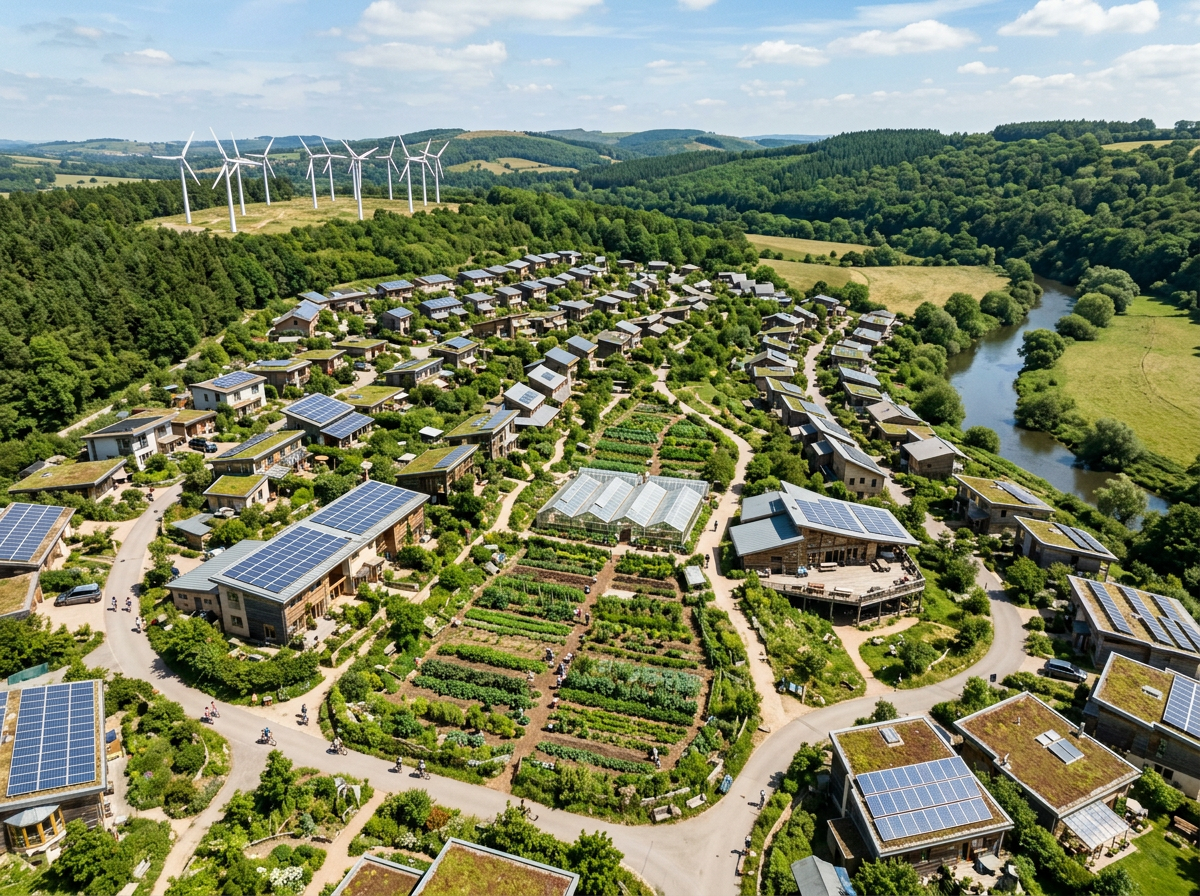
Building Resilience Through Adaptability, Redundancy, and Distributed Stewardship
Meta Description
Explore how anti-fragile communities cultivate resilience through decentralized systems, regenerative economics, adaptive governance, local sovereignty, and distributed infrastructure in an age of systemic uncertainty.
Introduction
Modern civilization is entering an era characterized by accelerating complexity, systemic volatility, ecological stress, technological disruption, and institutional fragility.
Communities increasingly face overlapping pressures that challenge traditional assumptions about stability, governance, economics, and resilience.
In response to this uncertainty, many people are reexamining a deeper question:
What makes communities capable not only of surviving disruption, but adapting and strengthening through it?
This question points toward the concept of anti-fragility.
Nassim Nicholas Taleb (2012) defines anti-fragility as the capacity of systems to gain from disorder, stress, volatility, and uncertainty rather than merely resist them. Fragile systems break under pressure. Robust systems withstand pressure. Anti-fragile systems adapt, evolve, and improve through challenge.
Applied to communities, anti-fragility involves designing social, economic, ecological, and governance structures capable of learning, decentralizing, regenerating, and reorganizing under changing conditions.
This does not mean eliminating risk entirely.
It means cultivating systems that remain adaptive when uncertainty inevitably emerges.
What Makes a Community Fragile?
Communities become fragile when survival depends excessively upon centralized, rigid, or tightly coupled systems with limited adaptability.
Fragility often increases when communities lack:
- Local resilience capacity
- Redundancy in critical systems
- Distributed knowledge
- Food and energy security
- Social trust
- Cooperative networks
- Adaptive governance
- Economic diversification
- Ecological stability
Highly optimized systems may appear efficient during periods of stability while quietly accumulating vulnerability beneath the surface.
For example:
- Communities dependent upon distant supply chains may struggle during transportation disruptions.
- Economies reliant upon single industries may collapse under market shifts.
- Overcentralized governance may become too slow to respond during crises.
- Digital dependency may create vulnerability during infrastructure failure.
- Ecological degradation may undermine long-term local resilience.
The COVID-19 pandemic revealed how quickly tightly interconnected systems can generate cascading disruptions across labor, healthcare, transportation, food systems, and local economies (Tooze, 2021).
Communities with stronger local adaptability often recovered more effectively because they possessed greater redundancy, cooperation, and decentralized responsiveness.
The Difference Between Resilience and Anti-Fragility
Resilience and anti-fragility are related but distinct concepts.
A resilient community can absorb shocks and maintain functionality.
An anti-fragile community goes further.
It learns, reorganizes, and evolves through stress.
For example:
- A resilient food system survives disruption.
- An anti-fragile food system diversifies and improves after disruption exposes weaknesses.
- A resilient governance structure maintains order during instability.
- An anti-fragile governance structure adapts based on feedback and emerging conditions.
- A resilient economy withstands volatility.
- An anti-fragile economy decentralizes risk and strengthens local participation after disruption.
Anti-fragility depends upon dynamic adaptation rather than static preservation.
Distributed Systems and Local Sovereignty
One of the foundational principles of anti-fragile communities is distributed resilience.
Centralized systems can coordinate efficiently at scale, but they may also create systemic vulnerabilities through concentration of risk.
Distributed systems reduce fragility by decentralizing critical functions across multiple nodes.
Examples include:
- Local food systems
- Distributed energy infrastructure
- Community-owned enterprises
- Cooperative governance
- Regional manufacturing
- Mutual aid networks
- Decentralized communication systems
- Localized water stewardship
When disruptions occur, distributed systems may compartmentalize failures rather than allowing them to cascade across entire regions.
This does not mean communities should become isolated from broader systems.
Rather, anti-fragile communities balance local sovereignty with strategic interdependence.
They maintain enough localized capability to adapt without becoming completely dependent upon distant centralized infrastructures.
Redundancy Is Not Inefficiency
Modern systems often prioritize efficiency above all else.
However, extreme efficiency frequently removes redundancy — the very buffers that enable survival during disruption.
Anti-fragile systems intentionally preserve redundancy.
Examples include:
- Multiple food sources
- Diverse energy systems
- Local skills distribution
- Backup communication methods
- Decentralized supply networks
- Community emergency coordination
- Diverse local economies
From a purely short-term economic perspective, redundancy may appear inefficient.
From a systems perspective, redundancy functions as resilience infrastructure.
Natural ecosystems themselves rely heavily upon redundancy and diversity to maintain stability under changing conditions.
Communities designed solely for optimization often become brittle.
Communities designed with adaptive redundancy are often more durable over time.
Social Trust as Community Infrastructure
Anti-fragility is not merely material.
It is relational.
Communities capable of adapting during crisis often possess strong social trust networks.
Trust enables:
- Cooperation during uncertainty
- Shared resource coordination
- Mutual aid
- Collective problem-solving
- Reduced social fragmentation
- Faster adaptive response
Francis Fukuyama (1995) argued that trust functions as a form of social capital enabling large-scale cooperation beyond immediate family structures.
Without trust, even well-resourced systems may become unstable under pressure.
Communities with high social fragmentation frequently struggle to coordinate effectively during periods of disruption.
Anti-fragile communities therefore cultivate:
- Civic participation
- Shared stewardship
- Local accountability
- Reciprocal relationships
- Community identity
- Distributed leadership
Social cohesion becomes a resilience multiplier.
Adaptive Governance and Distributed Leadership
Rigid governance structures often struggle under rapidly changing conditions.
Anti-fragile communities typically rely upon adaptive governance systems capable of integrating feedback, decentralizing decision-making, and responding dynamically to changing realities.
Adaptive governance may include:
- Participatory decision-making
- Distributed leadership structures
- Local accountability mechanisms
- Transparent communication
- Flexible coordination systems
- Rapid feedback integration
- Nested governance layers
Elinor Ostrom’s work on commons governance demonstrated that communities can sustainably manage shared resources through participatory stewardship systems adapted to local conditions (Ostrom, 1990).
Anti-fragile governance does not eliminate structure.
Rather, it balances coherence with flexibility.
Communities capable of learning from disruption often outperform systems trapped within rigid procedural frameworks.
Economic Diversity and Community Stability
Economic concentration often increases fragility.
Communities heavily dependent upon singular industries, centralized employers, or external financial systems may become vulnerable to sudden disruptions.
Anti-fragile economies generally exhibit diversity.
This may include:
- Small businesses
- Cooperative enterprises
- Local production capacity
- Skills-sharing networks
- Regional agriculture
- Ethical entrepreneurship
- Community finance initiatives
- Circular economic systems
Diverse local economies distribute risk across multiple sectors rather than concentrating survival within narrow economic dependencies.
Economic anti-fragility also involves retaining more local circulation of value rather than continuous extraction outward through monopolistic structures or speculative systems.
Ecological Stewardship and Regenerative Design
Human communities remain fully dependent upon ecological systems.
Soil, water, biodiversity, forests, fisheries, energy systems, and climate stability all influence long-term social resilience.
Communities that degrade ecological foundations often increase future fragility.
Anti-fragile communities increasingly integrate regenerative principles such as:
- Regenerative agriculture
- Watershed restoration
- Biodiversity stewardship
- Renewable energy systems
- Circular material flows
- Local ecological restoration
- Bioregional planning
Ecological resilience strengthens social resilience.
Regenerative systems often become more adaptive over time because they restore the health of underlying ecosystems rather than continuously depleting them.
Knowledge Distribution and Skills Resilience
Communities become fragile when critical knowledge is concentrated within narrow institutional or technological dependencies.
Anti-fragile communities distribute practical capabilities broadly across populations.
Important resilience capacities may include:
- Food cultivation
- Repair skills
- Water management
- Local healthcare knowledge
- Conflict mediation
- Ecological literacy
- Civic governance participation
- Emergency coordination
- Technological literacy
Distributed knowledge reduces dependency upon singular expertise bottlenecks.
Historically, communities with broader practical competence often adapted more effectively during periods of instability.
Technology and Appropriate Scale
Technology can strengthen anti-fragility when it increases adaptability, transparency, and local capability.
However, technological systems may also increase fragility when they create excessive dependency upon centralized infrastructures or opaque systems beyond community control.
Anti-fragile communities often evaluate technology according to questions such as:
- Does this increase local resilience?
- Does it distribute or concentrate power?
- Can the community maintain or repair it?
- Does it reduce or increase dependency?
- Does it strengthen ecological sustainability?
- Does it improve adaptive capacity?
The issue is not rejecting technology.
It is aligning technology with resilience rather than dependency.
Crisis as a Catalyst for Reorganization
Anti-fragility recognizes that disruption is not an anomaly.
It is an inevitable feature of complex systems.
Economic volatility, ecological stress, technological disruption, geopolitical instability, and institutional transformation will continue shaping the twenty-first century.
Communities designed around assumptions of permanent stability may struggle under such conditions.
Anti-fragile communities instead prepare for adaptation itself.
They cultivate:
- Flexibility
- Distributed capacity
- Social cohesion
- Ecological stewardship
- Participatory governance
- Local resilience
- Redundant infrastructure
- Adaptive learning cultures
The goal is not fear-driven survivalism.
It is regenerative preparedness.
Toward Communities That Evolve Through Complexity
The future may increasingly favor communities capable of balancing:
- Local sovereignty with global cooperation
- Efficiency with redundancy
- Innovation with resilience
- Flexibility with coherence
- Technology with ecological alignment
- Individual freedom with collective stewardship
Anti-fragility ultimately concerns relationship.
Relationship between people, institutions, ecosystems, infrastructure, and the systems supporting human life.
Communities capable of adapting together may become more stable than systems dependent entirely upon centralized optimization or rigid institutional permanence.
The future may not belong to the communities that avoid all disruption.
It may belong to the communities that learn how to evolve through it.
Suggested Crosslinks
- Regenerative Economics
- Intentional Community Design
- Building a Thriving Intentional Community
- Structural Systems Map
- Beyond the Peso: Why Pre-colonial Philippine Economics is the Blueprint for Modern Resilience
References
Fukuyama, F. (1995). Trust: The social virtues and the creation of prosperity. Free Press.
Ostrom, E. (1990). Governing the commons: The evolution of institutions for collective action. Cambridge University Press.
Taleb, N. N. (2012). Antifragile: Things that gain from disorder. Random House.
Tooze, A. (2021). Shutdown: How COVID shook the world’s economy. Viking.
The Living Archive is designed to be explored through pathways, categories, and search. If you’re looking for a specific idea, question, or theme, AI Search can help surface relevant connections across the archive.
Attribution
The Living Archive
Integrative Frameworks for Regenerative Civilization
© 2026 Gerald Daquila. All rights reserved.
Part of the Life.Understood. knowledge ecosystem and Stewardship Institute initiative.
This article is intended for educational, research, and civic inquiry purposes.
Readers are encouraged to engage critically, verify sources independently, and explore related knowledge hubs for broader systems context.
Leave a Reply