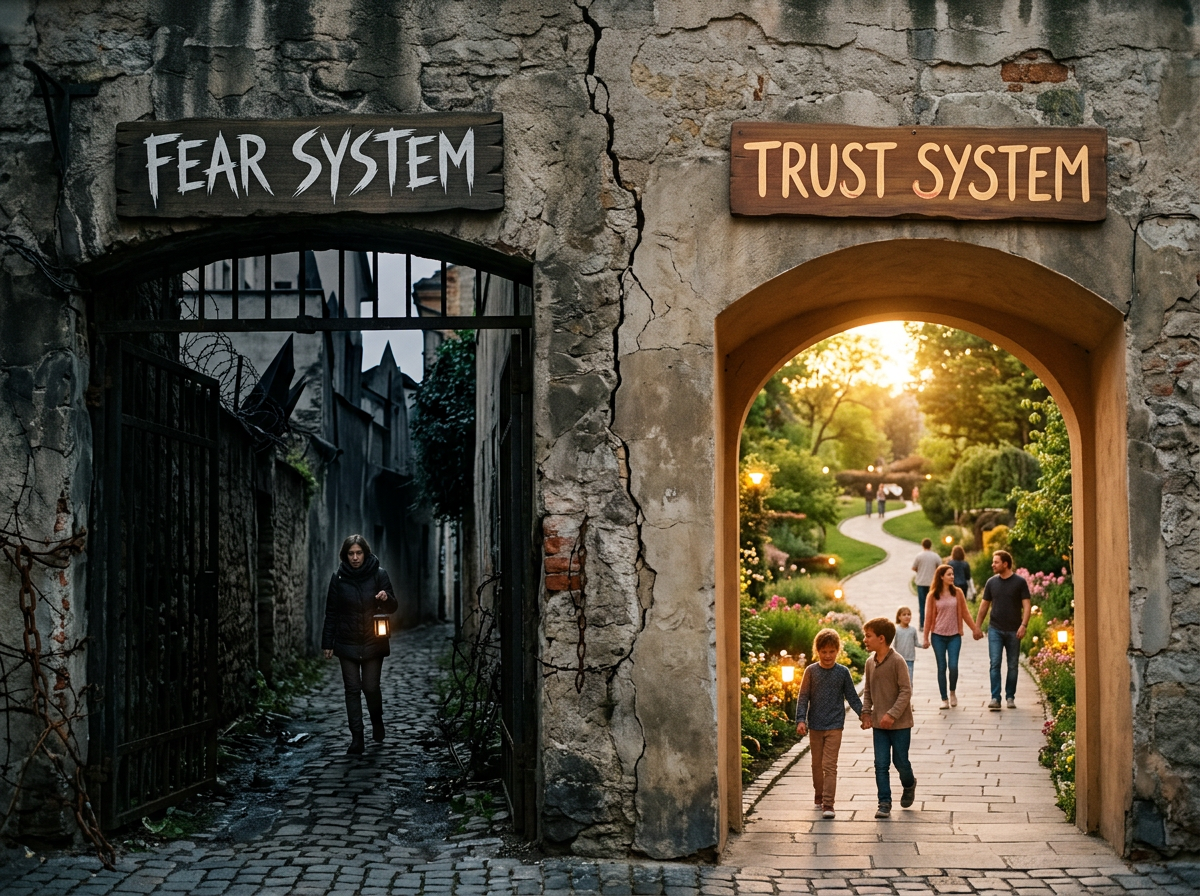
Exploring How Fear, Trust, Trauma, and Human Development Shape the Institutions We Create
Meta Description
Why does governance often mirror the psychological condition of a society? Explore the psychology of power, collective trauma, trust, leadership, and how inner states shape institutions and political systems.
Political systems are often discussed as if they exist independently of the people who create them.
Governments are analyzed through constitutions, laws, elections, institutions, policies, and economic structures. These factors undoubtedly matter. Yet beneath every governance system lies a less visible reality:
Governance is ultimately a human phenomenon.
Institutions do not emerge from abstract principles alone. They emerge from the beliefs, fears, values, aspirations, and psychological patterns of the societies that create them.
This suggests a provocative possibility:
Perhaps governance reflects collective inner states as much as it reflects political design.
- Why do some societies gravitate toward highly centralized authority while others emphasize distributed participation?
- Why do some populations trust institutions while others assume corruption?
- Why do certain leaders inspire devotion despite poor performance?
- Why do reforms repeatedly fail even when structural solutions appear obvious?
Part of the answer may lie within the psychology of power itself.
Understanding governance through a psychological lens reveals that political systems are not merely mechanisms of administration.
They are expressions of collective consciousness, cultural memory, and social development.
Power as a Psychological Relationship
Power is often imagined as something possessed.
- A government possesses power.
- A leader possesses power.
- An institution possesses power.
In reality, power functions more accurately as a relationship.
Political scientist Hannah Arendt argued that power emerges through collective agreement and cooperation rather than force alone (Arendt, 1970).
Even authoritarian systems ultimately depend upon social participation, compliance, legitimacy, or fear.
Power therefore exists not merely in rulers but in relationships between rulers and the ruled.
This observation shifts attention toward psychology.
If power is relational, then collective beliefs about authority become critically important.
Why Fear Produces Different Forms of Governance
Human beings respond to uncertainty in predictable ways.
Research in political psychology suggests that perceived threats often increase preferences for order, stability, and strong leadership (Marcus, Neuman, & MacKuen, 2000).
During periods of instability, populations frequently become more willing to trade autonomy for security.
This pattern appears repeatedly throughout history.
- Economic crises.
- Wars.
- Social disorder.
- Institutional breakdown.
Each can increase support for centralized authority.
The underlying psychological logic is understandable.
When uncertainty rises, predictability becomes valuable.
Consequently, governance structures often reveal how societies collectively respond to fear.
- A fearful society may prioritize control.
- A confident society may tolerate greater complexity, diversity, and decentralization.
Collective Trauma and Political Culture
Political systems do not emerge in historical isolation.
- Societies carry memories.
- Some are conscious.
- Others become embedded within culture.
Historical experiences such as:
- Colonization
- War
- Economic collapse
- Authoritarian rule
- Political violence
- Social upheaval
can shape collective expectations about power for generations (Alexander et al., 2004).
Trauma researchers increasingly recognize that unresolved collective wounds influence social behavior long after original events have ended (Yehuda & Lehrner, 2018).
These influences may appear as:
- Institutional distrust
- Hypervigilance
- Dependency on authority
- Political cynicism
- Strong in-group identification
- Fear of change
As explored in Trauma and Governance: How Unhealed Societies Create Dysfunctional Institutions, political dysfunction often reflects unresolved psychological dynamics operating at scale.
Governance becomes not merely administrative but therapeutic.
Trust: The Invisible Infrastructure
Political discussions often focus on visible infrastructure.
- Roads.
- Utilities.
- Public services.
- Regulations.
Yet societies depend equally upon invisible infrastructure.
Trust.
Political scientist Francis Fukuyama argued that trust functions as a foundational social resource enabling cooperation and collective action (Fukuyama, 1995).
High-trust societies typically require fewer monitoring mechanisms because citizens assume others will generally act in good faith.
Low-trust societies compensate differently.
- Rules multiply.
- Oversight expands.
- Bureaucracy grows.
- Enforcement intensifies.
The result is not merely administrative complexity.
It is increased social friction.
Trust therefore acts as a form of collective psychological capital.
Governance reflects its presence—or absence.
Why Societies Get the Leaders They Reward
Leadership discussions often focus on individual personalities.
However, leaders emerge from social environments.
Political systems tend to elevate individuals whose characteristics resonate with prevailing cultural conditions.
- Fearful populations may prefer certainty.
- Anxious populations may prefer reassurance.
- Fragmented populations may prefer strong identity narratives.
- Confident populations may tolerate ambiguity and experimentation.
Psychologist Erich Fromm argued that individuals often seek forms of authority that alleviate psychological uncertainty (Fromm, 1941).
This insight helps explain why leadership quality cannot be separated from collective psychology.
- Leaders influence society.
- Society also influences leaders.
- The relationship is reciprocal.
The Developmental Dimension of Governance
Not all conceptions of power are identical.
Developmental psychology suggests that human beings often progress through increasingly complex ways of understanding authority, morality, and social organization (Kegan, 1994).
At earlier developmental stages, authority may be viewed primarily through:
- Obedience
- Punishment
- Loyalty
- Group identity
More complex stages may emphasize:
- Systems thinking
- Shared responsibility
- Mutual accountability
- Institutional stewardship
This perspective suggests that governance systems reflect not only historical conditions but developmental capacities.
As societies become more capable of managing complexity, governance structures may evolve accordingly.
The future of governance may therefore depend partly upon human development itself.
Scarcity, Abundance, and Power
The psychology of power changes significantly depending upon perceptions of scarcity.
When people believe resources are limited, competition often intensifies.
- Power becomes associated with control over access.
- When security increases, cooperation becomes more feasible.
This dynamic connects directly to The Psychology of Enough: Why Scarcity Thinking Persists Even in Prosperity.
Scarcity-oriented societies frequently organize around protection.
Abundance-oriented societies can devote greater attention to stewardship.
The difference is not merely economic.
It is psychological.
The perception of scarcity often shapes governance as much as scarcity itself.
Why Governance Mirrors Collective Identity
Institutions do not merely manage society.
They symbolize collective identity.
Political systems express beliefs about:
- Human nature
- Responsibility
- Trust
- Freedom
- Cooperation
- Authority
Different societies answer these questions differently.
Consequently, governance structures vary.
The deeper issue is not simply which system exists.
The deeper issue is what assumptions about humanity that system reflects.
- Every governance model contains a psychological theory of human behavior.
- Whether acknowledged or not, those assumptions influence outcomes.
The Shadow Side of Power
Power amplifies existing tendencies.
This applies to individuals and institutions alike.
Research consistently suggests that power can reduce sensitivity to feedback and increase overconfidence when accountability mechanisms weaken (Keltner, Gruenfeld, & Anderson, 2003).
The challenge is not power itself.
All societies require decision-making capacity.
- The challenge is creating structures that balance power with accountability.
- Healthy systems recognize that no individual or institution is immune to bias.
Consequently, resilient governance requires:
- Transparency
- Feedback loops
- Distributed responsibility
- Civic participation
- Institutional learning
These mechanisms help counteract predictable psychological vulnerabilities.
From Domination to Stewardship
Historically, many governance systems have been organized around domination.
Power was exercised over people.
Increasingly, alternative models emphasize stewardship.
Stewardship views power differently.
Power becomes a responsibility rather than a privilege.
- A capacity rather than a possession.
- A service rather than a status.
This perspective aligns with emerging discussions around regenerative governance, collaborative leadership, and long-term institutional resilience.
The most effective future systems may be those capable of transforming power from an instrument of control into a vehicle for collective flourishing.
Governance as a Mirror
One of the most challenging implications of political psychology is that governance often mirrors society itself.
Citizens frequently criticize institutions while overlooking the cultural conditions that sustain them.
Yet institutions emerge from human behavior.
- If distrust is widespread, institutions often reflect distrust.
- If cooperation increases, institutions often become more cooperative.
- If accountability becomes culturally valued, governance frequently evolves accordingly.
This does not mean individuals are responsible for every systemic failure.
Rather, it suggests that societal transformation and institutional transformation are deeply interconnected.
Conclusion
Governance is often treated as a technical challenge involving laws, policies, and institutional design. While these factors matter, they represent only part of the story.
Beneath every political system lies a psychological landscape composed of beliefs, fears, hopes, identities, and collective memories. These inner realities influence how societies understand power, select leaders, build institutions, and respond to uncertainty.
The psychology of power reminds us that governance is not merely about structures.
- It is about people.
- Institutions reflect collective inner states as much as formal rules.
Consequently, lasting political transformation may require more than policy reform alone.
It may require deeper cultural, psychological, and developmental shifts capable of reshaping the conditions from which governance itself emerges.
The future of governance may therefore depend not only on better systems, but on healthier relationships with power.
Related Reading
- Trauma and Governance: How Unhealed Societies Create Dysfunctional Institutions
- Transition Fatigue: Why So Many People Feel the Old Systems No Longer Work
- Collapse or Transformation? How Societies Interpret Periods of Instability
- The Psychology of Enough: Why Scarcity Thinking Persists Even in Prosperity
- Overflow States: How Individuals and Communities Sustain Coherence
- Why Cooperation Breaks Down: Trust, Competition, and Survival
- The Future of Power: From Domination to Stewardship
- Institutional Stability vs Individual Competence: Why Capability Alone Doesn’t Win
- Regenerative Governance Principles
References
Alexander, J. C., Eyerman, R., Giesen, B., Smelser, N. J., & Sztompka, P. (2004). Cultural trauma and collective identity. University of California Press.
Arendt, H. (1970). On violence. Harcourt Brace.
Fromm, E. (1941). Escape from freedom. Farrar & Rinehart.
Fukuyama, F. (1995). Trust: The social virtues and the creation of prosperity. Free Press.
Kegan, R. (1994). In over our heads: The mental demands of modern life. Harvard University Press.
Keltner, D., Gruenfeld, D. H., & Anderson, C. (2003). Power, approach, and inhibition. Psychological Review, 110(2), 265–284.
Marcus, G. E., Neuman, W. R., & MacKuen, M. (2000). Affective intelligence and political judgment. University of Chicago Press.
Yehuda, R., & Lehrner, A. (2018). Intergenerational transmission of trauma effects: Putative role of epigenetic mechanisms. World Psychiatry, 17(3), 243–257. https://doi.org/10.1002/wps.20568
The Living Archive is designed to be explored through pathways, categories, and search. If you’re looking for a specific idea, question, or theme, AI Search can help surface relevant connections across the archive.
Attribution
The Living Archive
Integrative Frameworks for Regenerative Civilization
© 2026 Gerald Daquila. All rights reserved.
Part of the Life.Understood. knowledge ecosystem and Stewardship Institute initiative.
This article is intended for educational, research, and civic inquiry purposes.
Readers are encouraged to engage critically, verify sources independently, and explore related knowledge hubs for broader systems context.