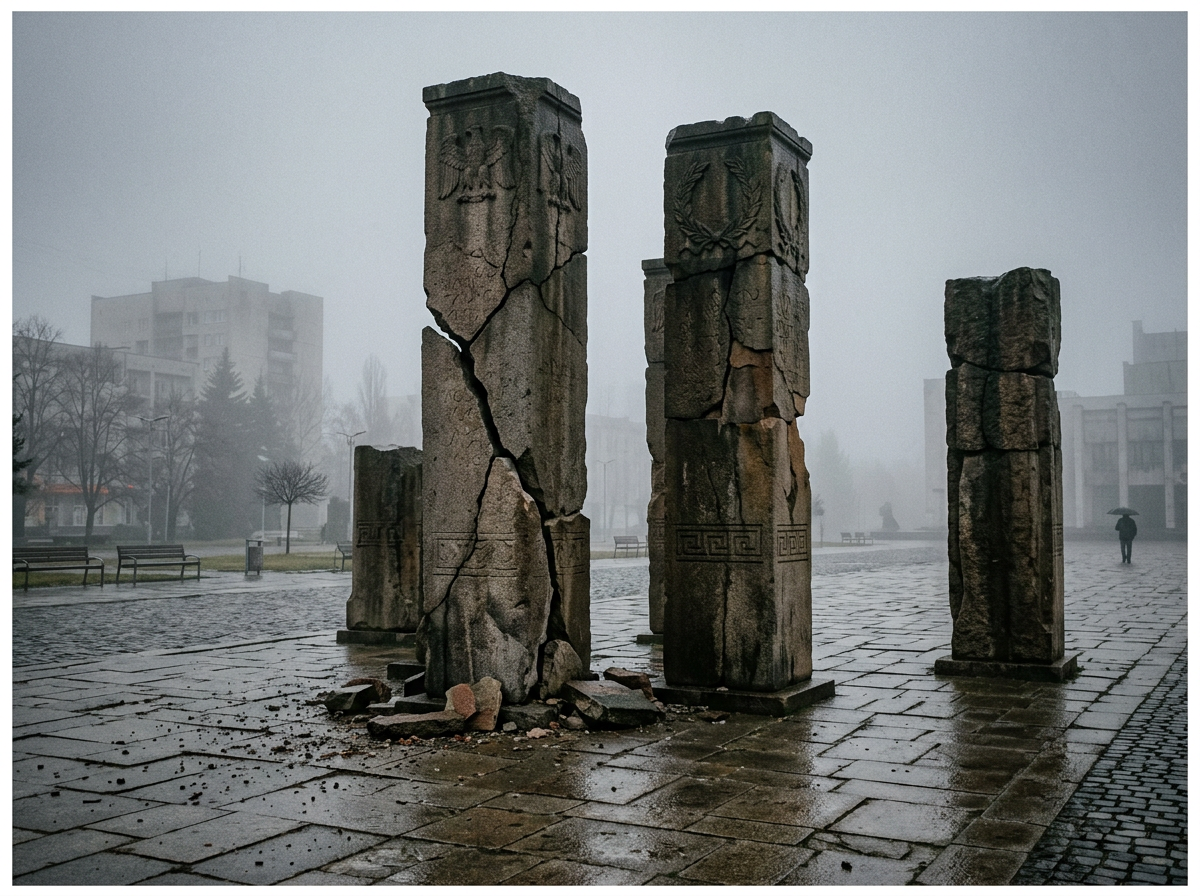
Why trust may be as important to societal resilience as roads, power grids, and communication networks—and why its erosion creates consequences far beyond politics.
Meta Description
Trust is often treated as a cultural or interpersonal issue, yet it functions as critical societal infrastructure. Explore how trust shapes governance, economic performance, institutional legitimacy, and collective resilience.
When people think about infrastructure, they usually imagine physical systems.
- Roads.
- Bridges.
- Ports.
- Power grids.
- Water systems.
- Telecommunications networks.
These structures allow societies to function.
Without them, economic activity slows, institutions struggle, and everyday life becomes increasingly difficult.
Yet there is another form of infrastructure that receives far less attention.
Trust.
Unlike physical infrastructure, trust cannot be photographed from space.
It does not appear on government budgets in the same way as highways or airports.
Yet trust performs many of the same functions.
- It enables coordination.
- It reduces friction.
- It lowers transaction costs.
- It allows institutions, communities, and economies to operate effectively.
When trust weakens, societies often experience consequences that extend far beyond interpersonal relationships.
Economic performance suffers.
Governance becomes more difficult.
Information systems fragment.
Social cohesion declines.
In this sense, trust functions as a form of invisible infrastructure.
And increasingly, it may be one of the most important forms of infrastructure a society possesses.
What Is Trust?
Trust is often discussed as a personal quality.
- A person is trustworthy.
- A friend is trusted.
- A relationship contains trust.
These examples are familiar.
Yet trust also exists at larger scales.
- Citizens trust institutions.
- Communities trust one another.
- Businesses trust contractual systems.
- People trust information sources.
- Organizations trust professional standards.
At its core, trust involves a willingness to accept vulnerability based on expectations regarding the behavior of others (Fukuyama, 1995).
Trust reduces uncertainty.
It allows individuals and groups to cooperate without requiring complete control over outcomes.
This seemingly simple function has enormous implications.
Why Trust Matters Economically
Economists have long recognized that trust possesses economic value.
In low-trust environments, people spend more time verifying information, monitoring behavior, enforcing agreements, and protecting themselves from potential risks.
These activities consume resources.
- They increase costs.
- They slow cooperation.
In high-trust environments, many of these costs decline.
- Agreements become easier.
- Collaboration becomes faster.
- Innovation becomes more likely.
Economic sociologist Francis Fukuyama (1995) argued that trust functions as a form of social capital that significantly influences economic performance.
The implications are substantial.
Trust is not merely a social virtue.
It is an economic asset.
Trust and Governance
Governance systems depend heavily on trust.
- Laws matter.
- Regulations matter.
- Institutions matter.
Yet governance becomes far more difficult when trust declines.
- Citizens may become less willing to cooperate.
- Public information may be viewed with suspicion.
- Policy implementation becomes more challenging.
- Institutional legitimacy weakens.
This does not mean governments should seek unquestioning trust.
Healthy societies require accountability and scrutiny.
Blind trust can be dangerous.
The challenge is maintaining sufficient trust for cooperation while preserving mechanisms for oversight and correction.
Functional governance depends on both.
The Invisible Reduction of Complexity
One of trust’s most important functions is reducing complexity.
Modern societies are extraordinarily complicated.
Every day, individuals rely upon countless systems they do not fully understand.
Most people cannot personally verify:
- Financial systems
- Electrical grids
- Medical research
- Aviation safety
- Food supply chains
- Communication networks
Instead, they rely upon institutions, professionals, and processes.
Trust allows this arrangement to function.
- Without trust, individuals would face impossible verification burdens.
- Every decision would require extensive investigation.
- Every interaction would become more costly.
Trust therefore acts as a complexity-management mechanism.
It allows societies to function despite the limitations of individual knowledge.
Trust as Social Capital
Sociologist Robert Putnam (2000) described trust as a key component of social capital.
Social capital refers to the networks, norms, and relationships that facilitate cooperation.
Communities with strong social capital often demonstrate:
- Higher civic participation
- Greater resilience
- Stronger cooperation
- Improved collective problem-solving
Importantly, trust tends to reinforce itself.
Communities that experience successful cooperation often develop greater trust.
- Greater trust supports further cooperation.
- The reverse dynamic also exists.
- Distrust can become self-reinforcing.
- Failed cooperation increases suspicion.
- Suspicion reduces cooperation.
- The cycle continues.
Trust therefore behaves much like a societal asset that can be accumulated or depleted.
Information Systems and Trust
The digital age has transformed trust dynamics.
Historically, information flowed through relatively stable institutions.
- Newspapers.
- Universities.
- Professional organizations.
- Public broadcasters.
These institutions were imperfect.
Yet they often provided common reference points.
Today’s information environment is far more fragmented.
- Individuals encounter information from countless sources.
- Artificial intelligence generates explanations at scale.
- Social media accelerates emotional reactions.
- Competing narratives circulate continuously.
- The challenge is not merely misinformation.
- The challenge is determining what deserves trust.
As information abundance increases, trust becomes increasingly valuable.
Without trusted methods for evaluating claims, societies struggle to maintain shared understanding.
Trust and Collective Action
Many societal challenges require collective action.
- Public health.
- Disaster response.
- Infrastructure development.
- Environmental stewardship.
- Community resilience.
Collective action depends on trust.
- People cooperate when they believe others will contribute fairly.
- They participate when institutions appear legitimate.
- They make sacrifices when they trust that benefits will be shared appropriately.
Trust therefore functions as a prerequisite for many forms of coordinated action.
When trust declines, collective challenges become harder to address.
Not necessarily because solutions are unavailable.
But because cooperation becomes more difficult.
Institutional Trust Versus Interpersonal Trust
An important distinction exists between interpersonal trust and institutional trust.
- Interpersonal trust concerns relationships between individuals.
- Institutional trust concerns confidence in systems and organizations.
The two influence one another.
Communities with strong interpersonal trust often support stronger institutions.
Effective institutions often reinforce interpersonal trust.
However, they are not identical.
A society may possess strong family and community relationships while exhibiting low institutional trust.
Alternatively, institutions may remain relatively trusted even as social relationships weaken.
Understanding these differences helps explain why trust challenges can emerge in different forms.
Solutions that strengthen one type of trust may not automatically strengthen the other.
How Trust Is Built
Trust is often discussed as though it were a feeling.
In practice, it emerges from repeated experiences.
Several factors consistently contribute to trust development:
Competence
- People trust systems that demonstrate capability.
Consistency
- Predictable behavior strengthens confidence.
Transparency
- Visibility increases credibility.
Accountability
- Mechanisms for correcting mistakes support legitimacy.
Reciprocity
- Mutual benefit encourages cooperation.
Fairness
- Perceived fairness strengthens willingness to participate.
Trust therefore emerges through structure as much as intention.
Well-designed systems often produce trust more effectively than persuasive messaging alone.
Trust Architecture
The concept of trust architecture refers to the structures that make trust possible.
Just as physical architecture shapes movement through space, trust architecture shapes cooperation within societies.
Examples include:
- Legal systems
- Professional standards
- Transparent governance processes
- Community institutions
- Independent media
- Educational systems
- Accountability mechanisms
These structures create environments where trust can develop.
Importantly, trust architecture does not eliminate the possibility of failure.
No system is perfect.
Its purpose is reducing uncertainty sufficiently for cooperation to occur.
The strongest societies often possess robust trust architectures rather than merely high levels of goodwill.
The Cost of Eroding Trust
Trust often disappears gradually.
- Small failures accumulate.
- Institutions become less responsive.
- Information becomes less reliable.
- Communities become less connected.
- Accountability weakens.
The consequences may remain invisible for years.
Eventually, however, trust erosion produces measurable effects.
- Cooperation declines.
- Polarization increases.
- Institutional effectiveness weakens.
- Economic costs rise.
- Social cohesion becomes more fragile.
At that point, rebuilding trust becomes far more difficult than maintaining it.
Like physical infrastructure, trust is often most appreciated after it begins to fail.
Trust in an Age of Complexity
The twenty-first century is characterized by increasing complexity.
- Information expands.
- Technologies evolve.
- Institutions face growing pressures.
- Global interdependence deepens.
Under these conditions, trust becomes more rather than less important.
The solution to complexity cannot simply be more information.
- Information requires interpretation.
- Interpretation requires credibility.
- Credibility depends upon trust.
As societies become more interconnected, trust increasingly serves as the connective tissue linking diverse systems together.
Beyond Infrastructure
Modern societies invest heavily in physical infrastructure.
They maintain roads, power systems, communication networks, and public facilities.
These investments are necessary.
Yet trust deserves similar attention.
Not because trust replaces institutions.
- Because trust allows institutions to function.
Not because trust eliminates disagreement.
- Because trust allows disagreement to occur constructively.
Not because trust guarantees success.
- Because trust makes cooperation possible.
The future challenges facing societies will require unprecedented levels of coordination.
- Technological disruption.
- Environmental adaptation.
- Information integrity.
- Community resilience.
- Institutional renewal.
None of these challenges can be addressed effectively through infrastructure alone.
They require trust.
In that sense, trust may be the most important infrastructure that rarely appears on a map.
Invisible when functioning.
Indispensable when absent.
Crosslinks
- Collective Nervous Systems: How Cultures Regulate Human Coherence
- Institutional Consciousness: Can Systems Evolve Beyond Survival Logic?
- Designing Human-Scale Institutions for the 21st Century
- Polycentric Governance in Practice: Lessons from Indigenous and Modern Systems
- Reciprocity Before Bureaucracy: How Communities Coordinated Without Modern Institutions
- Beyond Bureaucracy: Why Industrial Governance Systems Are Failing Human Complexity
- From Hierarchies to Stewardship: The Rise of Distributed Human Systems
- From Collective Trauma to System Design: A Living Archive Framework for the Philippines
References
Fukuyama, F. (1995). Trust: The social virtues and the creation of prosperity. Free Press.
Luhmann, N. (1979). Trust and power. Wiley.
Putnam, R. D. (2000). Bowling alone: The collapse and revival of American community. Simon & Schuster.
Rothstein, B. (2011). The quality of government: Corruption, social trust, and inequality in international perspective. University of Chicago Press.
The Living Archive is designed to be explored through pathways, categories, and search. If you’re looking for a specific idea, question, or theme, AI Search can help surface relevant connections across the archive.
Attribution
The Living Archive
Integrative Frameworks for Regenerative Civilization
© 2026 Gerald Daquila. All rights reserved.
Part of the Life.Understood. knowledge ecosystem and Stewardship Institute initiative.
This article is intended for educational, research, and civic inquiry purposes.
Readers are encouraged to engage critically, verify sources independently, and explore related knowledge hubs for broader systems context.