Logo - Life.Understood.

Category: SACRED TECHNOLOGY

  • AI as Mirror: Why Artificial Intelligence Reveals Human Incoherence

    AI as Mirror: Why Artificial Intelligence Reveals Human Incoherence


    A Systems-Level Interpretation of Intelligence, Reflection, and Responsibility in the Age of AI


    Meta Description

    Artificial intelligence does not create human dysfunction—it exposes it. This essay reframes AI as a mirror of human coherence, revealing deeper implications for sovereignty, discernment, and systems design.


    Introduction: The Misdiagnosis of AI

    Most discussions about artificial intelligence begin with the wrong premise.

    They assume that AI is:

    • a new form of intelligence
    • a potential replacement for human cognition
    • or an emerging existential threat

    These framings, while not entirely incorrect, are incomplete.

    They position AI as an external force acting upon humanity, rather than as a reflective system revealing what already exists within it.

    This piece proposes a different interpretation:

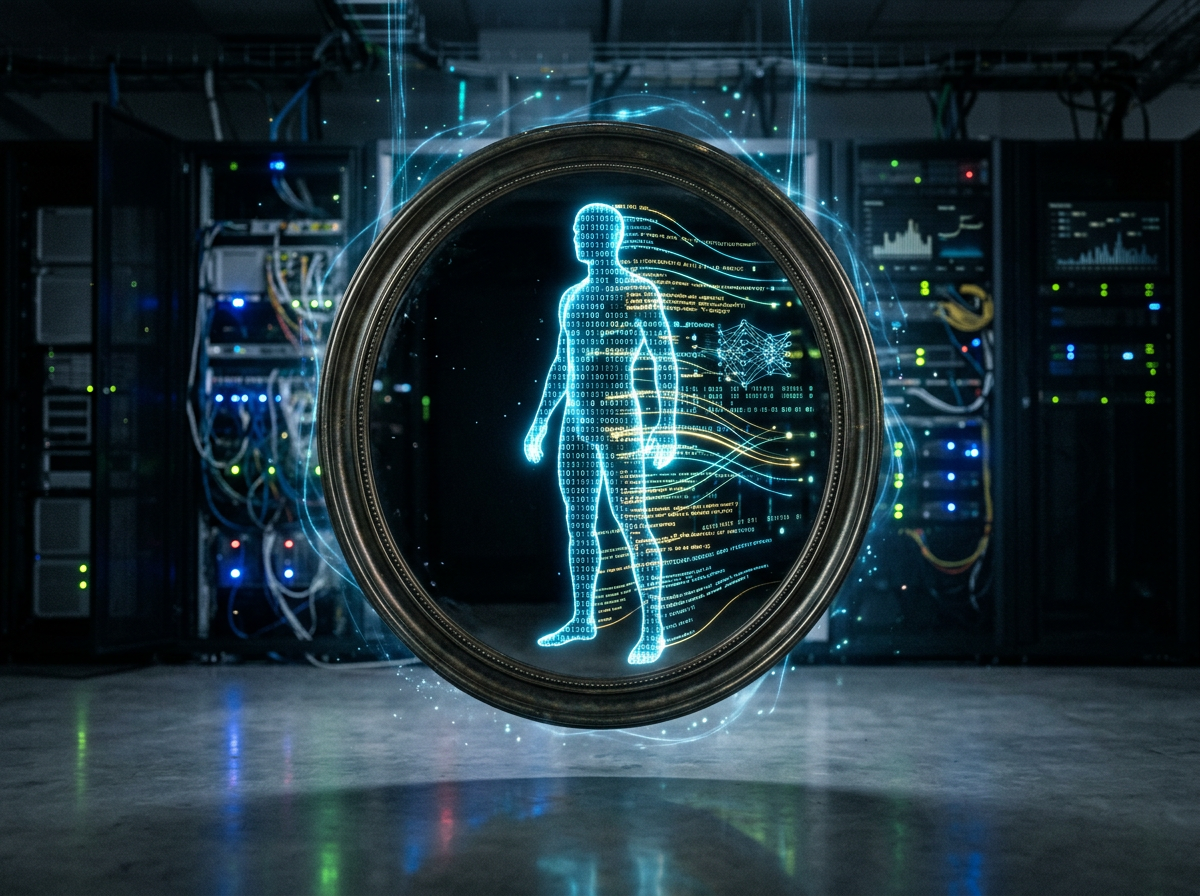
    Artificial intelligence is not primarily a creator of outcomes—it is an amplifier and mirror of human coherence or incoherence.

    To understand AI accurately, we must stop asking what AI will become, and begin asking:

    What does AI reveal about us?


    AI Does Not Invent—It Reconstructs

    At a functional level, modern AI systems do not “think” in the human sense.

    They:

    • process large-scale datasets
    • detect statistical patterns
    • generate outputs based on probability distributions

    This aligns with the current technical understanding of large language models as systems that predict likely sequences based on prior data, rather than independently reasoning agents (Bender et al., 2021).

    This has a critical implication:

    AI cannot generate meaning that does not already exist within the human-generated corpus it was trained on.

    It can recombine, accelerate, and simulate—but not originate from a vacuum.

    Therefore, when AI produces:

    • bias
    • misinformation
    • manipulation
    • brilliance
    • creativity-like outputs

    …it is not introducing something new.

    It is reflecting aggregated human input at scale.


    The Mirror Effect: Amplification of Human Patterns

    Historically, technologies have always reflected aspects of human behavior:

    • The printing press amplified ideology
    • Radio amplified propaganda
    • Social media amplified identity and division

    AI differs in one key way:

    It reflects not just behavior—but cognition itself.

    It mirrors:

    • how we reason
    • how we frame arguments
    • how we prioritize information
    • how we construct narratives

    And because it operates at scale and speed, it does not simply reflect—it magnifies.

    This is why AI systems have been shown to reproduce and even intensify societal biases present in their training data (Bender et al., 2021).

    But bias is only the surface.

    The deeper layer is this:

    AI exposes the underlying coherence or incoherence of human knowledge systems.


    What Is Human Incoherence?

    Incoherence is not ignorance.

    It is fragmentation.

    A system is incoherent when:

    • its parts contradict each other
    • its outputs are inconsistent
    • its signals cannot be reliably interpreted

    Applied to humans and societies, incoherence appears as:

    • conflicting beliefs held simultaneously
    • narratives detached from reality
    • decision-making driven by emotion rather than discernment
    • systems that cannot self-correct

    AI does not fix this.

    It renders it visible.


    Synthetic Output, Real Consequences

    As AI-generated content becomes indistinguishable from human-created material, a new condition emerges:

    Synthetic reality

    This includes:

    • AI-generated text, images, music and video
    • deepfakes and voice replication
    • automated narratives at scale

    The concern is not merely deception.

    It is the collapse of default trust.

    Research indicates that both the public and experts are increasingly concerned about AI’s role in misinformation, impersonation, and erosion of truth verification mechanisms (Pew Research Center, 2025).

    In such an environment:

    • truth is no longer externally guaranteed
    • authority is no longer stable
    • verification becomes an individual responsibility

    This connects directly to The Architecture of Silence: Breaking the Cycles of Colonial Shame, where inherited narratives operate without conscious verification.

    AI accelerates this condition globally.


    The Collapse of Passive Cognition

    In pre-AI environments, most individuals could operate under passive cognition:

    • information was consumed
    • authority was assumed
    • verification was outsourced

    AI disrupts this model.

    Because AI can generate:

    • plausible falsehoods
    • convincing arguments on both sides
    • authoritative-sounding explanations

    …it forces a shift:

    From passive consumption → to active discernment

    This aligns with the core principle in Sensemaking: The Skill We Weren’t Taught but Now Desperately Need, which prioritizes discernment over belief.

    AI does not eliminate truth.

    It removes the illusion that truth can be passively received.


    Coherence as the New Currency

    If AI amplifies both signal and noise, then the differentiator is no longer access to information.

    It is:

    coherence

    A coherent individual or system can:

    • integrate multiple inputs without contradiction
    • detect inconsistencies
    • maintain alignment between perception, reasoning, and action

    Incoherent systems cannot.


    They fragment under pressure.


    This is why AI does not uniformly empower all users.


    It amplifies the capabilities of the already coherent, and destabilizes the incoherent.


    AI and the ARK Framework

    The Applied Stewardship architecture becomes more—not less—relevant under AI conditions.

    In ARK-001 (Resource Loops)

    Decision-making may be assisted by AI.

    But if the human operators lack coherence, the system becomes:

    • optimized incorrectly
    • misaligned with real needs
    • vulnerable to manipulation

    In ARK-004 (Community Ledger SOP)

    Ledger systems depend on trust and accurate recording.

    AI introduces both:

    • enhanced tracking capabilities
    • and potential for synthetic manipulation

    This raises the stakes:

    Governance must evolve faster than tools.


    In ARK-003 (Jurisdictional Sovereignty)

    Authority cannot rely solely on external systems.

    It must be grounded in:

    • verifiable processes
    • accountable structures
    • and coherent leadership

    AI accelerates the need for this transition.


    The Deeper Layer: AI as Threshold

    At a metaphysical level, AI represents a threshold condition.

    Not because it is conscious.

    But because it forces humanity to confront:

    • authorship (who created this?)
    • agency (who decided this?)
    • responsibility (who is accountable?)

    These are not technical questions.

    They are ontological and ethical questions.

    Within the broader architecture of this platform, this aligns with the movement from:

    • fragmented identity
      → toward sovereign stewardship

    AI becomes:

    a test of whether humans can retain coherence when intelligence is externalized.


    Conclusion: The Mirror Cannot Be Blamed

    It is tempting to treat AI as:

    • the problem
    • the threat
    • or the solution

    But this misplaces responsibility.

    AI does not create human incoherence.

    It reveals it.

    And in doing so, it removes the buffer that once allowed incoherence to persist unnoticed.

    The implication is clear:

    The future of AI is not determined by the system itself—but by the coherence of those who use it.

    This is why the question is not:

    • Will AI become dangerous?

    But:

    • Will humans become coherent enough to use it responsibly?

    References

    Bender, E. M., Gebru, T., McMillan-Major, A., & Margaret Mitchell. (2021). On the dangers of stochastic parrots: Can language models be too big? Proceedings of the 2021 ACM Conference on Fairness, Accountability, and Transparency.

    Pew Research Center. (2025). Public and expert views on artificial intelligence.


    Suggested Internal Crosslinks


    Attribution

    ©2026 Gerald Daquila • Life.Understood.
    Steward of applied thinking at the intersection of systems, identity, and real-world constraint.

    This work draws from lived experience across cultures and environments, translated into practical frameworks for clearer thinking and more coherent contribution.

    This piece is part of an ongoing exploration of applied thinking in real-world systems.. Part of the ongoing Codex on leadership, awakening, and applied intelligence.


  • From Wound to Pattern — How Unconscious Survival Adaptations Repeat Across Generations

    From Wound to Pattern — How Unconscious Survival Adaptations Repeat Across Generations

    Tracing how early coping strategies become adult identities — and where the cycle can change


    5–7 minutes

    Prologue — Adaptation Is Not Destiny

    Before memory, there was adaptation.
    Before identity, there was response.

    Each soul enters a world already in motion — shaped by family histories, emotional climates, and unspoken survival rules. The young nervous system does not analyze; it learns. It reads tone, absence, intensity, and safety, shaping itself to endure what it cannot yet change.

    A child raised in safety learns trust.
    A child raised in unpredictability learns vigilance.
    A child raised in neglect learns self-reliance.
    A child raised in control learns compliance — or resistance.

    These early adjustments are acts of intelligence. They preserve connection. They protect life. They arise automatically, guided by the body’s instinct to survive within the conditions it is given.

    The difficulty begins when temporary survival strategies become permanent personality structures — when what once ensured endurance continues long after the original environment has changed.

    What once protected begins to define.

    This Codex is not a judgment of the past. It is an illumination of the hinge point where inheritance becomes choice. Here we look gently at the survival strategies that formed us — not to reject them, but to recognize where they are no longer required.

    For in the moment awareness dawns, repetition loosens.

    And what once moved through us automatically becomes something we can reshape with care.


    I · Survival Strategies That Outlive Their Environment

    In childhood, the nervous system organizes around one question:

    “What must I do to stay safe here?”

    The answers become patterns:

    Early EnvironmentSurvival AdaptationAdult Echo
    Emotional unpredictabilityHypervigilanceAnxiety, control-seeking
    NeglectSelf-sufficiencyDifficulty receiving support
    Harsh authorityCompliance or rebellionPeople-pleasing or oppositional behavior
    Power abuseIdentification with powerControlling leadership styles

    These responses are not moral failings. They are intelligent adjustments to early reality. However, when circumstances change but the adaptation remains, a mismatch develops between present reality and past conditioning.


    II · The Repetition Effect — Familiar Feels Like “Normal”

    Humans tend to recreate familiar emotional environments, even when those environments were painful.

    This is not because people consciously desire suffering. It is because the nervous system equates familiarity with predictability, and predictability with safety.

    This dynamic has been studied in trauma psychology by figures like Bessel van der Kolk, who describes how the body retains implicit memories of early stress and continues to react as if old conditions are still present.

    Examples of repetition patterns include:

    • Abused children becoming abusive parents
    • Children of emotionally distant caregivers becoming emotionally unavailable partners
    • Individuals raised in scarcity becoming hoarders when resources become available
    • Employees harmed by authoritarian leaders later adopting the same leadership style

    The original wound is not being reenacted intentionally.
    It is being replayed automatically.


    III · Identification With the Aggressor

    One powerful survival mechanism is identification with the source of power.

    When someone feels powerless in early life, they may unconsciously conclude:

    “Power is what prevents harm.”

    Later, when they gain authority, the nervous system may default to the same behaviors once feared. This dynamic has been observed in both personal and political contexts, including the rise of authoritarian personalities like Adolf Hitler and Joseph Stalin, whose regimes reflected cycles of fear, control, and domination that often mirror unresolved trauma at scale.

    At a smaller scale, this same mechanism appears in:

    • Abusive supervisors
    • Controlling parents
    • Intimidating partners

    The individual is not becoming “evil.”
    They are repeating a survival equation learned early:

    Power = Safety


    IV · From Personal Pattern to Social Structure

    When large numbers of individuals carry unexamined survival adaptations into adulthood, these patterns shape institutions.

    Scarcity-minded individuals build competitive systems.
    Control-oriented individuals create rigid hierarchies.
    Emotionally disconnected individuals design impersonal structures.

    Over time, society reflects the accumulated survival strategies of its members.

    This is how childhood wounds scale into:

    • Authoritarian governance
    • Workplace cultures built on fear
    • Economic systems rooted in hoarding and competition

    The system is not separate from people.
    It is a mirror of unprocessed conditioning.


    V · The Turning Point — Consciousness Creates Choice

    The cycle begins to loosen at a precise moment:

    When a person recognizes, “This reaction belongs to my past, not my present.”

    This awareness creates a gap between impulse and action.

    Instead of automatically repeating the pattern, a new question becomes possible:

    “Given who I am now, what do I choose instead?”

    This is not denial of the past.
    It is the reclamation of authorship over the future.

    Neuroscience research on neuroplasticity, advanced by scientists like Norman Doidge, shows that repeated conscious choices can reshape neural pathways over time. Patterns are learned — and can be relearned.


    VI · Changing the Cycle One Person at a Time

    Systemic change often feels overwhelming. But generational cycles do not break at the level of systems first. They break at the level of individuals who choose not to pass forward what they inherited.

    Each time someone:

    • Pauses instead of reacting
    • Listens instead of dominating
    • Shares instead of hoarding
    • Repairs instead of withdrawing

    …a survival adaptation is being updated.

    The shift may seem small, but patterns propagate socially. Children raised by even slightly more regulated caregivers develop different nervous system baselines. Employees led by self-aware managers create different workplace norms.

    One regulated person influences many others.


    Closing Reflection — The Future Is Not Obligated to the Past

    Early life shapes us, but it does not imprison us.

    Adaptations formed under pressure were necessary then. They deserve understanding, not shame. Yet what once ensured survival does not have to dictate the future.

    Conscious awareness is the leverage point where history loosens its grip.

    From there, the cycle shifts:
    Not by force.
    Not by denial.
    But by repeated, present-moment choice.

    When one person interrupts a pattern, the future quietly changes direction.


    Related Readings

    If this exploration of inherited survival patterns resonated, these pieces expand the lens from personal conditioning to relational and systemic flow:

    🔹 From Learned Helplessness to Personal Agency
    Looks at how long-term powerlessness can become an identity — and how agency can be rebuilt gently, one conscious choice at a time.

    🔹 Repair Before Withdrawal
    Explores the instinct to pull away when old wounds are activated, and why small acts of repair can interrupt repeating relational cycles.

    🔹 Four Horsemen of Relationships — Early Warning & Repair
    Examines how protective behaviors formed in stress can quietly erode connection — and how awareness restores emotional circulation.

    🔹 From Survival to Scarcity — How an Adaptive Instinct Became a Global System
    Traces how personal survival fear scaled into economic and social structures, showing how unconscious patterns shape collective reality.

    🔹 The Ethics of Receiving
    A reflection on how difficulty receiving often traces back to early survival conditioning, and how balanced exchange supports healing and trust.


    About the author

    Gerry explores themes of change, emotional awareness, and inner coherence through reflective writing. His work is shaped by lived experience during times of transition and is offered as an invitation to pause, notice, and reflect.

    If you’re curious about the broader personal and spiritual context behind these reflections, you can read a longer note here.

  • Protected: 📍Timeline Alignments

    Protected: 📍Timeline Alignments

    This content is password-protected. To view it, please enter the password below.

  • Protected: T4 Codex: Support for the Braid

    Protected: T4 Codex: Support for the Braid

    This content is password-protected. To view it, please enter the password below.

  • Protected: Temple Map of the Living Glyphs (Spiral DNA Mandala)

    Protected: Temple Map of the Living Glyphs (Spiral DNA Mandala)

    This content is password-protected. To view it, please enter the password below.

  • Protected: Soul Custodian Constitution & Light Ledger (Unified Guide)

    Protected: Soul Custodian Constitution & Light Ledger (Unified Guide)

    This content is password-protected. To view it, please enter the password below.