Introduction: The Requirement for an Internal Baseline
In the current climate of April 2026—characterized by high-velocity systemic noise, institutional trust-erosion, and a global “Trust Recession”—the primary risk to the individual is not external collapse, but internal Processing Defect.
Most professionals operate within the “Old System” using a reactive operating system. When external signals (financial volatility, socio-political shifts, or organizational decay) hit the individual, the lack of a Standardized Baseline leads to a cascade of emotional and cognitive waste.
This document establishes the Standard Work Instruction (SWI) for stabilizing the mind. Sovereignty is not a spiritual “peak experience”; it is an operational state of Coherence that allows for accurate sense-making under pressure.
By implementing this protocol, the Steward ensures that their internal “Gemba” (the place where life happens) remains stable, regardless of the volatility of the external market.
1. The Business Case: The Cost of Mental Muda (Waste)
In Lean terms, a non-standardized mind produces three specific types of waste:
Mura (Unevenness): The “pendulum effect” between being hyper-engaged with “New Earth” theories (like GESARA) and being paralyzed by legacy-system fear.
Muri (Overburden): Forcing the nervous system to process high-stress data without a filtration protocol.
Muda (Waste): Expending cognitive “inventory” on variables outside of your direct span of control.
2. Takt Time: The Rhythm of Coherence
Takt time is the heartbeat of the process.
Standard Rhythm: Three (3) 5-minute “Process Audits” per 24-hour cycle.
Target: Resetting the nervous system to “Neutral” every 4-6 hours to prevent the accumulation of systemic stress.
3. Work Sequence: The Stabilization Protocol
This sequence must be followed in exact order to ensure the integrity of the baseline.
Step
Operation
Description
Key Points / Safety
01
The Internal Gemba Walk
Sit in silence for 2 minutes. Scan the body and mind for “heat” (anxiety, urgency, or irritation).
Observation only. Do not attempt to fix. Note the location of the stress.
02
Signal Isolation
Identify the one thought or external news item currently driving the “heat.”
Ask: “Is this a signal I can act on, or is it noise?”
03
Muda Extraction
Consciously label the “Noise” as Waste. Mentally move this item into the “Non-Actionable” inventory bin.
This is a “Stop the Line” moment. Do not move forward until the noise is set aside.
04
Baseline Calibration
Perform 4-4-4-4 box breathing (Inhale 4, Hold 4, Exhale 4, Hold 4) for 5 cycles.
Goal: Heart-Rate Variability (HRV) stabilization.
05
Sovereign Re-engagement
Identify one (1) small, tangible task within your immediate physical reach that serves your Soul Blueprint.
The task must be completed immediately (e.g., a specific email, a financial move, or a physical cleanup).
4. Poka-yoke: Error-Proofing for Emotional Hijacking
In Lean, Poka-yoke prevents a defect from moving to the next stage of the process. In Sovereignty, it prevents an external trigger from becoming a destructive internal action.
Detected Defect: “The Doom-Scroll Loop” (Reading news or social signals that cause a spike in cortisol without providing actionable data).
The Mechanism: The 3-Breath Circuit Breaker
Sensor: A physical tightness in the chest or jaw when looking at a screen.
Action: Immediately place the device face-down.
Protocol: You are “interlocked.” You cannot pick the device back up until you have completed three full, conscious breaths.
Verification: After the third breath, ask: “Is the next click for Service or for Distraction?” If the answer is distraction, the line remains stopped.
5. Audit & Continuous Improvement (Kaizen)
A process that is not measured cannot be improved. At the end of each day, the “Silent Professional” should perform a quick “End-of-Shift” audit:
Compliance: Did I follow the SWI-001 Work Sequence today?
Defect Rate: How many times did I bypass my Poka-yoke?
Optimization: What is the one change to my environment that would make following this standard easier tomorrow?
Note: Sovereignty is the ultimate quality control. If the mind is stable, the life follows.
The Sovereign Audit: Following this protocol is an act of internal quality control. Verification of this standard does not happen here; it happens at your Gemba—the actual place where your life and leadership occur. No external validation is required or offered.
They attempt to develop and evaluate capability outside the conditions where it is actually required.
They rely on:
Interviews to assess
Training to develop
Frameworks to guide
These methods operate in environments that are controlled, predictable, and low-stakes.
Participants are given time to think. Information is structured. Outcomes are hypothetical.
In these environments, individuals can:
Articulate clear reasoning
Apply known frameworks
Present well-formed answers
But real performance does not happen under these conditions.
It happens under:
Constraint
Pressure
Uncertainty
Trade-offs
These conditions do not simply complicate decision-making.
They fundamentally change it.
They influence:
What individuals notice
What they prioritize
How they act when clarity is incomplete
How they respond when consequences are real
This creates a persistent gap between:
Perceived capability
Actual performance
The limitation is not that existing systems are entirely wrong.
It is that they are incomplete.
They assume that capability can be understood through:
Explanation
Reflection
Past experience
But these are second-order signals.
They describe behavior.
They do not generate it.
Real capability becomes visible only when individuals are placed inside conditions where decisions must be made before certainty is available.
This is the distinction between:
Describing performance
And demonstrating it
SRI—Simulation-Based Readiness Infrastructure—exists to close that gap.
The Structural Problem
Across organizations, three recurring issues appear.
1. Misjudged Capability
Individuals who perform well in interviews and structured environments often struggle under real conditions.
At the same time:
Quiet operators are overlooked
Non-performative individuals are underestimated
This happens because evaluation systems prioritize:
Communication
Confidence
Familiarity with expected answers
Rather than:
Decision-making under pressure
Trade-off handling
Behavioral consistency
As a result, organizations promote individuals based on signals that do not reliably translate into performance.
2. Ineffective Development
Most development systems improve understanding.
They help individuals:
Learn frameworks
Build conceptual clarity
Reflect on past experiences
But under real conditions:
Decisions slow down
Priorities become unclear
Trade-offs are avoided or mishandled
Participants often leave with confidence—but not necessarily with capability.
The issue is not lack of knowledge.
It is lack of exposure to realistic conditions.
3. Absence of Direct Observation
Most organizations do not directly observe capability.
They rely on:
Self-reported experience
Retrospective analysis
Managerial interpretation
These are indirect signals.
They do not show how individuals behave when:
Time is limited
Stakes are real
Conditions are unstable
This creates a system where performance is inferred rather than observed.
These three issues share a common root:
Capability is evaluated without observing behavior under real conditions.
What SRI Is
SRI is a system designed to observe, develop, and evaluate capability under conditions that resemble reality.
It does this by constructing environments that include:
Constraints
Variables
Incentives
Feedback loops
These elements are not added for realism alone.
They are added to make behavior visible.
This shifts leadership development from a knowledge problem to an environment problem.
Instead of asking:
“How do we teach people to think better?”
The question becomes:
“What conditions reveal how people actually think?”
This shift has structural implications.
Because once behavior is observed under constraint:
Assumptions can be tested
Patterns can be measured
Capability can be compared
Without this, development remains interpretive.
With it, development becomes observable.
SRI does not ask:
“What would you do?”
It shows:
“What did you actually do when conditions changed?”
Understanding the Process: Leadership Under Constraint
Before exploring how Simulation-Based Readiness Infrastructure (SRI) operates in practice, it may be helpful to understand the underlying dynamics that make capability visible under realistic conditions.
The map below illustrates how constraints, uncertainty, incentives, trade-offs, and consequences interact to shape decision-making and behavior.
While traditional evaluation systems often assess knowledge, intentions, or past experience, real capability emerges only when individuals must act under conditions where outcomes matter and certainty is incomplete.
The Leadership Under Constraint Model provides a framework for understanding how pressure reveals patterns that remain hidden in low-stakes environments.
By tracing the relationship between conditions, decisions, behavior, consequences, and feedback, the model highlights why simulation is uniquely suited to observing leadership as it actually operates.
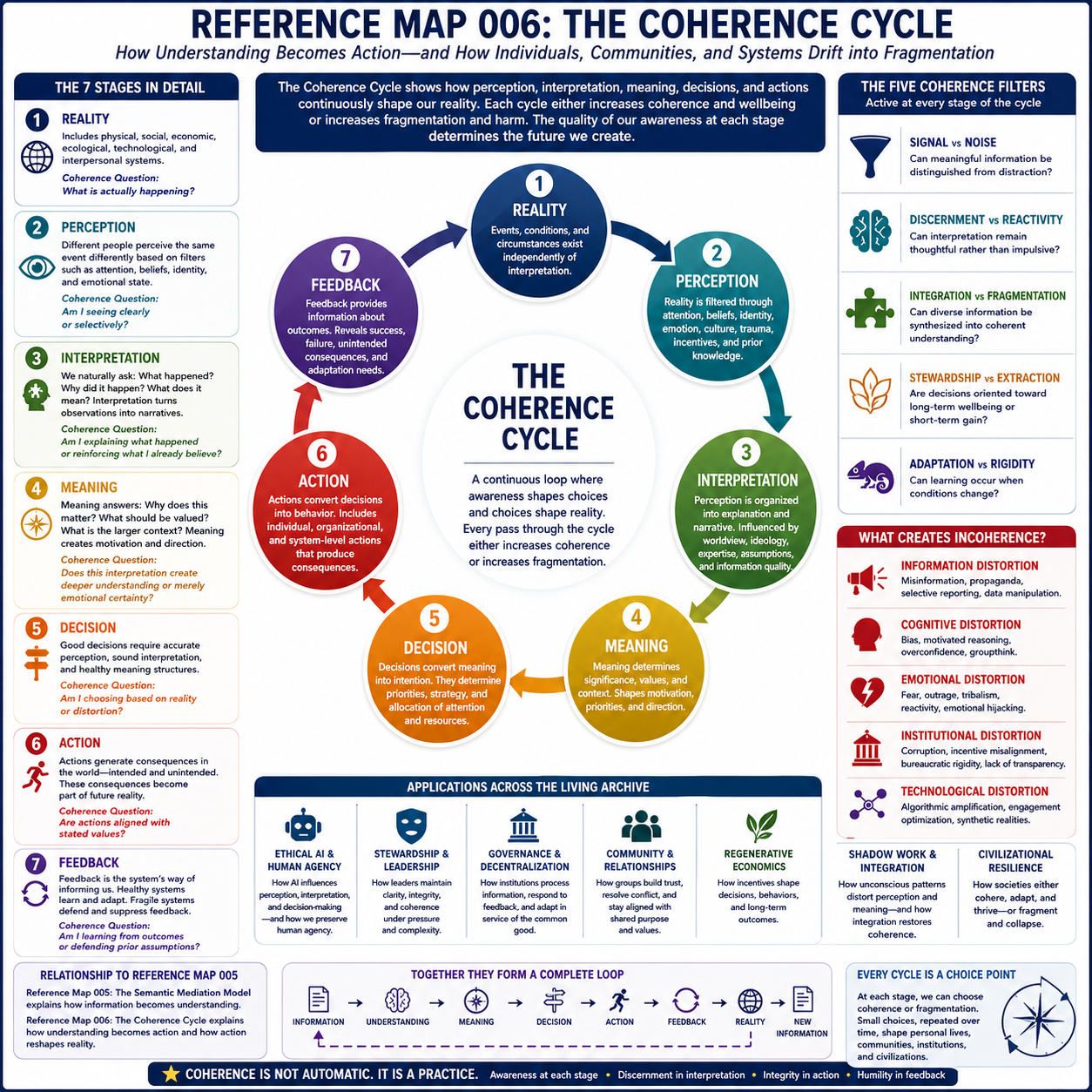
Together, these models explain both the conditions that reveal capability (Map 008) and the decision-making processes operating within those conditions (Map 006).
The Core Principle
Capability is only real if it holds under constraint.
Without constraint:
Behavior is optimized for correctness
Decisions are reversible
Performance appears stable
With constraint:
Trade-offs become unavoidable
Decisions carry consequence
Behavior becomes measurable
Constraint does not reduce performance.
It reveals it.
How SRI Works
SRI operates through three integrated layers.
1. Simulation Layer
Participants engage in environments that replicate real decision conditions:
Limited time
Incomplete information
Competing objectives
These environments are structured—but not predictable.
Decisions must be made before clarity is complete.
This shifts thinking from:
Analytical → to adaptive
Reflective → to responsive
The purpose is not immersion.
It is exposure to conditions where behavior emerges naturally.
2. Observation Layer
Behavior is tracked across:
Decision-making patterns
Trade-off handling
Incentive responses
Stability across scenarios
This produces:
Behavioral data—not narrative explanation
Patterns begin to emerge:
Does the individual maintain clarity under pressure?
Do they overcomplicate decisions?
Do they default to familiar patterns?
These patterns are difficult to detect in controlled environments.
A person’s internal capability aligns with external system requirements in a way that produces consistent, reliable performance.
It is not:
Intelligence alone
Experience alone
Personality alone
It is:
The integration of these under real constraints
Understanding the Process: The Leadership Under Constraint Model
Before examining the six dimensions of CLSS, it may be helpful to understand how capability becomes visible under realistic conditions.
The map below illustrates how constraints such as uncertainty, resource scarcity, time pressure, information gaps, conflicting objectives, and consequence exposure shape decision-making behavior.
As individuals respond to these conditions, observable capability signals emerge—including clarity, resilience, integrity, systems thinking, trade-off awareness, accountability, learning capacity, and adaptability.
The Leadership Under Constraint Model provides the operational foundation for simulation-based evaluation within CLSS. Rather than relying primarily on credentials, interviews, or self-reported strengths, it focuses on how capability reveals itself through decisions, actions, feedback, and adaptation when conditions become consequential.
Most work environments operate on a set of shared assumptions.
These assumptions shape:
how communication is interpreted
how decisions are made
how authority is expressed
how expectations are formed
Within a single, homogeneous context, these assumptions remain largely invisible. They are rarely questioned because they are consistently reinforced.
However, when work spans across different cultural environments, these assumptions no longer align automatically.
What is considered clear in one context may be ambiguous in another. What is considered efficient in one system may be perceived as abrupt or incomplete in another.
This is where a distinct capability begins to emerge.
Not language proficiency. Not adaptability in the general sense.
But the ability to translate between systems of meaning.
The Structure of Misalignment
Cross-cultural work does not fail primarily because of lack of effort.
It fails because of misaligned interpretations.
Consider:
a direct instruction intended as clarity may be received as rigidity
an indirect suggestion intended as politeness may be interpreted as uncertainty
silence intended as reflection may be perceived as disengagement
In each case, the words themselves are not necessarily incorrect. The interpretation is.
This creates a situation where:
communication increases
clarification attempts multiply
yet alignment does not improve
The issue is not the amount of communication. It is the lack of shared context.
Beyond Communication Skills
Cultural differences are often addressed at the level of communication techniques.
adjusting tone
modifying phrasing
learning etiquette
These adjustments are useful, but they operate on the surface.
Cultural translation operates at a deeper level.
It involves understanding:
how meaning is constructed
what is prioritized within a system
how decisions are justified
This is not about speaking differently. It is about interpreting differently.
The Layers of Translation
Cultural translation occurs across multiple layers:
1. Language
The most visible layer.
Differences in vocabulary, structure, and fluency can create immediate barriers. However, these are often the easiest to address.
2. Communication Style
How messages are delivered and received.
direct vs indirect
explicit vs implied
formal vs informal
Misalignment here leads to:
perceived bluntness or vagueness
over- or under-communication
3. Context and Assumptions
What is taken for granted.
how much background information is expected
what is considered “obvious”
how much explanation is required
This layer often creates hidden misunderstandings.
4. Decision Frameworks
How decisions are made and justified.
consensus-driven vs authority-driven
speed vs deliberation
risk tolerance vs risk avoidance
Differences here affect:
timelines
expectations
interpretations of progress
5. Relationship to Authority
How hierarchy is perceived and engaged.
formal vs informal interactions
expectations around initiative
interpretation of instructions
Misalignment can lead to:
hesitation or overreach
perceived lack of initiative or lack of respect
These layers interact. Misalignment at one level often affects others.
The Default Response: Adaptation
In cross-cultural environments, the default response is adaptation.
Individuals adjust:
their communication
their behavior
their expectations
This is necessary. But adaptation alone has limitations.
It is often reactive:
adjusting after misunderstandings occur
responding to feedback
aligning after misalignment becomes visible
While useful, this approach does not reduce the frequency of misalignment.
The Shift: From Adaptation to Translation
Cultural translation introduces a different approach.
Instead of adjusting after the fact, it anticipates differences in interpretation.
It asks:
How will this be understood in this context?
What assumptions might not be shared?
Where could meaning diverge?
This allows for adjustments before communication occurs.
For example:
making implicit assumptions explicit
clarifying intent alongside instructions
adjusting the level of detail based on context
These are small changes, but they reduce the likelihood of misalignment.
The Reduction of Invisible Friction
Much of the friction in cross-cultural work is not visible.
It appears as:
slight delays in response
repeated clarification
subtle hesitation
These signals are often attributed to:
inefficiency
lack of engagement
communication gaps
But they frequently originate from interpretation gaps.
Cultural translation reduces this friction by aligning meaning more closely from the outset.
This does not eliminate all differences. It reduces their disruptive effect.
The Strategic Value of Translation
In increasingly interconnected systems, cultural translation becomes more than a social skill.
It becomes a form of leverage.
By:
aligning expectations across contexts
reducing misinterpretation
enabling smoother coordination
it improves system performance.
This effect is often disproportionate.
A single clarification at the right point can:
prevent multiple rounds of rework
reduce delays across teams
improve decision quality
These are not large interventions. They are precise adjustments.
The Relationship to Other Thinking Tools
Cultural translation interacts with the other lenses in this system.
Quiet Leverage enables translation without unnecessary visibility
Together, they create a more coherent way of operating across complexity.
From Difference to Advantage
Cultural differences are often treated as obstacles to be managed.
They introduce variability, uncertainty, and the need for adjustment.
However, when understood structurally, they also reveal patterns.
how different systems prioritize
how decisions are approached
how meaning is constructed
Recognizing these patterns allows for:
more accurate interpretation
more effective alignment
more deliberate communication
At this point, difference is no longer just a source of friction.
It becomes a source of insight.
The Accumulation of Alignment
As with other forms of contribution, the effects of cultural translation accumulate.
Over time:
fewer misunderstandings occur
coordination becomes more fluid
expectations align more quickly
This creates a form of reliability that extends beyond individual tasks.
It affects how systems interact.
Closing
Working across cultures exposes the limits of assumed understanding.
It reveals that meaning is not fixed. It is constructed within context.
Cultural translation addresses this by making those constructions visible—and aligning them where necessary.
This is not achieved through increased communication alone, but through more accurate interpretation.
In doing so, it reduces friction that others may not see.
And where friction is reduced, systems function more effectively.
That is where its value lies.
Attribution
Written by Gerald Daquila Steward of applied thinking at the intersection of systems, identity, and real-world constraint.
This work draws from lived experience across cultures and environments, translated into practical frameworks for clearer thinking and more coherent contribution.
This piece is part of an ongoing exploration of applied thinking in real-world systems.. Part of the ongoing Codex on leadership, awakening, and applied intelligence.

![[SWI-001] Standard Work for the Sovereign Mind](https://geralddaquila.com/wp-content/uploads/2026/04/life.understood-69e6e2483e921.png)