Why Human Flourishing Depends on More Than Individual Effort
Meta Description
Explore the social architecture of thriving and the conditions that allow human potential to expand. Learn how trust, belonging, institutions, education, and opportunity shape individual and collective flourishing.
Many modern societies celebrate individual achievement.
Success is often portrayed as the result of personal discipline, talent, intelligence, perseverance, or ambition. While these qualities undoubtedly matter, they represent only part of the story.
Human beings do not develop in isolation.
Every individual emerges within a larger social environment composed of families, communities, institutions, cultures, economies, and information systems. These environments influence not only what people achieve, but what they believe is possible in the first place.
As a result, thriving is rarely an individual accomplishment alone.
It is also a systemic outcome.
The question is not merely whether people possess potential.
The question is whether the surrounding conditions allow that potential to develop.
Understanding these conditions reveals an important insight:
Human flourishing is not simply a personal project. It is also a design challenge.
The societies that create environments conducive to learning, trust, participation, meaning, and opportunity are often the societies that unlock the greatest reserves of human potential.
Beyond Survival
Human development begins with survival.
People require food, shelter, safety, and basic stability before higher-order capacities can fully emerge (Maslow, 1943).
Psychologist Abraham Maslow’s framework of human needs remains influential because it highlights the relationship between security and growth (Maslow, 1943).
Individuals experiencing chronic insecurity often direct substantial energy toward immediate concerns.
When safety improves, attention can gradually expand toward learning, creativity, relationships, contribution, and self-development.
This principle applies not only to individuals but to societies.
Fear-based environments frequently consume cognitive and emotional resources that might otherwise be directed toward growth.
As explored in The Psychology of Scarcity: Why Fear-Based Systems Reproduce Instability, chronic uncertainty often narrows attention and reinforces short-term thinking.
Thriving requires more than survival.
It requires conditions that allow human capacities to unfold.
Trust as Developmental Infrastructure
Trust is often discussed as a moral virtue.
- From a systems perspective, trust functions as infrastructure.
- When trust exists, cooperation becomes easier.
- Information flows more freely.
- Transaction costs decline.
- Communities become more capable of collective problem-solving.
Social capital researcher Robert Putnam (2000) argues that trust and civic engagement contribute significantly to the health and effectiveness of societies.
Trust creates conditions in which people feel safer taking constructive risks.
- Learning becomes easier.
- Innovation becomes more likely.
- Relationships become more resilient.
As explored in Trust Architecture: The Missing Infrastructure Behind Functional Societies, trust supports many of the invisible processes that enable societies to function effectively.
Without trust, individuals often redirect energy toward protection rather than contribution.
The result is frequently a reduction in collective capacity.
Belonging and Human Development
Human beings are inherently social.
The need for belonging appears consistently across cultures and historical periods.
People seek connection, recognition, participation, and shared meaning.
Research in developmental psychology suggests that supportive relationships play a critical role in cognitive, emotional, and social development (Kegan, 1994).
Belonging provides more than comfort.
It provides context.
People often discover their strengths through interaction with others.
Communities create opportunities for feedback, mentorship, collaboration, and mutual support.
- When belonging weakens, isolation can increase.
- When isolation increases, trust often declines.
- The resulting fragmentation affects not only individual wellbeing but also societal resilience.
Thriving societies therefore cultivate environments where people can participate meaningfully in collective life.
Education as Capacity Building
Education is frequently viewed as a mechanism for transmitting knowledge.
Its deeper function is capacity building.
Healthy educational systems help individuals learn how to think, not merely what to think.
They develop:
- Critical thinking.
- Communication skills.
- Emotional intelligence.
- Problem-solving abilities.
- Civic understanding.
- Adaptability.
In a rapidly changing world, these capacities may be more important than specific technical knowledge.
As explored in The Future of Knowing: From Search Engines to Semantic Mediation, information is increasingly abundant.
The challenge is not access alone.
- It is interpretation.
- Understanding.
- Integration.
- Discernment.
Educational systems that cultivate these abilities contribute directly to societal resilience and human flourishing.
Opportunity and Human Potential
Talent is widely distributed.
Opportunity is not.
Many individuals possess abilities that remain unrealized because they lack access to supportive conditions.
- Economic barriers.
- Educational limitations.
- Institutional dysfunction.
- Social exclusion.
- Geographic constraints.
These factors influence developmental outcomes regardless of individual capability.
This reality does not negate personal responsibility.
It simply acknowledges that potential requires pathways through which it can emerge.
A society that consistently expands access to opportunity increases the likelihood that hidden talents will become visible.
- The resulting benefits extend beyond individual success.
- They strengthen the entire system.
- Human potential represents one of the most valuable resources any society possesses.
- The challenge is creating conditions that allow it to flourish.
Information Environments and Human Development
Modern societies increasingly depend upon informational systems.
These systems influence perception, attention, learning, and decision-making.
As discussed in Informational Sovereignty: Staying Psychologically Grounded in Machine Environments, individuals now operate within environments shaped by algorithms, recommendation systems, and artificial intelligence.
The quality of these informational environments matters.
Information systems can support learning and understanding.
They can also amplify confusion, distraction, and polarization.
As explored in Attention as Ecology: Why Human Focus Is Becoming a Civilizational Resource, attention functions as a foundational resource for human development.
People cannot learn deeply if they cannot sustain attention.
They cannot solve complex problems if every interaction is optimized for distraction.
Thriving increasingly requires informational environments that support reflection rather than constant fragmentation.
Institutions and Human Flourishing
Institutions play a critical role in shaping societal outcomes.
- Schools.
- Governments.
- Businesses.
- Media organizations.
- Healthcare systems.
- Community organizations.
Each influences how opportunities, resources, responsibilities, and information are distributed.
- Healthy institutions create predictability without rigidity.
- They balance stability with adaptation.
- They cultivate trust while maintaining accountability.
As explored in Every Governance System Encodes a Model of Human Consciousness, institutions inevitably reflect assumptions about human nature and social organization.
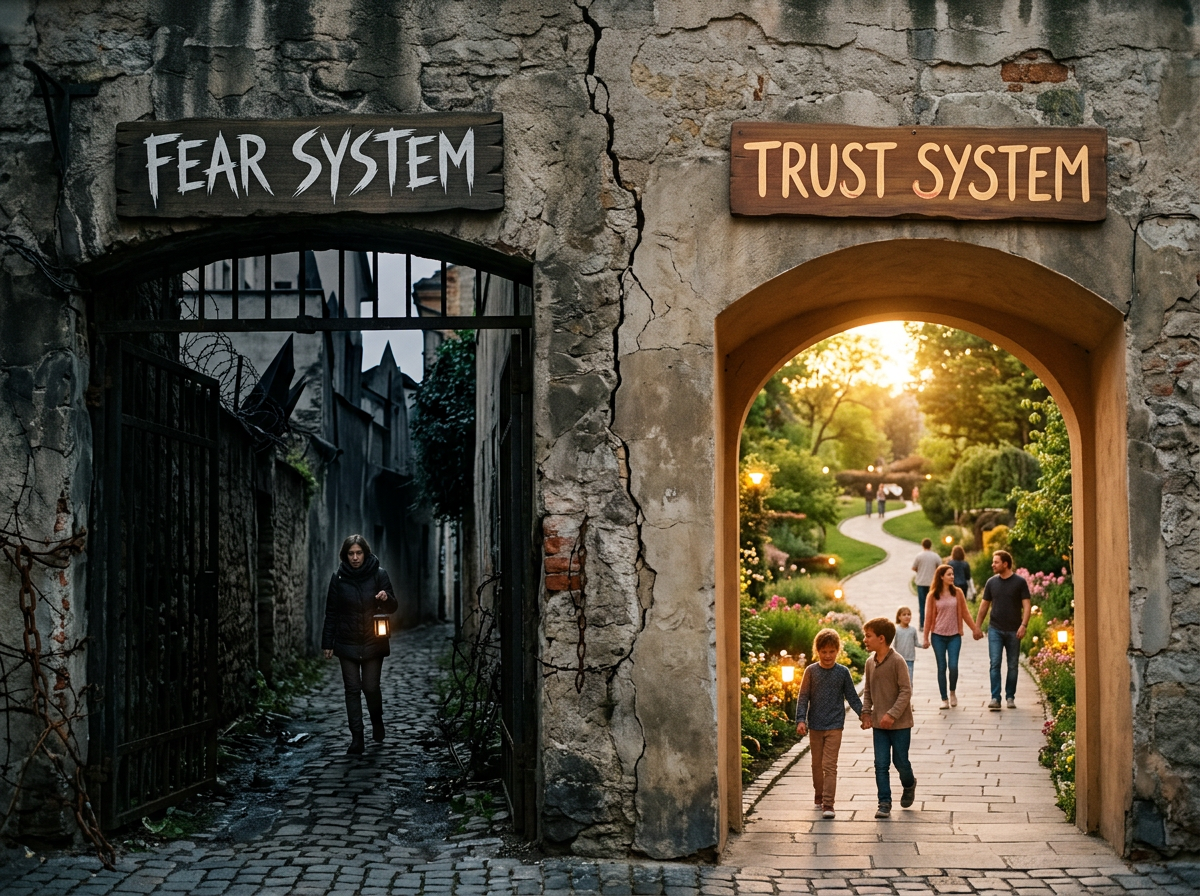
- Institutions designed primarily around fear often prioritize control.
- Institutions designed around trust tend to prioritize participation, learning, and development.
The distinction has profound implications for human flourishing.
The Relationship Between Freedom and Responsibility
Thriving requires freedom.
- Yet freedom alone is insufficient.
- Human flourishing also depends upon responsibility.
- Freedom without responsibility can produce fragmentation.
Responsibility without freedom can produce stagnation.
- Healthy societies seek a balance between the two.
- Individuals require enough freedom to explore, create, and contribute.
They also require opportunities to develop the capacities necessary for responsible participation.
This relationship mirrors broader developmental processes.
Growth occurs when people are supported while simultaneously challenged.
- Protected while encouraged to expand.
- Given autonomy while remaining connected to larger communities.
- Thriving emerges from this balance.
From Extraction to Participation
Many systems treat people primarily as resources.
- Workers.
- Consumers.
- Users.
- Voters.
- Data points.
Such approaches often reduce human beings to functional roles.
The result can be a form of social extraction in which individuals contribute energy without experiencing meaningful participation.
As explored in From Extraction to Circulation: The Systems Logic of Ethical Abundance, healthy systems depend upon circulation rather than extraction.
The same principle applies to human potential.
People flourish when they are invited to participate in shaping the systems that affect their lives.
- Participation increases agency.
- Agency strengthens engagement.
- Engagement supports development.
- Development contributes to thriving.
- The cycle becomes self-reinforcing.
Thriving as a Systems Outcome
A common misconception is that flourishing emerges solely from personal effort.
- The reality is more complex.
- Individual choices matter.
- Personal responsibility matters.
- Discipline matters.
Yet these factors operate within broader environments that either support or constrain development.
Systems do not determine outcomes completely.
- They influence probabilities.
- They shape incentives.
- They create opportunities.
- They establish barriers.
As systems thinker Donella Meadows (2008) observed, system structures often produce recurring patterns of behavior and outcomes.
If societies wish to increase human flourishing, they must pay attention not only to individual behavior but also to the conditions that shape it.
Conclusion
Human potential is one of the most remarkable resources any society possesses.
Yet potential alone guarantees nothing.
Potential requires conditions.
- Trust.
- Belonging.
- Education.
- Opportunity.
- Healthy institutions.
- Meaningful participation.
- Informational environments that support understanding.
These elements form part of the social architecture of thriving.
They create the conditions under which individuals can move beyond survival and contribute more fully to their communities, institutions, and societies.
The future may depend less on discovering extraordinary individuals and more on creating environments that allow ordinary people to develop extraordinary capacities.
In this sense, thriving is neither purely personal nor purely systemic.
It emerges from the relationship between the two.
The challenge facing modern societies is not merely how to solve problems.
It is how to create conditions in which human potential can continually expand.
Crosslinks
- Trust Architecture: The Missing Infrastructure Behind Functional Societies
- The Psychology of Scarcity: Why Fear-Based Systems Reproduce Instability
- From Extraction to Circulation: The Systems Logic of Ethical Abundance
- Informational Sovereignty: Staying Psychologically Grounded in Machine Environments
- The Future of Knowing: From Search Engines to Semantic Mediation
- Attention as Ecology: Why Human Focus Is Becoming a Civilizational Resource
- Every Governance System Encodes a Model of Human Consciousness
- Fear-Based Systems vs Trust-Based Systems: Two Civilizational Architectures
- Resilience Beyond Survival: Psychological Models for Transitional Eras
References
Kegan, R. (1994). In over our heads: The mental demands of modern life. Harvard University Press.
Maslow, A. H. (1943). A theory of human motivation. Psychological Review, 50(4), 370–396.
Meadows, D. H. (2008). Thinking in systems: A primer. Chelsea Green Publishing.
Putnam, R. D. (2000). Bowling alone: The collapse and revival of American community. Simon & Schuster.
The Living Archive is designed to be explored through pathways, categories, and search. If you’re looking for a specific idea, question, or theme, AI Search can help surface relevant connections across the archive.
Attribution
The Living Archive
Integrative Frameworks for Regenerative Civilization
© 2026 Gerald Daquila. All rights reserved.
Part of the Life.Understood. knowledge ecosystem and Stewardship Institute initiative.
This article is intended for educational, research, and civic inquiry purposes.
Readers are encouraged to engage critically, verify sources independently, and explore related knowledge hubs for broader systems context.