

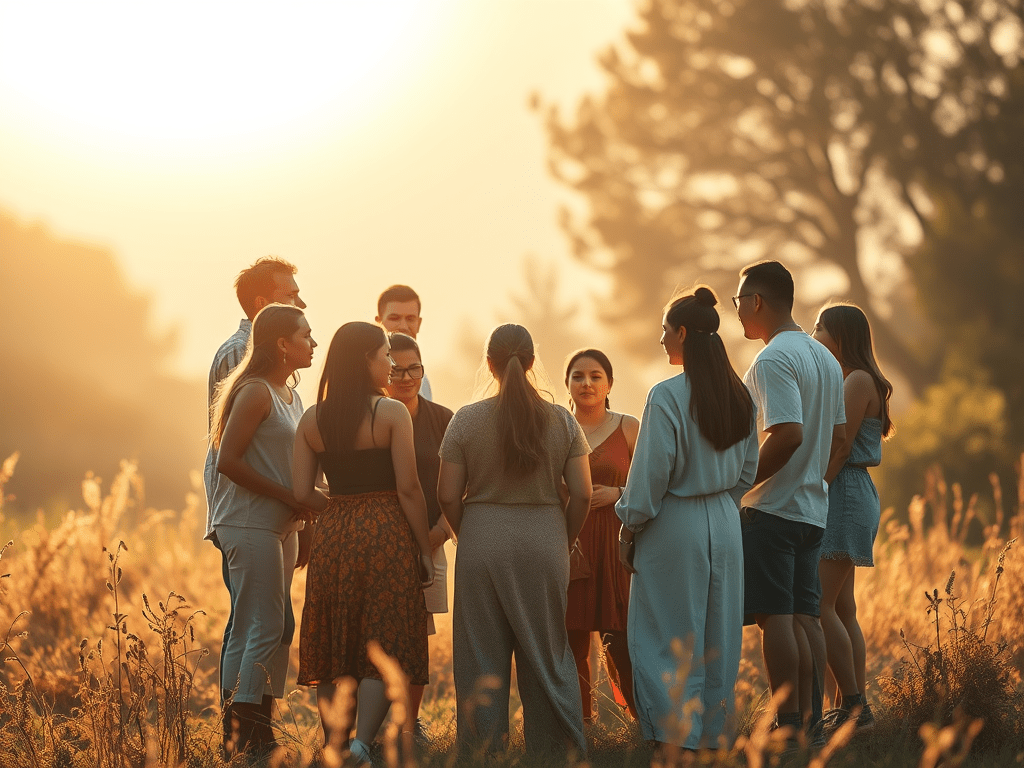
Sovereignty often begins as a personal realization:
“I am responsible for my own life.”
But as more people awaken to this truth, a larger question naturally emerges:
What happens when sovereignty expands beyond the individual — into families, communities, and entire cultures?
This is the beginning of collective sovereignty.
Not as a political slogan.
Not as rebellion.
But as a maturation of shared responsibility.
1. From Personal Agency to Shared Reality
When you first reclaim personal sovereignty, your focus is inward:
Your choices
Your boundaries
Your truth
But you do not live alone. Every sovereign choice you make ripples outward — into relationships, workplaces, and systems.
As more individuals stop outsourcing their thinking, values, and responsibility, something subtle shifts in the collective field:
People become harder to manipulate.
Fear loses some of its grip.
Blind obedience weakens.
Dialogue becomes more possible than domination.
Collective sovereignty begins when enough individuals are no longer waiting to be told how to live.
2. What Collective Immaturity Looks Like
Just as individuals can live unconsciously, so can cultures.
Collective immaturity often shows up as:
- Outsourcing responsibility to leaders or institutions
- Following narratives without questioning
- Reacting from fear rather than discernment
- Seeking saviors instead of developing shared capacity
In this state, power tends to concentrate, and agency tends to shrink.
This is not because people are incapable — but because systems often form around dependency rather than participation.
Collective sovereignty begins to grow when people ask:
“What is my role in shaping the world I live in?”
3. Awakening as Cultural Turning Point
Personal awakening has social consequences.
When individuals become more self-aware, they:
- Notice injustice more clearly
- Feel misalignment in harmful systems
- Seek relationships based on respect rather than control
- Question norms that once went unchallenged
This does not always lead to loud revolution. Often, it begins with quieter shifts:
- Choosing more ethical work
- Raising children with emotional awareness
- Supporting community-based solutions
- Withdrawing energy from systems that depend on unconscious participation
These small acts accumulate. Over time, they reshape cultural expectations.
4. The Difference Between Rescue and Maturation
There is a strong human tendency to hope for rescue — from leaders, movements, or imagined external forces.
But true collective sovereignty grows through maturation, not rescue.
Maturation means:
- Facing consequences
- Learning from mistakes
- Developing shared discernment
- Building systems that reflect lived values
Just as a person grows stronger by learning to navigate life rather than being controlled, societies grow stronger when people participate consciously rather than passively.
Support, inspiration, and collaboration can help.
But development cannot be outsourced.
5. How Personal Sovereignty Feeds Collective Change
You do not need to change the whole world at once to participate in collective sovereignty.
It grows through:
- Honest conversations
- Ethical decision-making
- Modeling self-responsibility
- Refusing to act from fear or blind conformity
- Supporting structures that increase dignity and agency
Every time you choose clarity over avoidance, responsibility over blame, and truth over performance, you contribute to a cultural field where sovereignty becomes more normal.
You become part of the nervous system of a maturing civilization.
6. The Slow Nature of Cultural Awakening
Cultural shifts rarely happen overnight. They move in waves, often with periods of tension, backlash, and confusion.
This can feel discouraging. But it is similar to personal growth: progress is not linear.
Old patterns surface before they dissolve. Systems resist before they reorganize. Awareness rises unevenly.
Collective sovereignty is not a single event.
It is an ongoing process of learning how to live together without domination or dependency.
7. The Role of Hope
Hope, in the context of collective sovereignty, is not the belief that someone else will fix everything.
It is the trust that:
Human beings can grow.
Consciousness can deepen.
Responsibility can spread.
Systems can evolve when enough people participate differently.
You may not see the full outcome in your lifetime. But every act of sovereignty adds to the momentum of cultural maturation.
Collective sovereignty is the natural extension of personal awakening.
As more individuals stand in inner authority, the culture around them slowly reorganizes to reflect it.
Not through force.
Not through rescue.
But through the steady expansion of conscious participation.
You might also resonate with these related pieces:
The Return of Inner Authority — Reclaiming Personal Sovereignty
Explores how sovereignty begins as the recovery of your own inner voice and self-trust.
Living Among Sovereign Beings — Love, Authority, and the End of Control
Looks at how honoring others’ sovereignty reshapes relationships, care, and leadership.
When Sovereignty Becomes Purpose — Contribution Without Losing Yourself
Examines how inner authority naturally matures into aligned contribution to the wider world.
About the author
Gerry explores themes of change, emotional awareness, and inner coherence through reflective writing. His work is shaped by lived experience during times of transition and is offered as an invitation to pause, notice, and reflect.
If you’re curious about the broader personal and spiritual context behind these reflections, you can read a longer note here.
 Life.Understood.
What stirred your remembrance? Share your reflection below—we’re weaving the New Earth together, one soul voice at a time.