


Concept Constellations, Evergreen Questions, and Living Questions
As the Living Archive expanded beyond eight hundred essays, codices, and reflective writings, additional structures became necessary to reveal the deeper conceptual patterns within the work.
Earlier layers of the archive organize material through topics, pillars, and pathways.
The structures described here operate one level deeper.
They map the ideas and questions that recur across the archive.
These tools do not replace existing navigation systems.
They function as additional interpretive lenses.
Together they form the Idea Architecture of the Living Archive.
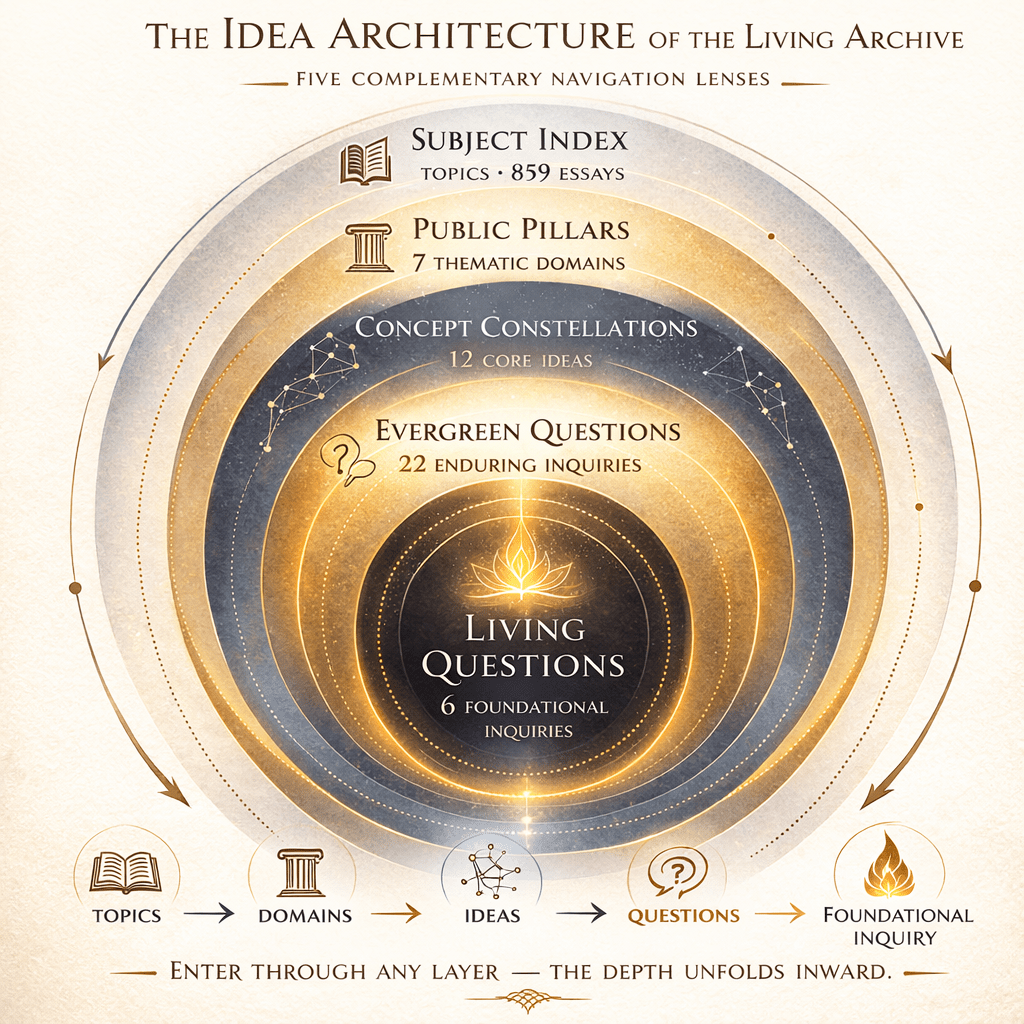
Figure A — The Idea Architecture of the Living Archive
Readers may enter through topics, ideas, or questions. Each pathway gradually leads toward the deeper philosophical inquiries that shape the archive.
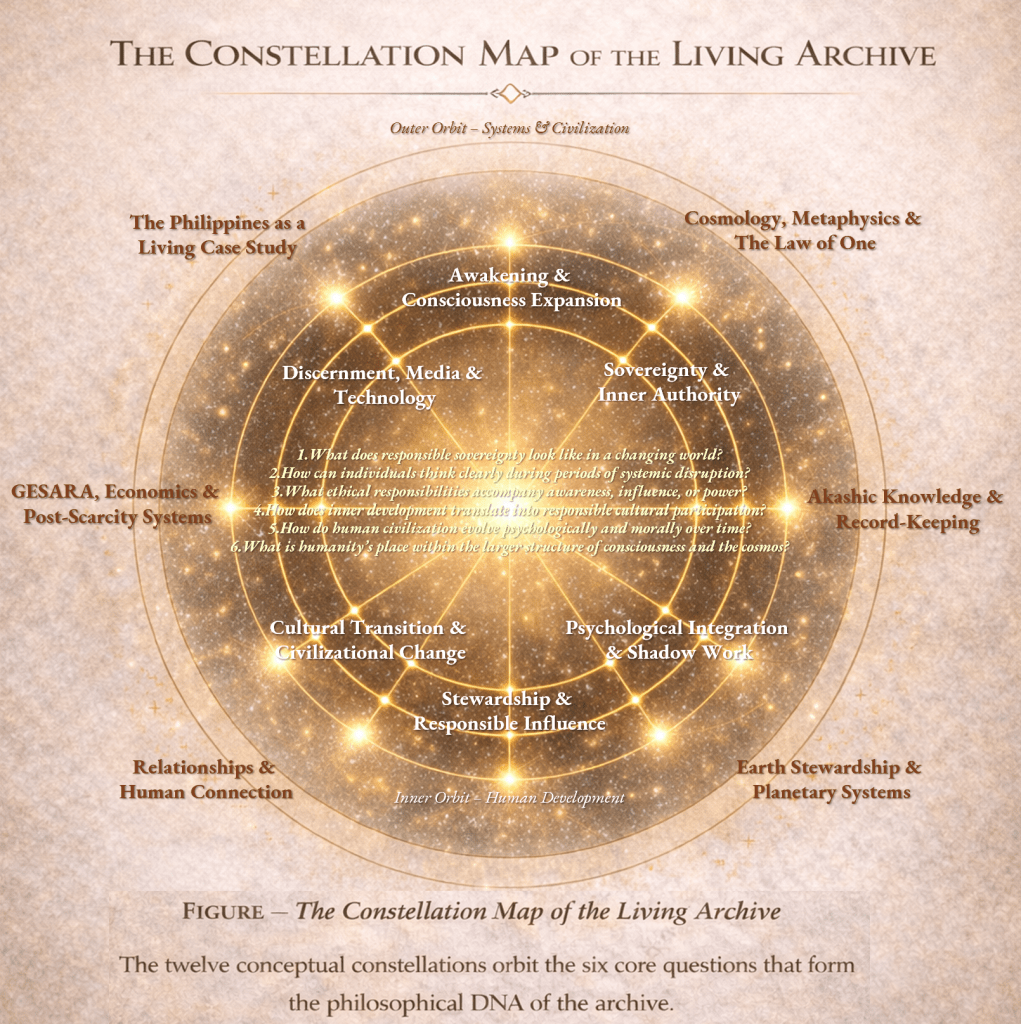
Figure B — The Constellation Map of the Living Archive
The twelve conceptual constellations orbit the six core questions that form the philosophical DNA of the archive.
The Three Idea Structures
Three complementary systems organize the conceptual dimension of the archive.
| Structure | Function |
|---|---|
| Idea / Concept Constellations | Organizes the archive by recurring core ideas |
| Evergreen Questions | Organizes the archive by enduring human inquiries |
| Living Questions | Reveals the foundational philosophical questions that generated the archive |
Each structure reveals a different layer of meaning within the work.
Layer One
🌌Idea / Concept Constellations
Concept Constellations map the core ideas that repeatedly appear across the archive.
Instead of organizing essays by subject category, this layer identifies the conceptual gravity centers around which many writings orbit.
Examples of constellation nodes include ideas such as:
- sovereignty
- discernment
- integration
- responsibility
- coherence
- awakening
- stewardship
- influence
- power
- cultural transition
Each concept functions as a constellation node.
Within each node, readers encounter essays and codices that approach the same idea from different angles.
This allows readers to follow the development of a concept across multiple writings rather than encountering it only once.
Concept Constellations therefore answer the question:
What ideas form the conceptual backbone of this archive?
Layer Two
❓Evergreen Questions on the Human Condition
While Concept Constellations organize ideas, the second layer organizes questions.
Across the archive, certain inquiries appear repeatedly.
They are not tied to a specific moment in history.
Instead they reflect enduring aspects of the human condition.
Examples include questions such as:
- How does a person maintain clarity during periods of systemic uncertainty?
- What does sovereignty look like in everyday life?
- What responsibilities arise when awareness expands?
- How does awakening reshape identity and relationships?
- How does power alter a person’s ethical orientation?
- How can individuals participate in cultural transition responsibly?
Each question becomes a reflection gateway.
Under each gateway, readers encounter essays that approach the question from different perspectives.
This structure allows readers to explore the archive through inquiry rather than topic.
Evergreen Questions therefore answer:
What enduring human questions does this body of work explore?
Layer Three
🔥The Living Questions of the Archive
Beyond recurring ideas and inquiries, the archive also reveals a smaller set of foundational questions.
These are the deeper inquiries that appear to have generated the archive itself.
They are not simply topics of discussion.
They are the philosophical tensions that shaped the direction of the work over time.
Examples include questions such as:
- What does responsible sovereignty look like in a changing world?
- How can individuals think clearly during periods of systemic disruption?
- What does ethical influence require from those who hold awareness?
- How does inner development translate into responsible cultural participation?
These are referred to as Living Questions because they remain open.
They are not meant to be answered once and closed.
Instead they continue to guide reflection as the archive evolves.
This layer therefore asks:
What questions gave rise to this body of work in the first place?
Relationship to the Existing Archive Architecture
The Living Archive now contains several complementary navigation systems.
Each reveals the archive from a different perspective.
| Layer | Function |
|---|---|
| Subject Index | Entry by topic |
| Public Pillars | Entry by thematic domain |
| Archive Spine | Structural overview |
| Idea Constellations | Entry by concept |
| Evergreen Questions | Entry by inquiry |
| Living Questions | Foundational philosophical orientation |
Together these structures allow readers to approach the archive through:
- subjects
- themes
- structural pathways
- conceptual frameworks
- philosophical inquiry
No single pathway is required.
Readers may explore according to their own curiosity.
Why These Structures Exist
Large bodies of writing often contain patterns that are difficult to see when reading individual essays.
Concept Constellations and Question Maps help reveal those patterns.
They allow readers to see the archive not merely as a collection of essays, but as a coherent body of thought developing across time.
These structures support:
- deeper reflection
- slower reading
- long-range integration
They also help preserve the intelligibility of the archive for readers encountering it years from now.
A Note on Exploration
These structures are not prescriptive.
They exist as maps, not instructions.
Readers are free to explore the archive through any pathway they prefer.
The purpose of these maps is simply to make the deeper architecture of the work more visible.
Threshold Flame — Living Archive
© 2025–2026 Gerald Alba Daquila
Flameholder of SHEYALOTH
 Life.Understood.