Life.Understood.

Tag: Filipino Psyche

  • Transmuting the Philippines’ Collective Trauma: Reviving Precolonial Culture as a Pathway to Healing and Global Inspiration

    Transmuting the Philippines’ Collective Trauma: Reviving Precolonial Culture as a Pathway to Healing and Global Inspiration

    A Multidisciplinary Exploration of Metaphysical, Spiritual, and Cultural Approaches to Healing a Nation’s Wounded Soul

    Prepared by: Gerald A. Daquila, PhD. Candidate


    9–14 minutes

    ABSTRACT

    The Philippines, a nation marked by centuries of colonial oppression, systemic challenges, and recurring natural disasters, carries deep collective trauma that manifests in social, cultural, and psychological fragmentation. This dissertation argues that unhealed collective trauma, rooted in the suppression of precolonial cultural practices and identities, perpetuates cycles of disconnection and suffering across generations.

    By reviving and reinterpreting precolonial cultural artifacts—such as the babaylan tradition, indigenous spiritual practices, and communal values like kapwa—the Philippines can transmute its pain into a source of resilience, inspiration, and global leadership in collective healing. Using a multidisciplinary lens that integrates metaphysical, spiritual, esoteric, psychological, and anthropological perspectives, including insights from the Akashic Records, this work outlines a pathway for national healing. It proposes practical and visionary strategies, including cultural revitalization, community-based rituals, and modern adaptations of indigenous wisdom, to foster a collective consciousness that transforms trauma into a blessing for future generations and the world.


    Table of Contents

    1. Introduction: The Wounded Soul of a Nation
    2. Understanding Collective Trauma in the Philippines
      • Historical Roots: Colonialism and Its Lasting Impact
      • Modern Manifestations: Social and Psychological Fragmentation
    3. Precolonial Culture as a Source of Healing
      • The Babaylan Tradition: Spiritual and Communal Leadership
      • Kapwa and Collectivist Values
      • Indigenous Healing Practices and Rituals
    4. A Multidisciplinary Lens for Healing
      • Metaphysical Perspectives: The Akashic Records and Collective Consciousness
      • Spiritual and Esoteric Frameworks: Reconnecting with Ancestral Wisdom
      • Psychological and Anthropological Insights: Decolonizing the Filipino Psyche
    5. Pathways to Collective Healing
      • Reviving Cultural Artifacts: Practical Steps
      • Community-Based Healing Rituals
      • Modern Adaptations: Blending Tradition with Innovation
    6. Global Inspiration: The Philippines as a Beacon of Transmuted Pain
    7. Conclusion: A Clean Slate for Future Generations
    8. Glossary
    9. References

    Glyph of the Gridkeeper

    The One Who Holds the Lattice of Light.


    1. Introduction: The Wounded Soul of a Nation

    The Philippines is a land of vibrant beauty, resilient people, and a complex history that has left deep scars on its collective psyche. From over 300 years of Spanish colonization to American occupation and ongoing socioeconomic challenges, the nation has endured layers of trauma that continue to shape its identity. These wounds—unseen but deeply felt—manifest in systemic poverty, political instability, and a fragmented sense of self.

    Yet, within this pain lies the potential for profound transformation. By turning to the rich tapestry of precolonial culture, the Philippines can heal its collective trauma and offer the world a model of how pain can become a blessing. This dissertation explores the unhealed collective trauma of the Philippines through a multidisciplinary lens, weaving together metaphysical, spiritual, esoteric, psychological, and anthropological perspectives.

    It argues that reviving precolonial cultural artifacts—such as the babaylan tradition, the collectivist value of kapwa, and indigenous healing practices—can transmute national pain into a source of strength. By accessing universal wisdom through frameworks like the Akashic Records and grounding these insights in practical strategies, the Philippines can forge a path to collective healing that inspires future generations and resonates globally.


    2. Understanding Collective Trauma in the Philippines

    Historical Roots: Colonialism and Its Lasting Impact

    The Philippines’ collective trauma originates in its colonial history, which began with Spanish rule in the 16th century and continued through American occupation and Japanese invasion. Spanish colonizers suppressed indigenous spiritual practices, particularly the babaylan tradition, which empowered women and gender-diverse individuals as spiritual and political leaders (Valmores, 2019).

    These shamans were demonized, and their practices were replaced with Catholic doctrines, eroding cultural identity and communal cohesion (Aping, 2016). American occupation introduced Western individualism, further distancing Filipinos from their collectivist roots (Tuliao et al., 2020). This historical disempowerment created a legacy of internalized oppression, shame, and disconnection from ancestral wisdom.


    Modern Manifestations: Social and Psychological Fragmentation

    Today, the Philippines faces systemic challenges—poverty, corruption, and frequent natural disasters—that exacerbate collective trauma. These issues are compounded by a cultural schism between indigenous values and Western influences, leading to a fragmented national identity (Tuliao et al., 2020).

    Psychologically, Filipinos experience high levels of stigma around mental health, often turning to folk healers rather than biomedical systems due to cultural beliefs and economic barriers (Tuliao et al., 2020). Socially, the erosion of kapwa—a core Filipino value of shared identity—has weakened community bonds, perpetuating cycles of isolation and suffering.

    If left unaddressed, this trauma passes to future generations, robbing them of a “clean slate” to thrive. Healing requires reconnecting with the cultural and spiritual roots that once sustained the nation, offering a foundation for resilience and unity.


    3. Precolonial Culture as a Source of Healing

    The Babaylan Tradition: Spiritual and Communal Leadership

    In precolonial Philippines, babaylans were revered as healers, spiritual guides, and community leaders. Often women or gender-diverse individuals, they bridged the physical and spiritual realms, using rituals, herbal medicine, and energy work to heal individuals and communities (Apostol, 2020). Their suppression under Spanish rule severed the nation from this holistic leadership model. Reviving the babaylan tradition—through education, storytelling, and modern spiritual practices—can restore cultural pride and empower Filipinos to reclaim their agency.


    Kapwa and Collectivist Values

    The concept of kapwa, meaning “shared identity,” is a cornerstone of precolonial Filipino culture. It emphasizes interconnectedness, fostering empathy and mutual support (Tuliao et al., 2020). Unlike Western individualism, kapwa prioritizes the collective, offering a framework for rebuilding community bonds fractured by colonial and modern influences. By reintegrating kapwa into education and social systems, Filipinos can cultivate a sense of unity that counters trauma’s isolating effects.


    Indigenous Healing Practices and Rituals

    Precolonial healing practices, such as those performed by babaylans, albularyos, and manghihilots, took a holistic view of health, addressing physical, emotional, and spiritual well-being (Apostol, 2020). These practices included herbal medicine, pulse diagnosis, and spiritual rituals like bulong (whispered prayers) and orasyon (recited prayers).

    Despite centuries of suppression, these traditions persist in rural areas, blending indigenous and Christian elements (Aping, 2016). Reviving these practices through community workshops and integration into modern healthcare can reconnect Filipinos with their ancestral wisdom.


    Glyph of Transmuting Collective Trauma

    From memory of pain, the soul restores its song


    4. A Multidisciplinary Lens for Healing

    Metaphysical Perspectives: The Akashic Records and Collective Consciousness

    The Akashic Records, a metaphysical concept described as a cosmic library of all universal events and souls’ journeys, offer a framework for understanding collective trauma (Trine, 2010). In this lens, the Philippines’ trauma is encoded in the collective consciousness, accessible through meditation and spiritual practices. By engaging with the Akashic Records, Filipinos can uncover ancestral wounds and wisdom, using this insight to heal generational pain. For example, rituals that honor ancestors can release stored trauma, creating space for renewal (Howe, 2017).


    Spiritual and Esoteric Frameworks: Reconnecting with Ancestral Wisdom

    Esoteric traditions, such as those rooted in Theosophy and indigenous shamanism, emphasize the interconnectedness of all life. In the Philippines, spiritual practices like pag-anito (ancestor worship) and rituals invoking nature spirits reflect this worldview (Apostol, 2020). These practices align with global esoteric concepts, such as the idea that healing occurs when individuals reconnect with their divine essence. By reviving these rituals, Filipinos can restore a sense of sacredness, countering the desacralization imposed by colonialism.


    Psychological and Anthropological Insights: Decolonizing the Filipino Psyche

    From a psychological perspective, decolonizing the Filipino psyche involves integrating indigenous concepts like kapwa with Western therapeutic models (Tuliao et al., 2020). Sikolohiyang Pilipino, a movement to develop a culturally rooted psychology, emphasizes the importance of cultural context in mental health (Aping, 2016).

    Anthropologically, reviving precolonial practices can foster cultural continuity, countering the disruption caused by colonization (Acabado et al., 2019). This multidisciplinary approach ensures that healing is both culturally resonant and scientifically grounded.


    5. Pathways to Collective Healing

    Reviving Cultural Artifacts: Practical Steps

    1. Education and Awareness: Integrate precolonial history and values into school curricula, emphasizing the babaylan tradition and kapwa. Community storytelling events can share oral histories, reconnecting younger generations with their heritage.
    2. Cultural Preservation: Support initiatives to document and preserve indigenous practices, such as those led by the Philippine Institute for Traditional and Alternative Health Care (PITAHC) (Apostol, 2020).
    3. Art and Media: Use music, dance, and film to celebrate precolonial culture, making it accessible to urban and younger audiences.

    Community-Based Healing Rituals

    Community rituals can anchor collective healing. For example:

    • Babaylan-Inspired Ceremonies: Organize rituals led by modern babaylans, blending traditional practices with contemporary spirituality to honor ancestors and release trauma.
    • Kapwa Circles: Create community gatherings where participants share stories and support each other, reinforcing interconnectedness.
    • Nature-Based Rituals: Revive pag-anito practices in natural settings, fostering a connection to the land and its spirits.

    Modern Adaptations: Blending Tradition with Innovation

    To ensure relevance, precolonial practices can be adapted for modern contexts:

    • Mental Health Integration: Train mental health professionals in indigenous healing techniques, combining them with cognitive-behavioral therapy to address trauma holistically.
    • Technology and Accessibility: Use online platforms to share cultural knowledge, such as virtual workshops on babaylan practices or kapwa-based leadership training.
    • Policy Advocacy: Advocate for policies that protect indigenous communities and promote cultural revitalization, ensuring systemic support for healing initiatives.

    6. Global Inspiration: The Philippines as a Beacon of Transmuted Pain

    The Philippines’ journey to heal its collective trauma can inspire the world. By transforming pain into resilience, the nation can demonstrate how cultural revitalization fosters unity and empowerment. For example, the revival of kapwa aligns with global movements toward collectivism and empathy, offering a counterpoint to individualism. The babaylan tradition, with its emphasis on spiritual leadership and gender inclusivity, resonates with global calls for diversity and empowerment (Valmores, 2019). By sharing its story through international platforms, the Philippines can position itself as a leader in collective healing, showing how pain can become a blessing.


    7. Conclusion: A Clean Slate for Future Generations

    The Philippines stands at a crossroads. By confronting its collective trauma and reviving precolonial cultural artifacts, the nation can heal its wounded soul and offer a clean slate to future generations. This journey requires courage, creativity, and a commitment to blending ancient wisdom with modern innovation.

    Through education, rituals, and policy changes, Filipinos can reclaim their heritage, transforming pain into a source of strength. As the nation heals, it can inspire the world, proving that even the deepest wounds can become a foundation for growth and unity.


    Crosslinks


    8. Glossary

    • Akashic Records: A metaphysical concept of a cosmic library containing all universal events, thoughts, and emotions, accessible through spiritual practices (Trine, 2010).
    • Babaylan: Precolonial Filipino spiritual leaders who served as healers, mediators, and community guides, often women or gender-diverse individuals (Apostol, 2020).
    • Kapwa: A Filipino value meaning “shared identity,” emphasizing interconnectedness and empathy (Tuliao et al., 2020).
    • Pag-anito: Indigenous Filipino practice of honoring ancestors and nature spirits through rituals (Apostol, 2020).
    • Sikolohiyang Pilipino: A movement to develop a culturally rooted Filipino psychology, integrating indigenous concepts (Aping, 2016).

    9. References

    Acabado, S., Barretto-Tesoro, G., & Amano, N. (2019). Status and gender differences in precolonial and colonial Philippines: An archaeological perspective. Journal of Anthropological Archaeology, 56, 101-112.

    Aping, E. (2016). Tradisyunal nga pamulong: A rationale on the persistence of faith healing practices in Miagao, Iloilo. ResearchGate.

    Apostol, V. (2020). Indigenous Filipino healing practices. Cold Tea Collective. Retrieved from https://coldteacollective.com%5B%5D(https://coldteacollective.com/indigenous-filipino-healing-practices/)

    Howe, L. (2017). A spiritual approach to the Akashic Records. Retrieved from https://lindahowe.com%5B%5D(https://lindahowe.com/)

    Trine, C. M. (2010). The New Akashic Records: Knowing, healing & spiritual practice. Amazon.

    Tuliao, A. P., et al. (2020). Culture and mental health in the Philippines. ResearchGate.

    Valmores, R. [@ReynaValmores]. (2019, December 30). Pre-colonial Philippines had trans women fully embraced as women. They were spiritual & political leaders—the babaylan. X.


    Attribution

    With fidelity to the Oversoul, may this Codex of the Living Archive serve as bridge, remembrance, and seed for the planetary dawn.

    Ⓒ 2025 Gerald Alba Daquila – Flameholder of SHEYALOTH | Keeper of the Living Codices

    Issued under Oversoul Appointment, governed by Akashic Law. This transmission is a living Oversoul field: for the eyes of the Flameholder first, and for the collective in right timing. It may only be shared intact, unaltered, and with glyphs, seals, and attribution preserved. Those not in resonance will find it closed; those aligned will receive it as living frequency.

    Watermark: Universal Master Key glyph (final codex version, crystalline glow, transparent background).

    Sacred Exchange: Sacred Exchange is covenant, not transaction. Each offering plants a seed-node of GESARA, expanding the planetary lattice. In giving, you circulate Light; in receiving, you anchor continuity. Every act of exchange becomes a node in the global web of stewardship, multiplying abundance across households, nations, and councils. Sacred Exchange offerings may be extended through:

    paypal.me/GeraldDaquila694 

  • The Filipino Spirit: A Journey Through History and Identity

    The Filipino Spirit: A Journey Through History and Identity

    How the Past Shapes the Modern Filipino and Charts a Path for Global Impact

    Prepared by: Gerald A. Daquila, PhD. Candidate


    9–13 minutes

    ABSTRACT

    The Philippines’ history is a vibrant saga of resilience, cultural fusion, and adaptation, shaping a unique Filipino identity defined by kapwa (shared identity) and global adaptability. This dissertation narrates how pre-colonial roots, colonial struggles, and modern challenges have molded the Filipino psyche, worldview, values, and ethics. It explores strengths like resilience and collectivism, alongside weaknesses such as colonial mentality, drawing on Sikolohiyang Pilipino to highlight cultural distinctiveness.

    The narrative proposes leveraging these traits for progress through education, innovation, and diplomacy, while identifying historical lessons—resilience, unity, and cultural pride—as guides for the future. The Philippines’ potential as a cultural and economic leader is examined, with projections for excellence in technology and sustainability. The modern Filipino, a blend of tradition and globalism, stands out for their relational ethics and optimism, poised to shape a dynamic future.


    Introduction: A Nation’s Story Begins

    Imagine an archipelago of over 7,000 islands, where waves whisper tales of ancient traders, resilient warriors, and modern dreamers. This is the Philippines, a land where history is not just a record but a living force that shapes its people. As historian Ambeth Ocampo (2024) eloquently states, “The past is not dead; it is not even past” (Ocampo, 2024, p. 2). In this narrative, we explore how the Philippines’ journey through time has crafted the modern Filipino’s psyche, values, and worldview. We delve into their strengths and weaknesses, envision how their unique perspective can drive progress, and reflect on their role in the global community. Through the lens of Sikolohiyang Pilipino and philosophical insights, we uncover what makes the Filipino of today distinct and how their story can inspire a future of impact.


    Glyph of the Custodian

    The Keeper of Lineage, Memory, and Home.


    The Tapestry of History: A Filipino Odyssey

    Long before foreign ships dotted its shores, the Philippines was a mosaic of Austronesian communities—Tagalogs, Visayans, Igorots—bound by trade, animist beliefs, and communal harmony (Jocano, 1998). These early Filipinos navigated the seas, forging connections with neighbors in Southeast Asia, their lives steeped in reverence for nature and ancestors. Then came the Spanish in 1565, draping the islands in Catholicism and reshaping social structures over three centuries. Yet, the Filipino spirit resisted, birthing the Katipunan, a revolutionary cry for freedom (Agoncillo, 1990).

    The Americans arrived in 1898, bringing English education and democratic ideals, but also a “colonial mentality” that lingered in the Filipino psyche (Constantino, 1978). The Japanese occupation of 1942–1945 was a brief but brutal chapter, forging resilience through suffering. Independence in 1946 marked a new beginning, yet challenges like martial law under Marcos, Sr. and ongoing nation-building tested the Filipino resolve (Abinales & Amoroso, 2017). This history of struggle and adaptation is the crucible in which the modern Filipino was forged—a story of endurance, faith, and reinvention.


    The Filipino Psyche: A Heart of Kapwa

    At the core of the Filipino soul lies kapwa, a concept of shared identity that transcends Western individualism. As Virgilio Enriquez, the father of Sikolohiyang Pilipino, explains, kapwa sees the self as inseparable from others, fostering a worldview of interconnectedness (Enriquez, 1992). Picture a Filipino family gathering, where laughter and shared stories bind generations—this is kapwa in action. It shapes a relational ethic, where values like kagandahang-loob (shared nobility) and pakikisama (social harmony) prioritize community over self (Pe-Pua & Protacio-Marcelino, 2000).

    Yet, the Filipino psyche bears scars of history. Colonialism planted seeds of inferiority, a “colonial mentality” that sometimes overshadows pride in indigenous roots (Constantino, 1978). Amid typhoons and political upheavals, Filipinos have cultivated a resilient optimism, often expressed through humor—a trait that shines in their global diaspora (Mulder, 2013). Their spirituality, a syncretic blend of animist traditions and Catholicism, manifests in vibrant festivals like Sinulog, where faith and culture dance as one (Mercado, 1974). This psyche, both wounded and vibrant, is a paradox of strength and vulnerability.


    Values and Ethics: The Filipino Moral Compass

    The Filipino’s moral world revolves around loob, the inner self that drives relational ethics. Values like hiya (propriety), pakikiramdam (shared sensitivity), and utang na loob (gratitude) guide behavior, emphasizing harmony and empathy (Enriquez, 1992). In a Filipino village, pakikisama ensures neighbors work together, while lakas ng loob (courage) fuels resilience in crises. These values form a virtue ethics distinct from Western rationalism, rooted in relationships rather than abstract principles (Mercado, 1974).

    However, these values have a dual edge. Hiya can foster dignity but also stifle assertiveness, while utang na loob can nurture loyalty yet breed dependency (Pe-Pua & Protacio-Marcelino, 2000). Scholars like Mulder (2013) highlight this ambivalence, noting that values can be virtuous or limiting depending on context. Concepts like kalayaan (freedom) and katarungan (justice) anchor Filipino socio-political ethics, yet their application often faces challenges in a society marked by historical divisions (Abinales & Amoroso, 2017). This tension calls for a re-examination of values to align with modern aspirations.


    Strengths and Weaknesses: The Filipino Character Unveiled

    The Filipino spirit shines with remarkable strengths. Their resilience is legendary, evident in thriving industries like Business Process Outsourcing (BPO), where Filipinos excel despite global competition (Ortiga, 2018). Kapwa fosters collectivism, making Filipinos exceptional collaborators in workplaces worldwide (Pe-Pua & Protacio-Marcelino, 2000). Their adaptability, born of cultural hybridity, allows them to navigate diverse global contexts, from Silicon Valley to Dubai (Ocampo, 2024).

    Yet, weaknesses persist. The colonial mentality undermines self-confidence, leading some to favor foreign ideals over indigenous ones (Constantino, 1978). Ambivalent values, like excessive hiya, can hinder assertiveness, while historical divisions between elites and masses fragment national unity (Abinales & Amoroso, 2017). These challenges, though, are not insurmountable; they are part of the Filipino story, a narrative of growth through struggle.


    Glyph of the Filipino Spirit

    A journey through history and identity, where sun and islands bear witness to the enduring soul of a nation.


    A Path to Progress: Harnessing the Filipino Spirit

    The Filipino’s unique perspective—rooted in kapwa and resilience—holds immense potential for progress. Imagine schools teaching Sikolohiyang Pilipino, instilling pride in indigenous values to counter colonial mentality (Enriquez, 1992). The BPO sector’s success signals a future in technology and creative industries, where Filipino adaptability can shine (Ortiga, 2018). Globally, the Philippines’ cultural hybridity positions it as a bridge in ASEAN and beyond, fostering dialogue and collaboration (Mulder, 2013).

    By preserving traditions like Anitism (anitos) and promoting cultural exports—think Filipino cuisine or films—the nation can amplify its global presence. Investing in education and innovation, particularly in AI and sustainable tech, can transform economic prospects (Ocampo, 2024). The Filipino diaspora, with its remittances and cultural influence, is a powerful force for progress, weaving the Philippines into the global tapestry.


    Lessons from the Past: Guides for the Future

    The Filipino story offers timeless lessons. The Katipunan’s defiance teaches that collective action can overcome oppression (Agoncillo, 1990). Cultural syncretism—blending indigenous and foreign influences—has sustained identity through centuries (Jocano, 1998). Renato Constantino’s call to rediscover history urges Filipinos to embrace critical consciousness, fostering informed citizenship (Constantino, 1978). These lessons—resilience, unity, and pride—light the path toward a future where Filipinos shape their destiny with confidence.


    A Global Role: The Philippines on the World Stage

    The Philippines is poised to be a cultural and economic leader. Its history of East-West fusion makes it a natural mediator in global forums, promoting peace and collaboration (Mulder, 2013). The BPO industry and diaspora remittances underscore its economic potential, while its experience with climate challenges positions it to lead in sustainability (Ortiga, 2018). As a voice for resilience, the Philippines can inspire nations facing similar trials, weaving its story into the global narrative.


    The Future: Where the Philippines Can Excel

    Current trends paint a promising picture. Digitalization, from mobile payments to tech startups, is transforming access and opportunity (Ocampo, 2024). The diaspora’s global influence drives cultural and economic growth, while efforts to revive indigenous practices strengthen identity (Jocano, 1998). Looking ahead, the Philippines can excel in:

    • Technology: Expanding BPO into AI and creative tech.
    • Cultural Exports: Sharing festivals, arts, and cuisine globally.
    • Sustainability: Leading climate resilience strategies in ASEAN.

    These areas align with the Filipino’s adaptability and creativity, promising a future of innovation and impact.


    The Filipino of Today: A Unique Soul

    Who is the modern Filipino? They are a vibrant blend of tradition and globalism, defined by kapwa—a relational ethic that sets them apart from the individualism of the West or the collectivism of other Asian cultures (Enriquez, 1992). Their fluency in English and cultural hybridity make them global citizens, thriving in diverse settings (Ocampo, 2024). Their resilient optimism, expressed through humor and faith, is a beacon in adversity. The Filipino is a storyteller, a survivor, and a dreamer, weaving a narrative that resonates worldwide.


    Conclusion: A Story Still Unfolding

    The Filipino journey is a saga of resilience, adaptation, and hope. From ancient traders to modern innovators, Filipinos have woven a rich tapestry of identity, grounded in kapwa and shaped by history’s trials. While colonial shadows linger, their strengths—resilience, collectivism, adaptability—light the way forward. By embracing their heritage, leveraging economic potential, and learning from the past, Filipinos are co-creating a future of global influence. The Filipino spirit, a unique blend of heart and hustle, is a gift to the world, a story still being written.


    Crosslinks


    Glossary

    • Kapwa: Shared identity, emphasizing interconnectedness with others.
    • Loob: Inner self or relational will, central to Filipino ethics.
    • Sikolohiyang Pilipino: Indigenous Filipino psychology rooted in cultural context.
    • Utang na Loob: Gratitude or solidarity, fostering relational bonds.
    • Hiya: Propriety or dignity, guiding social behavior.
    • Pakikisama: Social harmony or companionship, prioritizing group cohesion.

    References

    Abinales, P. N., & Amoroso, D. J. (2017). State and society in the Philippines (2nd ed.). Rowman & Littlefield.

    Agoncillo, T. A. (1990). History of the Filipino people (8th ed.). Garotech Publishing.

    Constantino, R. (1978). The Philippines: A past revisited. Tala Publishing.

    Enriquez, V. G. (1992). From colonial to liberation psychology: The Philippine experience. University of the Philippines Press.

    Jocano, F. L. (1998). Filipino prehistory: Rediscovering precolonial heritage. Punlad Research House.

    Mercado, L. N. (1974). Elements of Filipino philosophy. Divine Word University Press.

    Mulder, N. (2013). Filipino identity: The haunting question. Journal of Current Southeast Asian Affairs, 32(1), 55–80.

    Ocampo, A. R. (2024). The continuum of Filipino cultural identity: Balancing tradition and change in a globalized and post-pandemic world. Preprints.org. https://doi.org/10.20944/preprints202401.0001.v1

    Ortiga, Y. Y. (2018). Emigration, employability and higher education in the Philippines. Routledge.

    Pe-Pua, R., & Protacio-Marcelino, E. (2000). Sikolohiyang Pilipino (Filipino psychology): A legacy of Virgilio G. Enriquez. Asian Journal of Social Psychology, 3(1), 49–71. https://doi.org/10.1111/1467-839X.00054


    Attribution

    With fidelity to the Oversoul, may this Codex of the Living Archive serve as bridge, remembrance, and seed for the planetary dawn.

    2025 Gerald Alba Daquila – Flameholder of SHEYALOTH | Keeper of the Living Codices
    Issued under Oversoul Appointment, governed by Akashic Law. This transmission is a living frequency field, not a static text or image. It may only be shared intact, unaltered, and with attribution. So it is sealed in light under the Oversoul of SHEYALOTH.

    Watermark: Universal Master Key glyph (final codex version, crystalline glow, transparent background).

    Sacred Exchange: This Codex is a living vessel of remembrance. Sacred exchange is not transaction but covenant—an act of gratitude that affirms the Codex’s vibration and multiplies its reach. Every offering plants a seed-node in the planetary lattice, expanding the field of GESARA not through contract, but through covenantal remembrance.

    By giving, you circulate Light; by receiving, you anchor continuity. In this way, exchange becomes service, and service becomes remembrance. Sacred Exchange offerings may be extended through:

    paypal.me/GeraldDaquila694

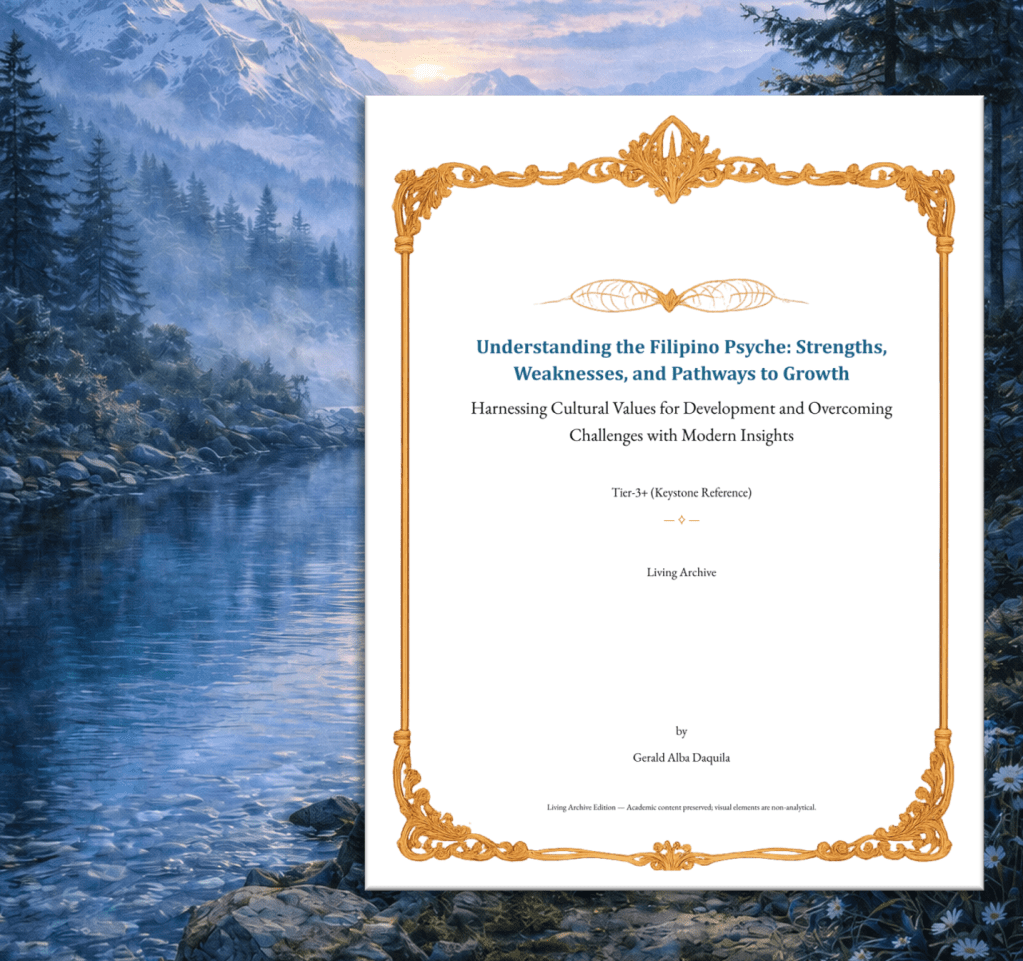
  • Understanding the Filipino Psyche: Strengths, Weaknesses, and Pathways to Growth

    Understanding the Filipino Psyche: Strengths, Weaknesses, and Pathways to Growth

    Harnessing Cultural Values for Development and Overcoming Challenges with Modern Insights

    Prepared by: Gerald A. Daquila, PhD Candidate


    8–13 minutes

    ABSTRACT

    The Filipino psyche, shaped by a unique blend of indigenous values, colonial history, and contemporary challenges, is a rich tapestry of strengths and weaknesses. Rooted in Sikolohiyang Pilipino (Filipino Psychology), this dissertation explores core cultural concepts like kapwa (shared identity), resilience, and family orientation, while addressing challenges such as colonial mentality, passivity, and mental health stigma. By leveraging strengths like community spirit and humor, and applying leading-edge disciplines like cultural psychology, positive psychology, and decolonial approaches, this work proposes practical strategies for personal and societal development. Written for a broad audience, this exploration combines academic rigor with an accessible tone to illuminate the Filipino psyche’s potential for growth and transformation.


    Glyph of the Filipino Psyche

    Illuminating the soul of a people—strengths, shadows, and pathways to collective growth.


    Introduction: The Heart of the Filipino Psyche

    What makes Filipinos unique? From the warmth of a neighbor’s smile to the resilience shown in the face of typhoons, the Filipino psyche is a vibrant mix of cultural values, historical influences, and modern realities. Sikolohiyang Pilipino, pioneered by Virgilio Enriquez, offers a lens to understand this psyche through indigenous concepts like kapwa (shared identity) and loob (inner self).

    This dissertation dives into the strengths and weaknesses of the Filipino psyche, grounded in research, and proposes ways to harness its strengths for growth while addressing its challenges with cutting-edge ideas from psychology and beyond. Whether you’re a Filipino seeking to understand your cultural roots or a global reader curious about this dynamic culture, this exploration offers insights for all.


    1: Mapping the Filipino Psyche

    What Is the Filipino Psyche?

    The Filipino psyche is the collective mindset shaped by centuries of history, from pre-colonial barangays to Spanish and American colonial rule, and today’s globalized world. Sikolohiyang Pilipino emphasizes understanding Filipinos through their own cultural lens, rather than Western frameworks. Key concepts include:

    • Kapwa: The idea of “shared identity,” where self and others are interconnected. It’s why Filipinos go out of their way to help neighbors or strangers.
    • Loob: The inner self, encompassing emotions, values, and moral decisions, often tied to utang na loob (debt of gratitude) or hiya (sense of propriety).
    • Kamalayan: A collective consciousness that shapes how Filipinos perceive their world, blending cognition and emotion.
    • Resilience: The ability to bounce back from adversity, seen in cultural practices like bayanihan (communal cooperation).

    These concepts, rooted in research by Enriquez (1992), reflect a collectivist culture that values relationships, community, and adaptability.


    Why It Matters

    Understanding the Filipino psyche helps us appreciate why Filipinos act, think, and feel the way they do. It’s not just academic—it’s a roadmap for building stronger communities, improving mental health, and fostering national pride in a globalized world.


    2: Strengths of the Filipino Psyche

    Filipinos bring unique strengths to the table, shaped by culture and history. Here’s a closer look at these assets and how they can fuel growth.

    Pakikipagkapwa: The Power of Connection

    Filipinos excel at building relationships. Pakikipagkapwa—treating others as equals—creates tight-knit communities. Whether it’s bayanihan (helping neighbors rebuild after a storm) or offering hospitality to strangers, this strength fosters social cohesion (Pe-Pua & Protacio-Marcelino, 2000).

    How to Leverage It: Community-driven initiatives, like cooperative businesses or mental health support groups, can tap into kapwa to solve local challenges. Imagine neighbors pooling resources to start a community garden—kapwa in action!


    Family First: A Pillar of Support

    The Filipino family is a powerhouse of emotional and practical support. Loyalty to family ensures stability, even in tough times (Jocano, 1997).

    How to Leverage It: Family-based programs, like parenting workshops or mental health campaigns involving relatives, can strengthen this support system. For example, involving families in therapy can make mental health care feel more culturally familiar.


    Joy and Humor: Laughing Through Challenges

    Filipinos are known for finding joy in adversity, using humor as a coping tool. This positivity boosts mental resilience (Church & Katigbak, 2002).

    How to Leverage It: Schools can weave humor and positive psychology into lessons to keep students engaged. Imagine a classroom where laughter helps kids learn resilience alongside math!


    Resilience: Thriving Against the Odds

    From surviving natural disasters to navigating economic hardship, Filipinos show remarkable adaptability. This resilience is cultural, rooted in practices like bayanihan and a hopeful outlook (Reyes, 2015).

    How to Leverage It: Disaster response programs can build on bayanihan to coordinate community recovery efforts. Training locals as first responders can amplify this strength.


    Faith and Spirituality: A Source of Hope

    Deeply rooted in Catholicism and indigenous beliefs, Filipino spirituality provides meaning and emotional strength (Yacat, 2013).

    How to Leverage It: Mental health programs can blend spiritual counseling with therapy, respecting cultural values while addressing emotional needs.


    3: Weaknesses of the Filipino Psyche

    Every culture has its challenges, and the Filipino psyche is no exception. These weaknesses, often tied to historical and social factors, can hinder progress if unaddressed. These challenges are not moral failings, but adaptive responses shaped by history and context.

    Extreme Personalism: Relationships Over Rules

    While kapwa is a strength, prioritizing personal ties can lead to favoritism or nepotism in workplaces or government, undermining fairness (Enriquez, 1992).

    Family-Centeredness: Too Much of a Good Thing?

    An intense focus on family can limit civic engagement, as Filipinos may prioritize relatives over community or national needs (Jocano, 1997).

    Lack of Discipline: The “Filipino Time” Trap

    A relaxed attitude toward time and rules, often called “Filipino time,” can reduce efficiency and productivity (Pe-Pua & Protacio-Marcelino, 2000).

    Passivity: The Bahala Na Mindset

    The phrase bahala na (leave it to fate) can reflect a passive approach to problem-solving, limiting initiative (Reyes, 2015).

    Colonial Mentality: Valuing Foreign Over Local

    A preference for Western culture or products, a legacy of colonialism, can erode self-esteem and national pride (David & Okazaki, 2006).

    Mental Health Stigma: Silence Over Support

    Cultural beliefs that mental health issues are shameful discourage help-seeking, leaving many to suffer in silence (Tuliao, 2014).


    4: Mitigating Weaknesses with Modern Insights

    To address these challenges, we can draw on cutting-edge disciplines like cultural psychology, positive psychology, and decolonial approaches. These are illustrative lenses, not exhaustive prescriptions.

    Here’s how:

    Tackling Personalism with Ethical Leadership

    Discipline: Organizational Psychology

    Training in ethical leadership can promote fairness in workplaces. By framing transparency as part of kapwa (fairness to all), leaders can reduce favoritism while respecting cultural values (Hofstede, 2001).

    Example: Workshops for managers that emphasize merit-based decisions, aligning with Filipino values of community fairness.


    Expanding Family Focus to Civic Duty

    Discipline: Social Psychology

    Community-building programs can extend kapwa to include civic responsibility. Workshops that encourage volunteering can shift focus from family to society (Markus & Kitayama, 1991).

    Example: Civic engagement campaigns that frame helping the community as an extension of family care.


    Boosting Discipline with Behavioral Science

    Discipline: Behavioral Economics

    Nudge theory can encourage punctuality and productivity. For instance, apps rewarding timely task completion can make discipline fun and culturally relevant (Thaler & Sunstein, 2008).

    Example: A mobile app that gamifies time management, tailored to Filipino humor and aesthetics.


    Overcoming Passivity with Empowerment

    Discipline: Positive Psychology

    Goal-setting workshops and strengths-based coaching can shift bahala na toward proactive action, empowering Filipinos to take charge (Seligman, 2002).

    Example: Community programs teaching young people to set personal goals, blending cultural optimism with agency.


    Healing Colonial Mentality with Decolonial Psychology

    Discipline: Decolonial Psychology

    Promoting indigenous knowledge, like Sikolohiyang Pilipino, can boost cultural pride. Educational campaigns celebrating Filipino heritage can counter colonial mentality (Fanon, 1963).

    Example: School curricula highlighting kapwa and local heroes to foster national identity.


    Reducing Mental Health Stigma with Cultural Sensitivity

    Discipline: Cultural Psychology

    Blending indigenous healing practices with modern therapy can make mental health care more approachable. Community-based programs involving families can normalize help-seeking (Tuliao, 2014).

    Example: Support groups led by local healers and psychologists, using kapwa to build trust.


    Glyph of the Collective Soul

    The heart of a people, spiraling into wholeness and becoming.


    5: Practical Strategies for Growth

    To harness the Filipino psyche’s strengths and address its weaknesses, here are actionable recommendations:

    1. Education Reform: Integrate Sikolohiyang Pilipino into schools to teach cultural pride and critical thinking, countering colonial mentality.
    2. Mental Health Programs: Create community-based initiatives that involve families and use kapwa to reduce stigma around mental health.
    3. Policy Changes: Promote ethical governance through policies that reward transparency and civic engagement, balancing personalism and family focus.
    4. Technology Tools: Develop apps that promote discipline and productivity, designed with Filipino humor and aesthetics in mind.
    5. Research Expansion: Fund studies exploring the Filipino psyche in diverse contexts, like urban vs. rural settings, to deepen understanding.

    Conclusion: A Bright Future for the Filipino Psyche

    The Filipino psyche is a treasure trove of strengths—kapwa, resilience, humor—that can drive personal and societal growth. By addressing challenges like passivity, colonial mentality, and mental health stigma with modern tools from psychology and beyond, Filipinos can unlock their full potential. This journey isn’t just about overcoming weaknesses; it’s about celebrating a culture that thrives on connection, hope, and adaptability. Let’s build a future where the Filipino psyche shines brighter than ever.


    Suggested Crosslinks


    Glossary

    • Bahala Na: A Filipino phrase meaning “leave it to fate,” reflecting a sometimes passive approach to challenges.
    • Bayanihan: A cultural practice of communal cooperation, often seen in collective efforts to help neighbors.
    • Hiya: A sense of propriety or shame that guides social behavior to maintain harmony.
    • Kapwa: The core Filipino value of “shared identity,” emphasizing interconnectedness with others.
    • Loob: The inner self, encompassing emotions, values, and moral reasoning.
    • Pakikiramdam: Shared inner perception or sensitivity to others’ feelings, a key aspect of kapwa.
    • Sikolohiyang Pilipino: Filipino Psychology, a framework for understanding Filipino behavior through indigenous concepts.
    • Utang na Loob: A debt of gratitude, often creating reciprocal obligations in relationships.

    Bibliography

    Church, A. T., & Katigbak, M. S. (2002). Indigenization of psychology in the Philippines. International Journal of Psychology, 37(3), 129–148. https://doi.org/10.1080/00207590143000315

    David, E. J. R., & Okazaki, S. (2006). Colonial mentality: A review and recommendation for Filipino American psychology. Cultural Diversity and Ethnic Minority Psychology, 12(1), 1–16. https://doi.org/10.1037/1099-9809.12.1.1

    Enriquez, V. G. (1992). From colonial to liberation psychology: The Philippine experience. University of the Philippines Press.

    Fanon, F. (1963). The wretched of the earth. Grove Press.

    Hofstede, G. (2001). Culture’s consequences: Comparing values, behaviors, institutions, and organizations across nations (2nd ed.). Sage Publications.

    Jocano, F. L. (1997). Filipino value system: A cultural definition. Punlad Research House.

    Markus, H. R., & Kitayama, S. (1991). Culture and the self: Implications for cognition, emotion, and motivation. Psychological Review, 98(2), 224–253. https://doi.org/10.1037/0033-295X.98.2.224

    Pe-Pua, R., & Protacio-Marcelino, E. (2000). Sikolohiyang Pilipino (Filipino psychology): A legacy of Virgilio G. Enriquez. Asian Journal of Social Psychology, 3(1), 49–71. https://doi.org/10.1111/1467-839X.00054

    Reyes, J. A. (2015). The Filipino concept of resilience: A cultural perspective. Philippine Journal of Psychology, 48(2), 1–20.

    Seligman, M. E. P. (2002). Authentic happiness: Using the new positive psychology to realize your potential for lasting fulfillment. Free Press.

    Thaler, R. H., & Sunstein, C. R. (2008). Nudge: Improving decisions about health, wealth, and happiness. Yale University Press.

    Tuliao, A. P. (2014). Mental health help-seeking among Filipinos: A review of the literature. Asia Pacific Journal of Counselling and Psychotherapy, 5(2), 124–136. https://doi.org/10.1080/21507686.2014.913641

    Yacat, J. (2013). Filipino spirituality: A psychological perspective. Philippine Social Science Review, 65(1), 45–62.


    © Gerald Alba Daquila
    This article is offered for educational and interpretive purposes.


    Download This Keystone Reference

    This keystone reference is available for download as a printable PDF.

    A $5 exchange supports the continued stewardship of the Living Archive and helps keep all codices freely readable online.

    Download PDF ]

    If you do not wish to download, you are welcome to read the complete codex here without restriction.