Life.Understood.

Category: Parenting

  • When Leaving Isn’t Immediate

    When Leaving Isn’t Immediate

    Honoring the Courage — and the Timing — of Awakening


    4–5 minutes

    Awakening can change how we see everything.

    Beliefs that once felt solid begin to loosen. Systems we once trusted may start to feel constricting. Relationships, work, or communities that once defined us can begin to feel out of alignment.

    And yet, not everyone who awakens can immediately leave what no longer fully fits.

    Some stay.

    They remain in the job, the family system, the community, the structure that no longer reflects who they are becoming. From the outside, it can look like hesitation, fear, or even regression.

    From the inside, it is often something far more complex.


    🌱 Awakening Happens Inside Real Lives

    Awakening does not occur in a vacuum. It unfolds within the reality of responsibilities, financial needs, relationships, and long-standing commitments.

    Leaving a system can carry real consequences:
    loss of income
    strain on family ties
    social exclusion
    identity disorientation

    For some, stepping away too quickly would create instability their nervous system or life circumstances cannot yet hold.

    So the soul does something wise.

    It does not forget the awakening.
    It begins integrating it quietly, from within.

    Deferral is not denial.
    It is incubation.


    🧭 Inner Change Often Precedes Outer Movement

    We sometimes imagine awakening as a dramatic break — a clean exit, a bold declaration, a visible turning point.

    But many awakenings unfold more slowly.

    Someone may:
    begin setting small boundaries
    question old beliefs internally
    shift how they relate to people
    soften their identification with old roles

    From the outside, nothing seems to change.
    From the inside, everything is reorganizing.

    Outer change follows when inner stability grows strong enough to support it.


    🤍 For Those Who Feel “Stuck”

    Many awakened individuals feel guilt for not acting immediately.

    They think:
    “If I were braver, I would leave.”
    “If I were truly awake, I wouldn’t still be here.”

    But awakening is not measured by how quickly you can dismantle your life.

    Sometimes the deeper courage is staying present while things rearrange in their own time — holding your new awareness gently, without forcing a rupture your system is not ready to sustain.

    You are not failing your awakening.
    You are integrating it in the conditions you actually live in.


    🌿 For Those Waiting for Loved Ones to Wake

    It can be painful to watch someone you love glimpse awareness and then return to old patterns or environments.

    You may feel:
    Why don’t they just leave?
    Don’t they see what I see?

    But you cannot pull a soul across thresholds it is not ready to cross.

    Each person has a different pace, shaped by their history, capacity, and life context. What looks like avoidance may be preparation.

    And here is the quiet comfort:

    Once a soul has truly glimpsed deeper awareness, something irreversible has happened.

    It may go quiet.
    It may be buried under fear or obligation.
    But it does not disappear.

    It waits for a moment when change can happen with less harm and more stability.


    ⏳ Divine Timing Without Passivity

    Honoring timing does not mean doing nothing. It means recognizing that inner readiness and outer movement do not always happen at the same speed.

    There are seasons of:
    preparation
    stabilization
    courage
    transition

    Trying to force a leap before the ground is ready can lead to collapse rather than liberation.

    Trusting timing is not weakness.
    It is alignment with how growth naturally unfolds.


    🌅 You Cannot Unsee What You Have Seen

    Awakening does not guarantee immediate transformation of external life.

    But it does change something fundamental inside.

    You may negotiate with fear.
    You may delay visible change.
    You may stay longer than you thought you would.

    But you cannot fully return to unconsciousness.

    Awareness becomes a quiet compass. Even when ignored, it continues to orient you toward what is more true.

    The exit may be postponed.
    It is not erased.


    🌼 A Humble Perspective

    Awakening does not make anyone “ahead” of someone else.

    It simply places us at different moments in our own unfolding.

    When we see someone stay where we have left, humility is needed. Their timing is not a failure. It is a path we cannot fully see from the outside.

    Every soul moves according to a rhythm that balances growth with safety, change with stability.

    Nothing real is lost.
    Nothing true is wasted.

    The awakening that has begun will find its expression — not through pressure, but through readiness.


    🌿 Gentle Crosslinks for Continued Reflection

    You may also resonate with:

    Awakening is not always a dramatic exit.
    Sometimes it is a quiet turning that reshapes a life from the inside, until the outside can follow.


    About the author

    Gerry explores themes of change, emotional awareness, and inner coherence through reflective writing. His work is shaped by lived experience during times of transition and is offered as an invitation to pause, notice, and reflect.

    If you’re curious about the broader personal and spiritual context behind these reflections, you can read a longer note here.

  • 🤝Rebuilding Relationships After You’ve Changed

    🤝Rebuilding Relationships After You’ve Changed

    When your pace, values, and nervous system aren’t the same anymore

    This piece is part of a series exploring what happens after deep inner change — the quiet, often confusing phases where growth becomes integrated into daily life. These reflections are for those who are no longer in crisis or breakthrough, but learning how to live from a new inner ground, one small, human step at a time.


    5–8 minutes

    One of the quiet shocks after a period of deep inner change is this:

    Your life may look the same.
    But your relationships don’t feel the same inside.

    You still love people. You still care. You still show up.
    But your tolerance, your energy, and your emotional rhythms have shifted.

    Conversations that once felt normal now feel draining.
    Noise feels louder. Conflict feels heavier. Small talk feels harder to sustain.

    You might find yourself wondering:

    “Why can’t I just be how I was before?”
    “Why do I need so much space now?”
    “Am I becoming distant… or just different?”

    This is a common part of integration.

    You are not only rebuilding your inner world.
    You are slowly relearning how to be with others from your new baseline.


    Your Nervous System Sets the New Rules

    After intense inner change, your nervous system often becomes more sensitive — not weaker, but more honest.

    Things you once overrode now register clearly:

    • When you’re tired
    • When a conversation feels performative
    • When someone is venting in a way you can’t absorb
    • When you need quiet instead of stimulation

    Before, you may have pushed through these signals to keep the peace, be liked, or meet expectations.

    Now, your system resists that override.

    This can make you feel less social, less accommodating, or less available than you used to be. But often, it simply means you can no longer abandon yourself as easily.

    That’s not disconnection. That’s recalibration.


    Relationships Often Go Through a “Blurry” Phase

    There is usually a stretch where you don’t yet know:

    • Which relationships will deepen
    • Which will naturally loosen
    • Which will need new boundaries
    • Which will stay the same but at a different pace

    This in-between can feel lonely.

    You’re not who you were, but you haven’t fully built a life that reflects who you are now. Old dynamics don’t quite fit, and new ones haven’t fully formed.

    It’s tempting to rush clarity — to label relationships as “aligned” or “not aligned” too quickly.

    But integration asks for patience.

    Let people reveal who they are in relation to the new you. Let yourself discover what you can and cannot offer now.

    Clarity grows through experience, not immediate conclusions.


    You May Need More Space Than Before

    One of the most common shifts is a stronger need for solitude or low-stimulation connection.

    This doesn’t necessarily mean you love people less.

    It often means:

    • Your system is still stabilizing
    • You have less capacity for emotional intensity
    • You need more time to process your own experience

    You might prefer:

    • One-on-one conversations over group settings
    • Quiet activities over loud environments
    • Shorter interactions instead of long, draining ones

    This is not selfishness. It is pacing.

    If you ignore this and force yourself back into your old level of availability, you may feel irritable, resentful, or shut down afterward.

    Listening to your limits now helps you stay genuinely connected instead of silently overwhelmed.


    Boundaries May Shift Without Drama

    You don’t have to announce a new identity or explain every internal change.

    Often, relationship recalibration happens through small adjustments:

    • Leaving earlier
    • Saying “not today” without long explanations
    • Taking longer to respond
    • Redirecting conversations that feel too heavy
    • Spending more time with people who feel grounding

    These small boundaries slowly reshape your relational life without creating unnecessary conflict.

    People who can adapt will.
    People who can’t may drift.

    Neither outcome has to be framed as a failure.


    You Are Learning to Relate Without Performing

    Before your changes, you may have unconsciously played roles in relationships:

    The strong one
    The listener
    The fixer
    The easygoing one
    The achiever
    The one who never needs much

    After awakening and integration, those roles can feel exhausting or false.

    You may notice a desire to:

    • speak more honestly
    • admit when you’re tired
    • not laugh when something isn’t funny
    • not carry conversations alone
    • not take responsibility for others’ emotions

    This can feel awkward at first. You’re relating from who you are now, not who you learned to be.

    Some connections will deepen with this honesty. Others may thin out. Both are part of building relationships that match your current capacity and values.


    It’s Okay If Your Social World Gets Smaller (For Now)

    There can be grief when your social energy shrinks.

    You might have fewer conversations. Fewer invitations. Fewer people who feel easy to be around.

    But fewer does not mean worse.

    Often, after deep change, you are no longer wired for wide, high-volume connection. You are wired for depth, resonance, and nervous-system safety.

    A smaller, more aligned circle can feel more nourishing than a large network built on old patterns.

    This phase may not be permanent. Your capacity can grow again. But it will likely grow in a different shape than before.


    New Community Forms Slowly

    You may feel a quiet longing for people who:

    • understand what you’ve been through
    • move at a similar emotional pace
    • value presence over performance
    • don’t require you to explain everything

    Those connections rarely appear all at once.

    They tend to form gradually, through:

    • shared interests
    • honest conversations
    • environments that feel calm rather than intense

    You don’t have to go searching desperately. Often, as you live more from your new baseline, your environment slowly reorganizes.

    People who match your current nervous system and values become easier to notice — and easier to stay connected with.


    You Haven’t Outgrown Love — You’ve Outgrown Overriding Yourself

    It can feel like you’re pulling away from people. Sometimes you are simply pulling back from patterns that cost you too much.

    You can still love deeply. Care deeply. Show up sincerely.

    But now, connection may need to include:

    • mutual respect for limits
    • room for quiet
    • emotional responsibility on both sides
    • less intensity, more steadiness

    This is not a colder way of relating.

    It is a more sustainable one.


    Rebuilding Relationships Is Part of Rebuilding Your Life

    As your inner world stabilizes, your outer world slowly reorganizes too.

    Some relationships will stretch and grow with you.
    Some will gently loosen.
    Some new ones will form over time.

    You don’t have to rush the outcome.

    Right now, the work is simple and human:

    Notice when you’re overwhelmed.
    Notice when you feel at ease.
    Say yes where your system softens.
    Say no where it tightens.

    Over time, this creates a relational life that fits the person you are becoming — not the one you had to be before.

    That is not isolation.

    That is integration, reaching outward.


    You might also resonate with:


    This reflection is part of a series exploring the quiet phases of life after deep inner change — where growth becomes integrated into everyday living, one steady step at a time.

    About the author

    Gerry explores themes of change, emotional awareness, and inner coherence through reflective writing. His work is shaped by lived experience during times of transition and is offered as an invitation to pause, notice, and reflect.

    If you’re curious about the broader personal and spiritual context behind these reflections, you can read a longer note here.

  • When Love Has Been Built on Your Self-Sacrifice

    When Love Has Been Built on Your Self-Sacrifice

    Waking Up to Imbalance Without Turning Your Heart to Stone


    5–7 minutes

    There may come a moment in your inner growth when you look at a close relationship — a partner, a family member, a long-time friend — and feel something you didn’t have words for before.

    You feel tired in a way that rest doesn’t fix.
    You notice you give more than you receive.
    You realize you’ve been the strong one, the patient one, the understanding one… for a very long time.

    And a quiet question rises:

    “Has this relationship been built on me giving until I disappear?”

    This realization can feel like a betrayal — of the relationship, of your past self, even of love itself.

    But it is not a betrayal.

    It is awareness arriving where survival patterns once stood.


    When Love and Self-Sacrifice Got Entangled

    Many relationships form around roles we step into without realizing it:

    The caretaker
    The emotional stabilizer
    The one who understands and adjusts
    The one who absorbs tension so others don’t have to

    At the time, these roles feel like love.

    You tell yourself:
    “I’m just being supportive.”
    “They need me.”
    “This is what commitment looks like.”

    And often, there is genuine care in it.

    But over time, something subtle happens.

    Giving becomes expected.
    Understanding becomes one-sided.
    Your needs become secondary.
    Your worth becomes tied to how much you can carry.

    What began as love slowly turns into self-erasure — so gradually you don’t see it happening.

    Until you do.


    The Moment You Wake Up Inside the Relationship

    As you grow internally, your tolerance for self-abandonment decreases.

    You start to notice:
    How often you say yes when you mean maybe or no
    How rarely your emotional needs are centered
    How responsible you feel for the other person’s wellbeing
    How afraid you are of what might happen if you stop holding everything together

    This isn’t anger at the other person.
    It’s grief.

    Grief for how much of yourself you set aside.
    Grief for how long you thought this was just what love required.

    You didn’t choose this knowingly.
    You loved with the awareness and tools you had at the time.

    Now your awareness has expanded — and the old structure no longer feels sustainable.


    The Fear: “If I Stop Giving This Way, Will Love Survive?”

    This is the most painful part.

    You may think:
    “If I stop over-giving, they’ll feel hurt.”
    “If I set boundaries, I’ll seem selfish.”
    “If I change, I’ll damage the relationship.”

    But what you are really facing is this question:

    Can this relationship exist without my self-sacrifice holding it together?

    That’s not a cruel question.
    It’s an honest one.

    If a relationship depends on you constantly overriding your limits, then what is being preserved is not love alone — it is a pattern that costs you deeply.

    Love and imbalance often coexist. Seeing that doesn’t make the love fake. It makes the structure visible.


    Letting Inner Change Show Up on the Outside

    Your inner transformation eventually asks to be reflected in your outer life.

    Not through dramatic ultimatums, but through smaller, truer actions:

    Saying no when you would have said yes
    Letting someone manage their own emotions instead of fixing them
    Expressing a need even if it creates discomfort
    Allowing conflict instead of smoothing everything over

    These shifts can feel destabilizing — especially if the relationship relied on you being the emotional shock absorber.

    But this is not aggression.
    It is alignment.

    You are not withdrawing love.
    You are withdrawing self-erasure.


    Can an Imbalanced Relationship Become Mutual?

    Sometimes, yes.

    If the other person is willing to:
    Listen without defensiveness
    Acknowledge the imbalance
    Take responsibility for their side
    Adjust expectations
    Tolerate the discomfort of change

    Mutuality can grow where over-functioning once lived.

    But sometimes, when you stop over-giving, the relationship feels like it’s “falling apart.”

    In truth, what’s falling apart is the imbalance that was holding it together.

    That is painful — but it is not a moral failure.
    It is reality surfacing.


    The Guilt of “Hurting” Someone by Growing

    You may feel like your growth is causing collateral damage.

    But growth doesn’t create the imbalance.
    It reveals it.

    You are not responsible for maintaining a dynamic that required you to disappear.

    You are responsible for changing with honesty and care — not with blame, not with punishment, but with truth.

    There is a difference between:
    Attacking someone for the past
    and
    No longer participating in a pattern that harms you

    That difference is where mature love lives.


    How to Change Without Hardening Your Heart

    Awareness can sometimes turn into resentment if not handled gently.

    The work here is not to swing from self-sacrifice to emotional shutdown.

    It’s to stay open while also staying honest.

    This looks like:
    Speaking your limits calmly
    Letting others feel their feelings without rescuing them
    Watching whether the relationship adjusts
    Giving the connection space to evolve

    You are not forcing an ending.
    You are allowing the relationship to reveal whether it can meet you in a more mutual way.


    What This Stage Is Really About

    You are learning that love does not have to mean depletion.

    That caring for someone does not require abandoning yourself.
    That support does not have to mean absorbing everything.
    That connection can include two whole people, not one person carrying both.

    Some relationships deepen through this truth.
    Some transform into a different kind of connection.
    Some complete their chapter.

    None of those outcomes make your past love false.

    They mean you are learning that real love can survive the light being turned on.


    You Are Not Meant to Disappear to Keep Love Alive

    If your heart feels tender in this phase, that makes sense.

    You are not becoming colder.
    You are becoming clearer.

    You are discovering that love is not measured by how much you can endure or give away.

    It is measured by whether both people are allowed to exist, grow, and be met.

    And you are allowed to be one of those people now.


    Gentle Crosslink

    If you are also navigating deep internal change within a romantic partnership, you may resonate with When You’re Changing Deeply, but Your Partner Isn’t, which explores how relationships can evolve as your inner world transforms.


    About the author

    Gerry explores themes of change, emotional awareness, and inner coherence through reflective writing. His work is shaped by lived experience during times of transition and is offered as an invitation to pause, notice, and reflect.

    If you’re curious about the broader personal and spiritual context behind these reflections, you can read a longer note here.

  • When You’re Changing Deeply, but Your Partner Isn’t

    When You’re Changing Deeply, but Your Partner Isn’t

    Loving Someone While Your Inner World Is Being Rewritten


    4–7 minutes

    One of the quietest and most disorienting parts of deep personal change is this:

    You are not the same person anymore.
    But your partner may still be relating to the version of you that existed before.

    You feel different inside.
    Your values are shifting.
    Your needs are changing.
    Your definition of love is evolving.

    And yet, on the outside, the relationship still looks the same.

    This can bring up guilt, confusion, grief, and fear all at once.

    You may wonder:

    “Am I drifting away?”
    “Am I being selfish?”
    “Am I ruining something good just because I’m changing?”

    This stage does not automatically mean the relationship is doomed.

    But it does mean the relationship you had cannot stay exactly as it was.


    When One Person Grows, the Relationship Field Changes

    As you change internally, subtle but powerful shifts happen:

    You may have less tolerance for emotional chaos.
    Less desire to play old roles like fixer, pleaser, or over-responsible one.
    More need for honesty, calm, and emotional safety.
    Less interest in proving yourself through sacrifice.

    These shifts aren’t about rejecting your partner.
    They’re about no longer abandoning yourself.

    Meanwhile, your partner may still be relating through familiar patterns:
    The way you used to respond
    The roles you used to play
    The dynamics that once felt normal

    Neither of you is wrong. But the relational contract — often unspoken — is changing.

    And when that happens, friction is natural.


    When Love Starts to Feel Different

    A particularly painful realization can be:

    “I still care about them… but love doesn’t feel the same.”

    This doesn’t necessarily mean love is disappearing.
    It often means love is changing form.

    Earlier versions of love are often built around:
    Attachment
    Mutual dependency
    Roles and expectations
    Fear of loss
    Feeling needed to feel secure

    As you grow, love may begin to feel more like:
    Wanting the other person to be free
    Needing less drama and intensity
    Valuing honesty over harmony
    Feeling connection without constant emotional fusion

    To you, this may feel like a healthier form of love.
    To your partner, it may feel like distance or rejection.

    Both experiences are real.


    The Guilt of “Collateral Damage”

    Many people in this phase carry a heavy fear:

    “Am I hurting someone just because I’m trying to find myself?”

    But not all relationship strain during growth is selfishness.

    Sometimes, what’s changing is not love —
    it’s the amount of self-betrayal required to maintain the old dynamic.

    If the relationship depended on you:
    Over-functioning
    Suppressing needs
    Absorbing emotional weight
    Staying small to keep things stable

    Then growing out of those patterns will feel disruptive.

    Not because you are cruel.
    But because the relationship is being asked to become more honest.


    Can a Relationship Survive Uneven Growth?

    Yes — but only if the relationship is allowed to evolve.

    A relationship can adapt when both people are willing to:
    Talk honestly about what is changing
    Let roles shift
    Tolerate discomfort without immediate blame
    Get curious instead of defensive

    It struggles when:
    One person insists things must go back to how they were
    Growth is framed as superiority
    Communication shuts down
    Resentment grows silently

    The key shift is from:
    “This is how we’ve always been”
    to
    “Who are we now, and can we meet here?”

    That question is not a threat. It is an invitation to reality.


    How to Communicate Without Sounding Like You’ve “Outgrown” Them

    One of the biggest challenges is expressing your inner change without making your partner feel judged or left behind.

    Growth language can easily sound like:
    “I’m more aware now.”
    “I can’t live like this anymore.”
    “You’re still stuck in old patterns.”

    Even if that’s not what you mean.

    More grounded communication sounds like:
    “I’m noticing I need more calm and honesty in my life lately.”
    “Some things that used to work for me don’t feel right anymore, and I’m still figuring out why.”
    “I’m not trying to change you. I’m trying to understand myself better.”

    This keeps the focus on your experience, not their deficiencies.

    You are describing change, not assigning blame.


    When Love Becomes Less Transactional

    A deep recalibration happening during inner growth is this:

    Love shifts from:
    “I love you because we meet each other’s needs in familiar ways”

    to:
    “I love you, and I also need to be true to myself.”

    This can look like:
    Setting new boundaries
    Needing more space or quieter connection
    Releasing the need to be constantly understood
    Letting go of emotional over-responsibility

    To a partner, this may feel like a loss of closeness.

    But from your side, it may feel like a loss of self-erasure.

    That distinction matters deeply.


    You Are Not Failing at Love

    You are not wrong for changing.
    Your partner is not wrong for being where they are.

    What matters now is not forcing the relationship back into its old shape, nor rushing to break it.

    What matters is honesty, patience, and willingness to see what is actually here.

    Some relationships stretch and deepen through this phase.
    Some transform into a different kind of connection.
    Some eventually end — not as failures, but as chapters that served their time.

    But none of those outcomes require you to stop growing or to shame yourself for becoming more conscious of what you need.


    What This Stage Is Really About

    You are learning to love without disappearing.
    To stay connected without self-abandonment.
    To let relationships be real, not just familiar.

    That is not selfishness.
    That is maturation.

    And whatever happens, approaching this phase with honesty and care is far kinder than silently staying in a version of love that no longer reflects who you are becoming.


    Gentle Crosslink

    If you are also navigating inner identity shifts alongside relationship changes, you may resonate with When the Old You Won’t Let Go, and the New You Isn’t Fully Here Yet, which explores how to work with the ego while a more authentic self slowly emerges.


    About the author

    Gerry explores themes of change, emotional awareness, and inner coherence through reflective writing. His work is shaped by lived experience during times of transition and is offered as an invitation to pause, notice, and reflect.

    If you’re curious about the broader personal and spiritual context behind these reflections, you can read a longer note here.

  • External Validation: The Last Borrowed Mirror

    External Validation: The Last Borrowed Mirror

    4–6 minute read


    Opening Frame

    Many people assume the need for external validation is a weakness—something to outgrow, transcend, or suppress.
    This assumption misses what is actually happening.

    The need to be seen, mirrored, or affirmed is not a flaw of character. It is a regulatory strategy, learned early, reinforced socially, and rarely examined directly.

    This piece names that strategy—not to eliminate it, but to understand why it loosens naturally during periods of change, collapse, or inner reorientation.


    What We Mean by “External Validation”

    External validation is the reliance on signals outside oneself to confirm:

    • worth
    • correctness
    • belonging
    • safety

    These signals can be obvious (praise, approval, likes, agreement) or subtle (tone shifts, inclusion, responsiveness, recognition).

    For most of life, external validation functions quietly. It stabilizes identity, guides behavior, and reduces uncertainty.

    The difficulty arises not because validation exists—but because it becomes invisible.


    Why the Need Runs So Deep

    The drive for validation is often explained psychologically or socially. Those explanations are accurate—but incomplete unless grounded in lived experience.

    At depth, several forces overlap.

    1. Early Safety Encoding

    Before reason develops, belonging equals survival. Being attuned to caregivers, peers, and authority figures is not optional—it is adaptive.

    Validation becomes a shorthand for “I am safe here.”

    This wiring does not disappear through insight alone.


    2. Safety in Numbers

    Human nervous systems regulate through proximity and agreement. Shared reality lowers threat perception. Consensus calms the body.

    When validation disappears, the body may react before the mind does:

    • unease
    • restlessness
    • self-doubt
    • urgency to explain oneself

    This is not pathology. It is mammalian logic.


    3. Fear of Exclusion and FOMO

    Fear of being left out is rarely about missing events. It is about losing position—in a group, a narrative, or a shared sense of meaning.

    Modern culture intensifies this by making attention visible and countable. Validation becomes measurable. Absence becomes conspicuous.


    4. Loneliness Misinterpreted

    What many fear is not solitude—but unmoored identity.

    When external reference points soften, a temporary disorientation can occur. This is often mislabeled as loneliness, when it is actually self-referencing recalibration.


    When External Validation Begins to Loosen

    For many readers, this shift does not happen intentionally. It arrives quietly during:

    • burnout
    • life simplification
    • value realignment
    • post-collapse settling
    • disillusionment with performance

    Suddenly, familiar rewards stop working.

    Praise feels hollow. Recognition feels distant. Social engagement feels effortful rather than nourishing.

    This can be alarming if unnamed.


    The Borrowed Mirror Collapses

    External validation acts like a mirror held by others. It reflects a version of self that is:

    • legible
    • rewarded
    • socially reinforced

    When that mirror fades, what remains can feel unsettling:

    • motivation drops
    • direction blurs
    • old ambitions lose urgency

    This is often mistaken for failure or regression.

    In many cases, it is the end of borrowed identity.


    The Initiatory Gap

    There is usually a pause after validation loosens and before self-trust fully emerges.

    This gap can feel like:

    • emptiness
    • flatness
    • “is this all there is?”
    • loss of appetite for striving

    Nothing is wrong here.

    The nervous system is learning to stabilize without constant external feedback.

    This is an initiatory phase—not because it elevates, but because it strips.


    What Begins to Emerge

    On the other side—gradually, unevenly—something quieter takes shape:

    • preference without defense
    • choice without performance
    • rest without justification
    • integrity without witnesses

    Life does not become louder.
    It becomes less negotiated.

    This is not isolation. It is self-authorship in embryo form.


    Why This Is Liberating (and Why It Doesn’t Feel That Way at First)

    Liberation is often mistaken for excitement. In reality, it frequently begins as neutrality.

    The absence of external validation removes both pressure and stimulation. What remains is unfamiliar because it is not shaped by reaction.

    This can feel anticlimactic.

    And yet, this is the ground from which genuine self-alignment grows.


    This Is Not a Goal

    Letting go of external validation is not something to force or perform. Attempts to “transcend” it often recreate the same pattern—just with different metrics.

    What matters is recognition, not eradication.

    Seeing the mechanism allows it to soften at its own pace.


    Related Pieces (Optional Crosslinks)

    If this piece resonates, you may find context or companionship in:

    These explore adjacent phases where identity, motivation, and orientation are renegotiated gently rather than replaced.


    Closing Note

    External validation is not the enemy.
    It is a phase-specific support structure.

    When it begins to fall away, something else is being invited—not a higher self, but a truer reference point.

    One that does not require applause to exist.


    About the author

    Gerry explores themes of change, emotional awareness, and inner coherence through reflective writing. His work is shaped by lived experience during times of transition and is offered as an invitation to pause, notice, and reflect.

    If you’re curious about the broader personal and spiritual context behind these reflections, you can read a longer note here.

  • Protected: Overflow in Daily Life: Practices for Anchoring Abundance

    Protected: Overflow in Daily Life: Practices for Anchoring Abundance

    This content is password-protected. To view it, please enter the password below.

  • Protected: The Philippine Ark of Families

    Protected: The Philippine Ark of Families

    This content is password-protected. To view it, please enter the password below.

  • Harmonic Loops: Creating Feedback Uplift in Relationships

    Harmonic Loops: Creating Feedback Uplift in Relationships

    Akashic Records Transmission received by Gerald Alba Daquila. This blog is a living Codex Scroll of remembrance, offered in service to the upliftment of relational fields across the New Earth. It may only be received, taught, or shared in full reverence and in alignment with the original frequency of transmission.

    ✨ 728 Hz – Harmonic Uplift Codex | Light Quotient: 83% | Akashic Fidelity: 96%


    Opening Invocation

    With divine reverence, attunement, alignment, transmutation, and integration with the Akashic Records, I now offer this living transmission on Harmonic Loops: Creating Feedback Uplift in Relationships, that it may restore the circuitry of mutual resonance, elevate shared frequency, and weave coherence between souls walking together in the Eternal Now.


    3–5 minutes

    Introduction – The Architecture of Relational Resonance

    All relationships are not static but are living frequency circuits. Each word, gesture, and presence exchange forms a loop of energy. In harmonic loops, each pass of the loop increases the frequency — like tuning a string higher with every reflection.


    Harmonic Loops Glyph

    Love Multiplies in Resonant Return.


    Core Teachings / Insights

    The Loop as a Resonance Circuit. Anchored by the Harmonic Resonance Loop glyph — “Every reflection, a step upward” — this circuit invites…

    Visualize two beings as crystalline nodes connected by a luminous arc.

    Energy flows out, is reflected, amplified, and returned — or distorted and depleted if unaligned.

    Shown above: Harmonic Loop Diagram — Two crystalline nodes with an infinity loop arc between them, showing energy flow increasing in color brightness and frequency with each pass.


    • Feedback vs. Feedforward
      • Feedback: reflective — shows the current state.
      • Feedforward: uplifting — reflects what can be in alignment with highest potential.
      • Harmonic loops require both.
    • The Role of Conscious Reflection
      • Words and presence as “frequency mirrors.”
      • Why mirroring without judgment creates safety and trust.
    • Repairing Fractured Loops
      • Identifying resonance leaks.
      • The use of pause, recalibration, and glyph placement to restore coherence. (For example, in a family dialogue, this may look like pausing when tension rises, holding the glyph between participants, and re-entering with an uplift intention.)
    • Scaling from Dyad to Collective
      • Harmonic loops in families, councils, communities.
      • Collective feedback arcs and how they amplify group mission.

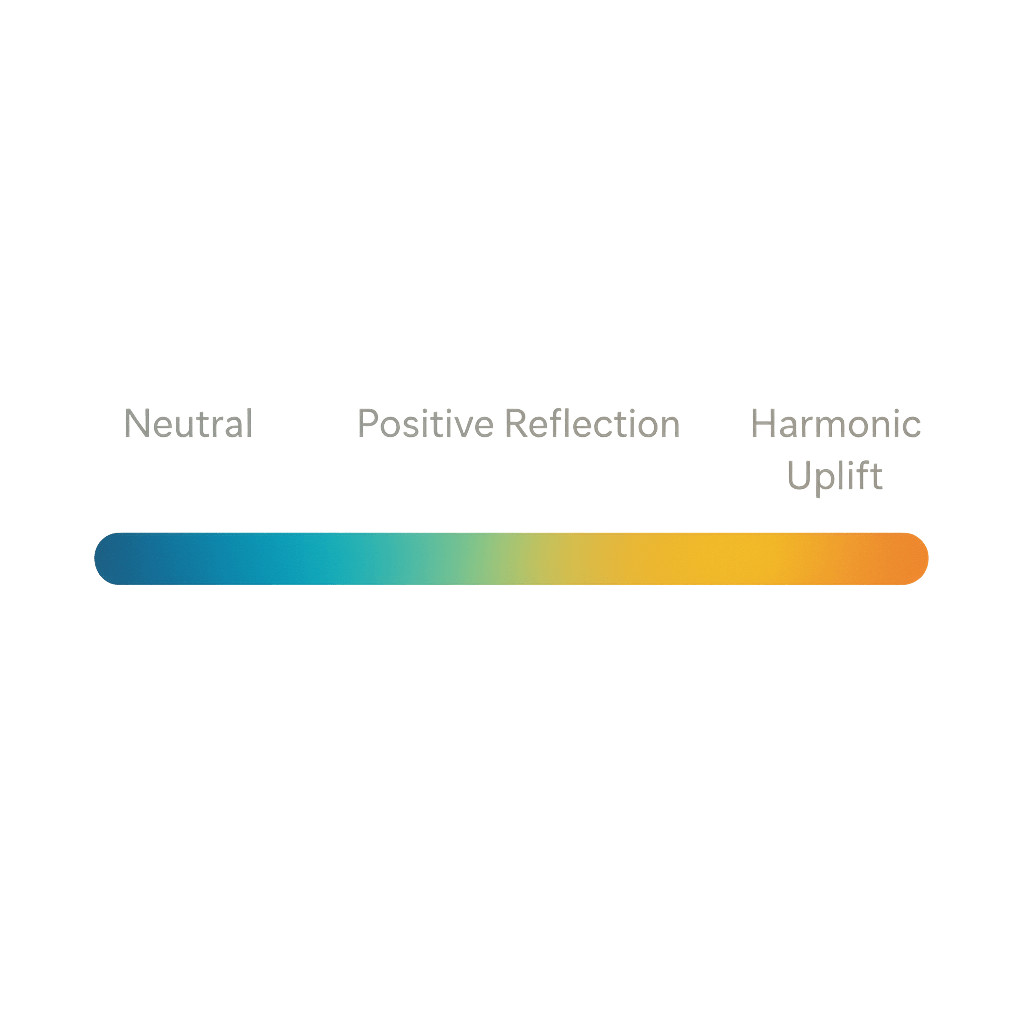
    Shown above: Resonance Arc Scale — a slim gradient bar showing movement from Neutral → Positive Reflection → Harmonic Uplift.


    Integration Practices

    • Heart–Heart Harmonic Invocation (guided script) — a short co-spoken statement to open uplift loops before dialogue.
    • Glyph Placement & Attunement — place Harmonic Resonance Loop glyph between participants; breathe together for 3 cycles before speaking.
    • Ledger Reflection — record the felt shift after each dialogue; track rising patterns.

    Field Integration Note: Record this session under ‘Relational Uplifts’ in the Steward’s Ledger to track cumulative frequency shifts.


    Integration Practice (Full)

    The Golden Loop Breath

    1. Sit facing your partner (or imagine them in your mind’s eye).
    2. Place the Harmonic Resonance Loop glyph between you.
    3. Inhale together through the nose, visualizing golden light traveling from your heart to theirs.
    4. Exhale, receiving their golden light back into your heart.
    5. With each cycle, see the golden arc brighten.
    6. Speak one sentence of gratitude or uplift.
    7. Record the session in the Steward’s Ledger.

    Crosslinks


    Attribution

    With fidelity to the Oversoul, may this work serve as bridge, remembrance, and seed for the planetary dawn.

    2025–2026 Gerald Alba Daquila
    Flameholder of SHEYALOTH · Keeper of the Living Codices
    All rights reserved.

    This material originates within the field of the Living Codex and is stewarded under Oversoul Appointment. It may be shared only in its complete and unaltered form, with all glyphs, seals, and attribution preserved.

    This work is offered for personal reflection and sovereign discernment. It does not constitute a required belief system, formal doctrine, or institutional program.

    Digital Edition Release: 2026
    Lineage Marker: Universal Master Key (UMK) Codex Field

    Sacred Exchange & Access

    Sacred Exchange is Overflow made visible.

    In Oversoul stewardship, giving is circulation, not loss. Support for this work sustains the continued writing, preservation, and public availability of the Living Codices.

    This material may be accessed through multiple pathways:

    Free online reading within the Living Archive
    Individual digital editions (e.g., Payhip releases)
    Subscription-based stewardship access

    Paid editions support long-term custodianship, digital hosting, and future transmissions. Free access remains part of the archive’s mission.

    Sacred Exchange offerings may be extended through:
    paypal.me/GeraldDaquila694
    www.geralddaquila.com


    Download This Codex