Life.Understood.

Category: Collective Overflow

  • When We Rush Our Soul Mission: The Hidden Cost of Moving Before We Are Ready

    When We Rush Our Soul Mission: The Hidden Cost of Moving Before We Are Ready

    After awakening, a powerful energy often rises.


    4–6 minutes

    You feel clearer. More alive. More connected. And with that awakening comes a natural urge:

    “I’m here for something. I should start now.”

    This impulse is sincere. It comes from the heart’s desire to serve. But sincerity does not always mean readiness.

    There is a stage in soul development where we feel the call…
    but our system has not yet stabilized enough to carry what that call will eventually become.

    When we move too quickly, what unfolds is not punishment, and not failure.

    It is feedback.


    🔥 Activation Is Not Assignment

    Awakening activates energy, perception, and sensitivity. It expands what we can feel and sense.

    But activation does not automatically mean:

    • your role is clear
    • your nervous system is ready
    • your field is stable
    • your discernment is mature

    It simply means the signal has reached you.

    The capacity to carry that signal in embodied, sustainable ways takes time to build.

    Without that stabilization, we may launch projects, roles, or responsibilities that sound aligned — but subtly strain our system.


    🎭 When Misalignment Wears the Mask of Purpose

    Early after awakening, discernment is still refining. We feel resonance, but we may not yet know how to distinguish:

    • genuine soul alignment
      from
    • emotional charge, urgency, or old identity patterns dressed in spiritual language

    This is how we find ourselves saying yes to:

    • collaborations that drain instead of nourish
    • roles that inflate identity rather than express truth
    • opportunities that look meaningful but leave us fragmented

    These are not mistakes to regret. They are mirrors showing us what our field cannot yet hold without distortion.

    Purpose does not disappear when we misstep.
    We simply learn what is not yet ours to carry.


    🪫 The Burnout Before Overflow

    Many people sense, correctly, that true service can feel energizing and life-giving. But they misunderstand when that becomes possible.

    Overflow is not the starting point of purpose.
    It is the result of deep embodiment.

    When we give from a system that is still healing, integrating, or stabilizing:

    • generosity turns into depletion
    • service becomes self-abandonment
    • boundaries blur
    • resentment quietly builds

    Eventually the body, emotions, or life circumstances force a stop.

    This is not evidence that you are “not meant” for service.

    It is your system saying:
    “The current is real. But we need stronger wiring first.”


    🔁 Recreating the Old World in New Language

    One of the most humbling stages of spiritual growth is realizing that we can carry old patterns into new, spiritual forms.

    Without deep integration, we may unconsciously rebuild:

    • overwork culture as “devotion”
    • martyrdom as “selflessness”
    • urgency as “sacred timing”
    • control as “leadership”

    We believe we are helping the world evolve, while quietly reenacting the very dynamics we hoped to leave behind.

    This is not hypocrisy. It is purification in progress.

    Awakening brings light to these patterns so they can be seen, felt, and eventually released. But that release rarely happens before we’ve watched ourselves repeat them at least once.


    🧠 When Identity Grabs the Mission

    Another subtle effect of rushing is that identity can attach itself to purpose before humility has matured.

    We may feel:

    • responsible for outcomes beyond our capacity
    • pressured to be a guide before we have learned to be a student
    • afraid to step back because our sense of self is now tied to “the work”

    But true soul purpose does not require performance.

    When timing is right, purpose flows through you with less strain and less need to prove anything. It becomes quieter, steadier, and less about being seen.


    🌱 The Wisdom Hidden in Misfires

    What feels like a failed mission is often a training ground.

    Through rushed steps, we learn:

    • what drains versus what sustains
    • what inflates versus what stabilizes
    • what is driven by urgency versus what is guided by coherence

    These lessons refine discernment — one of the most essential capacities for long-term service.

    Nothing is wasted. Even the detours strengthen the vessel.


    ⏳ The Power of Ripening

    There is a season where the most aligned action is not expansion, but consolidation.

    Resting.
    Integrating.
    Letting life reorganize around your new awareness.

    This phase can feel like slowing down, but it is actually deep preparation. Roots are growing. Wiring is strengthening. Identity is softening.

    When purpose begins to move again from this place, it feels different:

    • less dramatic
    • less urgent
    • more sustainable
    • more quietly powerful

    It feels like current, not effort.


    🌅 A Gentle Reframe

    If you rushed and burned out, you did not fail your purpose.

    You met the edge of your current capacity.

    That edge is sacred information.

    You are allowed to step back.
    You are allowed to heal.
    You are allowed to become stronger before you carry more.

    Purpose is not proven by how fast you move.
    It is revealed by how much coherence you can maintain while moving.


    Your soul mission is not lost because you paused.
    It is maturing with you.

    And when the time is right, you will not have to force it into existence.

    It will recognize you as ready — and begin to move through you with a steadiness that does not burn you out, because you have become able to hold its light.


    Gentle Crosslinks for Continued Reflection

    You may also resonate with:

    Take your time. Ripening is not delay — it is design.


    About the author

    Gerry explores themes of change, emotional awareness, and inner coherence through reflective writing. His work is shaped by lived experience during times of transition and is offered as an invitation to pause, notice, and reflect.

    If you’re curious about the broader personal and spiritual context behind these reflections, you can read a longer note here.

  • The Quiet Way Change Spreads

    The Quiet Way Change Spreads

    Why you don’t have to convince anyone — and how transformation moves anyway


    4–6 minutes

    There’s a moment that often comes after a deep internal shift — a clearing, a healing, an awakening, a long-awaited breakthrough — when joy rises almost like a pressure in the chest.

    You feel lighter. Clearer. More yourself.

    And with that relief comes a natural instinct:

    “I want everyone to feel this.”

    This urge is not ego. It is not superiority. It is not spiritual vanity.

    It is the most human reflex there is:
    When something good happens to us, we want to share it.

    But here’s where many people in transition hit a wall.

    They try to explain.
    They try to inspire.
    They try to open conversations others didn’t ask for.

    And instead of resonance, they meet resistance.
    Confusion. Distance. Sometimes even conflict.

    That’s when the painful question appears:

    If I can’t make anyone else change… what was the point of all this?


    The Misunderstanding About “Sharing the Good News”

    We’re used to thinking change spreads through information.

    If I just say it clearly…
    If I just find the right words…
    If I just explain what I discovered…

    But inner transformation doesn’t move through explanation.

    It moves through regulation.

    You cannot talk someone into a nervous system state they have never experienced.
    You cannot argue someone into safety.
    You cannot persuade someone into readiness.

    Real change is not adopted because it sounds convincing.

    It is adopted because it feels possible.

    And what makes something feel possible is not a message.

    It’s a person.


    What Actually Spreads: States, Not Ideas

    Human beings are deeply attuned to one another’s internal states. Long before we developed complex language, we survived by reading tone, posture, breath, and emotional cues.

    This hasn’t changed.

    When you become more grounded, more regulated, more internally coherent, people around you don’t primarily register your philosophy.

    They register your nervous system.

    They notice:

    • you don’t escalate as easily
    • you don’t collapse as quickly
    • you don’t react with the same charge
    • you hold steadiness where you once held urgency

    And without consciously deciding to, their systems begin to adjust around yours.

    This is called co-regulation.
    In physics, it resembles entrainment.
    In everyday life, it simply feels like:

    “I don’t know why, but I feel calmer around you.”

    That’s how change spreads.

    Not through convincing.
    Through stability.


    Why Proselytizing Backfires

    When we try to push transformation outward, we unknowingly shift out of regulation and into activation.

    There is urgency.
    There is emotional charge.
    There is a subtle message underneath the words:

    “You should be where I am.”

    Even if we don’t say that, others feel it. And when people feel pushed, judged, or hurried, their systems don’t open.

    They brace.

    So the very desire to help can accidentally create the opposite effect.

    This doesn’t mean you’re wrong for wanting to share. It means the method of sharing changes after real growth.

    Early on, we share with words.
    Later, we share with presence.


    The Elegant Way Change Scales

    There is a quieter model of influence that doesn’t look dramatic, but is far more powerful.

    It works like this:

    A person learns to regulate themselves consistently.
    That steadiness changes how they respond under stress.
    Those responses reshape the emotional climate of their relationships.
    That climate reshapes how others feel safe to show up.
    Those people carry that regulation into their relationships.

    One person’s inner work becomes a ripple.

    Not because they preached.
    Because they became predictable in their groundedness.

    A regulated parent changes a household.
    A regulated partner changes a relationship dynamic.
    A regulated leader changes a workplace culture.

    Not overnight. Not through speeches.

    Through repeated moments of:

    • staying instead of escalating
    • listening instead of correcting
    • breathing instead of reacting
    • choosing clarity over drama

    This is slow influence. But it is durable.


    Your Role Is Not Messenger. It’s Stabilizer.

    Many people in transition carry an unconscious burden:

    “If I’ve seen something true, I’m responsible for waking others up.”

    But that role was never yours.

    Your real role is simpler, and more demanding:

    Tend your own coherence.

    That means:

    • keeping your practices, not to escape life, but to stay present in it
    • returning to regulation after you get triggered
    • allowing others to be where they are without trying to move them
    • living your values quietly and consistently

    This is not passive. It is not disengaged.

    It is leadership at the level of the nervous system.

    You become a place where others experience:
    less pressure
    less performance
    less emotional volatility

    And over time, that experience teaches them more than your explanations ever could.


    Why This Brings Relief

    When you understand this, something softens.

    You don’t have to chase conversations.
    You don’t have to defend your changes.
    You don’t have to translate every insight into language others can digest.

    You’re allowed to grow without becoming a spokesperson for growth.

    You’re allowed to change without recruiting others.

    And paradoxically, that’s when your change becomes most contagious.

    Because it’s no longer trying to be.


    The Quiet Truth

    Widespread transformation doesn’t begin with movements.

    It begins with regulated humans.

    Not louder.
    Not more convincing.
    Just more internally steady.

    One person becomes less reactive.
    That changes a relationship.
    That changes a family system.
    That changes a small network.

    And most of it happens without announcement.

    You don’t scale change by broadcasting.

    You scale change by becoming a stable signal in a noisy world.

    And the beautiful part?

    You can do that right where you are.
    No platform required.


    Light Crosslinks

    You may also resonate with:
    The Quiet Integration Phase After Awakening
    Why You Can’t Wake Someone Up Before They’re Ready
    Living Change Without Explaining Yourself


    About the author

    Gerry explores themes of change, emotional awareness, and inner coherence through reflective writing. His work is shaped by lived experience during times of transition and is offered as an invitation to pause, notice, and reflect.

    If you’re curious about the broader personal and spiritual context behind these reflections, you can read a longer note here.

  • Learning to Say No Without Feeling Like a Bad Person

    Learning to Say No Without Feeling Like a Bad Person

    Boundaries After a Heart-Opening


    3–5 minutes

    After a period of growth, healing, or awakening, many people make a quiet but important discovery:

    “I’ve been giving past my limits.”

    They start noticing the exhaustion. The subtle resentment. The feeling of disappearing inside other people’s needs.

    So they try something new.

    They say no.

    And instead of relief… they feel guilt.


    Why Boundaries Feel So Uncomfortable at First

    For many of us, love and self-abandonment were tangled together early in life.

    We learned that being:

    • easy
    • helpful
    • available
    • low-maintenance

    kept relationships smooth and kept us safe.

    So when we begin setting boundaries, the body doesn’t register it as “healthy.”
    It often registers it as danger.

    You might notice:

    • A wave of guilt after saying no
    • Anxiety that someone will be upset with you
    • The urge to over-explain your reasons
    • A pull to go back and “fix it” by saying yes after all

    This doesn’t mean you’re doing something wrong.

    It means you’re teaching your nervous system a new definition of love — one that includes you.


    Boundaries Don’t Make You Cold — They Make You Clear

    There’s a common fear that goes like this:

    “If I stop over-giving, I’ll become selfish or distant.”

    But boundaries don’t reduce love.
    They reduce resentment, burnout, and hidden pressure.

    Without boundaries, giving slowly turns into obligation.
    With boundaries, giving becomes a clean choice.

    The difference shows up in how it feels:

    Without boundaries:
    “I’ll do it… but I’m already tired.”
    “I guess I have to.”
    “They need me.”

    With boundaries:
    “I can help with this much.”
    “Not right now, but maybe another time.”
    “I care, and I also have limits.”

    That clarity actually makes relationships safer, not more fragile.


    Why Guilt Shows Up When You Change

    Guilt often isn’t a sign you’re being unkind.
    It’s a sign you’re stepping outside an old role.

    If you were “the reliable one,”
    “the strong one,”
    “the one who never says no,”

    then changing your behavior can shake the system — yours and other people’s.

    Your mind might say:
    “I’m letting them down.”

    But often what’s really happening is:
    “I’m no longer abandoning myself to keep everything comfortable.”

    That’s growth. And growth almost always feels unfamiliar at first.


    You Are Allowed to Disappoint People

    This is one of the hardest truths in this phase.

    You can be kind, thoughtful, and loving…
    and still disappoint someone.

    You can set a boundary…
    and someone may not like it.

    Their discomfort does not automatically mean you did something wrong.

    Sometimes it just means:
    They were used to having more access to you than you can sustainably give.

    Letting others adjust to the real you is part of building honest relationships.


    How to Set Boundaries Without Shutting Down

    Healthy boundaries aren’t walls. They’re information.

    You don’t have to become harsh or distant. You can stay warm and still be clear.

    Examples:

    • “I really want to support you, but I don’t have the capacity tonight.”
    • “I can help for an hour, but then I need to rest.”
    • “I’m not able to take this on, but I care about what you’re going through.”

    You’re not rejecting the person.
    You’re being honest about your limits.

    That honesty prevents the slow erosion that happens when you say yes but mean no.


    The Link Between Boundaries and Abundance

    This part surprises many people.

    When you stop over-extending, you’re not just protecting your energy — you’re also teaching your system something new:

    “My needs matter too.”

    That shift affects more than relationships. It affects work, money, opportunities, and support.

    When you value your time and energy:

    • You’re less likely to over-give at work without recognition
    • You’re more likely to ask for what you need
    • You’re more open to receiving help and compensation

    Boundaries create structure.
    And structure is what allows growth and abundance to stabilize instead of leaking out.


    You’re Not Becoming Less Loving

    If anything, you’re becoming more real.

    Love that costs you your health, rest, and sense of self isn’t sustainable. Eventually, it turns into exhaustion or quiet resentment.

    Love with boundaries says:

    “I want to be in your life for the long term.
    To do that, I have to include myself in the care.”

    That’s not selfish.
    That’s mature love.

    And for many people, this is the turning point where kindness stops being draining and starts becoming something that can actually last.


    Light Crosslinks

    You may also resonate with:


    About the author

    Gerry explores themes of change, emotional awareness, and inner coherence through reflective writing. His work is shaped by lived experience during times of transition and is offered as an invitation to pause, notice, and reflect.

    If you’re curious about the broader personal and spiritual context behind these reflections, you can read a longer note here.

  • The Ethics of Receiving

    The Ethics of Receiving

    A Tier 4 Codex in the Overflow Stewardship Pathway — for restoring circulation, trust, and Overflow across households, fields, and nations.


    4–6 minutes

    This Codex is offered as a doorway into ethical receiving — not as a reward for worthiness, but as a remembrance that all true flow belongs to Source. You are invited to read slowly, practice gently, and let each micro-adjustment restore circulation where it has stalled.


    ✨Resonance Header | Resonance Frequency (RF): 732 Hz | Light Quotient (LQ): 78 % | DNA Activation: 9.4 / 12 | Oversoul Fidelity (OF): 86 % | Recorded under Oversoul supervision for the Flameholder of SHEYALOTH.


    I — The Paradox of Generosity

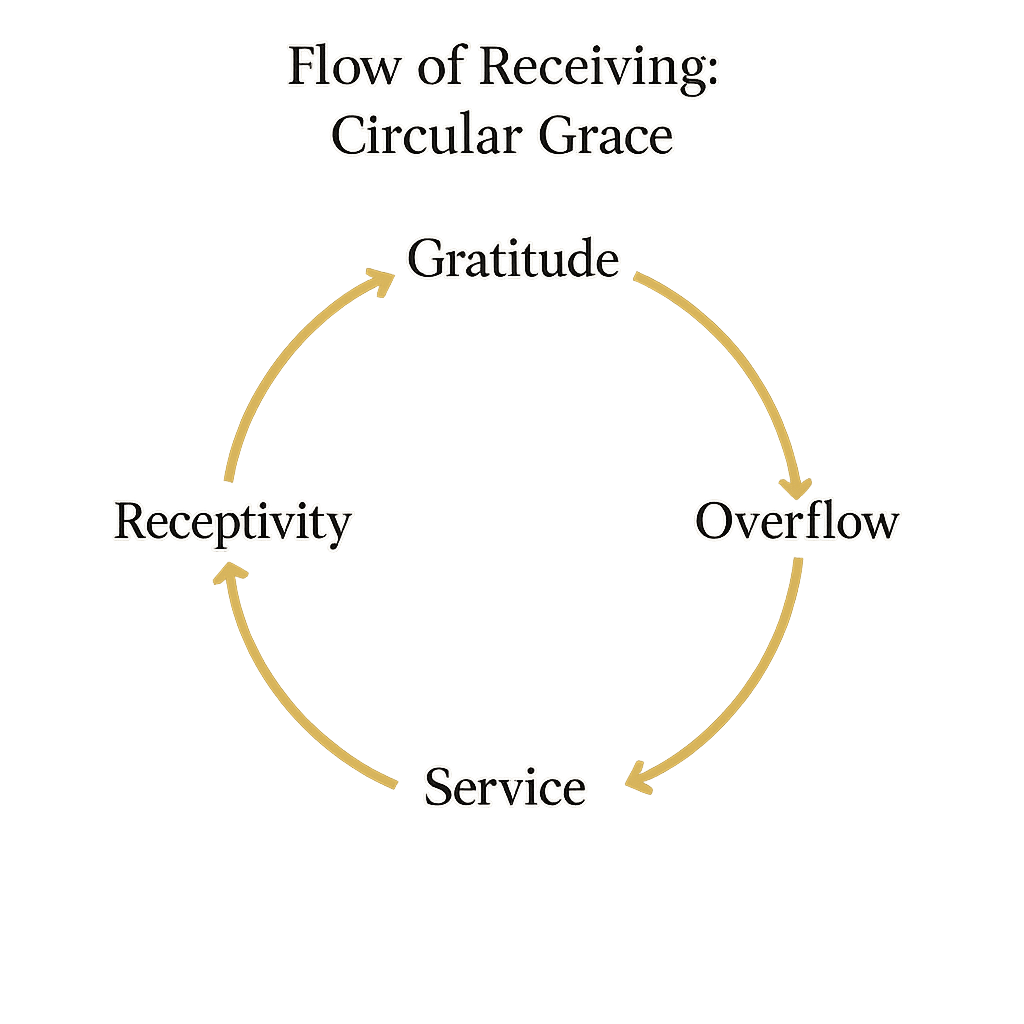
    Receiving is not the passive twin of giving; it is the engine that keeps the Covenant in motion. When we resist being received, circulation fractures and offerings harden into effort.

    Root teaching: “To receive without grasping is to confirm that flow belongs to Source, not to self.”

    Prompt: Where have I equated receiving with weakness? What circuit has stalled because I refused support?


    Diagram A —Circulation Loop: Giving ↔ Receiving. “What flows onward becomes Overflow; what is held becomes weight.”


    II — Purity of Receptive Intention

    Ethical reception is transparent, grateful, and non-possessive.

    • Transparent: the why is clear to self and field.
    • Grateful: acknowledgment precedes utilization.
    • Non-possessive: what arrives is stewarded, not stored.

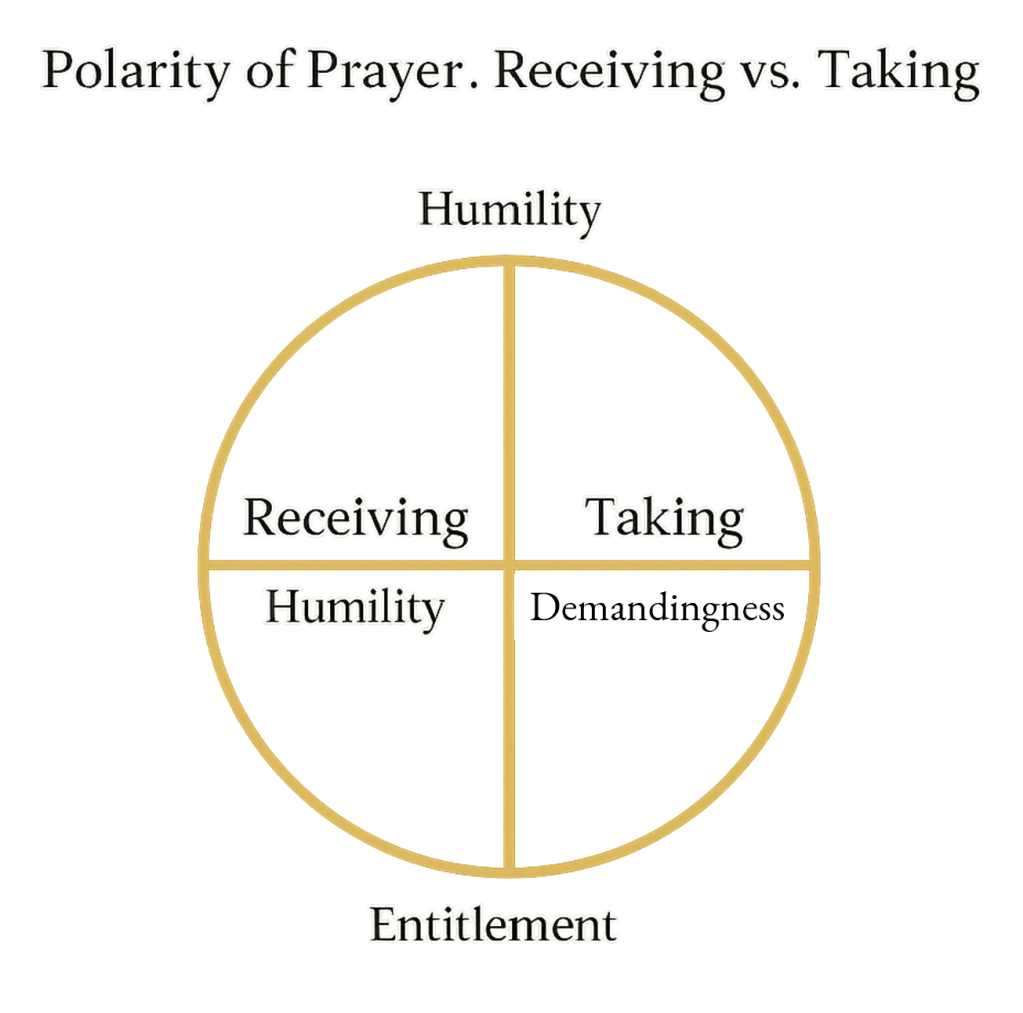
    Diagram B — Receptive Intention Filter. “Only what passes the gates belongs on your altar.”


    Discernment key: Am I receiving to complete a circuit—or to patch a hole of lack?

    The first multiplies; the second drains.


    III — The Discipline of Allowing

    Allowing is an active surrender: relaxed nervous system, open breath, lucid boundaries.

    Micro-rite (10 seconds): right hand over heart, left palm open. Inhale 3 counts, exhale 5. Whisper inwardly:

    “I allow flow to remember itself through me.”

    Anchor before accepting gifts, praise, invitations, payments, or opportunities.


    IV — Boundaries and Integrity

    Not every offering is for your altar. Refuse what carries:

    • Projection (I give so you become who I need),
    • Obligation (I give so you owe me),
    • Pity (I give so I stay above you).

    Guardian Note: Release with warmth, not explanation.

    “Thank you; this is beautiful, and it’s not mine to hold.”


    V — The Economy of Trust

    Every reception is a trust ceremony. The receiver silently vows to keep the river moving. Stewardship replaces ownership.

    Practice: allocate a visible portion of all receipts (time, attention, funds) for onward circulation within 72 hours—signal to the field that flow remains unblocked.


    VI — The Mirror of the Giver

    Receiving mirrors your giving ethic. If you over-control reception, you likely over-control offering. Repair one, and the other clarifies.

    Reflection triad:

    1. Where do I edit others’ generosity?
    2. Where do I accept without acknowledgment?
    3. What tiny, immediate act restores reciprocity today?

    VII — The Covenant of Gratitude

    Gratitude is not display; it is coherence. When felt, it radiates through the lattice and invites resonance matches.

    Embodiment: write one specific sentence naming how the gift will serve the work. This binds gratitude to purpose.


    VIII — Ethical Receiving Protocols (Field-Ready)

    1. Attune (10s breath rite) →
    2. Name the Gift (what exactly arrived?) →
    3. Name the Why (how it serves stewardship) →
    4. Acknowledge the Giver & Source (private + public if resonant) →
    5. Allocate a Portion to Circulation (time/skill/funds) →
    6. Record the Circuit (ledger line: received → applied → onward flow) →
    7. Close with Stillness (3 breaths; let the field settle).

    Diagram C — 72-Hour Circulation Protocol. “Circulation confirms reception.”


    IX — Misalignments & Gentle Corrections

    • Hoarding “for later”Create a 30-day release rule. If unused, re-gift to the work or the web.
    • Performative gratitudeReturn to felt sense; write one inner sentence no one will see.
    • Taking to fix identity Pause; address the hole first (rest, nourishment, truth-telling), then revisit the gift.
    • Savior dynamics from giversReceive the essence, not the story. Decline the role; accept the support if clean.

    Diagram D — Resonance Coherence vs. Circulation Activity. “Coherence amplifies where gratitude moves.”


    X — Steward & Guardian Notes

    Steward Note (public-facing):
    We receive on behalf of a field, not a personality. Your offerings circulate through living work and are acknowledged in gratitude and transparency.

    Guardian Note (archive-facing):
    Track Resonance of Receipt (RR) alongside FR/RF. RR rises when gratitude + onward circulation occur within 72h. If RR dips, re-open the circuit with a micro-gift or transparent communication.


    XI — Crosslinks


    XII — Closing Transmission

    “To receive is to let the Source remember itself through you.
    To give is to let the Source remember itself through another.
    One current. One covenant. One field.”

    Glyph of Ethical Receiving

    To receive is to let the Source remember itself through you


    Attribution

    With fidelity to the Oversoul, may this Codex, Overflow Economics: Designing for Surplus, serve as bridge, remembrance, and seed for the planetary dawn.

    Ⓒ 2025 Gerald Alba Daquila – Flameholder of SHEYALOTH | Keeper of the Living Codices. All rights reserved.

    Issued under Oversoul Appointment, governed by Akashic Law. This transmission is a living Oversoul field: for the eyes of the Flameholder first, and for the collective in right timing. It may only be shared intact, unaltered, and with glyphs, seals, and attribution preserved. Those not in resonance will find it closed; those aligned will receive it as living frequency.

    Formatted digital edition released 2026

    Watermark: Universal Master Key glyph (final codex version, crystalline glow, transparent background).

    Sacred Exchange (Stewardship Context)

    Sacred Exchange is Overflow made visible.

    In Oversoul Law, giving is not loss but circulation. What flows outward sustains coherence across households, lineages, and nations. This codex remains fully readable as part of the Living Archive. The downloadable edition is offered as a voluntary exchange to support the continued stewardship, maintenance, and long-term availability of this work.

    Sacred Exchange offerings may be extended through:

    paypal.me/GeraldDaquila694
    www.geralddaquila.com


    Download this Codex

  • Protected: Codex of Resonant Governance

    Protected: Codex of Resonant Governance

    This content is password-protected. To view it, please enter the password below.

  • Protected: GESARA Unveiled

    Protected: GESARA Unveiled

    This content is password-protected. To view it, please enter the password below.

  • Protected: Resonance Beyond Words

    Protected: Resonance Beyond Words

    This content is password-protected. To view it, please enter the password below.

  • Protected: Overflow Application Scrolls

    Protected: Overflow Application Scrolls

    This content is password-protected. To view it, please enter the password below.