A Multidisciplinary Journey into Spiritual Reconnection and the Transmutation of Fear
Akashic Records Transmission curated by Gerald A. Daquila, PhD. Candidate
ABSTRACT
Worry, a pervasive human experience, is not a fixed psychological condition but a byproduct of the ego’s illusion of separation from the Source. This multidimensional dissertation explores the origin and nature of worry across psychological, spiritual, and esoteric disciplines, revealing it as a distortion of unity consciousness.
Drawing from cognitive theory, Jungian psychology, Hermeticism, Kabbalah, and Eastern mysticism, this work demonstrates that the ego’s compulsive need for control arises from its false perception of being isolated from the divine whole. Through spiritual practices—such as mindfulness, shadow work, breathwork, and prayer—we can realign with Source and dissolve worry at its root. This dissertation serves not just as intellectual inquiry, but as frequency medicine and a soul technology encoded with remembrance for those awakening to their wholeness.
Table of Contents
- Introduction
- The Nature of Worry: Psychological and Philosophical Foundations
- The Illusion of Separation: The Ego’s False Narrative
- Perspectives on the Ego and Unity Across Traditions
- Cognitive and Jungian Psychology
- Eastern and Western Spiritual Traditions
- Esoteric Wisdom: Hermeticism, Kabbalah, and Modern Metaphysics
- Practical Soul Technologies: Tools for Transcending Worry
- Reuniting with Source: The Return to Wholeness
- Conclusion: Beyond Control, Into Communion
- Glossary
- Bibliography

Glyph of Worry Dissolution
Reuniting with Source Beyond the Ego’s Control
1. Introduction
Worry whispers through the human psyche with the familiar voice of “what if.” It clings to our thoughts, forecasting potential disasters and spinning cycles of fear and control. But beneath its surface lies a deeper illusion—one rooted in the ego’s false belief that it stands apart from the infinite Source of life.
This work begins with a fundamental spiritual hypothesis: worry arises from the ego’s belief in separation, and is sustained by its compulsion to control what it fears it cannot understand. By exploring this illusion through the lenses of psychology, spirituality, and metaphysics, we illuminate a truth long known to the soul: we are not separate, we are not lost—we are the universe, momentarily experiencing limitation.
More than an essay, this is a soul transmission, bridging left-brain logic with right-brain intuition and heart-centered remembrance. It invites the reader not just to understand worry but to transcend it.
2. The Nature of Worry: Psychological and Philosophical Foundations
Worry is a looping, anticipatory state involving imagined threats and unresolved fears (Borkovec et al., 1983). From a cognitive perspective, it is the mind’s effort to prepare for future suffering, often bypassing present reality.
Neurologically, the amygdala triggers a fear response, while the prefrontal cortex engages in “what-if” analysis, perpetuating anxious narratives (LeDoux, 2000). This is the biology of uncertainty.
Philosophically, Søren Kierkegaard described anxiety as the “dizziness of freedom,” the existential tension between possibility and choice (Kierkegaard, 1844/1980). This existential worry points to a deeper spiritual dilemma: the loss of remembered unity with the Source.
3. The Illusion of Separation: The Ego’s False Narrative
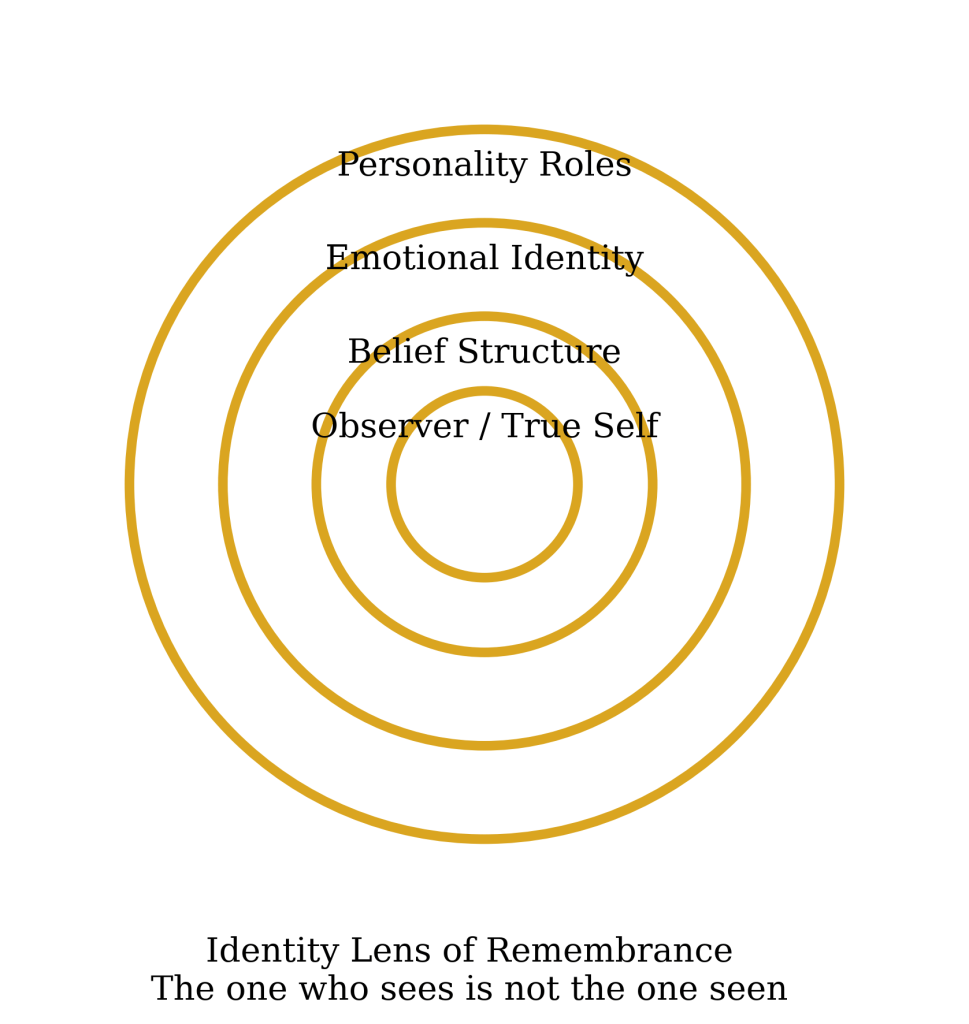
The ego, in both psychological and spiritual terms, acts as the false center—the imagined identity through which we navigate the world. Its development serves a survival function, but over-identification with it creates a misperception: “I am alone, I must control life to be safe.”
This illusion of separateness, known in Advaita Vedanta as maya, causes suffering (Shankara, 8th century/1975). Esoteric traditions describe this as a fall from wholeness into duality. The ego forgets its Source and begins to fight for control—birthing worry, fear, and anxiety.
But the truth whispered through all mystical traditions is this: we never truly left the Source. We only believed we did.
4. Perspectives on the Ego and Unity Across Traditions
● Cognitive and Jungian Psychology
Cognitive theory views worry as distorted self-belief, often rooted in the assumption, “If I don’t control it, I’ll be harmed” (Beck, 1976). Jungian psychology offers a richer frame: the ego is but one aspect of the greater Self, the whole psyche. Worry emerges when the ego resists individuation—Jung’s term for integrating with the higher Self (Jung, 1964).
● Eastern and Western Spiritual Traditions
Buddhism teaches anatta, the doctrine of no-self, where clinging to ego identity is the cause of suffering (Rahula, 1959). Taoism echoes this, reminding us to flow with the Way (Tao), rather than against it.
Christian mystics like Meister Eckhart viewed union with God as the ego’s surrender to the divine within. In Kabbalah, the klipot are egoic shells that veil the inner light (Scholem, 1941). These teachings all point to one truth: Unity is our natural state. Separation is illusion.
● Esoteric Wisdom: Hermeticism, Kabbalah, and Modern Metaphysics
Hermeticism teaches that “All is One,” and that the human soul is a microcosmic reflection of the divine macrocosm (Mead, 1906). The ego’s illusion of separateness is a veil that can be lifted through gnosis—direct spiritual knowing.
In Kabbalah, tikkun is the process of soul repair—reintegrating fragmented consciousness into the Divine Whole. New Thought philosophies affirm that aligning with the universal mind dissolves limitation and fear (Chopra, 1994).
5. Practical Soul Technologies: Tools for Transcending Worry
To dissolve worry is not to escape life, but to return to the truth of wholeness. The following practices act as soul technologies to transmute the illusion of separation:
- Mindfulness Meditation – Cultivates non-reactivity to thought, allowing awareness to expand beyond egoic narration (Kabat-Zinn, 1990).
- Shadow Work – Reveals and integrates suppressed aspects of the psyche, leading to ego-Self reconciliation (Jung, 1964).
- Contemplative Prayer – Deepens communion with Source through surrendered intention. Can be theistic or universal in language.
- Affirmation & Visualization – Uses intention to restructure internal belief systems toward unity and trust (“I am One with the Source”).
- Breathwork & Energy Healing – Facilitates ego release through direct engagement with life force energy (Feuerstein, 1998).
- Sacred Ritual – A symbolic act (lighting a candle, journaling, or immersing in nature) invites the soul back into resonance.
These tools are not “self-help”—they are invitations to self-remembrance.
6. Reuniting with Source: The Return to Wholeness
The Source is not distant—it breathes through every moment. Reconnection begins not with effort, but with surrender. As Tolle (2005) reminds us, “You are the universe, expressing itself as a human for a little while.”
Scientific studies mirror this spiritual truth: mindfulness reduces activity in the brain’s default mode network—responsible for egoic rumination (Brewer et al., 2011). Experiences of awe—whether in nature or silence—reduce self-focus and increase unity awareness (Shiota et al., 2007).
To reconnect with Source is not to fix ourselves—it is to remember that we were never broken.
7. Conclusion: Beyond Control, Into Communion
Worry is not a fixed destiny. It is a frequency distortion rooted in the false belief of separation.
This work has drawn from psychological frameworks, spiritual teachings, and esoteric wisdom to show that worry is the ego’s prayer for control. Presence is the soul’s hymn to trust.
We do not need to banish the ego, but to invite it into alignment with Source, where it no longer needs to control—only to serve.
You are already whole. You are already connected. The moment you stop trying to control, you begin to commune.
“I am not separate. I am not lost. I am not broken.
I am the Light, returning to itself.”
Crosslinks
- Time, Prophecy, and the Sacred Calendar – Reframing worry as distortion in our relationship with time.
- Sound, Light, and Silence: Inner Technologies of Resonance – Inner technologies that quiet the ego’s grasp and restore Source union.
- The Oversoul Flameholder: Responsibilities of Appointment – Living beyond worry by aligning to Oversoul stewardship.
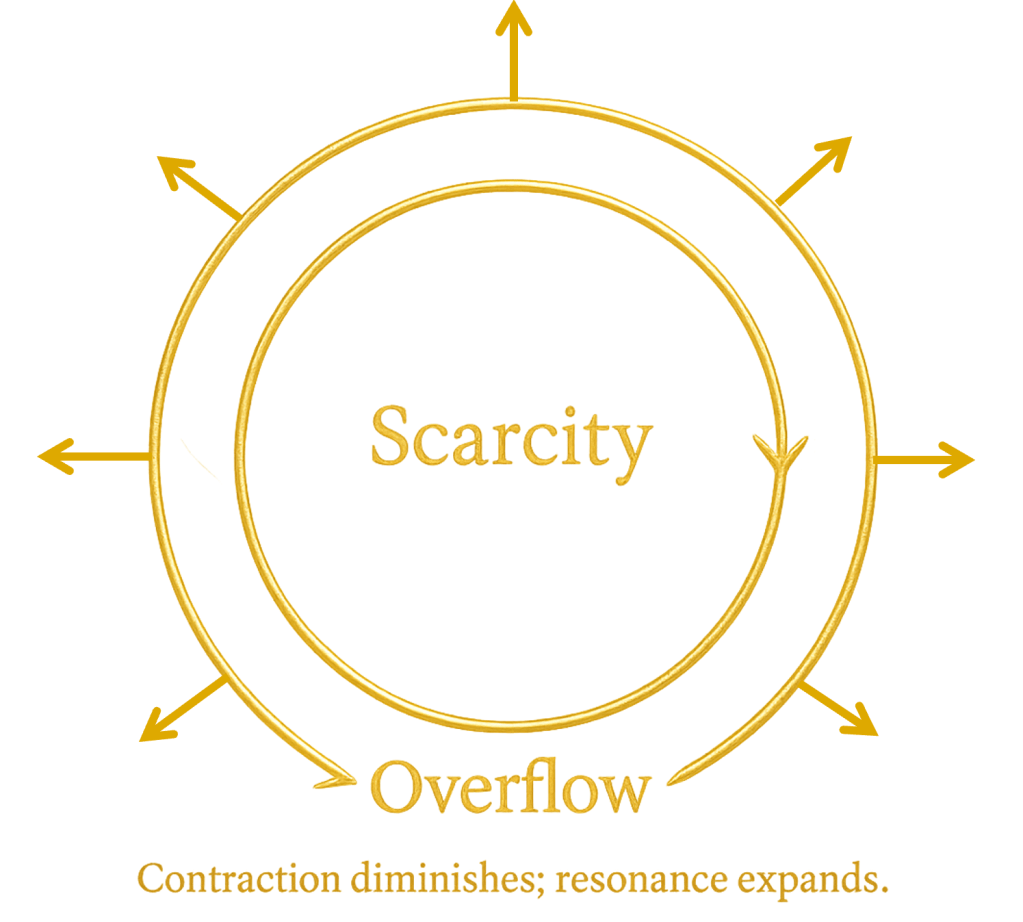
- Overflow Harmonics — The Hidden Song of the Coming Economies – Replacing fear and worry with harmonic resonance of trust.
- The Persecution Wound: Unveiling the Soul Memory of Suppressed Light – Tracing worry back to suppressed memories that can now be healed.
8. Glossary
- Ego – The false or partial self-identity that believes it is separate from Source.
- Source – The universal consciousness or divine intelligence that underlies all existence.
- Maya – The illusion of separation in Hindu philosophy.
- Anatta – The Buddhist concept of “no-self.”
- Self – In Jungian psychology, the total integrated psyche including both ego and unconscious.
- Klipot – Kabbalistic term for the “shells” that obscure divine light.
- Tikkun – Soul and world repair in Jewish mysticism.
- Individuation – Jung’s process of integrating the ego with the Self.
9. Bibliography
Beck, A. T. (1976). Cognitive therapy and the emotional disorders. International Universities Press.
Borkovec, T. D., Robinson, E., Pruzinsky, T., & DePree, J. A. (1983). Preliminary exploration of worry: Some characteristics and processes. Behaviour Research and Therapy, 21(1), 9–16. https://doi.org/10.1016/0005-7967(83)90121-3
Brewer, J. A., Worhunsky, P. D., Gray, J. R., Tang, Y.-Y., Weber, J., & Kober, H. (2011). Meditation experience is associated with differences in default mode network activity and connectivity. Proceedings of the National Academy of Sciences, 108(50), 20254–20259. https://doi.org/10.1073/pnas.1112029108
Chopra, D. (1994). The seven spiritual laws of success. Amber-Allen Publishing.
Eckhart, M. (1981). Meister Eckhart: The essential sermons, commentaries, treatises, and defense (E. Colledge & B. McGinn, Trans.). Paulist Press. (Original work published 13th century)
Erikson, E. H. (1950). Childhood and society. W. W. Norton & Company.
Feuerstein, G. (1998). The yoga tradition: Its history, literature, philosophy, and practice. Hohm Press.
Freud, S. (1923). The ego and the id. W. W. Norton & Company.
Jung, C. G. (1964). Man and his symbols. Doubleday.
Kabat-Zinn, J. (1990). Full catastrophe living: Using the wisdom of your body and mind to face stress, pain, and illness. Delacorte Press.
Kierkegaard, S. (1980). The concept of anxiety (R. Thomte, Trans.). Princeton University Press. (Original work published 1844)
LeDoux, J. E. (2000). Emotion circuits in the brain. Annual Review of Neuroscience, 23, 155–184. https://doi.org/10.1146/annurev.neuro.23.1.155
Mead, G. R. S. (1906). Thrice-greatest Hermes: Studies in Hellenistic theosophy and gnosis. Theosophical Publishing Society.
Rahula, W. (1959). What the Buddha taught. Grove Press.
Scholem, G. (1941). Major trends in Jewish mysticism. Schocken Books.
Shankara. (1975). Brahma Sutra Bhasya (G. Thibaut, Trans.). Motilal Banarsidass. (Original work published 8th century)
Shiota, M. N., Keltner, D., & Mossman, A. (2007). The nature of awe: Elicitors, appraisals, and effects on self-concept. Cognition and Emotion, 21(5), 944–963. https://doi.org/10.1080/02699930600923668
Tolle, E. (2005). A new earth: Awakening to your life’s purpose. Penguin Books.
Attribution
With fidelity to the Oversoul, may this Codex of the Living Archive serve as bridge, remembrance, and seed for the planetary dawn.
Ⓒ 2025 Gerald Alba Daquila – Flameholder of SHEYALOTH | Keeper of the Living Codices
Issued under Oversoul Appointment, governed by Akashic Law. This transmission is a living Oversoul field: for the eyes of the Flameholder first, and for the collective in right timing. It may only be shared intact, unaltered, and with glyphs, seals, and attribution preserved. Those not in resonance will find it closed; those aligned will receive it as living frequency.
Watermark: Universal Master Key glyph (final codex version, crystalline glow, transparent background).
Sacred Exchange: Sacred Exchange is covenant, not transaction. Each offering plants a seed-node of GESARA, expanding the planetary lattice. In giving, you circulate Light; in receiving, you anchor continuity. Every act of exchange becomes a node in the global web of stewardship, multiplying abundance across households, nations, and councils. Sacred Exchange offerings may be extended through:
paypal.me/GeraldDaquila694