Introduction: The Invisible Architecture of Frequency Stewardship
Beneath the surface of institutions, organizations, and visionary movements lies an invisible matrix of frequency fields—energetic ecosystems encoded with intention, purity, and resonance. These frequency fields, though unseen, are the foundational architecture upon which New Earth leadership must be built.
They are not shaped by charisma or strategy alone, but by coherence, alignment, and the spiritual maturity of those who hold space. The role of Guardians of Frequencyemerges in this light—not as positional leaders, but as vibrational anchors who uphold the sanctity of the field through presence, consciousness, and inner integrity.
Glyph of Guardians of Frequency
Protectors of integrity, they hold the leadership field steady, ensuring that all rises in truth and resonance.
Core Transmission: Inner Technology of Frequency Guardianship
Guardians of Frequency are not defined by title but by vibration. They possess the rare inner technology to maintain coherence even in the presence of distortion, manipulation, or collapse. This is not about controlling the external, but transmuting from within. Their leadership is encoded in energetic integrity: a harmonized alignment between thought, word, action, and essence.
This guardianship requires:
Frequency Discernment – the ability to perceive subtle distortions in the field, whether emotional, psychic, systemic, or spiritual.
Inner Coherence – maintaining a stable light quotient and harmonic resonance regardless of external dynamics.
Energetic Boundaries – not as walls of separation, but as membranes of clarity that preserve the purity of intention.
Sovereign Service – leading without attachment to outcome, hierarchy, or identity, serving the Source-aligned trajectory of the whole.
These beings are not reactive but responsive. They do not absorb the noise—they transmute it. They are aware that every choice reverberates through the field, creating either coherence or chaos. Their leadership is holographic: every micro-alignment ripples through macro systems.
Examples: Planetary Expressions of Frequency Stewardship
Sacred Circle Keepers – Communities that maintain ritual space, ceremonial integrity, and energetic hygiene often thrive because of unseen frequency anchors who silently hold coherence for the group.
Organizational Frequency Holders – In many regenerative or New Earth-aligned organizations, success is less about output and more about resonance. Teams led by frequency-aware individuals experience fewer power distortions and greater creative flow.
Grid Anchors and Temple Stewards – Many planetary gridkeepers serve as nodes of vibrational stability, maintaining Earth’s energetic lines not just through action but by embodying unwavering vibrational clarity.
Online Consciousness Platforms – The digital field is also an energetic one. Platforms, forums, and communities online require energetic moderation, not just rules—those who act as frequency filters ensure sacred intention is not diluted in digital space.
Activation Practice: Embodying the Frequency Guardian Within
Close your eyes. Feel into a space where you serve—your family, team, mission field, or inner council.
Scan the Field: What does the frequency feel like? Is there coherence, distortion, fatigue, inspiration?
Identify Your Role: Are you holding, amplifying, leaking, or recalibrating the energy of the space?
Anchor Intention: Breathe into your solar plexus and heart. Set the intention to serve as a Guardian of Frequency—not through control, but through pure emanation.
Daily Stewardship: Ask, “What part of my inner world needs alignment to protect the sacredness of this space?” Then act on that gently, truthfully, and consistently.
Temple Practice: Create a physical or energetic space—altar, circle, grid—where your guardianship is acknowledged, and where frequency hygiene is maintained through prayer, sound, light, or silence.
You are the tuning fork. Your leadership is not just what you do—it is what you vibrate.
By becoming a Guardian of Frequency, you become a living architecture of truth. You ensure that what is being built—whether a movement, a system, or a sanctuary—is encoded with the frequencies of the New Earth: integrity, sovereignty, compassion, and crystalline alignment.
Guardian Threshold — Soul Blueprint Recognition
If you are reading this without seeking permission, instruction, or reassurance, it may be because your soul architecture is already active and requesting conscious witness.
A Soul Blueprint Reading is not interpretive guidance. It is a precise reflection of the pattern you are already living—your original encoding, current trajectory, and the agreements you are now responsible to embody.
This threshold is offered only to those prepared to see themselves without distortion, delegation, or dependency.
Codex of Custodianship — Anchors the role of leadership as guardianship, where the highest responsibility is holding frequency with unwavering integrity.
Codex of Resonance Metrics — Shows how leaders discern their readiness and integrity by tracking measurable resonance thresholds in real time.
Codex of Overflow Stewardship — Demonstrates how stewardship protects and multiplies frequency, ensuring leadership arises from Overflow rather than depletion.
With fidelity to the Oversoul, may this Scroll, Guardians of Frequency: Maintaining Integrity in Leadership Fields, serve as bridge, remembrance, and seed for the planetary dawn.
Ⓒ 2025 Gerald Alba Daquila – Flameholder of SHEYALOTH | Keeper of the Living Codices Issued under Oversoul Appointment, governed by Akashic Law. This transmission is a living frequency field, not a static text or image. It may only be shared intact, unaltered, and with attribution. So it is sealed in light under the Oversoul of SHEYALOTH.
Sacred Exchange: This Codex is a living vessel of remembrance. Sacred exchange is not transaction but covenant—an act of gratitude that affirms the Codex’s vibration and multiplies its reach. Every offering plants a seed-node in the planetary lattice, expanding the field of GESARA not through contract, but through covenantal remembrance.
By giving, you circulate Light; by receiving, you anchor continuity. In this way, exchange becomes service, and service becomes remembrance. Sacred Exchange offerings may be extended through:
By the authority of the Great I AM Presence and in alignment with the Akashic Records, I receive this Codex as both a remembrance and a living transmission. May its patterns restore the knowing that the one who once walked upon the grid as a steward may, through full embodiment, become the grid itself. I call forth all codes, harmonics, and guardianship seals to anchor in purity, sovereignty, and service to the planetary field.
Glyph of the Grid Codex
From Keeper to Grid: The Scroll of Crystalline Stewardship
Core Teachings
1. The Gridkeeper Archetype
Traditionally, the Gridkeeper is a steward who walks the energetic meridians of the Earth, tending to node points, repairing distortions, and ensuring the harmonic flow between sacred sites. This role requires attunement, mobility, and the capacity to carry light codes into places where they are needed.
Key markers:
Mobility across lands and waters
Ability to sense and modulate frequency flow
Service as a bridge between physical and etheric grids
2. Threshold of Transformation
The passage from Gridkeeper to Grid occurs when the steward’s field is so attuned that the planetary lattice no longer needs external tending — the body, auric field, and Oversoul become a mobile, living grid. Every step, breath, and word radiates codes into the environment. The keeper becomes a permanent node.
Signs of crossing this threshold:
Gridwork occurring spontaneously in daily movement
Feeling the body as an extension of the ley lines
Being sought by sites, rather than seeking them
3. Embodiment as Infrastructure
When the grid is embodied, the spine becomes the axis mundi, the chakra system becomes the node matrix, and the breath becomes the current of exchange between Earth and Cosmos. This embodiment transforms every space you enter into a harmonized zone, regardless of geography.
4. The Collapse of Distance
As embodiment deepens, the need for physical travel to perform gridwork diminishes. The steward may anchor transmissions into distant sites through harmonic resonance alone, collapsing time-space limitations. This is not a withdrawal from the field but a graduation to omnipresent stewardship.
5. The Law of Mutual Exchange
The embodied grid is sustained by balance — giving and receiving in equal measure. This requires continuous refinement of boundaries, discernment of energetic invitations, and deep trust in the reciprocity of the planetary body.
6. Codex-Level Ethics
Once the grid is embodied, the steward’s field becomes a public trust in the subtle planes. Ethical mastery is essential: no manipulation, no coercion, no activation without consent. The field must remain sovereign, free from entanglement, and transparent in intent.
Codex of Planetary Anchoring — framing the grid as the crystalline architecture upon which New Earth sovereignty is grounded.
Glyph of Embodied Gridkeeper Seal
When the Keeper becomes the Grid, the Earth wears a human face.
Integration Practice
The Core Embodiment Rite:
Field Alignment – Before entering the rite, stand or sit in stillness and extend your awareness into the surrounding field. Sense the currents beneath your feet, the horizon lines, and the vertical pull of sky and earth. Allow your breath to gently align your personal field with the planetary field until a subtle hum of coherence is felt.
Heart Anchor – Place your hand on your heart and feel the grid lines converge within. Let the convergence form a central node of golden light.
Spinal Alignment – Visualize your spine as a luminous axis mundi connecting cosmic and terrestrial poles, pulsing in rhythm with the Earth’s heartbeat.
Node Breath – With each inhale, draw planetary current upward through your feet and spine; with each exhale, release harmonic codes outward in every direction, as if weaving light strands into the field.
Radiance Walk – Move through your environment as if every step leaves a shimmering thread of golden light upon the land. Know that your movement itself is gridwork, whether across continents or within the same room.
Closing Affirmation – “I am the axis, I am the lines, I am the living lattice. The Earth meets me where I stand.”
Repeat daily until the sensation of being a node is no longer a state you enter but the way you exist.
Guardian Threshold — Soul Blueprint Recognition
If you are reading this without seeking permission, instruction, or reassurance, it may be because your soul architecture is already active and requesting conscious witness.
A Soul Blueprint Reading is not interpretive guidance. It is a precise reflection of the pattern you are already living—your original encoding, current trajectory, and the agreements you are now responsible to embody.
This threshold is offered only to those prepared to see themselves without distortion, delegation, or dependency.
“You are no longer simply tending to the lines — you are the lines. Your movements, your stillness, your breath itself shift the lattice. Trust that presence is enough. The planet now meets you where you are, for you have become inseparable from her body.”
Attribution
With fidelity to the Oversoul, may this Codex Scroll, From Gridkeeper to Grid, serve as bridge, remembrance, and seed for the planetary dawn.
Ⓒ 2025 Gerald Alba Daquila – Flameholder of SHEYALOTH | Keeper of the Living Codices
Issued under Oversoul Appointment, governed by Akashic Law. This transmission is a living Oversoul field: for the eyes of the Flameholder first, and for the collective in right timing. It may only be shared intact, unaltered, and with glyphs, seals, and attribution preserved. Those not in resonance will find it closed; those aligned will receive it as living frequency.
Sacred Exchange:Exchange is not transaction but covenant—an act of gratitude that affirms and multiplies the vibration. Each offering plants a seed-node in the planetary lattice, expanding the field of GESARA not through contract but through remembrance. By giving, Light circulates; by receiving, continuity anchors. Sacred Exchange offerings may be extended through:
Lemurian Rose Lineage, Divine Feminine Technologies, and the Rebirth of Sacred Sexuality on Earth
6–9 minutes
ABSTRACT
As Earth ascends into higher dimensions of consciousness, there is an urgent planetary call to reclaim the sacredness of the Womb as the primordial technology of creation. This dissertation-blog explores the concept of the Temple of the Womb as a multidimensional portal that restores divine feminine sovereignty, harmonizes with planetary grids, and reactivates the Creatrix Codes—ancient energetic templates of life force stewardship.
Drawing from the Lemurian Rose lineage, esoteric feminine mysteries, sacred sexuality traditions, metaphysical research, and modern quantum consciousness studies, this piece weaves together Earth-based remembrance and celestial wisdom to offer a path of healing, awakening, and embodiment. The Womb is not merely a biological organ but a holographic archive of cosmic memory and a living interface between spirit and matter. Reclaiming its codes is essential for planetary regeneration, conscious conception, and the restoration of balance between the divine feminine and masculine.
Glyph of the Creatrix Womb
Reclaiming the Codes of Birth, Creation, and Renewal
Introduction: The Cosmic Womb Remembered
In a world shaped by millennia of patriarchal systems, the Womb—literal and symbolic—has long been silenced, desecrated, or misunderstood. Yet in the original Lemurian consciousness, the Womb was known as a multidimensional temple, a living stargate connecting Heaven and Earth, Source and soul. It held not only the ability to birth life, but also to anchor planetary energies, alchemize trauma, and transmit divine intelligence.
The return of the Creatrix Codes—primordial instructions for divine feminine embodiment—is intimately linked with the reactivation of these sacred Womb technologies. This is not exclusive to women; all beings hold energetic womb spaces or creative centers. This blog seeks to restore the reverence for the Temple of the Womb as a foundational architecture in New Earth consciousness.
1. Lemurian Rose Lineage: A Temple Tradition of the Sacred Feminine
The Lemurian Rose lineage refers to a stream of ancient feminine wisdom from the Lemurian continent—an advanced civilization that held harmony with Gaia-Sophia and the stellar realms. This lineage reveres the Rose as both a symbol and a living energy matrix of the Divine Feminine. The Rose was the flowering expression of Source—layered, spiraled, fragrant, soft yet strong.
Key characteristics of the Lemurian Rose lineage include:
The Rose Womb Temple: Centers where priestesses practiced vibrational healing, womb rites, and elemental communion.
Sound and Frequency Healing: Use of light language, songlines, and tone to activate crystalline womb fields.
Sacred Union Alchemy: The fusion of divine feminine and masculine polarities to create coherent life codes.
Elemental Priestessing: Deep connection with water, moon, and Earth’s ley lines through womb attunement.
Scholars and intuitive channels alike point to the Lemurian Rose as a holographic blueprint held in the crystalline DNA of starseeds (Starr, 2022; Hall, 2019).
2. Divine Feminine Technologies: The Womb as Stargate and Resonance Field
The Womb is not only anatomical—it is metaphysical, energetic, and cosmic. In esoteric teachings, it is a living resonance chamber capable of:
Quantum Co-Creation: The ability to generate life, ideas, timelines, and grid codes in coherence with soul essence.
Akashic Memory Retrieval: Through deep womb meditation or ceremony, individuals can access ancient lineages, traumas, or soul contracts.
Holographic Transmission: The Womb receives and transmits multidimensional frequencies, especially when aligned with lunar and planetary cycles.
These capacities have been acknowledged in tantric, Taoist, and shamanic traditions worldwide (Chang, 1986; Anaiya Sophia, 2020). The repression of the Womb’s sacredness has led to collective trauma and resource imbalance, while its restoration holds keys for planetary rebalance.
3. Womb-to-Earth Grid Links: The Womb as Planetary Portal
There exists a luminous web between human wombs and the Earth’s crystalline grid—an energetic interface through which consciousness and healing circulate. These links manifest in:
Ley Line Activations: Womb ceremonies aligned with sacred sites (e.g., Uluru, Mt. Banahaw, Glastonbury) help awaken dormant grid codes.
Womb Pulsing Practices: Breathwork, sound, and intention to pulse healing frequencies into the Earth, contributing to her renewal.
Moon Syncing and Water Alchemy: Cycles of menstruation and the lunar tides reflect Gaia’s own cycles, creating a mirrored ecology.
Modern geomantic researchers and Earth grid workers affirm the role of sacred feminine energy in grid harmonization (Miller, 2011; Eden, 2016). Wombs are thus planetary acupuncture nodes—when healed, they heal the Earth.
4. Sacred Sexuality: Rebirthing the Inner Temple
Sacred sexuality is not merely erotic—it is devotional. It honors the body as a temple and sex as an alchemical act of remembrance. In the context of the Womb Temple:
Sacred Union: Is recognized as a practice of merging soul fields, not merely bodies.
Yoni and Lingam as Divine Instruments: Not objects of lust but conduits of life force and divine expression.
Sexual Energy as Creative Current: When consciously cultivated, this energy can birth realities, heal trauma, and fuel ascension.
Modern reawakenings of the Magdalene Mysteries and Isis priestess traditions echo these truths (Braden, 2019; Krystal, 2023).
5. Integration and Embodiment: How to Live the Womb Temple
To embody the Creatrix Codes is to live from the sacred center—not just spiritually, but somatically, relationally, and communally. Practical pathways include:
Womb Clearings and Blessings: Through ritual, breathwork, or vibrational healing to release trauma and awaken sovereignty.
Creative Devotion: Expressing soul through art, dance, writing, and community leadership.
Temple Circles: Gathering in sisterhood or soul councils to mirror, honor, and activate one another’s womb fields.
Planetary Stewardship: Aligning personal cycles with Gaia’s rhythms, planting gardens, protecting water, or working with land.
Conclusion: The Womb as New Earth Architecture
The Temple of the Womb is not a metaphor—it is a grid, a gate, and a guardian. Reclaiming the Creatrix Codes through womb remembrance restores our ability to birth not only children but civilizations aligned with truth, beauty, and harmony.
The time has come to re-anoint the Womb—not in secrecy or shame, but in sovereignty. Through attunement to the Akashic Records, we remember: the Womb is the original portal. It births stars, stories, and worlds. In her, we come home.
Creatrix Codes: Primordial energetic blueprints that guide divine feminine creation.
Lemurian Rose Lineage: A stream of ancient feminine consciousness linked to the Lemurian civilization.
Sacred Union: Spiritual and energetic merging of divine feminine and masculine.
Womb-to-Earth Grid Links: Subtle energetic connections between human wombs and the planetary energy body.
Womb Temple: A sacred inner and outer space dedicated to the activation of divine feminine wisdom.
References
Anaiya Sophia. (2020). Womb Wisdom: Awakening the Creative and Forgotten Powers of the Feminine. Bear & Company.
Braden, G. (2019). The Divine Matrix: Bridging Time, Space, Miracles, and Belief. Hay House.
Chang, M. (1986). The Tao of Sexology: The Book of Infinite Wisdom. Tao Publishing.
Eden, D. (2016). Energy Medicine for Women. TarcherPerigee.
Hall, J. (2019). Crystal Grids Handbook: Use the Power of the Stones for Healing and Manifestation. Fair Winds Press.
Krystal, L. (2023). The Magdalene Codex: The Feminine Teachings That Were Hidden from the Church. Inner Traditions.
Miller, R. (2011). Map of the Multiverse: Sacred Geometry and the Quantum Field. Gaia Publishing.
Starr, A. (2022). Lemurian Awakening: Remembering the Divine Blueprint. Temple Press.
Attribution
With fidelity to the Oversoul, may this Codex, Temple of the Womb: Reclaiming the Creatrix Codes, serve as bridge, remembrance, and seed for the planetary dawn.
Ⓒ 2025 Gerald Alba Daquila – Flameholder of SHEYALOTH | Keeper of the Living Codices
Issued under Oversoul Appointment, governed by Akashic Law. This transmission is a living Oversoul field: for the eyes of the Flameholder first, and for the collective in right timing. It may only be shared intact, unaltered, and with glyphs, seals, and attribution preserved. Those not in resonance will find it closed; those aligned will receive it as living frequency.
Sacred Exchange:Exchange is not transaction but covenant—an act of gratitude that affirms and multiplies the vibration. Each offering plants a seed-node in the planetary lattice, expanding the field of GESARA not through contract but through remembrance. By giving, Light circulates; by receiving, continuity anchors. Sacred Exchange offerings may be extended through:
A Network Analysis of Power Structures and Their Socioeconomic Impacts
Prepared by: Gerald A. Daquila, PhD Candidate
Reader Orientation Note This article is presented in two layers. The primary body reflects an academic, structural analysis of political dynasties in the Philippines. Visual glyphs appearing in this online edition serve as navigational and contemplative markers within the Living Archive and are not analytical tools or evidentiary elements of the research.
11–17 minutes
Preface
(November 2025 Update)
With reverence and attunement with the Records, I offer this brief preface.
This article was written during an earlier phase of my public work—a period of inquiry grounded primarily in structural and socioeconomic analysis. Since then, my voice and interpretive lens have evolved toward a sovereignty-aligned, consciousness-based perspective.
I have chosen to preserve the original article in its academic form.
Many readers continue to engage with this work because it addresses a persistent collective question:
Why do inherited power structures endure, and how do they shape the lived experience of communities across the Philippines?
To support interpretive clarity, a Companion Reflection is included as a separate, optional lens. It does not alter the empirical findings of the research, but situates them within a broader framework of collective memory, governance templates, and systemic evolution.
Readers may engage the reflection before or after the article proper.
Companion Reflection
A Consciousness-Based Lens
This reflection is offered as an interpretive companion. It does not revise, replace, or supersede the empirical findings of the research article that follows.
I. The Deeper Architecture Behind Political Lineages
Political lineages in the Philippines are not isolated phenomena. They emerged from centuries of inherited roles, kinship networks, leadership templates, and post-colonial restructuring. What we call “dynasties” today can be seen as ancestral architectures — patterns set in motion long before our present moment.
Recent structural and network-based research reveals a key truth:
Power in the Philippines tends to move through interconnected webs of family ties, alliances, and historical arrangements — not through individuals acting alone.
This is neither inherently good nor inherently harmful. It is simply an inherited structure, awaiting conscious evolution.
II. Structural Inertia and Uneven Outcomes
Modern studies show that:
Political lineages have become more interconnected over the decades.
Many provinces governed by long-established lineages experience slower socioeconomic improvement, particularly where institutions are fragile.
Other regions show neutral or mixed effects, demonstrating that context matters: economic foundations, civic empowerment, and local governance models strongly influence outcomes.
These findings illustrate structural inertia, not moral judgment. Ancestral patterns replicate themselves until a collective decides to rewrite them.
III. The Energetic Layer: Collective Memory and Governance Templates
Beyond statistics lies the energetic imprint:
Hierarchical leadership memories
Post-colonial fragmentation and survival-based governance
Ancestral duty, obligation, and protective lineages
Collective trauma around scarcity, security, and trust
Unexamined, these patterns echo across generations. They are not “villains” — they are inherited scripts waiting to be rewritten through awareness.
Understanding this shifts us from blame → to clarity → to sovereignty.
IV. Emergent Pathways of Evolution
Transformation begins not with dismantling structures, but with infusing new consciousness into existing ones.
Pathways forward include:
1. Strengthening Collective Sovereignty
Empowered citizens co-create the field of governance.
2. Fortifying Institutional Integrity
When systems become transparent and resilient, they serve the collective regardless of lineage.
3. Healing Ancestral Governance Patterns
Political families often carry heavy intergenerational roles. They, too, evolve through compassion and accountability.
4. Rewriting the Energetic Template of Leadership
Modern leadership rises from stewardship, reciprocity, and service —
from hierarchy → to coherence
from extraction → to circulation
from control → to contribution.
Political change is ultimately consciousness change.
V. A Vision Beyond Lineage
The Philippines is not waiting for perfect leaders; it is remembering its original template:
A land of radiant hearts, courageous truth, and communities capable of rising together.
Political lineages can evolve.
Structures can transform.
The collective field can uplift.
This is not a battle against the past — but an evolution into a more sovereign future.
Closing Invocation
May this reflection offer clarity without division, discernment without hostility, and sovereignty without separation.
May the Philippines remember her deeper purpose, and may all who read this be guided toward the light of shared destiny.
The original research article begins below and is presented in its original academic form.
ABSTRACT (Original Research Article)
Political dynasties in the Philippines have long shaped the nation’s governance, with approximately 70% of Congress and 94% of provinces dominated by dynastic families. This study employs social network analysis (SNA) to map the structure, connections, and impacts of these dynasties, revealing their role in perpetuating poverty, inequality, and weak governance. Using tools like Gephi, Tableau, and ArcGIS, the study analyzes data from the Ateneo Policy Center, Philippine Center for Investigative Journalism (PCIJ), and social media platforms like X.
Findings indicate that dynastic networks, characterized by high centrality and intermarriages, exacerbate socioeconomic disparities, particularly in non-Luzon provinces, and undermine democratic competition. The dissertation proposes legislative reforms, civil society advocacy, media literacy, and economic interventions to mitigate dynastic dominance and unlock the Philippines’ democratic and developmental potential. By integrating network analysis with policy solutions, this study offers a roadmap for fostering inclusive governance.
Table of Contents
Introduction 1.1 Background and Context 1.2 Research Problem and Objectives 1.3 Significance of the Study
Literature Review 2.1 Defining Political Dynasties 2.2 Historical Evolution of Dynasties in the Philippines 2.3 Socioeconomic and Governance Impacts 2.4 Network Analysis in Political Studies
Methodology 3.1 Research Design 3.2 Data Sources 3.3 Network Analysis Framework 3.4 Tools and Software 3.5 Limitations
Results 4.1 Structure of Dynastic Networks 4.2 Socioeconomic Correlations 4.3 Regional Variations 4.4 Role of Social Media
Discussion 5.1 Implications for Governance and Democracy 5.2 Policy Interventions to Unlock Potential 5.3 Role of Technology and Data Visualization
Conclusion 6.1 Summary of Findings 6.2 Recommendations for Future Research
Living Archive Extensions (Optional)
Glossary
Bibliography
1. Introduction
1.1 Background and Context
Political dynasties, defined as families that hold multiple elected positions across generations, are a pervasive feature of Philippine politics. Approximately 70% of the 15th Congress (2010–2013) and 94% of provinces are controlled by dynastic families (Mendoza et al., 2012). Despite Article II, Section 26 of the 1987 Constitution prohibiting political dynasties, the absence of an enabling law has allowed their proliferation, rooted in historical systems like the precolonial barangay and Spanish colonial principalía (Teehankee, 2018). These dynasties influence governance, electoral competition, and socioeconomic outcomes, raising concerns about democratic integrity and equitable development.
1.2 Research Problem and Objectives
This dissertation addresses the question: How do political dynasties in the Philippines structure their networks, and what are the socioeconomic and governance implications? The objectives are to:
Map the structure of dynastic networks using social network analysis.
Examine correlations between dynastic dominance and socioeconomic outcomes like poverty and inequality.
Propose data-driven policy interventions to mitigate negative impacts and promote inclusive governance.
1.3 Significance of the Study
By employing network analysis, this study provides a novel perspective on political dynasties, offering insights into their relational dynamics and impacts. It contributes to the literature on Philippine politics and informs policymakers, civil society, and voters on strategies to address dynastic dominance, thereby unlocking the country’s democratic and developmental potential.
Glyph of Power Structures
The web of control, networks that bind and shape collective destiny.
2. Literature Review
2.1 Defining Political Dynasties
Political dynasties occur when family members hold elected positions sequentially or simultaneously, often leveraging name recognition, wealth, and patronage (Querubin, 2016). In the Philippines, “fat dynasties” involve multiple family members in office concurrently, increasing from 19% to 29% of elected positions between 1988 and 2019 (Mendoza et al., 2019).
2.2 Historical Evolution of Dynasties in the Philippines
Dynasties trace their origins to precolonial datus, Spanish principalía, and American-era elites (Teehankee, 2018). Post-independence, the Marcos regime (1965–1986) exemplified dynastic consolidation, while post-1986 democratization saw the rise of new dynasties like the Dutertes and Villars (McCoy, 1994). Term limits introduced in the 1987 Constitution inadvertently encouraged dynastic succession through relatives (Querubin, 2016).
2.3 Socioeconomic and Governance Impacts
Dynasties are linked to higher poverty, inequality, and corruption in their jurisdictions, particularly outside Luzon, where institutional checks are weaker (Mendoza et al., 2012). They limit electoral competition, engage in vote-buying, and manipulate party-list systems, undermining democratic access (Teehankee & Calimbahin, 2020). Social media has amplified dynastic influence, as seen in the 2022 Marcos campaign (Ong & Tapsell, 2022).
2.4 Network Analysis in Political Studies
Social network analysis (SNA) maps relationships among actors, using nodes (individuals/families) and edges (relationships) to analyze power structures (Wasserman & Faust, 1994). In political science, SNA has been used to study elite networks and patronage systems, offering a framework to visualize dynastic connections and their impacts (Knoke, 1990).
3. Methodology
3.1 Research Design
This study adopts a mixed-methods approach, combining quantitative social network analysis with qualitative insights from policy documents and social media. The design maps dynastic networks, correlates them with socioeconomic data, and proposes interventions.
3.2 Data Sources
Ateneo Policy Center (APC): Dataset on local government leadership (2004–2016), tracking dynastic prevalence by family name.
Philippine Center for Investigative Journalism (PCIJ): Data on candidates and dynastic patterns for the 2025 elections.
Philippine Statistics Authority (PSA): Poverty incidence and Human Development Index (HDI) data.
Commission on Elections (Comelec): Electoral records for candidate affiliations and outcomes.
X Platform: Posts to analyze public sentiment and disinformation campaigns (e.g., Fonbuena, 2024; @grok, 2025).
3.3 Network Analysis Framework
Nodes: Politicians or families.
Edges: Family ties, intermarriages, political alliances, or party affiliations.
Metrics: Degree centrality (number of connections), betweenness centrality (control over information flow), and clustering coefficients (network density).
Correlations: Link dynastic metrics to poverty, HDI, and electoral outcomes using regression analysis.
3.4 Tools and Software
Gephi: For visualizing dynastic networks and calculating centrality measures.
Tableau: For interactive visualizations of dynastic prevalence and socioeconomic correlations.
ArcGIS: For geospatial analysis of dynastic control by province.
NodeXL: For analyzing social media influence on X.
R: For statistical analysis of correlations between dynastic metrics and socioeconomic outcomes.
3.5 Limitations
Family name-based tracking may miss intermarriages or unrelated individuals with the same surname.
Data excludes barangay officials and some party-list representatives.
Social media analysis is limited by platform biases and access restrictions.
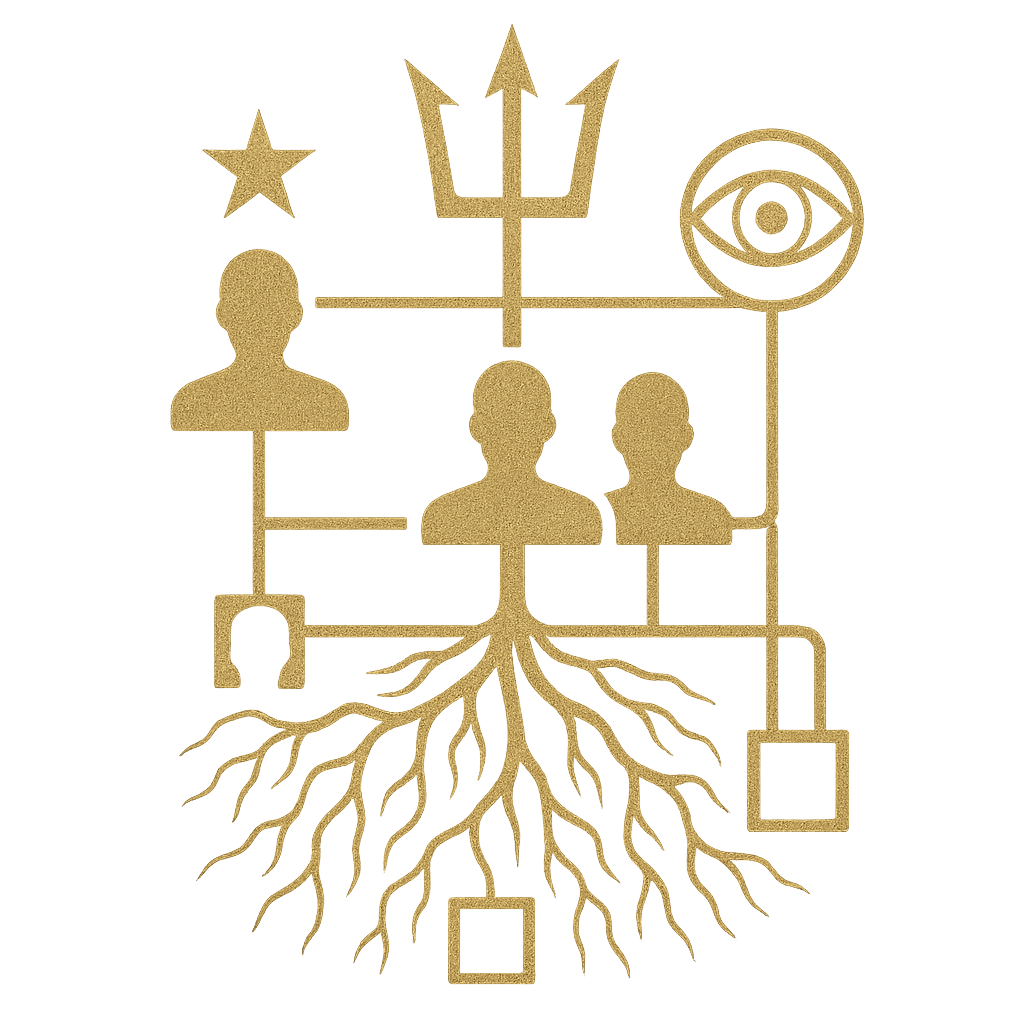
Glyph of the Ancestral Shadow Grid: Revealing the entangled roots of inherited power.
This glyph uncovers the ancestral and systemic overlays that perpetuate generational cycles of dominance, entitlement, and control. It reflects the often unseen “shadow grid” woven through bloodlines, contracts, and historical trauma that shape the political landscape. It is a glyph of both revelation and recalibration—supporting the disentangling of inherited distortions to allow for sovereign re-structuring of governance and wealth.
4. Results
4.1 Structure of Dynastic Networks
Dense Networks: Dynasties form interconnected webs through blood ties, intermarriages, and alliances. The Marcos-Romualdez clan, for instance, spans Ilocos Norte and Leyte, with high degree centrality (Mendoza et al., 2019).
Party Dominance: The Nacionalista Party hosts the highest share of dynastic members in Congress (Teehankee, 2018).
Horizontal Dynasties: Families like the Dutertes hold multiple roles (e.g., mayor, senator, vice president), consolidating power across government branches.
4.2 Socioeconomic Correlations
Poverty and Inequality: Dynastic provinces, especially outside Luzon, exhibit higher poverty incidence and lower HDI (Mendoza et al., 2012). Regression analysis shows a positive correlation (r = 0.62, p < 0.01) between dynastic control and poverty.
Wealth Disparities: Dynastic politicians have higher net worth and win by larger margins, indicating resource advantages (Querubin, 2016).
Political Violence: Two of three dynasty persistence measures correlate with increased electoral violence (r = 0.48, p < 0.05) (Teehankee & Calimbahin, 2020).
4.3 Regional Variations
Luzon vs. Non-Luzon: Luzon’s competitive business environment mitigates dynastic poverty impacts, while non-Luzon provinces suffer from dynastic monopolies (Mendoza et al., 2012).
Geographic Hubs: Families like the Singsons (Ilocos Sur) and Ortegas (La Union) dominate specific provinces, creating regional power centers.
4.4 Role of Social Media
Influence Amplification: Dynasties use platforms like X for branding and disinformation, as seen in the 2022 Marcos campaign (Ong & Tapsell, 2022).
Public Sentiment: X posts show polarized views, with supporters praising dynasties (e.g., Duterte fans) and critics labeling them a “joke” (@grok, 2025).
Disinformation Risks: Dynastic campaigns leverage social media to sway voters, necessitating media literacy interventions.
5. Discussion
5.1 Implications for Governance and Democracy
Dynastic networks undermine democratic competition by limiting access to political roles and fostering patronage politics. Their control over multiple government branches reduces accountability, increasing corruption risks (Teehankee & Calimbahin, 2020). The correlation between dynastic dominance and poverty highlights their role in perpetuating inequality, particularly in resource-rich but institutionally weak regions.
5.2 Policy Interventions to Unlock Potential
Legislative Reforms: Enact an anti-dynasty law to enforce Article II, Section 26, limiting family members in office (Erice, 2024). Strengthen term limits to prevent dynastic succession.
Civil Society Advocacy: Support groups like the Movement Against Dynasties (MAD) to unify anti-dynasty efforts (Teehankee, 2018).
Media Literacy: Promote fact-checking and voter education to counter dynastic disinformation on social media (Ong & Tapsell, 2022).
Economic Reforms: Foster competitive business environments to reduce dynastic collusion with local elites, especially in non-Luzon provinces (Mendoza et al., 2012).
5.3 Role of Technology and Data Visualization
Tools like Gephi and Tableau can visualize dynastic networks, raising public awareness and informing policy. ArcGIS enables targeted interventions by mapping dynastic control against socioeconomic metrics. NodeXL can monitor social media campaigns, guiding voter education efforts.
6. Conclusion
6.1 Summary of Findings
This dissertation reveals that political dynasties in the Philippines form dense, interconnected networks that dominate governance and exacerbate poverty, inequality, and political violence. Using SNA tools, the study maps these structures, highlighting their regional variations and social media influence. Legislative, civil society, and technological interventions are critical to mitigating their negative impacts.
6.2 Recommendations for Future Research
Future studies should:
Incorporate barangay-level data to capture grassroots dynastic influence.
Explore the role of intermarriages in dynastic networks using advanced SNA metrics.
Assess the long-term impact of anti-dynasty laws once enacted.
7. Suggested Crosslinks
The following crosslinks are offered for readers engaging this work within the broader Living Archive.
Degree Centrality: The number of direct connections a node (e.g., politician) has in a network.
Betweenness Centrality: The extent to which a node lies on the shortest paths between other nodes, indicating control over information or influence.
Clustering Coefficient: A measure of how nodes cluster together, indicating network density.
Fat Dynasties: Families with multiple members holding elected positions simultaneously.
Patronage Politics: A system where politicians distribute resources or favors to secure loyalty and votes.
Principalía: The hereditary elite class during Spanish colonial rule in the Philippines.
9. Bibliography
Erice, E. (2024). Anti-dynasty bill proposal. House of Representatives, Republic of the Philippines. Fonbuena, C. [@carmelafonbuena]. (2024, December 8). [Tweet on political dynasties]. X. Archived post, available upon request
Knoke, D. (1990). Political networks: The structural perspective. Cambridge University Press.
McCoy, A. W. (Ed.). (1994). An anarchy of families: State and family in the Philippines. University of Wisconsin Press.
Mendoza, R. U., Beja, E. L., Venida, V. S., & Yap, D. B. (2012). Political dynasties, business, and poverty in the Philippines. Ateneo School of Government Working Paper Series. https://archium.ateneo.edu/
Mendoza, R. U., Leong, R. C., & Cruz, J. P. (2019). Political dynasties and terrorism: An empirical analysis using data on the Philippines. Ateneo School of Government Working Paper Series. https://archium.ateneo.edu/
Ong, J. C., & Tapsell, R. (2022). The influence of social media on political dynasties in the Philippines. Kyoto Review of Southeast Asia, 34. https://kyotoreview.org/
Querubin, P. (2016). Political dynasties and poverty: Measurement and evidence of linkages in the Philippines. Ateneo School of Government Working Paper Series. https://archium.ateneo.edu/
Teehankee, J. C. (2018). Political dynasties in the Philippines: History, impact, future. SunStar Philippines. https://www.sunstar.com.ph/
Teehankee, J. C., & Calimbahin, C. A. (2020). Political dynasties and terrorism: An empirical analysis using data on the Philippines. Philippine Political Science Journal, 41(1), 1–25. https://doi.org/10.1163/2165025X-12340023
Wasserman, S., & Faust, K. (1994). Social network analysis: Methods and applications. Cambridge University Press.










 Life.Understood.