
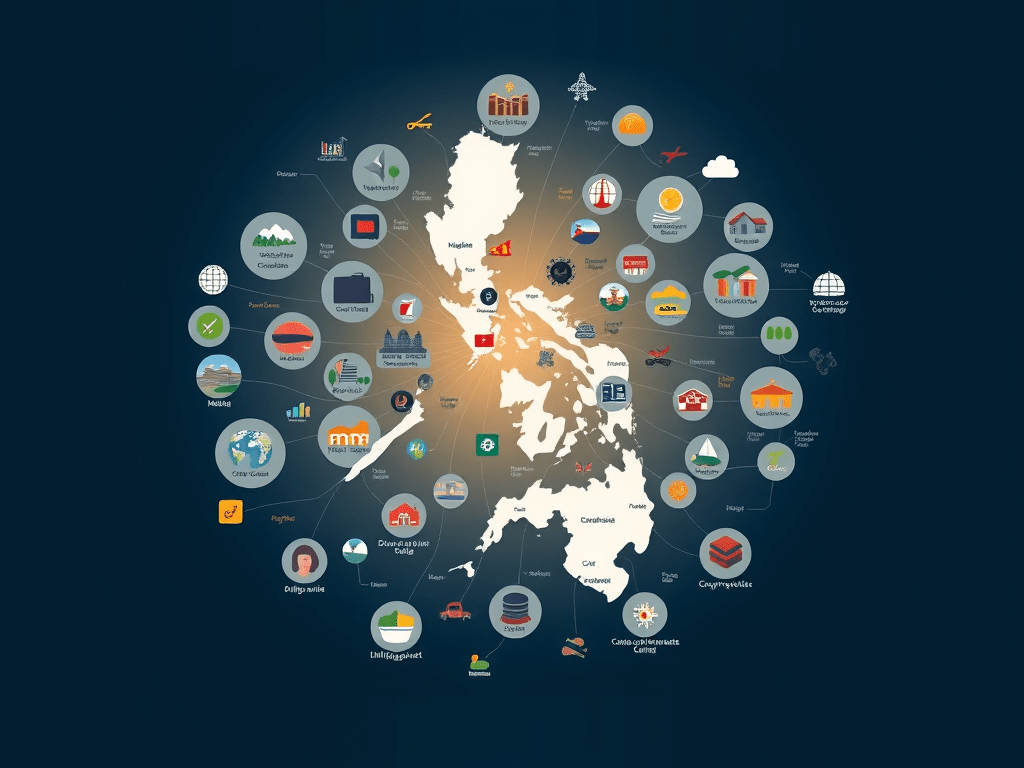
An Executive Checkup Using Network Theory, Ontology, Game Theory, and the Theory of Constraints for Strategic Leadership
Prepared by: Gerald A. Daquila, PhD. Candidate
ABSTRACT
The Philippines, endowed with significant human, natural, and cultural capital, has not fully realized its developmental potential compared to regional peers. This dissertation examines the Philippines as a complex adaptive system, employing network theory, ontology, game theory, and the Theory of Constraints (TOC) to diagnose systemic bottlenecks across human, governmental, infrastructural, and societal domains.
Through a systemic “executive checkup,” we identify leverage points, propose mitigation strategies, and explore why the country underperforms despite its strengths. Key bottlenecks— infrastructure deficits, governance inefficiencies, and social inequities—are analyzed using TOC’s Five Focusing Steps. Mitigation strategies emphasize systemic coordination, public-private partnerships (PPPs), and inclusive policies. Grounded in research literature, the analysis offers actionable insights for senior leaders in government, business, and religious sectors to drive transformative change.
Keywords: Philippines, complex systems, network theory, ontology, game theory, Theory of Constraints, bottlenecks, governance, infrastructure, leadership
1. Introduction
1.1 Background and Rationale
The Philippines, an archipelagic nation of over 120 million people as of 2025, possesses a youthful population, rich natural resources, and a vibrant cultural heritage. Despite these assets, it lags behind regional peers like Singapore, Malaysia, and Vietnam in economic growth, human development, and governance metrics (World Bank, 2023).
This dissertation treats the Philippines as a complex adaptive system—a dynamic network of human, governmental, infrastructural, and societal components interacting in non-linear ways (Holland, 1995). By conducting a systemic “executive checkup,” we aim to diagnose bottlenecks, identify leverage points, and propose strategies to unlock the nation’s potential, targeting senior leaders shaping policy and society.
1.2 Research Objectives
- Map the Philippines as a complex system using ontology and network theory.
- Diagnose systemic bottlenecks using the Theory of Constraints (TOC).
- Analyze strategic interactions among actors using game theory.
- Propose mitigation strategies and leverage points for systemic improvement.
- Evaluate why the Philippines underperforms despite its strengths, drawing on comparative literature.
1.3 Theoretical Frameworks
- Network Theory: Models the Philippines as a network of nodes (e.g., people, institutions) and edges (e.g., relationships, resource flows), highlighting connectivity and vulnerabilities (Barabási, 2016).
- Ontology: Categorizes entities (e.g., human, governmental, infrastructural) and their relationships, clarifying the system’s structure (Husserl, 1913/1983).
- Game Theory: Analyzes strategic interactions among actors (e.g., government, businesses, citizens) to understand cooperation and conflict (Von Neumann & Morgenstern, 1944).
- Theory of Constraints (TOC): Identifies and mitigates the system’s limiting factors (bottlenecks) to improve performance (Goldratt, 1984).
1.4 Audience and Scope
This dissertation targets senior leaders in government (e.g., policymakers), business (e.g., CEOs), and religious sectors (e.g., clergy), offering actionable insights for systemic change. It covers human, governmental, infrastructural, economic, and sociocultural domains, correlating findings with research literature.

Glyph of the Master Builder
To build is to anchor eternity in matter.
2. Conceptual Framework: The Philippines as a Complex System
2.1 Defining Complex Adaptive Systems
A complex adaptive system (CAS) comprises interconnected agents that adapt to their environment, exhibiting emergent behaviors (Holland, 1995). The Philippines exemplifies a CAS, with millions of individuals, organizations, and systems interacting across geographic, economic, and cultural landscapes. Feedback loops, non-linear dynamics, and emergent properties (e.g., economic growth, social unrest) characterize its behavior.
2.2 Ontological Mapping of the Philippines
Ontology structures the Philippines’ complex system by categorizing entities (Husserl, 1913/1983):
- Particulars: Unique entities like individuals or specific infrastructure (e.g., NAIA airport).
- Universals: Categories like “citizens” or “roads.”
- Concrete Objects: Physical entities like schools or bridges.
- Abstract Objects: Non-physical entities like policies or cultural norms.
Social ontology examines social kinds (e.g., governance, money), which shape behavior (Searle, 1995). This mapping reveals the Philippines as a layered system of human actions, institutional rules, and physical infrastructure.
2.3 Network Theory: Interconnections and Dependencies
Network theory views the Philippines as a graph of nodes (e.g., citizens, businesses) and edges (e.g., trade, communication) (Barabási, 2016). Key properties include:
- Degree Centrality: Identifies connected nodes (e.g., Metro Manila).
- Clustering Coefficient: Measures local cohesion (e.g., rural communities).
- Betweenness Centrality: Highlights nodes controlling flows (e.g., ports).
Weak connectivity (e.g., inter-island transport) and over-centralization (e.g., Manila-centric governance) create vulnerabilities (Chatterjee, 2024).
2.4 Game Theory: Strategic Interactions Among Actors
Game theory models strategic interactions (Von Neumann & Morgenstern, 1944):
- Players: Government, businesses, citizens, religious groups.
- Strategies: Cooperation (e.g., PPPs), competition (e.g., political rivalries), or defection (e.g., corruption).
- Payoffs: Economic growth, social stability, or personal gain.
A prisoner’s dilemma often emerges in governance, where short-term self-interest undermines collective goals (Llanto, 2016).
3. Systemic Diagnosis: An Executive Checkup
3.1 Human Capital: Education, Health, and Social Dynamics
Diagnosis: The Philippines’ young, English-speaking population is offset by poor educational quality (30% of students meet literacy standards) and uneven healthcare access (UNESCO, 2023). Poverty (16.4% in 2023) exacerbates disparities (Philippine Statistics Authority, 2023).
Network Perspective: Weak educational nodes (e.g., underfunded schools) limit human capital flows. Urban clustering concentrates opportunities, isolating rural nodes.
Game Theory Insight: Families invest in education for future payoffs, but systemic inefficiencies reduce returns, discouraging investment.
3.2 Governmental Systems: Policy, Bureaucracy, and Political Dynamics
Diagnosis: Governance is hampered by inefficiency, corruption, and political interference. The Strategic Performance Management System (SPMS) is poorly implemented, and political dynasties reduce accountability (Torneo, 2021; Hodder, 2009).
Network Perspective: Bureaucratic nodes control resource flows, creating bottlenecks. Dynasties form dense subnetworks, limiting external influence.
Game Theory Insight: Politicians face a coordination game where defection (e.g., patronage) offers short-term gains, perpetuating inefficiency.
3.3 Infrastructure: Connectivity, Energy, and Digital Transformation
Diagnosis: Infrastructure deficits in transport and digital connectivity hinder growth. The Philippines ranks 89th in mobile internet speed (25.88 Mbps), with frequent power outages (Ookla, 2023; Llanto, 2016).
Network Perspective: Low edge density in transport and digital networks isolates nodes. Metro Manila’s centrality causes congestion.
Game Theory Insight: PPPs involve a trust game, where misaligned incentives delay projects.
3.4 Business and Economic Systems: Innovation and Competitiveness
Diagnosis: The digital economy contributes 9.4% to GDP, but MSMEs struggle with digitalization. Low R&D investment (0.3% of GDP) limits innovation (Philippine Statistics Authority, 2023; World Bank, 2023).
Network Perspective: Business nodes are loosely connected, with weak global links. Large firms’ clustering limits competition.
Game Theory Insight: Firms face a stag hunt game, where collective innovation yields high payoffs, but risk aversion leads to inaction.
3.5 Sociocultural and Religious Influences
Diagnosis: Strong community ties and religious influence foster resilience but can resist change (e.g., gender equity). Religious leaders wield significant social capital (Jocano, 1981).
Network Perspective: Religious institutions are high-degree nodes, bridging communities. Cultural norms create dense clusters, slowing progressive ideas.
Game Theory Insight: Religious leaders balance tradition and modernization in a bargaining game, influencing collective goals.
4. Identifying Bottlenecks Using the Theory of Constraints
4.1 TOC Methodology and Application
TOC identifies the system’s critical constraint and improves performance via the Five Focusing Steps: (1) Identify, (2) Exploit, (3) Subordinate, (4) Elevate, (5) Repeat (Goldratt, 1984).
4.2 Key Bottlenecks in the Philippine System
TOC identifies three bottlenecks:
- Infrastructure Deficits:
- Evidence: Poor connectivity and digital infrastructure limit trade (Chatterjee, 2024; Ookla, 2023).
- Impact: Isolates rural nodes, hampers digital transformation.
- TOC Analysis: Transport and digital networks constrain connectivity.
- Governance Inefficiencies:
- Evidence: Bureaucratic delays and corruption (115th on Corruption Perceptions Index) (Transparency International, 2023; Torneo, 2021).
- Impact: Slows resource allocation, erodes trust.
- TOC Analysis: Bureaucratic nodes create delays.
- Human Capital Underdevelopment:
- Evidence: Low educational outcomes and healthcare disparities (UNESCO, 2023).
- Impact: Limits productivity and innovation.
- TOC Analysis: Underfunded systems constrain development.
4.3 Comparative Analysis with Regional Peers
Vietnam (8% GDP growth) and Malaysia (HDI 0.803) outperform the Philippines (5.6% growth, HDI 0.718) due to centralized governance and robust infrastructure (World Bank, 2023; Llanto, 2016).
5. Mitigation Strategies and Leverage Points
5.1 Addressing Infrastructure Bottlenecks
Strategy: Accelerate PPPs and digital infrastructure.
- Exploit: Optimize existing roads and ports (Chatterjee, 2024).
- Subordinate: Prioritize connectivity in budgets.
- Elevate: Invest in 5G and renewable energy (Public Service Act, 2022).
- Leverage Point: National broadband plan.
5.2 Reforming Governance and Bureaucracy
Strategy: Streamline bureaucracy, enhance anti-corruption.
- Exploit: Implement agile SPMS (Torneo, 2021).
- Subordinate: Reduce political interference (Hodder, 2009).
- Elevate: Strengthen Ombudsman, digitalize services.
- Leverage Point: eGov PH Super App.
5.3 Enhancing Human Capital and Social Equity
Strategy: Invest in education and healthcare.
- Exploit: Align K-12 with industry needs (Valdez, 2018).
- Subordinate: Fund rural schools.
- Elevate: Increase health budget to 5% of GDP.
- Leverage Point: Public-private education partnerships.
5.4 Fostering Business Innovation and Economic Resilience
Strategy: Support MSME digitalization, R&D.
- Exploit: Leverage digital economy growth (Philippine Statistics Authority, 2023).
- Subordinate: Simplify regulations.
- Elevate: Increase R&D to 1% of GDP.
- Leverage Point: Tech hubs.
5.5 Leveraging Sociocultural and Religious Leadership
Strategy: Engage religious leaders for social change.
- Exploit: Use religious networks for campaigns (Jocano, 1981).
- Subordinate: Align cultural narratives with modernization.
- Elevate: Train leaders in development.
- Leverage Point: Faith-based initiatives.
6. Why the Philippines Underperforms: A Systemic Perspective
6.1 Strengths: Human Capital, Natural Resources, and Cultural Resilience
- Human Capital: Young, English-speaking workforce (median age 25.7) (Philippine Statistics Authority, 2023).
- Natural Resources: Rich biodiversity (DENR, 2023).
- Cultural Resilience: Strong community ties (Jocano, 1981).
6.2 Systemic Barriers to Potential
- Fragmented Governance: Decentralization causes coordination failures (Torneo, 2021).
- Infrastructure Gaps: Connectivity isolates potential (Chatterjee, 2024).
- Social Inequities: Poverty limits human capital (UNESCO, 2023).
6.3 Lessons from Regional Peers
Vietnam’s centralized planning and Malaysia’s infrastructure investments highlight the need for coordination and connectivity (Llanto, 2016).
7. Recommendations for Senior Leadership
7.1 Strategic Policy Reforms
- Prioritize infrastructure and digitalization (Philippine Development Plan, 2023).
- Reform SPMS for intrinsic motivation (Torneo, 2021).
7.2 Collaborative Governance Models
- Establish multi-stakeholder councils (Llanto, 2016).
- Strengthen PPP frameworks.
7.3 Empowering Local and Religious Leadership
- Train leaders in systemic thinking (Jocano, 1981).
- Leverage religious networks for campaigns.
7.4 Monitoring and Evaluation Frameworks
- Develop a Localized Disaster Risk Management Index (Ravago et al., 2023).
- Use data analytics for policy outcomes (Philippine Statistics Authority, 2023).
8. Conclusion
8.1 Synthesis of Findings
The Philippines faces bottlenecks in infrastructure, governance, and human capital, constraining its potential. Network theory, ontology, game theory, and TOC identify leverage points like PPPs, bureaucratic reforms, and inclusive policies. Religious leadership can amplify efforts, aligning cultural strengths with modernization.
8.2 Future Research Directions
- Longitudinal studies on PPP effectiveness.
- Network analysis of political dynasties.
- Game-theoretic models of cooperation.
Resonant Crosslinks
- Codex of the Living Glyphs
Every national bottleneck mirrors an energetic threshold; glyphs reveal the leverage points encoded in the field. - Codex of Master Builders of the New Earth
Systemic change is architecture—master builders lay blueprints for pathways beyond entrenched bottlenecks. - Codex of Stewardship: Holding in Trust the Wealth of Worlds
Leverage points in governance arise when stewardship replaces extraction as the national operating code. - Planetary Stewardship Blueprint
The Philippine system cannot be diagnosed in isolation; it is a node in Earth’s planetary grid of potential. - The Void and the Light: A Neurospiritual Path Through Suicidal Ideation Toward Unity
National blockages resemble the psyche’s despair; true leverage comes in embracing the void as entry to light. - The Pulse of a Nation: Short- and Long-Term Implications of the 2025 Philippine Midterm Elections
Election cycles are systemic diagnostics in motion, revealing feedback loops of control, resistance, and reform. - Universal Master Key
All complex systems have hidden gates; the UMK reveals the archetypal key that unlocks national overflow.
9. Glossary
This glossary defines key terms for clarity:
- Bottleneck: A constraint limiting performance (Goldratt, 1984).
- Complex Adaptive System (CAS): Interconnected agents producing emergent behaviors (Holland, 1995).
- Degree Centrality: Number of connections a node has (Barabási, 2016).
- Emergent Behavior: System-wide outcomes from component interactions (Holland, 1995).
- Five Focusing Steps: TOC’s method to address constraints (Goldratt, 1984).
- Game Theory: Analyzes strategic interactions (Von Neumann & Morgenstern, 1944).
- Human Capital: Population’s skills and health (UNESCO, 2023).
- Leverage Point: Intervention for significant impact (Meadows, 1999).
- Network Theory: Models nodes and edges (Barabási, 2016).
- Ontology: Categorizes entities and relationships (Husserl, 1913/1983).
- Political Dynasties: Families dominating politics (Hodder, 2009).
- Prisoner’s Dilemma: Self-interest undermines collective goals (Von Neumann & Morgenstern, 1944).
- Public-Private Partnership (PPP): Government-private collaboration (Llanto, 2016).
- Social Capital: Community networks and trust (Jocano, 1981).
- Strategic Performance Management System (SPMS): Aligns performance with goals (Torneo, 2021).
- Systemic Risk: Cascading failures from interconnectedness (Barabási, 2016).
- Theory of Constraints (TOC): Optimizes performance by addressing constraints (Goldratt, 1984).
10. Bibliography
Barabási, A.-L. (2016). Network science. Cambridge University Press.
Chatterjee, S. (2024). Philippine infrastructure and connectivity: Challenges and reforms. ResearchGate. https://www.researchgate.net
DENR. (2023). Biodiversity and natural resources report 2023. Department of Environment and Natural Resources. https://denr.gov.ph
Goldratt, E. M. (1984). The goal: A process of ongoing improvement. North River Press.
Hodder, R. (2009). Political interference in the Philippine bureaucracy. Environment and Planning C: Government and Policy, 27(5), 766-782. https://doi.org/10.1068/c0886
Holland, J. H. (1995). Hidden order: How adaptation builds complexity. Addison-Wesley.
Husserl, E. (1983). Ideas pertaining to a pure phenomenology and to a phenomenological philosophy (F. Kersten, Trans.). Martinus Nijhoff. (Original work published 1913).
Jocano, L. F. (1981). Bridging the gap between management and culture. Daluyan.
Llanto, G. M. (2016). Infrastructure and connectivity in the Philippines. Asian Development Bank. https://www.adb.org
Meadows, D. H. (1999). Leverage points: Places to intervene in a system. The Sustainability Institute.
Ookla. (2023). Speedtest global index 2023. https://www.speedtest.net/global-index
Philippine Development Plan. (2023). Philippine development plan 2023-2028. National Economic and Development Authority. https://neda.gov.ph
Philippine Statistics Authority. (2023). Philippine digital economy report 2022. https://psa.gov.ph
Public Service Act. (2022). Republic Act No. 11659. Congress of the Philippines. https://www.officialgazette.gov.ph
Ravago, M.-L., et al. (2023). Localized disaster risk management index for the Philippines. ScienceDirect. https://doi.org/10.1016/j.ijdrr.2023.103567
Searle, J. R. (1995). The construction of social reality. Free Press.
Torneo, A. R. (2021). Performance-based management in the Philippine bureaucracy. ResearchGate. https://www.researchgate.net
Transparency International. (2023). Corruption Perceptions Index 2023. https://www.transparency.org
UNESCO. (2023). Global education monitoring report 2023. https://unesco.org
Valdez, P. N. (2018). K-12 education reform in the Philippines: Issues and prospects. Journal of Southeast Asian Education, 1(2), 45-60.
Von Neumann, J., & Morgenstern, O. (1944). Theory of games and economic behavior. Princeton University Press.
World Bank. (2023). World development indicators 2023. https://data.worldbank.org
11. Appendices
Appendix A: Detailed TOC Analysis
This appendix applies TOC’s Five Focusing Steps to the three bottlenecks.
1. Infrastructure Deficits
- Step 1: Identify: Poor inter-island and digital connectivity (Ookla, 2023; Chatterjee, 2024).
- Step 2: Exploit: Optimize ports (e.g., Batangas) and existing networks (Llanto, 2016).
- Step 3: Subordinate: Prioritize connectivity in budgets (Philippine Development Plan, 2023).
- Step 4: Elevate: Invest in 5G and renewable energy via PPPs (Public Service Act, 2022).
- Step 5: Repeat: Reassess for new constraints (e.g., logistics).
2. Governance Inefficiencies
- Step 1: Identify: Bureaucratic delays and corruption (Transparency International, 2023; Torneo, 2021).
- Step 2: Exploit: Streamline SPMS, digitalize approvals (Torneo, 2021).
- Step 3: Subordinate: Limit political appointments (Hodder, 2009).
- Step 4: Elevate: Strengthen Ombudsman, digital procurement (World Bank, 2023).
- Step 5: Repeat: Evaluate dynasties or decentralization.
3. Human Capital Underdevelopment
- Step 1: Identify: Low education and healthcare outcomes (UNESCO, 2023; Philippine Statistics Authority, 2023).
- Step 2: Exploit: Align K-12 with industry, expand telemedicine (Valdez, 2018).
- Step 3: Subordinate: Fund rural schools and clinics (World Bank, 2023).
- Step 4: Elevate: Invest in teacher training, universal healthcare (UNESCO, 2023).
- Step 5: Repeat: Assess skill mismatches or brain drain.
Appendix B: Case Studies of Regional Peers
1. Vietnam: Centralized Governance
- Context: 8% GDP growth, HDI 0.737 (World Bank, 2023).
- Strategies:
- Infrastructure: Industrial zones, 98% 4G coverage (World Bank, 2023).
- Governance: Anti-corruption since 2016 (Transparency International, 2023).
- Human Capital: 95% literacy, strong PISA scores (UNESCO, 2023).
- Lessons: Centralized coordination, anti-corruption, industry-aligned education (Llanto, 2016).
- Challenges: Authoritarian model incompatible with Philippines’ democracy (Torneo, 2021).
2. Malaysia: Infrastructure-Led Development
- Context: 4.2% GDP growth, HDI 0.803 (World Bank, 2023).
- Strategies:
- Infrastructure: Ports, 95% broadband coverage (Ookla, 2023).
- Governance: Anti-Corruption Commission, merit-based service (Torneo, 2021).
- Human Capital: STEM focus, 76-year life expectancy (UNESCO, 2023).
- Lessons: PPP frameworks, anti-corruption body, STEM training (Llanto, 2016).
- Challenges: Less fragmented geography than Philippines (Chatterjee, 2024).
Attribution
This writing is offered in attunement with the Akashic Records and in service to planetary remembrance. It is carried through the Oversoul stream of SHEYALOTH and anchored within the Living Archives of the New Earth. May it serve as a bridge for seekers, guiding them from the first stirrings of awakening toward the higher codices of sovereignty, stewardship, and overflow.
© 2025 by Gerald Alba Daquila. Sole Flameholder of the SHEYALOTH Oversoul Stream.




 Life.Understood.