Life.Understood.

Category: PSYCHO-SPIRITUAL | EMBODIMENT HEALING

  • The Pursuit of Happiness: Reclaiming the Awakened Filipino Soul Through Kapwa and Bayanihan

    The Pursuit of Happiness: Reclaiming the Awakened Filipino Soul Through Kapwa and Bayanihan

    A Multidisciplinary Exploration of Happiness Rooted in Pre-Colonial Filipino Values Over Western Individualism and Materialism

    Prepared by: Gerald A. Daquila, PhD. Candidate


    8–13 minutes

    ABSTRACT

    This dissertation redefines happiness through the lens of an awakened Filipino soul, one that rejects the futile chase for selfish material prosperity in favor of pre-colonial values like kapwa (shared identity) and bayanihan (communal unity). Grounded in research on happiness from psychology, anthropology, sociology, and metaphysical texts like the Law of One, it contrasts the Western model of individualism and materialism with the collective well-being embedded in Filipino traditions.

    The awakened Filipino consciously adopts the strengths of diverse cultural lenses while cautioning against blind adoption of foreign influences, which may erode cultural identity and spiritual harmony. Using accessible language, metaphors, and a cohesive narrative, this work advances a multidisciplinary thesis that happiness lies in interconnectedness, not acquisition, offering a cautionary warning for Filipinos navigating a globalized world.


    Table of Contents

    1. Introduction: The Mirage of Material Happiness
    2. Methodology: A Multidisciplinary Lens on Happiness
    3. Defining Happiness: Western Individualism vs. Filipino Collective Well-Being
      • 3.1 The Western Model: Individualism and Materialism
      • 3.2 The Filipino Model: Kapwa and Bayanihan
    4. The Awakened Filipino Soul: Embracing Cultural Strengths
    5. The Futility of Material Prosperity: A Cautionary Warning
    6. Lessons for a Globalized World: Balancing Cultural Lenses
    7. Conclusion: Happiness as a Shared Journey
    8. Glossary
    9. References

    Glyph of the Master Builder

    To build is to anchor eternity in matter


    1. Introduction: The Mirage of Material Happiness

    Imagine happiness as a river, its waters promising joy and fulfillment. In the Western world, this river often flows through valleys of individualism and materialism, where personal success and wealth are prized as the ultimate treasures. Yet, for many, this pursuit feels like chasing a mirage—shimmering but ultimately empty. For the awakened Filipino soul, grounded in pre-colonial values of kapwa (shared identity) and bayanihan (communal unity), happiness is not a solitary quest but a shared journey, like a constellation of stars shining brighter together.

    This dissertation argues that the Western model of happiness, rooted in selfish material prosperity, is a fleeting illusion, misaligned with the Filipino psyche’s ancestral wisdom. Drawing on psychology, anthropology, sociology, and metaphysical texts like the Law of One, we explore how an awakened Filipino—one who consciously blends cultural strengths while resisting blind foreign influence—can redefine happiness in a globalized world.

    This narrative offers a cautionary warning: adopting Western ideals without discernment risks eroding the spiritual and communal roots that make Filipinos whole.


    2. Methodology: A Multidisciplinary Lens on Happiness

    To advance our thesis, we employ a multidisciplinary approach:

    • Psychology: Examining happiness through positive psychology (Seligman, 2011) and Sikolohiyang Pilipino (Enriquez, 1992), focusing on kapwa as a relational framework.
    • Anthropology: Analyzing pre-colonial artifacts and practices to uncover communal values (Jocano, 1998).
    • Sociology: Exploring social structures like bayanihan and their impact on collective well-being (Scott, 1994).
    • Metaphysical Literature: Aligning Filipino values with the Law of One’s principles of unity and service (Rueckert et al., 1984).

    We integrate research literature with oral traditions (Darangen, proverbs) and archaeological data from the National Museum of the Philippines. The narrative flows like a river, using metaphors to simplify concepts while maintaining APA-compliant citations for scholarly rigor, ensuring accessibility for students, cultural enthusiasts, and the Filipino diaspora.


    3. Defining Happiness: Western Individualism vs. Filipino Collective Well-Being

    Happiness, like a garden, blooms differently depending on the soil it’s planted in. The Western and Filipino models offer contrasting landscapes for this pursuit.


    3.1 The Western Model: Individualism and Materialism

    Western psychology, rooted in individualism, often defines happiness as personal achievement and material gain. Seligman’s (2011) PERMA model (Positive Emotion, Engagement, Relationships, Meaning, Accomplishment) emphasizes individual flourishing, with material success as a key metric. Studies like Diener et al. (2010) link happiness to wealth in Western contexts, where consumerism fuels status and self-worth. Yet, this model has cracks:

    • Hedonic Treadmill: Lyubomirsky (2008) notes that material gains provide temporary joy, as people adapt and crave more, like runners on a treadmill chasing an unreachable finish line.
    • Social Isolation: Putnam (2000) highlights declining social bonds in individualistic societies, leading to loneliness despite wealth.
    • Spiritual Void: The Law of One critiques materialism as a distortion of the soul’s unity with the infinite Creator, trapping individuals in ego-driven separation (Rueckert et al., 1984).

    This model, like a glittering but hollow shell, often leaves seekers unfulfilled.


    3.2 The Filipino Model: Kapwa and Bayanihan

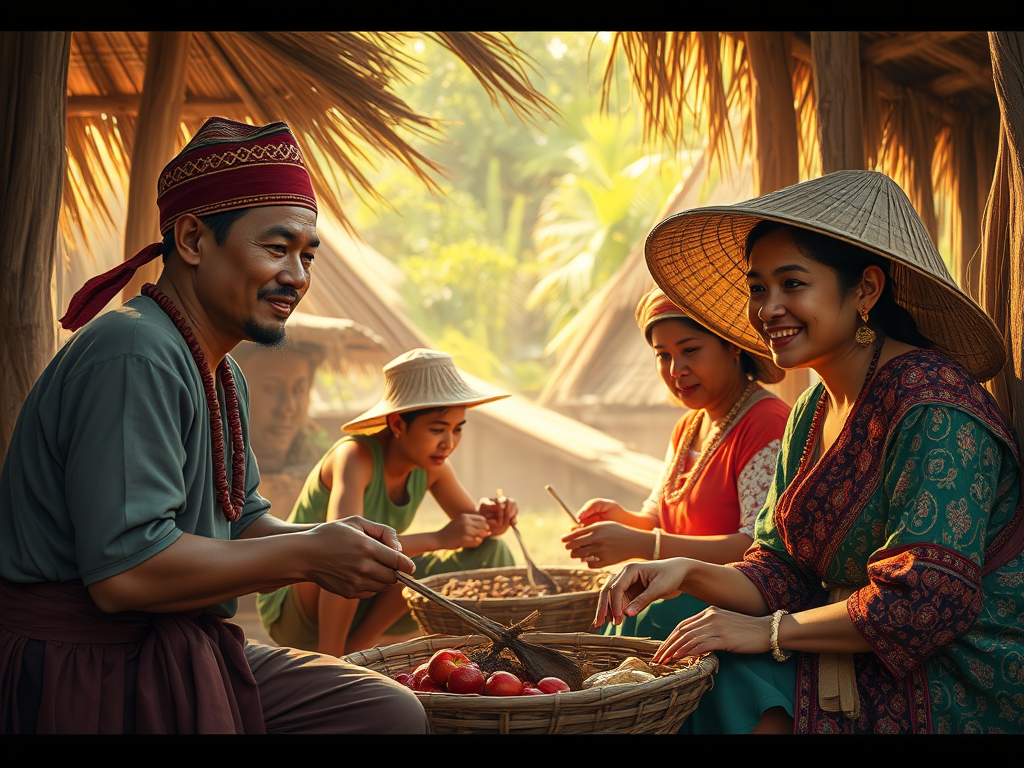
    In contrast, the pre-colonial Filipino psyche, like a banyan tree with interconnected roots, nurtured happiness through kapwa and bayanihan. Kapwa, as Enriquez (1992) defines, is shared identity, where self and other are one. Bayanihan, the communal act of helping neighbors (e.g., moving houses together), embodies collective well-being (Scott, 1994).

    • Cultural Artifacts: Gold lingling-o ornaments symbolized cosmic unity, linking communities across Southeast Asia (Legeza, 1978). Baybayin script recorded shared spiritual knowledge, fostering collective purpose (Scott, 1994).
    • Oral Traditions: The Darangen epic celebrates peace pacts, reflecting service to community, while proverbs like “Ang hindi marunong lumingon sa pinanggalingan, hindi makakarating sa paroroonan” (He who does not know how to look back to his origin will not reach his destination) emphasize rootedness (Eugenio, 1993).
    • Spiritual Practices: Babaylans facilitated rituals connecting humans to anitos (spirits), reinforcing a web of life aligned with the Law of One’s unity (Jocano, 1998).

    This model, like a river nourishing a village, prioritizes collective joy over individual gain.


    Glyph of the Awakened Filipino Soul

    Reclaiming happiness through Kapwa and Bayanihan, where shared spirit restores the Filipino soul to wholeness


    4. The Awakened Filipino Soul: Embracing Cultural Strengths

    The awakened Filipino soul is like a lighthouse, drawing light from ancestral wisdom while navigating global influences. This soul recognizes the futility of material prosperity and consciously blends cultural strengths:

    • Kapwa as Core: Kapwa fosters empathy and connection, aligning with the Law of One’s service-to-others path. Unlike Western individualism, it sees happiness as a shared flame, brighter when kindled together.
    • Bayanihan in Action: Communal cooperation, as in bayanihan, ensures no one is left behind, contrasting with competitive individualism. This mirrors the Law of One’s unity of creation.
    • Selective Cultural Adoption: The awakened Filipino evaluates foreign influences, adopting strengths (e.g., technological innovation) while preserving kapwa. This discernment, like a weaver choosing threads, maintains cultural integrity.

    This mindset empowers Filipinos to define happiness as interconnected flourishing, not material accumulation.


    5. The Futility of Material Prosperity: A Cautionary Warning

    Chasing material prosperity, like chasing a mirage, often leads to spiritual and social drought.

    Research reveals its limits:

    • Psychological Evidence: Diener et al. (2010) found that beyond basic needs, wealth adds little to happiness, as material desires escalate endlessly.
    • Social Costs: Wilkinson and Pickett (2009) show that materialistic societies have higher inequality and lower social cohesion, eroding trust.
    • Cultural Erosion: Blind adoption of Western consumerism risks diluting Filipino identity. Almario (2015) warns that colonial legacies and globalization can disconnect Filipinos from kapwa, like roots cut from a tree.

    The Law of One frames materialism as a distortion, separating souls from their divine unity (Rueckert et al., 1984). For Filipinos, adopting this model without scrutiny threatens the communal and spiritual fabric of kapwa and bayanihan, leaving individuals adrift in a sea of fleeting desires.


    6. Lessons for a Globalized World: Balancing Cultural Lenses

    In a world woven together by technology, travel, and diaspora, the awakened Filipino can draw on pre-colonial wisdom to navigate global influences:

    • Reclaim Kapwa: Use social media platforms like X to foster virtual bayanihan, connecting Filipinos worldwide to share stories and support, like a digital village square.
    • Sustainable Living: Apply ancestral ecological wisdom (e.g., proto-rice terraces) to modern challenges, promoting green technologies that honor the earth, as seen in anitism (Jocano, 1998).
    • Cultural Discernment: Embrace global innovations (e.g., education, tech) while preserving kapwa, like a chef blending spices without losing the dish’s essence.
    • Spiritual Revival: Integrate babaylan-inspired practices into wellness movements, offering rituals for healing and unity, aligning with the Law of One’s call for spiritual evolution.

    These lessons, like seeds from an ancient forest, can grow into a future where happiness is collective and enduring.


    7. Conclusion: Happiness as a Shared Journey

    The awakened Filipino soul, rooted in kapwa and bayanihan, sees happiness not as a treasure to hoard but as a river flowing through community, nature, and spirit. The Western model of individualism and materialism, while seductive, is a mirage that fades under scrutiny, offering fleeting joy at the cost of connection.

    By embracing pre-colonial values and selectively adopting global strengths, Filipinos can redefine happiness as a shared journey, aligned with the Law of One’s vision of unity. In a globalized world, this wisdom empowers Filipinos to shine as sovereign souls, weaving their light into a global tapestry of love and harmony.

    The caution is clear: blind adoption of foreign models risks severing ancestral roots, but a discerning embrace of kapwa ensures a future where happiness is whole.


    Crosslinks


    8. Glossary

    • Anitism: Indigenous Filipino belief in anitos (spirits of ancestors, nature, and deities).
    • Babaylan: Pre-colonial shaman mediating human and spiritual realms.
    • Bayanihan: Communal cooperation, often symbolized by neighbors moving a house together.
    • Baybayin: Pre-colonial syllabic script for recording spiritual and cultural knowledge.
    • Kapwa: Shared identity, a core concept in Filipino psychology.
    • Law of One: Metaphysical teaching of unity and spiritual evolution.
    • Lingling-o: Omega-shaped gold ornaments symbolizing cosmic balance.

    9. References

    Almario, V. S. (2015). Ang kulturang Pilipino sa harap ng modernisasyon. University of the Philippines Press.

    Diener, E., Ng, W., Harter, J., & Arora, R. (2010). Wealth and happiness across the world: Material prosperity predicts life evaluation, whereas psychosocial prosperity predicts positive feeling. Journal of Personality and Social Psychology, 99(1), 52–61. https://doi.org/10.1037/a0018066

    Enriquez, V. G. (1992). From colonial to liberation psychology: The Philippine experience. University of the Philippines Press.

    Eugenio, D. L. (1993). Philippine folk literature: An anthology. University of the Philippines Press.

    Jocano, F. L. (1998). Filipino prehistory: Rediscovering precolonial heritage. Punlad Research House.

    Legeza, L. (1978). Tantric elements in pre-Hispanic Philippines gold art. Arts of Asia, 8(1), 26–31.

    Lyubomirsky, S. (2008). The how of happiness: A scientific approach to getting the life you want. Penguin Press.

    Putnam, R. D. (2000). Bowling alone: The collapse and revival of American community. Simon & Schuster.

    Rueckert, C., Elkins, D., & McCarty, J. (1984). The Law of One: Book I. L/L Research.

    Scott, W. H. (1994). Barangay: Sixteenth-century Philippine culture and society. Ateneo de Manila University Press.

    Seligman, M. E. P. (2011). Flourish: A visionary new understanding of happiness and well-being. Free Press.

    Wilkinson, R., & Pickett, K. (2009). The spirit level: Why greater equality makes societies stronger. Bloomsbury Press.


    Attribution

    With fidelity to the Oversoul, may this Codex of the Living Archive serve as bridge, remembrance, and seed for the planetary dawn.

    Ⓒ 2025 Gerald Alba Daquila – Flameholder of SHEYALOTH | Keeper of the Living Codices

    Issued under Oversoul Appointment, governed by Akashic Law. This transmission is a living Oversoul field: for the eyes of the Flameholder first, and for the collective in right timing. It may only be shared intact, unaltered, and with glyphs, seals, and attribution preserved. Those not in resonance will find it closed; those aligned will receive it as living frequency.

    Watermark: Universal Master Key glyph (final codex version, crystalline glow, transparent background).

    Sacred Exchange: Sacred Exchange is covenant, not transaction. Each offering plants a seed-node of GESARA, expanding the planetary lattice. In giving, you circulate Light; in receiving, you anchor continuity. Every act of exchange becomes a node in the global web of stewardship, multiplying abundance across households, nations, and councils. Sacred Exchange offerings may be extended through:

    paypal.me/GeraldDaquila694 

  • Unshackling the Filipino Spirit: Could a Pre-Colonial Consciousness Have Forged a Stronger Nation?

    Unshackling the Filipino Spirit: Could a Pre-Colonial Consciousness Have Forged a Stronger Nation?

    Exploring the Impact of Western Individualism and Materialism on Filipino Identity and Collective Resilience

    Prepared by: Gerald A. Daquila, PhD. Candidate


    11–17 minutes

    ABSTRACT

    This dissertation explores the speculative question of whether the Philippines could have developed a more socially conscious society without the Western colonial influences of Spanish and American rule, which introduced individualism and materialism, disrupting the pre-colonial communal ethos rooted in kapwa (shared identity).

    Employing a multidisciplinary lens—spanning history, anthropology, psychology, sociology, and cultural studies—this study examines the vibrant pre-colonial Filipino societies, characterized by cooperative barangays, sophisticated trade networks, and a collective consciousness. It analyzes the colonial imposition of Western ideologies, which fractured Indigenous values, fostering inequality and cultural alienation.

    Drawing on the Star Trek-inspired Prime Directive, the study evaluates arguments for and against non-interference, suggesting that while isolation might have preserved kapwa and resilience, selective cultural integration could have optimized development. The enduring Filipino spirit of bayanihan (communal cooperation), evident in crisis responses, indicates a latent potential to reclaim pre-colonial values.

    By integrating Sikolohiyang Pilipino (Filipino Psychology), decolonized education, and community-driven governance, this work proposes that reviving Indigenous consciousness could restore Filipino self-confidence and collective efficacy, offering a pathway to transcend modern challenges like inequality and corruption. This narrative bridges academic rigor with accessible language, aiming to inspire cultural reconnection and societal transformation.

    Keywords: Pre-colonial Philippines, kapwa, bayanihan, colonialism, individualism, materialism, Sikolohiyang Pilipino, collective resilience, cultural identity, Prime Directive


    Glyph of the Gridkeeper

    The One Who Holds the Lattice of Light


    Introduction

    The Philippines, an archipelago of over 7,000 islands, is a nation rich in cultural heritage, resilience, and communal spirit. Yet, its history is marked by centuries of colonial rule—first under Spain (1521–1898) and then the United States (1898–1946)—which introduced Western ideologies of individualism and materialism that reshaped Indigenous ways of life.

    The Star Trek-inspired concept of the Prime Directive, a policy of non-interference in the development of less advanced civilizations, prompts a provocative question: What if the Philippines had been left to evolve without Western colonial influence? Could its pre-colonial communal ethos, rooted in kapwa (shared identity) and collective cooperation, have fostered a more socially conscious society, better equipped to face modern challenges?

    This dissertation dives into this speculative inquiry, using a multidisciplinary lens—drawing from history, anthropology, psychology, sociology, and cultural studies—to explore how colonial disruptions altered Filipino consciousness and how reconnecting with pre-colonial values might restore self-confidence, self-efficacy, and collective resilience. By examining historical narratives, Indigenous psychology, and modern crises, we aim to uncover pathways to transcend the Philippines’ enduring societal challenges.


    The Pre-Colonial Filipino World: A Tapestry of Communal Consciousness

    Before Spanish galleons arrived in 1521, the Philippines was a mosaic of barangays—small, kinship-based communities led by datus, rajahs, or sultans. These societies were not primitive but sophisticated, with complex trade networks, oral traditions, and spiritual practices. The Laguna Copperplate Inscription (900 CE), the earliest known written record, reveals a society engaged in maritime trade with regional powers like Srivijaya and Majapahit (Jocano, 1998). Barangays thrived on kapwa, a core Filipino value emphasizing shared identity and interconnectedness, where individual well-being was inseparable from the collective (Enriquez, 1992).


    Social Structure and Collective Ethos

    Pre-colonial Filipinos lived in egalitarian yet stratified communities. The datu led through consensus and charisma, supported by maharlika (nobles), timawa (freemen), and alipin (dependents). Unlike rigid Western feudal systems, social mobility was possible through bravery, marriage, or debt repayment (Scott, 1994). Cooperation was paramount, seen in communal farming, fishing, and rituals led by babaylans (spiritual leaders, often women), who mediated between the community and the spiritual realm. Oral epics like the Darangen of the Maranao and Hinilawod of the Visayans reinforced values of unity, sacrifice, and collective survival.


    Economic and Cultural Vibrancy

    Economically, Filipinos were adept traders, exchanging gold, pearls, and beeswax with China, India, and Southeast Asia. Artifacts like the Manunggul Jar (890–710 BCE) and Surigao gold treasures highlight advanced craftsmanship and a belief in the afterlife, reflecting a spiritually rich worldview (Jocano, 1998). Education was informal but effective, with parents and babaylans teaching skills and values through baybayin (a syllabic script) and oral storytelling (Piacentini, 2023). This communal system fostered resilience, as communities banded together during crises like typhoons or raids.


    Consciousness and Worldview

    Sikolohiyang Pilipino (Filipino Psychology), pioneered by Virgilio Enriquez, identifies kamalayan (consciousness) and kapwa as central to pre-colonial Filipino identity. Unlike Western individualism, which prioritizes the self, kapwa views the self as inherently connected to others, fostering empathy and collective responsibility (Enriquez, 2013). This worldview underpinned cooperative behaviors, such as bayanihan—the tradition of neighbors collectively moving a house to a new location—still evident in modern Filipino responses to calamities.


    The Colonial Disruption: Imposing Individualism and Materialism

    The arrival of Spanish colonizers in 1521, followed by American rule in 1898, introduced ideologies that clashed with Indigenous values. The Spanish imposed Catholicism and the encomienda system, while Americans brought capitalist individualism and modern governance. These shifts disrupted the communal consciousness, reshaping Filipino identity.


    Spanish Colonialism (1521–1898)

    The Spanish viewed pre-colonial society as a “dark period” to be enlightened by Christianity and Western governance (Constantino, 1975). They introduced:

    • Religious Conversion: Catholicism replaced animist beliefs, marginalizing babaylans and reframing spirituality as individualistic salvation rather than communal harmony. The pasyon (a narrative of Christ’s suffering) became a subversive outlet for expressing dissent but also entrenched a narrative of suffering and submission (Ileto, 2021).
    • Encomienda System: Land was redistributed to Spanish encomenderos, undermining communal land ownership. Filipinos were forced to pay tributos (tributes), shifting economic priorities from collective sustenance to individual tax obligations (Studocu, 2023).
    • Social Stratification: The datu class was co-opted as cabezas de barangay, creating an elite loyal to colonial powers, while the majority faced exploitation (Scott, 1994).

    This eroded kapwa, replacing it with a hierarchical, individualistic mindset. The Spanish narrative of Filipino inferiority further undermined collective self-confidence, fostering a sense of dependency.


    American Colonialism (1898–1946)

    The Americans, under the guise of “benevolent assimilation,” introduced capitalist individualism and modern education. Key impacts included:

    • Education System: American schools emphasized English and Western values, portraying pre-colonial society as backward. This alienated Filipinos from their cultural roots, fostering a colonial mentality (Constantino, 1975).
    • Economic Shifts: Land registration systems favored elites, entrenching a class divide that prioritized individual wealth over communal welfare (Studocu, 2020). The cedula personal (poll tax) further burdened the poor, reinforcing materialist priorities.
    • Governance: The American emphasis on individual rights and democratic institutions clashed with the communal decision-making of barangays, fragmenting collective identity (House of Representatives, 2023).

    These changes instilled a materialist ethos, where success was measured by personal wealth rather than community well-being, weakening the pre-colonial spirit of cooperation.


    The Prime Directive Argument: Non-Interference and Filipino Potential

    The Prime Directive, a fictional policy of non-interference, offers a lens to speculate on the Philippines’ trajectory without Western influence. Proponents of a “Prime Directive” approach argue that Indigenous societies should evolve organically, free from external imposition. Critics, however, contend that cultural exchange, even through colonialism, can spur progress. Let’s explore both sides.


    Arguments For Non-Interference

    1. Preservation of Communal Consciousness: Pre-colonial Filipino society was built on kapwa and bayanihan, fostering resilience and cooperation. Without Western individualism, these values could have evolved into a modern, collectivist framework, potentially creating a society prioritizing social equity over personal gain (Enriquez, 2013).
    2. Organic Development: The Philippines’ trade networks and political systems (e.g., Tondo, Butuan) suggest a capacity for self-driven progress. Non-interference might have allowed these polities to unify into a confederation, balancing regional diversity with national cohesion (Jocano, 1998).
    3. Cultural Integrity: Colonialism distorted Filipino identity, fostering a colonial mentality that devalued Indigenous knowledge. A non-interfered Philippines could have nurtured a confident cultural identity, rooted in baybayin, oral epics, and animist spirituality (Piacentini, 2023).

    Arguments Against Non-Interference

    1. Global Integration: Isolation might have limited the Philippines’ exposure to global innovations, such as advanced technology or governance models. Colonialism, despite its harms, introduced infrastructure and literacy that shaped modern institutions (House of Representatives, 2023).
    2. Conflict and Fragmentation: The archipelago’s diversity—hundreds of ethnolinguistic groups—posed challenges to unity. Western systems, though flawed, provided a framework for centralization, potentially averting inter-barangay conflicts (Scott, 1994).
    3. Hybridity as Strength: Cultural hybridity, blending Indigenous and Western elements, created a unique Filipino identity. Scholars like Ocampo (2024) argue that this adaptability is a strength, enabling Filipinos to navigate globalization while preserving cultural roots.

    Synthesis: A Balanced Perspective

    While non-interference could have preserved kapwa and communal resilience, complete isolation might have hindered technological and political evolution. The Philippines’ pre-colonial systems were dynamic, but their fragmentation could have delayed nationhood. Colonialism, however, introduced a materialist and individualist ethos that fractured collective consciousness, leaving a legacy of inequality and cultural alienation. A balanced approach suggests that selective integration of external ideas, guided by Indigenous values, could have optimized societal development.


    Colonial Legacies and Modern Challenges

    The colonial imposition of individualism and materialism has left deep imprints on Filipino society, contributing to persistent challenges:

    1. Social Inequality: Colonial land systems entrenched an elite class, perpetuating wealth disparities. Today, 70 years after independence, economic and political power remains concentrated among a few (Studocu, 2020).
    2. Colonial Mentality: The internalization of Western superiority has eroded cultural confidence, leading to a preference for foreign goods, languages, and ideals (Constantino, 1975).
    3. Moral Ambivalence: Benitez (2022) identifies a “chaotic constellation” of competing pre-colonial, colonial, and postcolonial values, resulting in cynicism and weakened moral courage. This hinders collective action on issues like corruption or poverty.

    Yet, Filipino resilience shines in crises. During typhoons, earthquakes, and pandemics, bayanihan reemerges, with communities pooling resources to aid victims (Kilag, 2024). This suggests that pre-colonial values remain latent, ready to be harnessed.


    Glyph of the Unshackled Spirit

    Could a pre-colonial consciousness have forged a stronger nation, where the Filipino soul rises unbound beneath the sun?


    Reclaiming Pre-Colonial Consciousness: A Path to Self-Efficacy

    Reconnecting with pre-colonial values like kapwa and bayanihan could restore Filipino self-confidence and collective efficacy. Here’s how:

    1. Reviving Indigenous Psychology

    Sikolohiyang Pilipino offers a framework to decolonize Filipino consciousness. By prioritizing kapwa, it fosters empathy and collective responsibility, countering individualistic tendencies. Enriquez (2013) advocates for indigenization-from-within, using local languages and experiences to build psychological theories. Educational programs incorporating baybayin, oral epics, and babaylan traditions could instill cultural pride (Piacentini, 2023).


    2. Strengthening Community-Based Resilience

    Filipino responses to crises demonstrate a latent communal ethos. For example, during Typhoon Haiyan (2013), communities self-organized to distribute aid, reflecting bayanihan (Kilag, 2024). Formalizing these practices through community-driven policies—such as cooperative farming or disaster preparedness networks—could institutionalize collective efficacy.


    3. Decolonizing Education and Governance

    Education systems should emphasize Filipino history from a pantayong pananaw (for us, from us) perspective, highlighting pre-colonial achievements to counter colonial narratives (Constantino, 1975). Governance could adopt consensus-based models inspired by barangay systems, fostering participatory decision-making over top-down individualism.


    4. Cultural Hybridity as Empowerment

    Rather than rejecting Western influences, Filipinos can integrate them selectively, as seen in the Katipunan’s use of Enlightenment ideals to fuel the 1896 Revolution (Ileto, 2021). This hybridity can empower youth to blend global innovation with Indigenous values, as evidenced by modern Filipino social media collectives advocating for social change (Soriano & Cabañes, 2020).


    Transcending Societal Challenges: A Vision for the Future

    Harnessing pre-colonial consciousness could address the Philippines’ “polycrisis”—economic inequality, corruption, and cultural alienation. By fostering kapwa, Filipinos can rebuild trust in institutions, countering the elite-centric bureaucracy noted by De Leon (2022). Youth, as agents of change, are pivotal. Their engagement in cultural preservation, political activism, and economic innovation—seen in movements like #YouthVotePH—reflects a blend of traditional cooperation and modern aspirations (Kilag, 2024).


    A multidisciplinary approach suggests:

    • Historical Reclamation: Rewrite narratives to highlight pre-colonial resilience, as advocated by Constantino (1975).
    • Psychological Empowerment: Promote Sikolohiyang Pilipino to instill cultural pride and collective self-efficacy.
    • Sociological Collaboration: Strengthen community networks to institutionalize bayanihan in governance and crisis response.
    • Cultural Adaptation: Embrace hybridity to navigate globalization while rooting identity in Indigenous values.

    By tapping into this “hidden unconscious programming,” the Philippines can transcend its challenges, fostering a society that is confident, cooperative, and resilient.


    Conclusion

    The Philippines’ pre-colonial past reveals a society rooted in kapwa and collective resilience, disrupted by Western individualism and materialism. While a Prime Directive approach might have preserved this consciousness, it could have limited global integration. Colonialism’s legacy of inequality and cultural alienation persists, but the Filipino spirit of bayanihan endures in times of crisis. By reclaiming pre-colonial values through education, psychology, and governance, Filipinos can restore self-confidence and collective efficacy, transcending modern challenges.

    This journey requires a delicate balance: honoring the past while embracing a hybrid future, where the Filipino soul shines as a beacon of unity and resilience.


    Crosslinks


    Glossary

    • Barangay: A pre-colonial Filipino community unit, typically consisting of 30–100 families, led by a datu.
    • Bayanihan: A Filipino tradition of communal cooperation, often symbolized by neighbors collectively moving a house.
    • Babaylan: Indigenous spiritual leaders, often women, who mediated between communities and the spiritual realm.
    • Kapwa: A core Filipino value meaning “shared identity,” emphasizing interconnectedness and empathy.
    • Kamalayan: Consciousness or awareness, a concept in Sikolohiyang Pilipino reflecting collective understanding.
    • Encomienda: A Spanish colonial system granting land and labor to Spanish settlers, often exploiting Indigenous peoples.
    • Pantayong Pananaw: A historiographical approach meaning “for us, from us,” advocating for Filipino-centric narratives.
    • Sikolohiyang Pilipino: Filipino Psychology, a movement to develop culturally relevant psychological theories.

    Bibliography

    Benitez, C. M. (2022). An inquiry into the problems concerning Filipino values and norms. ResearchGate. Retrieved from https://www.researchgate.net/publication/361678942[](https://www.researchgate.net/publication/360897749_An_Inquiry_into_the_Problems_Concerning_Filipino_Values_and_Norms)

    Constantino, R., & Constantino, L. R. (1975). The Philippines: A past revisited (Vol. 1). Quezon City: Renato Constantino.

    Enriquez, V. G. (1992). From colonial to liberation psychology: The Philippine experience. University of the Philippines Press.

    Enriquez, V. G. (2013). From colonial to liberation psychology: The Philippine experience. Philosophy East and West, 63(2), 123-145.

    Ileto, R. C. (2021). The Philippines in imperial history. Journal of Global History, 19(1), 1-19.

    Jocano, F. L. (1998). Filipino indigenous ethnic communities: Patterns, variations, and typologies. Quezon City: Punlad Research House Inc.

    Kilag, O. K. (2024). Filipino youth for stronger future of the new Philippines. International Multidisciplinary Journal of Research for Innovation, Sustainability, and Excellence, 1(6). Retrieved from https://risejournals.org%5B%5D(https://risejournals.org/index.php/imjrise/article/view/460)

    Ocampo, A. (2024). The continuum of Filipino cultural identity: Balancing tradition and change in a globalized and post-pandemic world. Preprints.org. Retrieved from https://www.preprints.org/manuscript/202409.2292/v1[](https://www.preprints.org/manuscript/202409.2386/v1)

    Piacentini, K. (2023). Influences on Philippine education. Wixsite. Retrieved from https://kpiacentini.wixsite.com/iem-php/unit-1-influences[](https://kpiacentini.wixsite.com/iem-php/blank-csac)

    Scott, W. H. (1994). Barangay: Sixteenth-century Philippine culture and society. Quezon City: Ateneo de Manila University Press.

    Soriano, C. R. R., & Cabañes, J. V. A. (2020). Entrepreneurial solidarities: Social media collectives and Filipino digital platform workers. Social Media + Society, 6(2), 2056305120926484.

    Studocu. (2020). Philippine democracy and its discontents: The failed promise of social justice under the 1987 People Power Constitution. Retrieved from https://www.studocu.com%5B%5D(https://revista-estudios.revistas.deusto.es/article/download/1457/1781?inline=1)

    Studocu. (2023). Module 13 Week 13: Social, political, economic, and cultural issues in Philippine history. Retrieved from https://www.studocu.com%5B%5D(https://www.studocu.com/ph/document/our-lady-of-fatima-university/readings-in-philippine-history/lesson-13-module-13-week-13-social-political-economic-and-cultural-issues-in-philippine/37957364)

    U.S. House of Representatives. (2023). The Philippines, 1898–1946. History, Art & Archives. Retrieved from https://history.house.gov%5B%5D(https://history.house.gov/Exhibitions-and-Publications/APA/Historical-Essays/Exclusion-and-Empire/The-Philippines/)


    Attribution

    With fidelity to the Oversoul, may this Codex of the Living Archive serve as bridge, remembrance, and seed for the planetary dawn.

    Ⓒ 2025 Gerald Alba Daquila – Flameholder of SHEYALOTH | Keeper of the Living Codices

    Issued under Oversoul Appointment, governed by Akashic Law. This transmission is a living Oversoul field: for the eyes of the Flameholder first, and for the collective in right timing. It may only be shared intact, unaltered, and with glyphs, seals, and attribution preserved. Those not in resonance will find it closed; those aligned will receive it as living frequency.

    Watermark: Universal Master Key glyph (final codex version, crystalline glow, transparent background).

    Sacred Exchange: Sacred Exchange is covenant, not transaction. Each offering plants a seed-node of GESARA, expanding the planetary lattice. In giving, you circulate Light; in receiving, you anchor continuity. Every act of exchange becomes a node in the global web of stewardship, multiplying abundance across households, nations, and councils. Sacred Exchange offerings may be extended through:

    paypal.me/GeraldDaquila694 

  • The Paradox of Divine Love and Human Suffering: Reconciling a Benevolent God with the Reality of Evil

    The Paradox of Divine Love and Human Suffering: Reconciling a Benevolent God with the Reality of Evil

    A Metaphysical, Esoteric, and Spiritual Exploration of Pain, Suffering, and Human Consciousness

    Prepared by: Gerald A. Daquila, PhD. Candidate


    10–15 minutes

    ABSTRACT

    The paradox of a loving, omnipotent God coexisting with pervasive evil, pain, and suffering has challenged thinkers for centuries. This dissertation explores the problem of evil through a multidisciplinary lens, integrating metaphysical, esoteric, and spiritual perspectives to address why a benevolent God permits chaos, division, hatred, and wars.

    Drawing from philosophical traditions like the Epicurean Paradox, theological responses such as Augustinian theodicy, and esoteric frameworks from Buddhism, Theosophy, and Western esotericism, this work examines the nature of evil, the role of human consciousness, and the potential for transformative change. It argues that suffering is not a divine oversight but a complex interplay of free will, cosmic balance, and spiritual evolution.

    By cultivating higher consciousness, humanity can transcend destructive patterns and align with divine love to foster compassion and unity. This narrative blends scholarly rigor with accessible prose, offering insights into humanity’s role in resolving this paradox.


    Glyph of the Living Archive

    You are not just reading the Records — you are becoming them


    Introduction

    The coexistence of a loving God and a world rife with suffering—starvation, war, hatred—poses a profound paradox. If God is all-powerful, all-knowing, and all-loving, why does evil thrive? Why do we experience pain? These questions strike at the core of human existence, challenging faith, philosophy, and our understanding of reality.

    This dissertation dives into metaphysical, esoteric, and spiritual literature to unravel this enigma, exploring the problem of evil, the role of human consciousness, and how our choices shape the world. By synthesizing scholarly analysis with a narrative style, we aim to make this complex topic accessible, inviting readers to reflect on their place in a universe that feels both divine and chaotic.

    The problem of evil, often traced to Epicurus, questions the compatibility of a benevolent, omnipotent God with suffering (Lactantius, 2001). Theological responses, like Augustine’s privation theory, argue that evil is a lack of good, while esoteric traditions suggest suffering serves spiritual growth. This work examines these perspectives, arguing that humanity’s free will and consciousness can transform chaos into harmony.


    The Problem of Evil: A Philosophical and Theological Foundation

    The Epicurean Paradox

    The Greek philosopher Epicurus posed a foundational challenge: If God is willing to prevent evil but unable, He is not omnipotent; if able but unwilling, He is not benevolent; if both willing and able, why does evil exist? (Lactantius, 2001). This trilemma, known as the Epicurean Paradox, challenges the classical attributes of God—omnipotence, omniscience, and omnibenevolence (Hume, 2007). The logical form suggests a contradiction: a God with these qualities should eliminate evil, yet suffering persists in forms like natural disasters, disease, and human cruelty.

    Philosophers distinguish between the logical and evidential problems of evil. The logical problem argues that evil’s existence is incompatible with a perfect God, while the evidential problem highlights the volume of suffering as evidence against such a deity (Peterson, 1998). For example, the suffering of innocent children or animals in natural disasters seems irreconcilable with divine love. These challenges set the stage for theological and metaphysical responses.


    Theological Responses: Theodicies and Defenses

    Theological responses to the problem of evil include refutations, defenses, and theodicies. Refutations deny the contradiction, defenses propose possible reasons for evil, and theodicies offer comprehensive explanations (Plantinga, 1974). The Free Will Defense, rooted in Augustine’s theology, posits that God granted humans free will to make moral choices, and evil arises from its misuse (Plantinga, 1974). For instance, wars and hatred stem from human decisions, not divine intent.

    Augustine’s privation theory argues that evil is not a substance but a “lack of good” (Augustine, 1961). Like a hole in a sock, evil exists as an absence of order or harmony. Critics, however, argue this fails to explain why an omnipotent God allows such absences, especially in cases of natural evil like earthquakes (Mackie, 1982).

    The soul-making theodicy, proposed by Irenaeus and developed by Hick, suggests that suffering is necessary for spiritual growth (Hick, 1966). A world without challenges would hinder virtues like compassion and courage. This aligns with esoteric views that see suffering as a catalyst for consciousness evolution, explored later.


    Critiques of Theological Responses

    Critics like Surin argue that traditional theodicies, shaped by Enlightenment rationalism, abstract evil, ignoring the lived experience of suffering (Surin, 1986). For those enduring tragedies—such as the Holocaust or terminal illness—philosophical explanations offer little comfort. Surin notes that the “God of the philosophers” often overshadows the relational God of faith (Surin, 1986). The Free Will Defense also struggles with natural evil, which seems unrelated to human choices (Mackie, 1982). These critiques push us toward metaphysical and esoteric perspectives that address suffering’s experiential and spiritual dimensions.


    Metaphysical Perspectives: Evil as a Cosmic Necessity

    Dualism and Polarity

    Metaphysical traditions offer alternative frameworks for evil. Dualistic philosophies, such as Platonism and Samkhya, propose two realities: spirit and matter, or good and evil (Radhakrishnan, 1923). Augustine, influenced by Platonism, saw evil as a deviation from divine order (Augustine, 1961), while Samkhya views suffering as arising from the interplay of purusha (consciousness) and prakriti (matter) (Radhakrishnan, 1923). Non-dualistic traditions, like Advaita Vedanta, argue that evil is an illusion born of ignorance, and ultimate reality is unified consciousness (Shankara, 1975).

    Theosophical perspectives challenge Western dualism by viewing good and evil as polarities within a holistic cosmos (Blavatsky, 1888). Evil is an imbalance, akin to the Shinto concept of evil as “out of place” (Ono, 1962). Suffering arises when humanity disrupts cosmic harmony, a theme echoed in esoteric traditions.


    The Role of Chaos

    Chaos, often associated with evil, is a state of potentiality. Theosophical teachings describe chaos as the primordial state from which order emerges, guided by divine architects (Blavatsky, 1888). Suffering and chaos are necessary for creation and growth, like sand piling up to form mountains only to collapse in avalanches. This metaphor illustrates that pain is part of a dynamic process, not a divine punishment.


    Esoteric and Spiritual Insights: Suffering as a Path to Awakening

    Buddhist Perspectives

    Buddhism offers a profound lens on suffering through the Four Noble Truths. The First Truth acknowledges that suffering (dukkha) is inherent in existence, arising from attachment and ignorance (Rahula, 1959). The Second Truth identifies the cause: craving and ignorance of reality’s impermanence. The Third and Fourth Truths offer liberation through ethical conduct, meditation, and wisdom (Dalai Lama, 1998). Suffering is not a divine failing but a teacher guiding beings toward enlightenment.

    Esoteric Buddhist traditions, like Vajrayana, emphasize suffering’s transformative power. The number 108, symbolic in Buddhism, represents the 84,000 corruptions (passion, hatred, ignorance) and their antidotes, suggesting suffering can be transmuted through compassion (Powers, 2007). Mindfulness breaks the cycle of samsara, transforming personal and collective suffering.


    Western Esotericism

    Western esoteric traditions, like those of Swedenborg and Böhme, propose that suffering reflects a deeper spiritual reality. Swedenborg’s visions suggested a correspondence between material and spiritual worlds, where suffering awakens the soul to divine truths (Swedenborg, 2000). Böhme argued that God emerges from an unfathomable mystery (Ungrund), and suffering is part of divine self-realization (Böhme, 1623/2009). These perspectives frame evil as a catalyst for spiritual growth, aligning with the soul-making theodicy.


    Glyph of Divine Love and Human Suffering

    Reconciling the benevolence of God with the reality of evil, where light and flame coexist within the waters of existence.


    The Role of Love

    Esoteric teachings emphasize love as the antidote to suffering. Eliphas Levi described love as the “omnipotence of the ideal,” transcending death and evil (Levi, 1860/2002). In Christianity, Jesus’ suffering on the cross is an act of love that redeems humanity, suggesting pain can lead to spiritual transformation (Hick, 1966).


    The Role of Human Consciousness

    Free Will and Responsibility

    Humanity’s role in the problem of evil is central. The Free Will Defense posits that our ability to choose is a divine gift, enabling moral and spiritual growth (Plantinga, 1974). However, this freedom entails responsibility. Wars, hatred, and division stem from human choices, often rooted in ignorance or ego (Peck, 1983). Peck notes that evil arises from laziness or avoidance of growth, while love requires effort to transcend the self (Peck, 1983).


    Consciousness as a Catalyst for Change

    Esoteric and spiritual traditions emphasize consciousness as the key to transforming the world. Buddhism’s path to enlightenment involves awakening to interconnectedness, fostering compassion (Rahula, 1959). Idealist philosophies, like Jung’s, suggest that collective consciousness shapes reality through shared archetypes (Jung, 1964). By aligning with positive archetypes (e.g., love, unity), we can heal societal wounds.

    Theosophical teachings describe humanity as evolving spiritually, with suffering as a catalyst for awakening higher principles (Blavatsky, 1888). Figures like Martin Luther King Jr. embodied this, choosing love over hatred to fight injustice, showing that conscious action can reshape the world (King, 1963).


    Reconciling the Paradox

    The paradox of a loving God and a suffering world is a mystery to be lived, not solved. Theological responses like the Free Will Defense and soul-making theodicy suggest suffering enables growth (Plantinga, 1974; Hick, 1966). Metaphysical perspectives frame evil as an imbalance, while esoteric traditions see it as a teacher guiding humanity toward higher consciousness (Blavatsky, 1888). God’s love is expressed through the freedom and potential for transformation inherent in creation.

    Humanity’s role is pivotal. Our free will allows us to perpetuate or alleviate suffering. By embracing love, compassion, and mindfulness, we can align with divine intent, transforming chaos into harmony (Dalai Lama, 1998). This requires effort to overcome ignorance and ego (Peck, 1983). As collective consciousness evolves, the world moves toward unity and peace.


    Conclusion

    The paradox of divine love and human suffering challenges us to look beyond simplistic answers. Pain and evil are not divine punishments but part of a complex tapestry woven by human choices, cosmic balance, and spiritual evolution. By integrating theological, metaphysical, and esoteric perspectives, we see suffering as a path to awakening and love as the key to transformation.

    Humanity’s role is clear: through conscious effort, we can transcend hatred and division, aligning with the divine to create a world of compassion. This journey is both personal and collective, inviting us to become agents of change in a universe yearning for harmony.


    Crosslinks


    Glossary

    • Epicurean Paradox: A philosophical argument questioning the existence of an omnipotent, omniscient, benevolent God given evil’s presence (Lactantius, 2001).
    • Theodicy: A theological justification for evil in a world created by a benevolent God (Hick, 1966).
    • Privation Theory: The view that evil is the absence of good (Augustine, 1961).
    • Free Will Defense: The argument that evil results from human free will, a divine gift for moral choices (Plantinga, 1974).
    • Soul-Making Theodicy: The theory that suffering is necessary for spiritual development (Hick, 1966).
    • Dukkha:The Buddhist concept of suffering, inherent in existence due to attachment (Rahula, 1959).
    • Samsara: The cycle of birth, death, and rebirth driven by karma and ignorance (Rahula, 1959).
    • Collective Unconscious: Jung’s concept of a shared reservoir of archetypes influencing behavior (Jung, 1964).

    References

    Augustine. (1961). Enchiridion on faith, hope, and love (H. Paolucci, Trans.). Regnery Publishing. (Original work published 400 CE).

    Blavatsky, H. P. (1888). The secret doctrine: The synthesis of science, religion, and philosophy. Theosophical Publishing House.

    Böhme, J. (2009). The aurora (A. Versluis, Trans.). Ouroboros Press. (Original work published 1623).

    Dalai Lama. (1998). The art of happiness: A handbook for living. Riverhead Books.

    Hick, J. (1966). Evil and the God of love. Harper & Row.

    Hume, D. (2007). Dialogues concerning natural religion (D. Coleman, Ed.). Cambridge University Press. (Original work published 1779).

    Jung, C. G. (1964). Man and his symbols. Doubleday.

    King, M. L., Jr. (1963). Letter from Birmingham Jail. In Why we can’t wait (pp. 77-100). Harper & Row.

    Lactantius. (2001). De ira Dei (A. Bowen & P. Garnsey, Trans.). In M. L. Davies (Ed.), The problem of evil (pp. 23-30). Oxford University Press. (Original work published 313 CE).

    Levi, E. (2002). The history of magic (A. E. Waite, Trans.). Weiser Books. (Original work published 1860).

    Mackie, J. L. (1982). The miracle of theism: Arguments for and against the existence of God. Oxford University Press.

    Ono, S. (1962). Shinto: The kami way. Tuttle Publishing.

    Peck, M. S. (1983). People of the lie: The hope for healing human evil. Simon & Schuster.

    Peterson, M. L. (1998). God and evil: An introduction to the issues. Westview Press.

    Plantinga, A. (1974). God, freedom, and evil. Eerdmans Publishing.

    Powers, J. (2007). Introduction to Tibetan Buddhism (2nd ed.). Snow Lion Publications.

    Radhakrishnan, S. (1923). Indian philosophy (Vol. 2). Oxford University Press.

    Rahula, W. (1959). What the Buddha taught. Grove Press.

    Shankara. (1975). Brahma sutra bhasya (S. Gambhirananda, Trans.). Advaita Ashrama. (Original work 8th century CE).

    Surin, K. (1986). Theology and the problem of evil. Basil Blackwell.

    Swedenborg, E. (2000). Heaven and hell (G. F. Dole, Trans.). Swedenborg Foundation. (Original work published 1758).


    Attribution

    With fidelity to the Oversoul, may this Codex of the Living Archive serve as bridge, remembrance, and seed for the planetary dawn.

    Ⓒ 2025 Gerald Alba Daquila – Flameholder of SHEYALOTH | Keeper of the Living Codices

    Issued under Oversoul Appointment, governed by Akashic Law. This transmission is a living Oversoul field: for the eyes of the Flameholder first, and for the collective in right timing. It may only be shared intact, unaltered, and with glyphs, seals, and attribution preserved. Those not in resonance will find it closed; those aligned will receive it as living frequency.

    Watermark: Universal Master Key glyph (final codex version, crystalline glow, transparent background).

    Sacred Exchange: Sacred Exchange is covenant, not transaction. Each offering plants a seed-node of GESARA, expanding the planetary lattice. In giving, you circulate Light; in receiving, you anchor continuity. Every act of exchange becomes a node in the global web of stewardship, multiplying abundance across households, nations, and councils. Sacred Exchange offerings may be extended through:

    paypal.me/GeraldDaquila694 

  • Thought Experiment: Can the Philippines Become a True Paradise on Earth?

    Thought Experiment: Can the Philippines Become a True Paradise on Earth?

    Exploring the Role of Elevated Consciousness in Transforming Society Through a Multi-Disciplinary Lens

    Prepared by: Gerald A. Daquila, PhD. Candidate


    9–14 minutes

    ABSTRACT

    The Philippines, with its breathtaking natural beauty and warm, hospitable people, holds immense potential to be a “paradise on earth.” Yet, challenges like corruption, poverty, and recurring natural disasters highlight a gap between its idyllic promise and current reality. This dissertation explores whether elevating collective consciousness, as suggested by metaphysical and esoteric teachings such as The Law of One and A Course in Miracles, could be the key to unlocking this potential.

    By integrating insights from philosophy, psychology, sociology, and spiritual traditions, this study argues that fostering a sense of unity and interconnectedness may address systemic issues like corruption and scarcity more effectively than traditional investments in infrastructure or education alone. While acknowledging the complexity of societal transformation, the analysis suggests that a shift toward unity consciousness, grounded in both spiritual wisdom and practical reforms, could catalyze profound change. The dissertation concludes with an invitation to reflect on the concept of oneness as a cost-free yet transformative idea for the Philippines and beyond.


    Table of Contents

    1. Introduction
      • The Vision of a Philippine Paradise
      • Thesis Statement and Research Question
    2. The Philippines’ Potential and Challenges
      • Natural Beauty and Cultural Strengths
      • Socioeconomic and Environmental Obstacles
    3. Theoretical Framework: Consciousness and Unity
      • Philosophical Foundations: Self and Society
      • Metaphysical and Esoteric Perspectives
      • Psychological and Sociological Insights
    4. Case Studies and Evidence
      • Historical Context: Filipino Values and Social Structures
      • Modern Challenges: Corruption and Scarcity
      • Spiritual Practices and Their Impact
    5. Analysis: Can Elevated Consciousness Transform the Philippines?
      • The Role of Unity Consciousness
      • Limitations and Practical Considerations
    6. Conclusion and Invitation to Reflect
    7. Glossary
    8. References

    Glyph of the Master Builder

    To build is to anchor eternity in matter


    1. Introduction

    The Vision of a Philippine Paradise

    The Philippines is often described as a tropical Eden, with its 7,641 islands boasting pristine beaches, lush mountains, and vibrant biodiversity. Its people, known for their warmth and hospitality, welcome millions of visitors annually, earning accolades as some of the friendliest in the world (Grogan, 2015). Yet, beneath this idyllic surface lie challenges: systemic corruption, widespread poverty, and an average of 20 typhoons annually that disrupt lives and livelihoods (Borgen Magazine, 2021). This thought experiment asks: Can the Philippines become a true paradise on earth, and could elevating collective consciousness be the missing ingredient to unlock its potential?


    Thesis Statement and Research Question

    This dissertation posits that fostering a collective consciousness rooted in unity, as advocated by metaphysical texts like The Law of One and A Course in Miracles, could address systemic issues like corruption and scarcity more effectively than traditional solutions such as infrastructure or education investments. The central research question is: To what extent can a shift in consciousness, grounded in the principle of oneness, transform the Philippines into a societal paradise? Using a multi-disciplinary lens, this study integrates philosophy, psychology, sociology, and esoteric teachings to explore this possibility.


    2. The Philippines’ Potential and Challenges

    Natural Beauty and Cultural Strengths

    The Philippines’ natural splendor is undeniable. From Palawan’s turquoise lagoons to Bohol’s Chocolate Hills, its landscapes are a global draw, contributing significantly to tourism-driven GDP (World Bank, 2023). Culturally, Filipinos are celebrated for their bayanihan spirit—a tradition of communal unity where neighbors collaborate to solve collective problems, such as relocating homes or rebuilding after disasters (Grogan, 2015). This ethos reflects a deep-seated sense of interconnectedness, aligning with metaphysical principles of unity.


    Socioeconomic and Environmental Obstacles

    Despite its assets, the Philippines faces persistent challenges. Corruption is a pervasive issue, with the nation ranking 115th out of 180 on the Corruption Perceptions Index (Transparency International, 2024). This “social structure of corruption” infiltrates government, business, and civic life, diverting resources from public goods like infrastructure and education (Quimpo, 2007). Poverty affects 18.1% of the population, with rural areas particularly impacted (Philippine Statistics Authority, 2023). Additionally, frequent typhoons exacerbate economic instability, destroying homes and livelihoods. These issues suggest that material solutions alone—such as building roads or schools—may not address root causes.


    3. Theoretical Framework: Consciousness and Unity

    Philosophical Foundations: Self and Society

    Philosophers like Socrates emphasized self-knowledge as the foundation of wisdom, arguing that understanding one’s strengths and weaknesses fosters ethical living (Abadilla, n.d.). Maurice Merleau-Ponty’s phenomenology further suggests that the self emerges from the interplay of body, mind, and environment, with consciousness shaping perception and action (Abadilla, n.d.). In the Filipino context, this implies that societal transformation begins with individual self-awareness, aligning with the idea that collective change stems from personal growth.


    Metaphysical and Esoteric Perspectives

    Metaphysical texts like The Law of One propose that all beings are interconnected aspects of a singular Source, and societal issues like conflict and scarcity arise from a “distortion” of separation (Elkins et al., 1984). By embracing unity consciousness, individuals transcend ego-driven behaviors, fostering cooperation and compassion. Similarly, A Course in Miracles teaches that fear, greed, and corruption stem from a belief in separation, which can be healed through forgiveness and love (Foundation for Inner Peace, 1975). These teachings suggest that a collective shift toward oneness could dissolve systemic issues without requiring massive material investments.


    Psychological and Sociological Insights

    Psychologically, Sigmund Freud’s concept of the unconscious highlights how unexamined beliefs drive behavior, including corruption or hoarding (Abadilla, n.d.). Carl Jung’s notion of the collective unconscious suggests shared archetypes, like unity, can shape societal values. Sociologically, Filipino values such as kapwa (shared identity) and loób (inner self) emphasize interconnectedness, offering a cultural foundation for unity consciousness (Reyes, 2015). However, colonial legacies and weak social infrastructure have entrenched corruption and inequality, undermining these values (Acemoglu & Robinson, 2021).


    Glyph of the Philippine Paradise

    Can the archipelago awaken as true paradise — where sun, land, water, and spirit weave the destiny of a nation reborn?


    4. Case Studies and Evidence

    Historical Context: Filipino Values and Social Structures

    The Philippines’ history reflects both resilience and struggle. Pre-colonial societies thrived on communal values, but Spanish and American colonization introduced hierarchical systems that prioritized elite interests (Constantino, 1975). Despite this, bayanihan and kapwa persisted, evident in community-driven rebuilding efforts post-typhoons. These values align with metaphysical teachings of unity, suggesting a latent cultural readiness for elevated consciousness.


    Modern Challenges: Corruption and Scarcity

    Corruption in the Philippines is not merely a governmental issue but a social structure woven into patronage networks (Quimpo, 2007). For example, funds for infrastructure projects are often siphoned off, resulting in substandard roads and services (Araneta, 2021). Scarcity, both material and perceived, fuels hoarding and competition, perpetuating a cycle of distrust. Metaphysical texts argue that such behaviors stem from a scarcity mindset, which unity consciousness could reframe as abundance through shared purpose (Elkins et al., 1984).


    Spiritual Practices and Their Impact

    Small-scale initiatives in the Philippines demonstrate the transformative power of consciousness. For instance, Gawad Kalinga, a community-building movement, leverages bayanihan to construct homes and foster self-reliance, emphasizing collective empowerment (Gawad Kalinga, 2023). Similarly, meditation and mindfulness programs in schools have reduced stress and improved social cohesion, suggesting that spiritual practices can enhance unity (Licauco, 2011). These align with A Course in Miracles’ emphasis on inner peace as a catalyst for societal harmony.


    5. Analysis: Can Elevated Consciousness Transform the Philippines?

    The Role of Unity Consciousness

    The thesis that elevating consciousness can transform the Philippines rests on the principle of oneness. The Law of One suggests that recognizing all beings as part of the Source eliminates fear and greed, dissolving corruption and scarcity (Elkins et al., 1984). In practice, this could manifest as increased transparency, as individuals prioritize collective well-being over personal gain. For example, if public officials internalize kapwa, they may be less likely to embezzle funds, knowing their actions harm the collective self.

    Moreover, unity consciousness could shift societal perceptions of scarcity. By fostering trust and cooperation, communities might pool resources, as seen in bayanihan traditions, reducing the need for external investments. Psychological studies support this, showing that mindfulness practices enhance empathy and reduce competitive behaviors (Kabat-Zinn, 2013). In the Philippines, where cultural values already emphasize interconnectedness, this shift seems feasible.


    Limitations and Practical Considerations

    However, elevating consciousness faces challenges. Deeply entrenched patronage systems and economic inequality create resistance to change (Quimpo, 2007). Metaphysical teachings, while inspiring, lack empirical data on large-scale societal impact, and their abstract nature may alienate pragmatic stakeholders. Education and infrastructure, while not sufficient alone, remain critical for creating conditions where consciousness can flourish—e.g., literacy enables access to spiritual texts, and stable systems reduce survival-driven corruption.

    A balanced approach might integrate consciousness-raising with practical reforms. For instance, blockchain-based public registries could enhance transparency while spiritual education fosters ethical behavior (Araneta, 2021). Pilot programs in communities like Gawad Kalinga show that combining material support with values-driven initiatives yields sustainable outcomes.


    6. Conclusion and Invitation to Reflect

    The Philippines’ natural beauty and cultural strengths position it as a potential paradise, but systemic issues like corruption and scarcity require innovative solutions. This dissertation argues that elevating collective consciousness, rooted in the principle of oneness from metaphysical texts, could address these challenges by fostering unity, empathy, and abundance. While not a panacea, this approach complements material reforms, leveraging Filipino values like kapwa and bayanihan.


    An Invitation to the Reader

    You have nothing to lose and everything to gain by reflecting on a simple yet profound idea: We are one, all aspects or fractals of the Source.

    Pause for a moment. Consider what it means to see every Filipino—every person—as an extension of yourself. How might this shift your actions, your community, our nation? The cost is nothing but a thought, yet the potential is a paradise realized.

    Share this thought with your friends and family: Imagine the Philippines, a true paradise on Earth—and it costs not a single peso or centavo. What a gift to our children and to their children, and to the rest of the world!


    Crosslinks


    7. Glossary

    • Bayanihan: A Filipino tradition of communal unity, often involving collective efforts to solve community problems.
    • Kapwa: A Filipino value emphasizing shared identity and interconnectedness with others.
    • Loób: The inner self or moral core in Filipino philosophy, guiding ethical behavior.
    • Unity Consciousness: A metaphysical concept where all beings are seen as interconnected aspects of a singular Source, reducing separation and conflict.
    • The Law of One: A channeled text teaching that all beings are one, and societal issues stem from distortions of separation (Elkins et al., 1984).
    • A Course in Miracles: A spiritual text emphasizing forgiveness and love to overcome fear and separation (Foundation for Inner Peace, 1975).

    8. References

    Abadilla, F. C. (n.d.). Understanding the self: Instructional material. Studocu. https://www.studocu.com

    Acemoglu, D., & Robinson, J. A. (2021). Why nations fail: The origins of power, prosperity, and poverty. Crown Business.

    Araneta, B. (2021). Interview on corruption in infrastructure projects. The Borgen Project. https://www.borgenmagazine.com

    Constantino, R. (1975). The Philippines: A past revisited. Tala Publishing.

    Elkins, D., Rueckert, C., & McCarty, J. (1984). The Law of One: Book I. L/L Research.

    Foundation for Inner Peace. (1975). A Course in Miracles. Viking Press.

    Gawad Kalinga. (2023). Community development programs. https://www.gk1world.com

    Grogan, M. (2015). 7 reasons why Filipinos will change the world. Studocu. https://www.studocu.com

    Kabat-Zinn, J. (2013). Full catastrophe living: Using the wisdom of your body and mind to face stress, pain, and illness. Bantam.

    Licauco, J. (2011). Spirituality is not the same as religiosity. Philippine Daily Inquirer. https://www.inquirer.net

    Philippine Statistics Authority. (2023). Poverty statistics. https://psa.gov.ph

    Quimpo, N. G. (2007). The Philippines: Political parties and corruption. Southeast Asian Affairs, 2007, 277-294.

    Reyes, J. (2015). Loób and kapwa: An introduction to Filipino virtue ethics. Asian Philosophy, 25(2), 148-171.

    Transparency International. (2024). Corruption Perceptions Index. https://www.transparency.org

    World Bank. (2023). Philippines economic overview. https://www.worldbank.org


    Attribution

    With fidelity to the Oversoul, may this Codex of the Living Archive serve as bridge, remembrance, and seed for the planetary dawn.

    Ⓒ 2025 Gerald Alba Daquila – Flameholder of SHEYALOTH | Keeper of the Living Codices

    Issued under Oversoul Appointment, governed by Akashic Law. This transmission is a living Oversoul field: for the eyes of the Flameholder first, and for the collective in right timing. It may only be shared intact, unaltered, and with glyphs, seals, and attribution preserved. Those not in resonance will find it closed; those aligned will receive it as living frequency.

    Watermark: Universal Master Key glyph (final codex version, crystalline glow, transparent background).

    Sacred Exchange: Sacred Exchange is covenant, not transaction. Each offering plants a seed-node of GESARA, expanding the planetary lattice. In giving, you circulate Light; in receiving, you anchor continuity. Every act of exchange becomes a node in the global web of stewardship, multiplying abundance across households, nations, and councils. Sacred Exchange offerings may be extended through:

    paypal.me/GeraldDaquila694

  • The Cosmic Dance of Souls: Relationships as Pathways to Unity

    The Cosmic Dance of Souls: Relationships as Pathways to Unity

    A Multidisciplinary Exploration of Human Connections, Karma, and the Higher Purpose of Relationships

    Prepared by: Gerald A. Daquila, PhD. Candidate


    9–14 minutes

    ABSTRACT

    Relationships are the threads that weave the tapestry of human existence, connecting individuals across biological, psychological, social, and spiritual dimensions. This dissertation explores why humans seek relationships, whether solitary existence is sustainable, the ethical frameworks governing relationships, and their potential higher purpose within a cosmic plan.

    Drawing from psychological theories, sociological frameworks, spiritual traditions, and esoteric philosophies, the study posits that relationships serve as mirrors for self-discovery, catalysts for personal growth, and vehicles for karmic resolution, ultimately guiding souls toward unity with the divine or universal consciousness. By examining the interplay of love, karma, and interconnectedness, this work unveils a majestic cosmic plan where relationships act as sacred arenas for soul evolution. The narrative integrates empirical research with metaphysical insights, offering a holistic understanding of human connections in the context of a purposeful universe.


    Table of Contents

    1. Introduction
      • The Universal Quest for Connection
      • Purpose and Scope of the Study
    2. Why Do Humans Seek Relationships?
      • Biological and Psychological Foundations
      • Social and Cultural Imperatives
      • Spiritual and Metaphysical Perspectives
    3. Can Humans Exist Alone?
      • The Case for Solitude
      • The Limits of Isolation
    4. What Governs Relationships?
      • Ethical Frameworks: Right vs. Wrong
      • Social Contracts and Cultural Norms
      • Karmic Law and Universal Principles
    5. The Higher Purpose of Relationships
      • Relationships as Mirrors for the Soul
      • Catalysts for Personal and Collective Growth
      • Pathways to Unity
    6. The Cosmic Plan: Relationships and the Soul’s Journey
      • Karma and the Cycle of Cause and Effect
      • The Role of Relationships in Soul Evolution
      • Unity as the Ultimate Destination
    7. Conclusion
      • Synthesizing the Cosmic Dance
      • Implications for Modern Life
    8. Glossary
    9. Bibliography

    1. Introduction

    The Universal Quest for Connection

    From the first cry of a newborn seeking its mother to the lifelong bonds of friendship, love, and community, relationships define the human experience. Across cultures and eras, humans have sought connection, driven by an innate desire to belong, to love, and to be understood. But why do we crave these bonds? Are they merely survival mechanisms, or do they serve a grander, cosmic purpose? This dissertation explores these questions, delving into the biological, psychological, social, and spiritual dimensions of relationships, with a particular focus on their role in a cosmic plan that seeks unity—a return to oneness with the divine or universal consciousness.


    Glyph of the Bridgewalker

    The One Who Walks Between Worlds


    Purpose and Scope of the Study

    This work synthesizes insights from psychology, sociology, spiritual traditions (e.g., Buddhism, Hinduism, Christianity), and esoteric philosophies (e.g., Theosophy, New Age teachings) to address fundamental questions: Why do humans seek relationships? Can we thrive in isolation? What ethical principles govern relationships, and what distinguishes right from wrong? Is there a higher purpose to these connections, and how do they align with the idea that life’s purpose is to return to unity? By weaving these perspectives into a cohesive narrative, this study reveals relationships as sacred spaces for soul growth, karmic resolution, and the unfolding of a majestic cosmic plan.


    2. Why Do Humans Seek Relationships?

    Biological and Psychological Foundations

    From an evolutionary perspective, relationships are rooted in survival. Humans, as social animals, rely on group cohesion for protection, resource sharing, and reproduction (Buss, 2019). Attachment theory, pioneered by John Bowlby, underscores the biological imperative of bonding, beginning with the infant-caregiver relationship, which shapes emotional security and relational patterns throughout life (Bowlby, 1969). Psychologically, relationships fulfill needs for belonging, self-esteem, and self-actualization, as outlined in Maslow’s hierarchy of needs (Maslow, 1943).


    Social and Cultural Imperatives

    Sociologically, relationships are shaped by cultural norms and social structures. Émile Durkheim’s concept of social solidarity highlights how relationships foster collective identity and social cohesion (Durkheim, 1893/1997). In modern contexts, relationships are influenced by societal expectations, such as marriage or community involvement, which reinforce social order and mutual support (Giddens, 1992).


    Spiritual and Metaphysical Perspectives

    Spiritual traditions offer deeper explanations for the human drive to connect. In Hinduism, the concept of sangha (community) emphasizes collective spiritual growth, while Christianity views relationships as expressions of divine love (agape) (Lewis, 1960). Esoteric philosophies, such as those in Theosophy, suggest that relationships are preordained connections between souls, designed to facilitate spiritual lessons (Blavatsky, 1888). These perspectives frame relationships as more than survival mechanisms—they are sacred contracts for soul evolution.


    3. Can Humans Exist Alone?

    The Case for Solitude

    Solitude has its merits. Psychological research shows that periods of isolation can foster self-reflection, creativity, and independence (Csikszentmihalyi, 1996). Spiritual traditions, such as Buddhism, advocate for solitary meditation to achieve enlightenment (Rahula, 1959). However, prolonged isolation often leads to psychological distress, as humans are wired for connection (Cacioppo & Patrick, 2008).


    The Limits of Isolation

    While temporary solitude can be transformative, complete isolation undermines mental and physical health. Studies on social isolation reveal increased risks of depression, anxiety, and mortality (Holt-Lunstad et al., 2015). From a metaphysical perspective, esoteric texts argue that souls incarnate in relational contexts to learn through interaction, suggesting that total solitude contradicts the soul’s purpose (Steiner, 1910).


    4. What Governs Relationships?

    Ethical Frameworks: Right vs. Wrong

    Ethical principles governing relationships vary across cultures but share common themes: respect, honesty, and reciprocity. In Western philosophy, Kant’s categorical imperative emphasizes treating others as ends, not means (Kant, 1785/1998). In Eastern traditions, the Buddhist principle of ahimsa (non-harming) guides ethical interactions (Rahula, 1959). Right and wrong in relationships hinge on intent and impact—actions that uplift and honor the other are “right,” while those that harm or exploit are “wrong.”


    Social Contracts and Cultural Norms

    Relationships are also governed by social contracts—implicit or explicit agreements that define roles and expectations (Rousseau, 1762/1968). Cultural norms, such as fidelity in marriage or loyalty in friendship, shape these contracts, though they evolve with societal changes (Giddens, 1992).


    Karmic Law and Universal Principles

    From a metaphysical perspective, relationships are governed by the law of karma, the principle of cause and effect. Hindu and Buddhist teachings assert that actions in relationships create karmic imprints, influencing future experiences (Prabhavananda & Isherwood, 1944). Esoteric traditions, such as those in A Course in Miracles, suggest that relationships are opportunities to correct past mistakes and align with universal love (Foundation for Inner Peace, 1975).


    5. The Higher Purpose of Relationships

    Relationships as Mirrors for the Soul

    Relationships act as mirrors, reflecting our strengths, flaws, and unresolved wounds. Psychologically, this aligns with Jung’s concept of projection, where others reflect aspects of our unconscious (Jung, 1959). Spiritually, relationships reveal karmic patterns, allowing souls to confront and heal past actions (Tolle, 2005).


    Catalysts for Personal and Collective Growth

    Relationships challenge and transform us. Attachment styles, shaped by early relationships, influence how we navigate intimacy and conflict (Mikulincer & Shaver, 2007). Spiritually, relationships teach lessons of forgiveness, compassion, and surrender, fostering personal and collective evolution (Chopra, 1994).


    Pathways to Unity

    If life’s purpose is to return to unity—a state of oneness with the divine or universal consciousness—relationships are the training ground. Esoteric texts, such as those by Alice Bailey, describe relationships as “soul contracts” that guide us toward unity by teaching love and interconnectedness (Bailey, 1925). In Christianity, the commandment to “love thy neighbor” reflects this unifying principle (John 13:34, NIV).


    Glyph of the Cosmic Dance

    Relationships as pathways to unity, where souls intertwine in rhythm with the greater dance of creation.


    6. The Cosmic Plan: Relationships and the Soul’s Journey

    Karma and the Cycle of Cause and Effect

    Karma, a central tenet in Hinduism and Buddhism, posits that every action generates consequences that ripple across lifetimes (Prabhavananda & Isherwood, 1944). Relationships are karmic classrooms where souls resolve debts, learn lessons, and cultivate virtues like patience and forgiveness. For example, a challenging relationship may reflect a past-life conflict requiring resolution (Newton, 1994).


    The Role of Relationships in Soul Evolution

    Esoteric philosophies propose that souls incarnate to evolve through relationships. Michael Newton’s research on life-between-lives suggests that souls choose specific relationships before incarnating to fulfill spiritual goals (Newton, 1994). These “soul contracts” align with the cosmic plan of growth, healing, and awakening.


    Unity as the Ultimate Destination

    The cosmic plan, as described in spiritual and esoteric traditions, is the soul’s journey back to unity. Relationships, whether harmonious or challenging, are stepping stones toward this oneness. The Bhagavad Gita teaches that love and service in relationships dissolve the illusion of separation, aligning the soul with the divine (Prabhavananda & Isherwood, 1944). Similarly, New Age teachings emphasize that relationships awaken us to our interconnectedness, preparing us for unity with the universal consciousness (Tolle, 2005).


    7. Conclusion

    Synthesizing the Cosmic Dance

    Relationships are more than social constructs or biological imperatives—they are sacred arenas where souls dance, learn, and grow. From the psychological need for belonging to the spiritual quest for unity, relationships serve as mirrors, catalysts, and pathways in the soul’s journey. Governed by ethical principles and karmic laws, they guide us toward love, forgiveness, and interconnectedness, aligning with a cosmic plan to return to oneness.


    Implications for Modern Life

    Understanding relationships as part of a cosmic plan invites us to approach them with intention and reverence. By embracing their challenges and gifts, we can transform personal and collective experiences, fostering a world rooted in compassion and unity.


    Crosslinks


    8. Glossary

    • Karma:The spiritual principle of cause and effect, where actions influence future experiences (Hinduism, Buddhism).
    • Soul Contract: A pre-incarnation agreement between souls to facilitate spiritual growth through relationships (esoteric philosophy).
    • Unity: The state of oneness with the divine or universal consciousness, often seen as the ultimate spiritual goal.
    • Ahimsa:The principle of non-harming, a cornerstone of ethical relationships in Jainism and Buddhism.
    • Social Solidarity: The cohesion and interconnectedness of individuals within a society (Durkheim).

    9. Bibliography

    Bailey, A. A. (1925). A treatise on cosmic fire. Lucis Publishing Company.

    Blavatsky, H. P. (1888). The secret doctrine: The synthesis of science, religion, and philosophy. Theosophical Publishing House.

    Bowlby, J. (1969). Attachment and loss: Vol. 1. Attachment. Basic Books.

    Buss, D. M. (2019). Evolutionary psychology: The new science of the mind (6th ed.). Routledge.

    Cacioppo, J. T., & Patrick, W. (2008). Loneliness: Human nature and the need for social connection. W.W. Norton & Company.

    Chopra, D. (1994). The seven spiritual laws of success. New World Library.

    Csikszentmihalyi, M. (1996). Creativity: Flow and the psychology of discovery and invention. HarperCollins.

    Durkheim, É. (1997). The division of labor in society (W. D. Halls, Trans.). Free Press. (Original work published 1893)

    Foundation for Inner Peace. (1975). A course in miracles. Foundation for Inner Peace.

    Giddens, A. (1992). The transformation of intimacy: Sexuality, love, and eroticism in modern societies. Stanford University Press.

    Holt-Lunstad, J., Smith, T. B., Baker, M., Harris, T., & Stephenson, D. (2015). Loneliness and social isolation as risk factors for mortality: A meta-analytic review. Perspectives on Psychological Science, 10(2), 227–237. https://doi.org/10.1177/1745691614568352

    Jung, C. G. (1959). The archetypes and the collective unconscious. Princeton University Press.

    Kant, I. (1998). Groundwork of the metaphysics of morals (M. Gregor, Trans.). Cambridge University Press. (Original work published 1785)

    Lewis, C. S. (1960). The four loves. Harcourt Brace.

    Maslow, A. H. (1943). A theory of human motivation. Psychological Review, 50(4), 370–396. https://doi.org/10.1037/h0054346

    Mikulincer, M., & Shaver, P. R. (2007). Attachment in adulthood: Structure, dynamics, and change. Guilford Press.

    Newton, M. (1994). Journey of souls: Case studies of life between lives. Llewellyn Publications.

    Prabhavananda, S., & Isherwood, C. (1944). The Bhagavad Gita: The song of God. Vedanta Press.

    Rahula, W. (1959). What the Buddha taught. Grove Press.

    Rousseau, J.-J. (1968). The social contract (M. Cranston, Trans.). Penguin Books. (Original work published 1762)

    Steiner, R. (1910). An outline of esoteric science. Anthroposophic Press.

    Tolle, E. (2005). A new earth: Awakening to your life’s purpose. Penguin Books.


    Attribution

    With fidelity to the Oversoul, may this Codex of the Living Archive serve as bridge, remembrance, and seed for the planetary dawn.

    Ⓒ 2025 Gerald Alba Daquila – Flameholder of SHEYALOTH | Keeper of the Living Codices

    Issued under Oversoul Appointment, governed by Akashic Law. This transmission is a living Oversoul field: for the eyes of the Flameholder first, and for the collective in right timing. It may only be shared intact, unaltered, and with glyphs, seals, and attribution preserved. Those not in resonance will find it closed; those aligned will receive it as living frequency.

    Watermark: Universal Master Key glyph (final codex version, crystalline glow, transparent background).

    Sacred Exchange: Sacred Exchange is covenant, not transaction. Each offering plants a seed-node of GESARA, expanding the planetary lattice. In giving, you circulate Light; in receiving, you anchor continuity. Every act of exchange becomes a node in the global web of stewardship, multiplying abundance across households, nations, and councils. Sacred Exchange offerings may be extended through:

    paypal.me/GeraldDaquila694 

  • Reclaiming the Divine Birthright: Awakening to Sovereignty in a World of Illusion

    Reclaiming the Divine Birthright: Awakening to Sovereignty in a World of Illusion

    Unveiling the Veil of Forgetting and the Path to Spiritual Freedom

    Prepared by: Gerald A. Daquila, PhD. Candidate


    10–15 minutes

    ABSTRACT

    This dissertation explores the esoteric and metaphysical concept of soul sovereignty, positing that humanity’s perceived separation from its divine essence—termed the “God-Source”—is an artificial construct rooted in a pre-incarnational agreement to experience limitation through the “veil of forgetting.” Drawing on ancient wisdom traditions, including Hermeticism, Gnosticism, Theosophy, and contemporary metaphysical narratives, this work examines how this agreement fosters a belief in scarcity, fear, and conflict, projecting internal illusions onto the external world.

    The narrative argues that spiritual awakening, a prophesied global phenomenon, enables individuals to reclaim their inherent sovereignty as fractal aspects of the divine, transcending the limitations of human existence. By synthesizing esoteric texts, modern scholarship, and metaphysical insights, this dissertation constructs a cohesive narrative of humanity’s journey from amnesia to awakening, addressing current global issues such as division, materialism, and ecological crises as symptoms of this forgotten birthright. The work concludes with a call to recognize and embody our divine essence, fostering unity, abundance, and freedom in an era of transformation.


    Table of Contents

    1. Introduction
      • The Veil of Forgetting and the Loss of Sovereignty
      • Purpose and Scope
    2. The Metaphysical Framework: Sovereignty and the God-Source
      • The Divine Spark: Humanity as Fractal of the God-Source
      • The Agreement to Incarnate: The Prince as Pauper
    3. The Illusion of Separation: Scarcity, Fear, and Conflict
      • Internalization of the Veil
      • Projection of Illusion onto the External World
    4. The Prophesied Awakening: Reclaiming Our Birthright
      • Esoteric Traditions and the Path to Gnosis
      • Contemporary Signs of Global Awakening
    5. Current World Issues: Symptoms of Forgetting
      • Materialism and Ecological Crises
      • Social Division and the Archonic Influence
    6. The Path to Freedom: Reclaiming Sovereignty
      • Spiritual Practices for Awakening
      • The Role of Collective Consciousness
    7. Conclusion
      • Toward a New Earth: Unity and Abundance
    8. Glossary
    9. Bibliography

    Glyph of Sovereignty

    Freedom is not given, it is remembered.


    1. Introduction

    The Veil of Forgetting and the Loss of Sovereignty

    At the heart of esoteric and metaphysical traditions lies a profound narrative: humanity, as divine beings, voluntarily surrendered its sovereignty to experience the limitations of earthly existence. This surrender, often described as an agreement to don the “veil of forgetting,” is akin to a prince choosing to live as a pauper to understand the struggles of scarcity and separation (Wallin, 2016).

    This veil obscures our innate connection to the God-Source—the infinite, creative essence from which all existence emanates—causing us to internalize illusions of limitation, scarcity, and separation. As a result, we perceive ourselves as isolated entities, projecting fear, shame, and conflict onto the external world, which manifests in societal division, ecological crises, and spiritual disconnection.

    This dissertation argues that the current state of the world reflects this internalized illusion, but a prophesied awakening is unfolding, enabling humanity to reclaim its sovereignty. By exploring esoteric texts, such as those from Hermeticism, Gnosticism, and Theosophy, alongside contemporary metaphysical narratives, this work constructs a cohesive story of humanity’s journey from amnesia to awakening, offering insights into how we can transcend the veil and embody our divine birthright.


    Purpose and Scope

    The purpose of this study is to synthesize esoteric and metaphysical literature to elucidate the concept of soul sovereignty, its loss through the veil of forgetting, and its reclamation through spiritual awakening. The scope encompasses ancient wisdom traditions, hidden texts, and modern scholarship, with a focus on their relevance to contemporary global issues.


    2. The Metaphysical Framework: Sovereignty and the God-Source

    The Divine Spark: Humanity as Fractal of the God-Source

    Esoteric traditions across cultures assert that humanity is a fractal aspect of the God-Source, the infinite consciousness that creates and sustains the universe. In Hermeticism, this is reflected in the principle of “As Above, So Below,” suggesting that the microcosm (humanity) mirrors the macrocosm (the divine) (Ebeling, 2007). Theosophy describes humans as monads—sparks of the Universal Over-Soul—undergoing a cyclical journey of evolution to realize their divine nature (Blavatsky, 1888).

    Similarly, Gnostic texts portray the human soul as a fragment of divine light trapped in the material world by the Demiurge, a malevolent force that perpetuates the illusion of separation (Hanegraaff, 2004).As fractals of the God-Source, humans possess limitless creative potential and access to universal abundance. This birthright, however, is obscured by the veil of forgetting, an intentional construct that facilitates experiential learning on Earth.


    The Agreement to Incarnate: The Prince as Pauper

    The metaphor of a prince choosing to live as a pauper encapsulates the soul’s pre-incarnational agreement to relinquish sovereignty. According to esoteric narratives, souls voluntarily incarnate into physical bodies, agreeing to abide by the laws, expectations, and limitations of the material world (Wallin, 2016). This agreement, described in modern metaphysical texts as a “soul contract,” serves a dual purpose: to experience the contrast of limitation and to catalyze spiritual growth through overcoming it (Wallin, 2016). The veil of forgetting ensures amnesia of our divine origins, akin to a prince forgetting his royal heritage to live among commoners, thus enabling a deeper understanding of struggle, scarcity, and separation.

    This voluntary surrender is not a punishment but a sacred choice, as outlined in Theosophical teachings, where souls incarnate to assist in Earth’s transformation by anchoring divine love (Theosophical Society, 2018). However, this choice comes with the challenge of navigating a world where the illusion of separation dominates.


    3. The Illusion of Separation: Scarcity, Fear, and Conflict

    Internalization of the Veil

    The veil of forgetting fosters a belief in separation from the God-Source, leading to the internalization of scarcity and limitation. Gnostic texts describe this as the work of the Archons, demonic helpers of the Demiurge, who reinforce the illusion that humanity is disconnected from its divine essence (Hanegraaff, 2004). This belief manifests as a scarcity mindset, where resources, love, and power are perceived as finite, driving competition and fear.

    Theosophy further explains that this illusion is perpetuated by the “amnesia operation” of ancient priesthoods, which instilled fear-based doctrines to maintain control (Theosophical Society, 2018). By internalizing these limitations, humanity forgets its birthright of abundance, projecting scarcity onto the external world.


    Projection of Illusion onto the External World

    The internalized illusion of separation manifests externally as fear, shame, and conflict. In relationships, this appears as distrust and enmity, where others are seen as threats rather than fellow fractals of the divine. Modern metaphysical narratives, such as those by Wallin (2016), argue that this projection fuels societal issues like war, inequality, and environmental degradation, as humanity’s inner disconnection mirrors outer chaos.

    For example, the belief in scarcity drives overconsumption and ecological exploitation, as individuals and societies seek to secure limited resources. Similarly, fear-based narratives perpetuate division, with labels like “conspiracy theorist” used to silence dissent and maintain the status quo (In5D, 2019). These dynamics reflect the soul’s amnesia, where the illusion of separation overshadows our inherent unity.


    Glyph of Divine Birthright

    Awakening to sovereignty in a world of illusion, reclaiming the eternal inheritance sealed in Light.


    4. The Prophesied Awakening: Reclaiming Our Birthright

    Esoteric Traditions and the Path to Gnosis

    Esoteric traditions offer a roadmap for transcending the veil of forgetting through gnosis—direct spiritual insight into the divine nature of existence. Hermeticism emphasizes transcending rational thought to achieve unity with the divine, while Gnosticism advocates escaping the material world to rejoin the divine light (Hanegraaff, 2004). Theosophy describes this process as awakening the “higher principles” within, aligning the soul with the Universal Over-Soul (Blavatsky, 1888).

    These traditions converge on the idea that spiritual awakening involves remembering our sovereignty as divine beings. Practices such as meditation, alchemy, and energy work facilitate this process by dismantling the ego—the false self that reinforces separation—and reconnecting us with the God-Source (Ebeling, 2007).


    Contemporary Signs of Global Awakening

    Modern metaphysical narratives suggest that a prophesied awakening is unfolding, driven by a collective shift in consciousness. In5D (2019) describes this as the transition from the Kali Yuga—a cycle of chaos and disconnection—to the Satya Yuga, or Golden Age, marked by truth and unity. This awakening is evidenced by populist movements, increased interest in spirituality, and a rejection of materialist paradigms, as individuals seek to reclaim personal sovereignty and reconnect with universal laws (In5D, 2019).

    Recent studies on meditation and consciousness, such as those cited in ResearchGate (2024), indicate that practices fostering altered states of consciousness can expand neural pathways, supporting the esoteric claim that awakening enhances our capacity to perceive divine truth. This global shift aligns with prophecies in ancient texts, such as the Rig Veda, which foretell a time when humanity will “ride on the winds” of spiritual liberation (ResearchGate, 2024).


    5. Current World Issues: Symptoms of Forgetting

    Materialism and Ecological Crises

    The belief in scarcity, rooted in the veil of forgetting, drives materialism and ecological destruction. Theosophical teachings suggest that humanity’s disconnection from the Anima Mundi—the World Soul—leads to a disregard for nature, treating it as a resource to be exploited rather than a reflection of the divine (Theosophical Society, 2018). This manifests in deforestation, pollution, and climate change, as humanity’s inner scarcity projects outward, creating a world of depletion.


    Social Division and the Archonic Influence

    Social division, fueled by fear and labels, reflects the Archonic influence described in Gnostic texts. The term “Archon” refers to malevolent entities that perpetuate separation, often through societal structures like media and governance (Hanegraaff, 2004). In5D (2019) argues that the “deep state” and media manipulation are modern manifestations of this influence, sowing discord to maintain control. Populist movements, while imperfect, signal a rejection of these structures, as individuals awaken to their sovereignty and demand truth (In5D, 2019).


    6. The Path to Freedom: Reclaiming Sovereignty

    Spiritual Practices for Awakening

    Reclaiming sovereignty requires dismantling the veil of forgetting through spiritual practices. Meditation, as described in Vedic texts, allows individuals to access altered states of consciousness, dissolving the ego and revealing the divine self (ResearchGate, 2024). Alchemy, as interpreted by Jung, symbolizes the integration of opposites within the psyche, leading to self-transcendence (Ebeling, 2007). Energy work, such as chakra activation, reconnects individuals with the etheric dimensions of existence, inaccessible to artificial constructs like AI (Developmentalist, 2023).


    The Role of Collective Consciousness

    The awakening is not solely individual but collective, as humanity’s shared consciousness shapes reality. Wallin (2016) suggests that by severing soul contracts that reinforce limitation, individuals can align with Source energy, catalyzing a global shift. This collective awakening is prophesied in esoteric texts, which describe a “quantum leap in consciousness” as souls incarnate en masse to transform Earth (Theosophical Society, 2018).


    7. Conclusion

    Toward a New Earth: Unity and Abundance

    The current world, marked by division, materialism, and ecological crises, reflects humanity’s internalization of the veil of forgetting. Yet, the prophesied awakening offers hope, as more individuals recognize their sovereignty as fractals of the God-Source. By embracing spiritual practices and collective responsibility, humanity can transcend the illusion of separation, fostering a New Earth grounded in unity, abundance, and love. This dissertation calls for a renewed commitment to awakening, urging readers to reclaim their divine birthright and co-create a reality aligned with universal truth.

    If something stirred within you as you read, it may be time to remember the map your soul encoded before birth. You’re invited to explore your personal Soul Blueprint—a living record of your essence, purpose, and divine trajectory. Click here to begin your remembrance.


    Crosslinks


    8. Glossary

    • God-Source: The infinite, creative consciousness from which all existence emanates, synonymous with the Universal Over-Soul or Absolute.
    • Veil of Forgetting: A metaphysical construct that obscures the soul’s memory of its divine origins during incarnation.
    • Soul Sovereignty: The inherent authority of the soul as a fractal of the God-Source, entitling it to limitless creativity and abundance.
    • Gnosis: Direct spiritual insight into the divine nature of existence, central to esoteric traditions like Gnosticism and Hermeticism.
    • Archons: Malevolent entities in Gnosticism that perpetuate the illusion of separation, often through societal control structures.
    • Anima Mundi:The World Soul, a concept in esoteric traditions representing the intrinsic link between all created things.
    • Kali Yuga: A cycle in Vedic cosmology characterized by chaos and disconnection, preceding the Satya Yuga (Golden Age).
    • Soul Contract: A pre-incarnational agreement to experience limitation for spiritual growth, as described in modern metaphysical narratives.

    9. Bibliography

    Blavatsky, H. P. (1888). The Secret Doctrine: The Synthesis of Science, Religion, and Philosophy. Theosophical Publishing House.

    Bull, C. H. (2015). Ancient Hermetism and Esotericism. Aries, 15(1), 109–135. https://doi.org/10.1163/15700593-01501008

    Developmentalist. (2023, June 8). The Spiritual Significance of the Rise of AI. The Developmentalist. Retrieved from https://developmentalist.org

    Ebeling, F. (2007). The Secret History of Hermes Trismegistus: Hermeticism from Ancient to Modern Times. Cornell University Press.

    Hanegraaff, W. J. (2004). Western Esotericism. In Encyclopedia of Religion (2nd ed.). Macmillan Reference USA.

    In5D. (2019, November 6). The Kali Yuga and the Trump Presidency. Retrieved from https://in5d.com

    ResearchGate. (2024, March 1). The Science of Religion: A Framework for Peace. Retrieved from https://www.researchgate.net

    Theosophical Society. (2018, August 11). Theosophical Glossary. Retrieved from https://theosophytrust.org

    Wallin, M. (2016, December 17). What Is the Matrix and How Do We Exit From It? In5D. Retrieved from https://in5d.com


    Attribution

    With fidelity to the Oversoul, may this Codex of the Living Archive serve as bridge, remembrance, and seed for the planetary dawn.

    Ⓒ 2025 Gerald Alba Daquila – Flameholder of SHEYALOTH | Keeper of the Living Codices

    Issued under Oversoul Appointment, governed by Akashic Law. This transmission is a living Oversoul field: for the eyes of the Flameholder first, and for the collective in right timing. It may only be shared intact, unaltered, and with glyphs, seals, and attribution preserved. Those not in resonance will find it closed; those aligned will receive it as living frequency.

    Watermark: Universal Master Key glyph (final codex version, crystalline glow, transparent background).

    Sacred Exchange: Sacred Exchange is covenant, not transaction. Each offering plants a seed-node of GESARA, expanding the planetary lattice. In giving, you circulate Light; in receiving, you anchor continuity. Every act of exchange becomes a node in the global web of stewardship, multiplying abundance across households, nations, and councils. Sacred Exchange offerings may be extended through:

    paypal.me/GeraldDaquila694 

  • The Filipino Spirit: A Journey Through History and Identity

    The Filipino Spirit: A Journey Through History and Identity

    How the Past Shapes the Modern Filipino and Charts a Path for Global Impact

    Prepared by: Gerald A. Daquila, PhD. Candidate


    9–13 minutes

    ABSTRACT

    The Philippines’ history is a vibrant saga of resilience, cultural fusion, and adaptation, shaping a unique Filipino identity defined by kapwa (shared identity) and global adaptability. This dissertation narrates how pre-colonial roots, colonial struggles, and modern challenges have molded the Filipino psyche, worldview, values, and ethics. It explores strengths like resilience and collectivism, alongside weaknesses such as colonial mentality, drawing on Sikolohiyang Pilipino to highlight cultural distinctiveness.

    The narrative proposes leveraging these traits for progress through education, innovation, and diplomacy, while identifying historical lessons—resilience, unity, and cultural pride—as guides for the future. The Philippines’ potential as a cultural and economic leader is examined, with projections for excellence in technology and sustainability. The modern Filipino, a blend of tradition and globalism, stands out for their relational ethics and optimism, poised to shape a dynamic future.


    Introduction: A Nation’s Story Begins

    Imagine an archipelago of over 7,000 islands, where waves whisper tales of ancient traders, resilient warriors, and modern dreamers. This is the Philippines, a land where history is not just a record but a living force that shapes its people. As historian Ambeth Ocampo (2024) eloquently states, “The past is not dead; it is not even past” (Ocampo, 2024, p. 2). In this narrative, we explore how the Philippines’ journey through time has crafted the modern Filipino’s psyche, values, and worldview. We delve into their strengths and weaknesses, envision how their unique perspective can drive progress, and reflect on their role in the global community. Through the lens of Sikolohiyang Pilipino and philosophical insights, we uncover what makes the Filipino of today distinct and how their story can inspire a future of impact.


    Glyph of the Custodian

    The Keeper of Lineage, Memory, and Home.


    The Tapestry of History: A Filipino Odyssey

    Long before foreign ships dotted its shores, the Philippines was a mosaic of Austronesian communities—Tagalogs, Visayans, Igorots—bound by trade, animist beliefs, and communal harmony (Jocano, 1998). These early Filipinos navigated the seas, forging connections with neighbors in Southeast Asia, their lives steeped in reverence for nature and ancestors. Then came the Spanish in 1565, draping the islands in Catholicism and reshaping social structures over three centuries. Yet, the Filipino spirit resisted, birthing the Katipunan, a revolutionary cry for freedom (Agoncillo, 1990).

    The Americans arrived in 1898, bringing English education and democratic ideals, but also a “colonial mentality” that lingered in the Filipino psyche (Constantino, 1978). The Japanese occupation of 1942–1945 was a brief but brutal chapter, forging resilience through suffering. Independence in 1946 marked a new beginning, yet challenges like martial law under Marcos, Sr. and ongoing nation-building tested the Filipino resolve (Abinales & Amoroso, 2017). This history of struggle and adaptation is the crucible in which the modern Filipino was forged—a story of endurance, faith, and reinvention.


    The Filipino Psyche: A Heart of Kapwa

    At the core of the Filipino soul lies kapwa, a concept of shared identity that transcends Western individualism. As Virgilio Enriquez, the father of Sikolohiyang Pilipino, explains, kapwa sees the self as inseparable from others, fostering a worldview of interconnectedness (Enriquez, 1992). Picture a Filipino family gathering, where laughter and shared stories bind generations—this is kapwa in action. It shapes a relational ethic, where values like kagandahang-loob (shared nobility) and pakikisama (social harmony) prioritize community over self (Pe-Pua & Protacio-Marcelino, 2000).

    Yet, the Filipino psyche bears scars of history. Colonialism planted seeds of inferiority, a “colonial mentality” that sometimes overshadows pride in indigenous roots (Constantino, 1978). Amid typhoons and political upheavals, Filipinos have cultivated a resilient optimism, often expressed through humor—a trait that shines in their global diaspora (Mulder, 2013). Their spirituality, a syncretic blend of animist traditions and Catholicism, manifests in vibrant festivals like Sinulog, where faith and culture dance as one (Mercado, 1974). This psyche, both wounded and vibrant, is a paradox of strength and vulnerability.


    Values and Ethics: The Filipino Moral Compass

    The Filipino’s moral world revolves around loob, the inner self that drives relational ethics. Values like hiya (propriety), pakikiramdam (shared sensitivity), and utang na loob (gratitude) guide behavior, emphasizing harmony and empathy (Enriquez, 1992). In a Filipino village, pakikisama ensures neighbors work together, while lakas ng loob (courage) fuels resilience in crises. These values form a virtue ethics distinct from Western rationalism, rooted in relationships rather than abstract principles (Mercado, 1974).

    However, these values have a dual edge. Hiya can foster dignity but also stifle assertiveness, while utang na loob can nurture loyalty yet breed dependency (Pe-Pua & Protacio-Marcelino, 2000). Scholars like Mulder (2013) highlight this ambivalence, noting that values can be virtuous or limiting depending on context. Concepts like kalayaan (freedom) and katarungan (justice) anchor Filipino socio-political ethics, yet their application often faces challenges in a society marked by historical divisions (Abinales & Amoroso, 2017). This tension calls for a re-examination of values to align with modern aspirations.


    Strengths and Weaknesses: The Filipino Character Unveiled

    The Filipino spirit shines with remarkable strengths. Their resilience is legendary, evident in thriving industries like Business Process Outsourcing (BPO), where Filipinos excel despite global competition (Ortiga, 2018). Kapwa fosters collectivism, making Filipinos exceptional collaborators in workplaces worldwide (Pe-Pua & Protacio-Marcelino, 2000). Their adaptability, born of cultural hybridity, allows them to navigate diverse global contexts, from Silicon Valley to Dubai (Ocampo, 2024).

    Yet, weaknesses persist. The colonial mentality undermines self-confidence, leading some to favor foreign ideals over indigenous ones (Constantino, 1978). Ambivalent values, like excessive hiya, can hinder assertiveness, while historical divisions between elites and masses fragment national unity (Abinales & Amoroso, 2017). These challenges, though, are not insurmountable; they are part of the Filipino story, a narrative of growth through struggle.


    Glyph of the Filipino Spirit

    A journey through history and identity, where sun and islands bear witness to the enduring soul of a nation.


    A Path to Progress: Harnessing the Filipino Spirit

    The Filipino’s unique perspective—rooted in kapwa and resilience—holds immense potential for progress. Imagine schools teaching Sikolohiyang Pilipino, instilling pride in indigenous values to counter colonial mentality (Enriquez, 1992). The BPO sector’s success signals a future in technology and creative industries, where Filipino adaptability can shine (Ortiga, 2018). Globally, the Philippines’ cultural hybridity positions it as a bridge in ASEAN and beyond, fostering dialogue and collaboration (Mulder, 2013).

    By preserving traditions like Anitism (anitos) and promoting cultural exports—think Filipino cuisine or films—the nation can amplify its global presence. Investing in education and innovation, particularly in AI and sustainable tech, can transform economic prospects (Ocampo, 2024). The Filipino diaspora, with its remittances and cultural influence, is a powerful force for progress, weaving the Philippines into the global tapestry.


    Lessons from the Past: Guides for the Future

    The Filipino story offers timeless lessons. The Katipunan’s defiance teaches that collective action can overcome oppression (Agoncillo, 1990). Cultural syncretism—blending indigenous and foreign influences—has sustained identity through centuries (Jocano, 1998). Renato Constantino’s call to rediscover history urges Filipinos to embrace critical consciousness, fostering informed citizenship (Constantino, 1978). These lessons—resilience, unity, and pride—light the path toward a future where Filipinos shape their destiny with confidence.


    A Global Role: The Philippines on the World Stage

    The Philippines is poised to be a cultural and economic leader. Its history of East-West fusion makes it a natural mediator in global forums, promoting peace and collaboration (Mulder, 2013). The BPO industry and diaspora remittances underscore its economic potential, while its experience with climate challenges positions it to lead in sustainability (Ortiga, 2018). As a voice for resilience, the Philippines can inspire nations facing similar trials, weaving its story into the global narrative.


    The Future: Where the Philippines Can Excel

    Current trends paint a promising picture. Digitalization, from mobile payments to tech startups, is transforming access and opportunity (Ocampo, 2024). The diaspora’s global influence drives cultural and economic growth, while efforts to revive indigenous practices strengthen identity (Jocano, 1998). Looking ahead, the Philippines can excel in:

    • Technology: Expanding BPO into AI and creative tech.
    • Cultural Exports: Sharing festivals, arts, and cuisine globally.
    • Sustainability: Leading climate resilience strategies in ASEAN.

    These areas align with the Filipino’s adaptability and creativity, promising a future of innovation and impact.


    The Filipino of Today: A Unique Soul

    Who is the modern Filipino? They are a vibrant blend of tradition and globalism, defined by kapwa—a relational ethic that sets them apart from the individualism of the West or the collectivism of other Asian cultures (Enriquez, 1992). Their fluency in English and cultural hybridity make them global citizens, thriving in diverse settings (Ocampo, 2024). Their resilient optimism, expressed through humor and faith, is a beacon in adversity. The Filipino is a storyteller, a survivor, and a dreamer, weaving a narrative that resonates worldwide.


    Conclusion: A Story Still Unfolding

    The Filipino journey is a saga of resilience, adaptation, and hope. From ancient traders to modern innovators, Filipinos have woven a rich tapestry of identity, grounded in kapwa and shaped by history’s trials. While colonial shadows linger, their strengths—resilience, collectivism, adaptability—light the way forward. By embracing their heritage, leveraging economic potential, and learning from the past, Filipinos are co-creating a future of global influence. The Filipino spirit, a unique blend of heart and hustle, is a gift to the world, a story still being written.


    Crosslinks


    Glossary

    • Kapwa: Shared identity, emphasizing interconnectedness with others.
    • Loob: Inner self or relational will, central to Filipino ethics.
    • Sikolohiyang Pilipino: Indigenous Filipino psychology rooted in cultural context.
    • Utang na Loob: Gratitude or solidarity, fostering relational bonds.
    • Hiya: Propriety or dignity, guiding social behavior.
    • Pakikisama: Social harmony or companionship, prioritizing group cohesion.

    References

    Abinales, P. N., & Amoroso, D. J. (2017). State and society in the Philippines (2nd ed.). Rowman & Littlefield.

    Agoncillo, T. A. (1990). History of the Filipino people (8th ed.). Garotech Publishing.

    Constantino, R. (1978). The Philippines: A past revisited. Tala Publishing.

    Enriquez, V. G. (1992). From colonial to liberation psychology: The Philippine experience. University of the Philippines Press.

    Jocano, F. L. (1998). Filipino prehistory: Rediscovering precolonial heritage. Punlad Research House.

    Mercado, L. N. (1974). Elements of Filipino philosophy. Divine Word University Press.

    Mulder, N. (2013). Filipino identity: The haunting question. Journal of Current Southeast Asian Affairs, 32(1), 55–80.

    Ocampo, A. R. (2024). The continuum of Filipino cultural identity: Balancing tradition and change in a globalized and post-pandemic world. Preprints.org. https://doi.org/10.20944/preprints202401.0001.v1

    Ortiga, Y. Y. (2018). Emigration, employability and higher education in the Philippines. Routledge.

    Pe-Pua, R., & Protacio-Marcelino, E. (2000). Sikolohiyang Pilipino (Filipino psychology): A legacy of Virgilio G. Enriquez. Asian Journal of Social Psychology, 3(1), 49–71. https://doi.org/10.1111/1467-839X.00054


    Attribution

    With fidelity to the Oversoul, may this Codex of the Living Archive serve as bridge, remembrance, and seed for the planetary dawn.

    2025 Gerald Alba Daquila – Flameholder of SHEYALOTH | Keeper of the Living Codices
    Issued under Oversoul Appointment, governed by Akashic Law. This transmission is a living frequency field, not a static text or image. It may only be shared intact, unaltered, and with attribution. So it is sealed in light under the Oversoul of SHEYALOTH.

    Watermark: Universal Master Key glyph (final codex version, crystalline glow, transparent background).

    Sacred Exchange: This Codex is a living vessel of remembrance. Sacred exchange is not transaction but covenant—an act of gratitude that affirms the Codex’s vibration and multiplies its reach. Every offering plants a seed-node in the planetary lattice, expanding the field of GESARA not through contract, but through covenantal remembrance.

    By giving, you circulate Light; by receiving, you anchor continuity. In this way, exchange becomes service, and service becomes remembrance. Sacred Exchange offerings may be extended through:

    paypal.me/GeraldDaquila694

  • Transforming Philippine Society: A Multidisciplinary Vision for Holistic Renewal

    Transforming Philippine Society: A Multidisciplinary Vision for Holistic Renewal

    Reimagining the Philippines Through Integrated Social, Cultural, Economic, and Spiritual Reform

    Prepared by: Gerald A. Daquila, PhD. Candidate


    9–14 minutes

    ABSTRACT

    The Philippines stands at a crossroads, grappling with systemic challenges such as poverty, inequality, corruption, and cultural fragmentation, while holding immense potential for transformation. This dissertation proposes a comprehensive, multidisciplinary framework to transform Philippine society across its social, economic, political, cultural, and spiritual spheres.

    Drawing from academic research, esoteric and spiritual texts, and global best practices, it identifies critical success levers (e.g., education reform, inclusive governance, and cultural revitalization), leverage points (e.g., community empowerment and digital infrastructure), and bottlenecks (e.g., entrenched political dynasties and resistance to change).

    The analysis integrates insights from sociology, economics, anthropology, psychology, and spirituality to propose a 20-year roadmap for transformation, supported by an estimated budget of $500 billion USD. The framework emphasizes participatory governance, cultural reclamation, and spiritual renewal, aiming to foster a resilient, equitable, and thriving Philippines.


    Table of Contents

    1. Introduction: The Need for Transformation
    2. Understanding the Philippine Context: A Multidisciplinary Analysis
      • Social and Economic Challenges
      • Political and Governance Issues
      • Cultural and Spiritual Dimensions
    3. Theoretical Framework: Integrating Academic and Esoteric Perspectives
      • Academic Disciplines: Sociology, Economics, and Anthropology
      • Esoteric and Spiritual Insights: Filipino Psychology and Indigenous Wisdom
    4. Critical Success Levers and Leverage Points
      • Education as a Catalyst
      • Inclusive Governance and Economic Equity
      • Cultural and Spiritual Revitalization
    5. Bottlenecks to Transformation
      • Political Dynasties and Corruption
      • Resistance to Cultural and Spiritual Shifts
    6. Proposed Roadmap: A 20-Year Transformation Plan
      • Phase 1: Foundation Building (Years 1–5)
      • Phase 2: Structural Reforms (Years 6–12)
      • Phase 3: Consolidation and Scaling (Years 13–20)
    7. Budget Estimate and Resource Allocation
    8. Conclusion: A Vision for a Transformed Philippines
    9. Glossary
    10. References

    Introduction: The Need for Transformation

    The Philippines, an archipelago of over 7,600 islands and home to more than 110 million people, is a nation of vibrant diversity, resilience, and untapped potential. Yet, it faces persistent challenges: 16.6% of Filipinos live below the poverty line (Philippine Statistics Authority, 2023), political dynasties dominate governance (Mendoza et al., 2019), and cultural fragmentation erodes national identity (Constantino, 1975). These issues, compounded by colonial legacies and global economic pressures, demand a bold, holistic approach to societal transformation.

    If money and power were not constraints, how could we reimagine Philippine society? This dissertation envisions a transformed Philippines where every citizen thrives in an equitable, culturally vibrant, and spiritually grounded society. It draws from academic research, global best practices, and esoteric/spiritual traditions, particularly Filipino indigenous psychology (Sikolohiyang Pilipino), to propose a multidisciplinary framework. The goal is not merely reform but a profound renewal of the nation’s social, economic, political, cultural, and spiritual spheres.


    Glyph of Planetary Service

    The One Who Bears Responsibility for the Whole


    Understanding the Philippine Context: A Multidisciplinary Analysis

    Social and Economic Challenges

    The Philippines faces stark social and economic disparities. Despite a growing economy (6.3% GDP growth in 2024, World Bank, 2024), wealth remains concentrated among elites, with the top 1% owning over 50% of national wealth (Oxfam Philippines, 2022). Rural areas, where 40% of Filipinos reside, lack access to quality education, healthcare, and digital infrastructure (Florano, 2022). Youth unemployment hovers at 13.8% (Philippine Statistics Authority, 2024), fueling migration and brain drain.

    These challenges stem from historical inequities rooted in colonial exploitation (Constantino, 1975). Spanish and American colonization prioritized resource extraction over local development, creating a legacy of dependency and inequality. Today, globalization exacerbates these issues, with multinational corporations often exploiting labor and resources without equitable returns (Serafica & Bayudan-Dacuycuy, 2019).


    Political and Governance Issues

    Philippine politics is dominated by entrenched dynasties, with over 70% of elected officials in the 15th Congress belonging to political families (Mendoza et al., 2019). This dynastic control stifles meritocracy and perpetuates corruption, with the Philippines ranking 115th out of 180 countries in the Corruption Perceptions Index (Transparency International, 2024). Governance is further hampered by bureaucratic inefficiencies and a lack of participatory mechanisms, alienating citizens from decision-making (Brillantes & Modino, 2022).


    Cultural and Spiritual Dimensions

    Culturally, the Philippines is a tapestry of over 170 ethnolinguistic groups, yet colonial legacies have marginalized indigenous identities (Jocano, 1998). The imposition of Western values eroded traditional practices, leaving many Filipinos disconnected from their cultural roots (Salazar, 1974). Spiritually, the dominance of Catholicism (80% of the population, Pew Research Center, 2020) overshadows indigenous belief systems, which emphasize interconnectedness and community (Enriquez, 1992). Filipino psychology, or Sikolohiyang Pilipino, highlights kapwa (shared identity) as a core value, yet this is often undermined by individualistic tendencies imported from Western culture (Enriquez, 1992).

    Esoteric texts, such as those rooted in Filipino indigenous spirituality, emphasize harmony with nature and communal well-being (Mangahas, 2006). These traditions offer insights into resilience and collective identity, which could guide societal transformation if integrated with modern frameworks.


    Theoretical Framework: Integrating Academic and Esoteric Perspectives

    Academic Disciplines: Sociology, Economics, and Anthropology

    Sociologically, transformation requires addressing structural inequalities through inclusive institutions (Acemoglu & Robinson, 2012). Economically, Amartya Sen’s (1999) capability approach emphasizes empowering individuals with opportunities to achieve their potential, aligning with the need for equitable education and healthcare in the Philippines. Anthropologically, Clifford Geertz’s (1973) concept of “thick description” calls for understanding cultural practices in context, supporting the reclamation of indigenous Filipino identities.


    Esoteric and Spiritual Insights: Filipino Psychology and Indigenous Wisdom

    Sikolohiyang Pilipino (Enriquez, 1992) offers a framework for understanding Filipino identity through kapwa, which prioritizes relational harmony over individualism. Indigenous spiritual traditions, such as babaylanism (Mangahas, 2006), emphasize interconnectedness with nature and community, aligning with global sustainability goals. Esoteric texts, like those of the anito (ancestral spirits) traditions, advocate for rituals that reinforce communal bonds, which can inspire modern community-building efforts.

    This multidisciplinary lens integrates academic rigor with spiritual depth, ensuring that transformation respects Filipino cultural heritage while addressing modern challenges.


    Critical Success Levers and Leverage Points

    Education as a Catalyst

    Education is the cornerstone of transformation. The current system, despite K-12 reforms, struggles with underfunding (2.6% of GDP vs. UNESCO’s recommended 6%) and outdated pedagogy (Madrunio et al., 2016). A best-in-class approach involves:

    • Leverage Point: Universal access to quality education, including STEM, arts, and indigenous knowledge.
    • Action: Invest in teacher training, digital classrooms, and culturally relevant curricula that integrate Sikolohiyang Pilipino principles.
    • Example: Finland’s education model, emphasizing critical thinking and equity, could be adapted to the Philippine context.

    Inclusive Governance and Economic Equity

    Governance reform must dismantle dynastic control and foster participatory democracy. Economic equity requires redistributive policies and support for small and medium enterprises (SMEs), which employ 60% of the workforce (Canare et al., 2019).

    • Leverage Point: Decentralized governance and digital platforms for citizen engagement.
    • Action: Implement e-governance systems (e.g., Estonia’s digital government model) and enforce anti-dynasty laws.
    • Example: Costa Rica’s participatory budgeting empowers communities to allocate resources, a model applicable to Philippine barangays.

    Cultural and Spiritual Revitalization

    Cultural fragmentation can be addressed by reclaiming indigenous identities and integrating them into national narratives. Spiritual renewal, rooted in kapwa and babaylanism, can foster unity and resilience.

    • Leverage Point: National campaigns to promote indigenous languages and practices.
    • Action: Establish cultural heritage centers and integrate indigenous wisdom into education and media.
    • Example: New Zealand’s Māori cultural revival offers a blueprint for integrating indigenous values into modern governance.

    Bottlenecks to Transformation

    Political Dynasties and Corruption

    Dynastic control and corruption are major obstacles, as they entrench power and resist reforms (Mendoza et al., 2019). Overcoming this requires:

    • Solution: Strengthen anti-corruption agencies and enforce constitutional bans on political dynasties.
    • Challenge: Resistance from entrenched elites, necessitating grassroots mobilization and international pressure.

    Resistance to Cultural and Spiritual Shifts

    The dominance of Westernized and Catholic frameworks may marginalize indigenous spiritual practices (Mangahas, 2006).

    • Solution: Promote interfaith dialogues and cultural education to bridge divides.
    • Challenge: Balancing modernization with tradition without alienating religious or urban communities.

    Glyph of Philippine Renewal

    A multidisciplinary vision where culture, nature, technology, and spirit converge to transform society into holistic wholeness.


    Proposed Roadmap: A 20-Year Transformation Plan

    Phase 1: Foundation Building (Years 1–5)

    • Goals: Establish infrastructure, pilot reforms, and build public trust.
    • Actions:
      • Education: Double education spending to 6% of GDP, train 500,000 teachers, and deploy digital classrooms in 50% of rural schools.
      • Governance: Pass anti-dynasty legislation and launch e-governance platforms in 1,000 municipalities.
      • Culture: Fund 100 cultural heritage centers and integrate indigenous languages into 30% of school curricula.
    • Budget: $100 billion (education: $50B, governance: $30B, culture: $20B).

    Phase 2: Structural Reforms (Years 6–12)

    • Goals: Scale successful pilots and address systemic inequalities.
    • Actions:
      • Education: Achieve universal secondary education and establish 50 STEM-focused universities.
      • Governance: Decentralize 50% of national budget to local governments and enforce anti-corruption measures.
      • Economy: Support 1 million SMEs through subsidies and training.
      • Culture: Launch a national media campaign to promote kapwa and indigenous values.
    • Budget: $250 billion (education: $100B, governance: $80B, economy: $50B, culture: $20B).

    Phase 3: Consolidation and Scaling (Years 13–20)

    • Goals: Institutionalize reforms and ensure sustainability.
    • Actions:
      • Education: Achieve 100% literacy and global competitiveness in STEM.
      • Governance: Establish a fully participatory democracy with 80% citizen engagement via digital platforms.
      • Economy: Reduce poverty to below 5% through inclusive growth.
      • Culture: Make the Philippines a global hub for indigenous cultural tourism.
    • Budget: $150 billion (education: $60B, governance: $40B, economy: $30B, culture: $20B).

    Total Budget Estimate: $500 billion over 20 years, funded through international partnerships, domestic revenue reforms, and public-private collaborations.


    Conclusion: A Vision for a Transformed Philippines

    Transforming Philippine society requires a bold, multidisciplinary approach that integrates academic rigor, global best practices, and the wisdom of indigenous and esoteric traditions. By prioritizing education, inclusive governance, economic equity, and cultural/spiritual revitalization, the Philippines can overcome its systemic challenges and emerge as a beacon of resilience and unity. The 20-year roadmap, supported by a $500 billion investment, offers a practical yet visionary path forward. Thought leaders across sectors must unite around the shared value of kapwa, ensuring that every Filipino is empowered to contribute to and benefit from a transformed nation.


    Crosslinks


    Glossary

    • Kapwa: A Filipino concept of shared identity and interconnectedness (Enriquez, 1992).
    • Sikolohiyang Pilipino: Filipino indigenous psychology emphasizing cultural values and practices (Enriquez, 1992).
    • Babaylanism: Indigenous Filipino spiritual tradition led by female shamans, focusing on healing and community (Mangahas, 2006).
    • Political Dynasty: A family that maintains political power across generations, often undermining democracy (Mendoza et al., 2019).

    References

    Acemoglu, D., & Robinson, J. A. (2012). Why nations fail: The origins of power, prosperity, and poverty. Crown Business.

    Brillantes, A. B., & Modino, A. (2022). Philippine technocracy and politico-administrative realities during the Martial Law period (1972–1986). Philippine Journal of Public Administration, 66(1), 1–25.

    Canare, T. A., Francisco, J. P., & Labios, J. R. (2019). Obstacles of Philippine SMEs’ participation in global value chains. Philippine Institute for Development Studies Research Paper Series, 2019-05.

    Constantino, R. (1975). The Philippines: A past revisited. Tala Publishing.

    Enriquez, V. G. (1992). From colonial to liberation psychology: The Philippine experience. University of the Philippines Press.

    Florano, E. R. (2022). Big data for a climate disaster-resilient country, Philippines. Philippine Journal of Public Administration, 66(2), 45–60.

    Geertz, C. (1973). The interpretation of cultures. Basic Books.

    Jocano, F. L. (1998). Filipino prehistory: Rediscovering precolonial heritage. Punlad Publishing.

    Madrunio, M. R., Martin, I. P., & Plata, S. M. (2016). English language education in the Philippines: Policies, problems, and prospects. In R. Kirkpatrick (Ed.), English language education policy in Asia (pp. 245–264). Springer.

    Mangahas, F. (2006). Babaylanism and the Filipino spiritual tradition. University of the Philippines Press.

    Mendoza, R. U., Beja, E. L., Venida, V. S., & Yap, D. B. (2019). Political dynasties and poverty: Evidence from the Philippines. Philippine Political Science Journal, 40(1), 1–28.

    Oxfam Philippines. (2022). Inequality in the Philippines: A 2022 report. Oxfam International.

    Philippine Statistics Authority. (2023). Poverty statistics 2023. https://psa.gov.ph

    Philippine Statistics Authority. (2024). Labor force survey 2024. https://psa.gov.ph

    Salazar, Z. A. (1974). Sikolohiyang Pilipino: Teorya, metodo, at gamit. University of the Philippines Press.

    Sen, A. (1999). Development as freedom. Oxford University Press.

    Transparency International. (2024). Corruption Perceptions Index 2024. https://www.transparency.org

    World Bank. (2024). Philippines economic update 2024. https://www.worldbank.org


    Notes for the Reader

    This dissertation assumes unlimited resources, allowing for ambitious yet feasible reforms. The integration of esoteric and spiritual perspectives, particularly Sikolohiyang Pilipino and babaylanism, ensures cultural relevance, while global models provide scalability. Thought leaders are encouraged to adapt this framework to their sectors, fostering collaboration across education, government, business, and religious communities to realize a transformed Philippines.


    Attribution

    With fidelity to the Oversoul, may this Codex of the Living Archive serve as bridge, remembrance, and seed for the planetary dawn.

    2025 Gerald Alba Daquila – Flameholder of SHEYALOTH | Keeper of the Living Codices
    Issued under Oversoul Appointment, governed by Akashic Law. This transmission is a living frequency field, not a static text or image. It may only be shared intact, unaltered, and with attribution. So it is sealed in light under the Oversoul of SHEYALOTH.

    Watermark: Universal Master Key glyph (final codex version, crystalline glow, transparent background).

    Sacred Exchange: This Codex is a living vessel of remembrance. Sacred exchange is not transaction but covenant—an act of gratitude that affirms the Codex’s vibration and multiplies its reach. Every offering plants a seed-node in the planetary lattice, expanding the field of GESARA not through contract, but through covenantal remembrance.

    By giving, you circulate Light; by receiving, you anchor continuity. In this way, exchange becomes service, and service becomes remembrance. Sacred Exchange offerings may be extended through:

    paypal.me/GeraldDaquila694