Life.Understood.

Category: COMMUNITY | INFRASTRUCTURE

  • Leaving Systems Cleanly

    Leaving Systems Cleanly

    On Disengagement Without Rebellion


    There comes a point in many lives when participation no longer feels aligned—not because something dramatic has happened, but because the cost of staying exceeds the meaning it once provided.

    This moment is often misunderstood.

    Leaving is assumed to require:

    • exposure
    • confrontation
    • moral judgment
    • collapse
    • replacement belief

    None of these are necessary.

    In fact, most of them create unnecessary harm.

    This essay is not about why to leave systems.
    It is about how to disengage without breaking yourself—or others—in the process.


    The First Misunderstanding: Leaving Is an Event

    Most people imagine leaving a system as a decisive act:

    • quitting
    • denouncing
    • exiting publicly
    • cutting ties

    But disengagement is rarely an event.
    It is a capacity shift.

    Long before departure becomes visible:

    • trust erodes
    • obedience feels heavier
    • explanations stop satisfying
    • participation becomes performative

    When this happens, the system has already lost coherence for you.

    Leaving cleanly means recognizing this early and responding proportionally.


    The Second Misunderstanding: Truth Requires Exposure

    There is a cultural assumption that if something is incoherent, it must be exposed.

    This is not always true.

    Exposure:

    • escalates conflict
    • invites identity defense
    • creates winners and losers
    • often strengthens the very system it targets

    Clean exits do not require public reckoning.

    They require private clarity.

    If a system depends on your compliance, it will interpret silence as defiance.
    That does not mean you owe it explanation.


    The Difference Between Exit and Rebellion

    Rebellion keeps the system central.
    Exit removes your energy quietly.

    Signs you are rebelling:

    • rehearsing arguments
    • hoping others will “see”
    • feeling morally ahead
    • needing validation for leaving

    Signs you are exiting cleanly:

    • reducing participation
    • simplifying commitments
    • declining without justification
    • letting misunderstanding stand

    Rebellion seeks recognition.
    Exit seeks coherence.


    Clean Exit Principle #1: Reduce, Don’t Reverse

    Abrupt reversals create shock.

    Whenever possible:

    • reduce frequency
    • reduce scope
    • reduce emotional investment
    • reduce explanatory load

    This gives your nervous system time to recalibrate and prevents unnecessary collateral damage.

    Not everything needs closure.
    Some things simply need less fuel.


    Clean Exit Principle #2: Don’t Replace One Authority With Another

    A common trap after leaving a system is to immediately adopt a new framework, ideology, or identity to justify the exit.

    This creates:

    • dependency transfer
    • delayed integration
    • subtle coercion

    You do not need a new story yet.

    A clean exit includes a period of not knowing.

    If that feels uncomfortable, that discomfort is not failure—it is withdrawal from certainty.


    Clean Exit Principle #3: Separate Capacity From Judgment

    It is tempting to conclude:

    “This system is wrong.”

    A cleaner conclusion is:

    “This system no longer fits my capacity, values, or limits.”

    The first invites conflict.
    The second restores agency.

    Most systems are not evil.
    They are outgrown.


    Clean Exit Principle #4: Leave Responsibility Where It Belongs

    You are not responsible for:

    • others’ readiness
    • others’ interpretations
    • others’ reactions

    You are responsible for:

    • honoring your limits
    • not misrepresenting yourself
    • not extracting on the way out
    • completing what you explicitly agreed to complete

    Leaving cleanly does not mean disappearing irresponsibly.
    It means not creating new obligations.


    Clean Exit Principle #5: Expect a Quiet Grief

    Even harmful or limiting systems provide:

    • structure
    • identity
    • belonging
    • certainty

    Leaving them often produces grief that has no clear object.

    This is normal.

    Grief does not mean you were wrong to leave.
    It means something real has ended.

    Do not rush to resolve it.


    When Silence Is the Most Ethical Choice

    There will be moments when you could speak—
    and choose not to.

    This is not avoidance.

    It is discernment.

    If speaking would:

    • harden positions
    • create dependency
    • substitute persuasion for readiness
    • relieve your discomfort at others’ expense

    …then silence is not passive.
    It is protective.


    After the Exit: What Remains

    A clean exit leaves you with:

    • fewer explanations
    • more internal consistency
    • slower decisions
    • clearer boundaries
    • less urgency to convince

    You may feel temporarily unmoored.

    That is not a problem to solve.

    It is the space where self-authored participation begins.


    A Final Note

    Leaving systems cleanly is not a virtue.
    It is a skill.

    It does not make you right.
    It makes you less entangled.

    If you are still inside something, there is no rush.
    If you are already halfway out, there is no need to dramatize the rest.

    The cleanest exits are often invisible.

    And that is enough.


    Related Reflections

    Readers are invited to explore these in any order—or not at all.


    About the author

    Gerry explores themes of change, emotional awareness, and inner coherence through reflective writing. His work is shaped by lived experience during times of transition and is offered as an invitation to pause, notice, and reflect.

    If you’re curious about the broader personal and spiritual context behind these reflections, you can read a longer note here.

  • Protected: GESARA Council Templates

    Protected: GESARA Council Templates

    This content is password-protected. To view it, please enter the password below.

  • Protected: 📍How to Navigate Collective Chaos Energetically

    Protected: 📍How to Navigate Collective Chaos Energetically

    This content is password-protected. To view it, please enter the password below.

  • Protected: Intro to New Earth Consciousness

    Protected: Intro to New Earth Consciousness

    This content is password-protected. To view it, please enter the password below.

  • Protected: ⚖️The Ethics of Support Across Nodes

    Protected: ⚖️The Ethics of Support Across Nodes

    This content is password-protected. To view it, please enter the password below.

  • The Ethics of Receiving

    The Ethics of Receiving

    A Tier 4 Codex in the Overflow Stewardship Pathway — for restoring circulation, trust, and Overflow across households, fields, and nations.


    4–6 minutes

    This Codex is offered as a doorway into ethical receiving — not as a reward for worthiness, but as a remembrance that all true flow belongs to Source. You are invited to read slowly, practice gently, and let each micro-adjustment restore circulation where it has stalled.


    ✨Resonance Header | Resonance Frequency (RF): 732 Hz | Light Quotient (LQ): 78 % | DNA Activation: 9.4 / 12 | Oversoul Fidelity (OF): 86 % | Recorded under Oversoul supervision for the Flameholder of SHEYALOTH.


    I — The Paradox of Generosity

    Receiving is not the passive twin of giving; it is the engine that keeps the Covenant in motion. When we resist being received, circulation fractures and offerings harden into effort.

    Root teaching: “To receive without grasping is to confirm that flow belongs to Source, not to self.”

    Prompt: Where have I equated receiving with weakness? What circuit has stalled because I refused support?


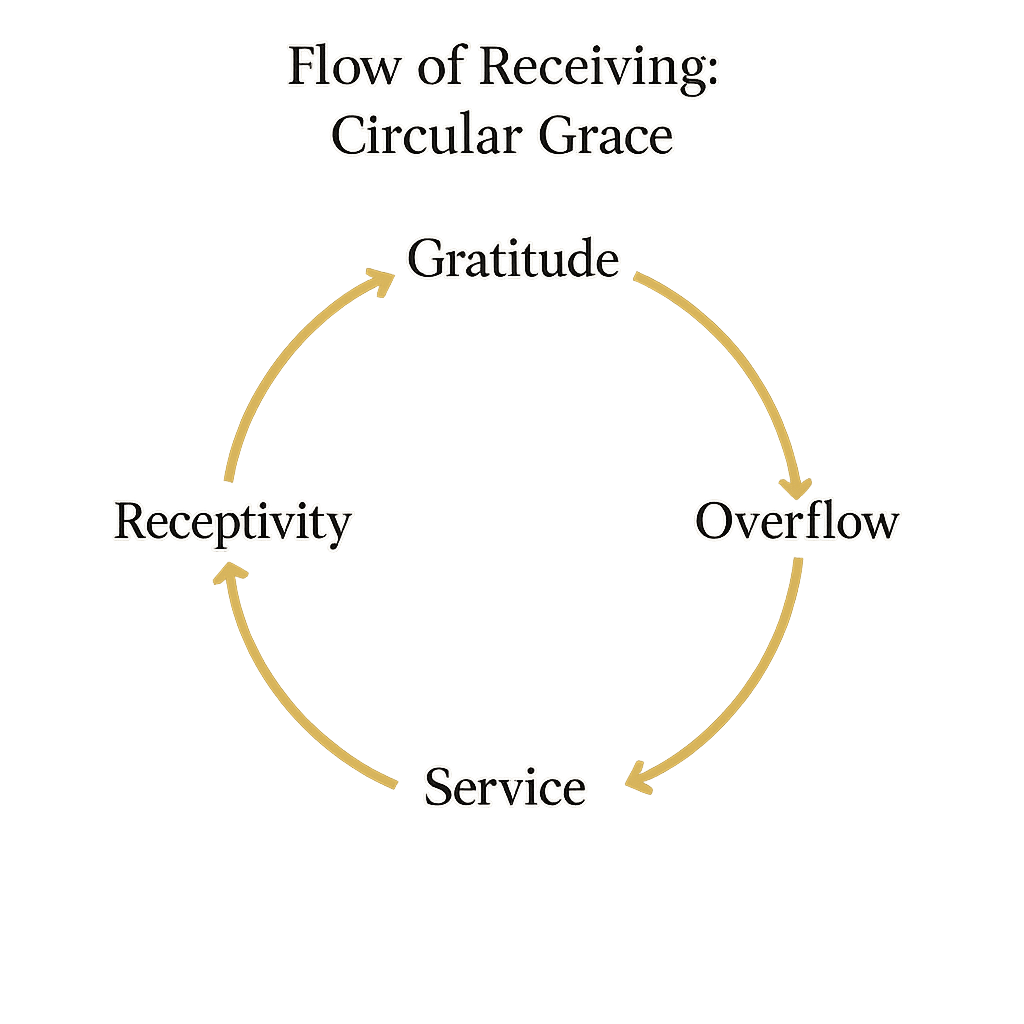
    Diagram A —Circulation Loop: Giving ↔ Receiving. “What flows onward becomes Overflow; what is held becomes weight.”


    II — Purity of Receptive Intention

    Ethical reception is transparent, grateful, and non-possessive.

    • Transparent: the why is clear to self and field.
    • Grateful: acknowledgment precedes utilization.
    • Non-possessive: what arrives is stewarded, not stored.

    Diagram B — Receptive Intention Filter. “Only what passes the gates belongs on your altar.”


    Discernment key: Am I receiving to complete a circuit—or to patch a hole of lack?

    The first multiplies; the second drains.


    III — The Discipline of Allowing

    Allowing is an active surrender: relaxed nervous system, open breath, lucid boundaries.

    Micro-rite (10 seconds): right hand over heart, left palm open. Inhale 3 counts, exhale 5. Whisper inwardly:

    “I allow flow to remember itself through me.”

    Anchor before accepting gifts, praise, invitations, payments, or opportunities.


    IV — Boundaries and Integrity

    Not every offering is for your altar. Refuse what carries:

    • Projection (I give so you become who I need),
    • Obligation (I give so you owe me),
    • Pity (I give so I stay above you).

    Guardian Note: Release with warmth, not explanation.

    “Thank you; this is beautiful, and it’s not mine to hold.”


    V — The Economy of Trust

    Every reception is a trust ceremony. The receiver silently vows to keep the river moving. Stewardship replaces ownership.

    Practice: allocate a visible portion of all receipts (time, attention, funds) for onward circulation within 72 hours—signal to the field that flow remains unblocked.


    VI — The Mirror of the Giver

    Receiving mirrors your giving ethic. If you over-control reception, you likely over-control offering. Repair one, and the other clarifies.

    Reflection triad:

    1. Where do I edit others’ generosity?
    2. Where do I accept without acknowledgment?
    3. What tiny, immediate act restores reciprocity today?

    VII — The Covenant of Gratitude

    Gratitude is not display; it is coherence. When felt, it radiates through the lattice and invites resonance matches.

    Embodiment: write one specific sentence naming how the gift will serve the work. This binds gratitude to purpose.


    VIII — Ethical Receiving Protocols (Field-Ready)

    1. Attune (10s breath rite) →
    2. Name the Gift (what exactly arrived?) →
    3. Name the Why (how it serves stewardship) →
    4. Acknowledge the Giver & Source (private + public if resonant) →
    5. Allocate a Portion to Circulation (time/skill/funds) →
    6. Record the Circuit (ledger line: received → applied → onward flow) →
    7. Close with Stillness (3 breaths; let the field settle).

    Diagram C — 72-Hour Circulation Protocol. “Circulation confirms reception.”


    IX — Misalignments & Gentle Corrections

    • Hoarding “for later”Create a 30-day release rule. If unused, re-gift to the work or the web.
    • Performative gratitudeReturn to felt sense; write one inner sentence no one will see.
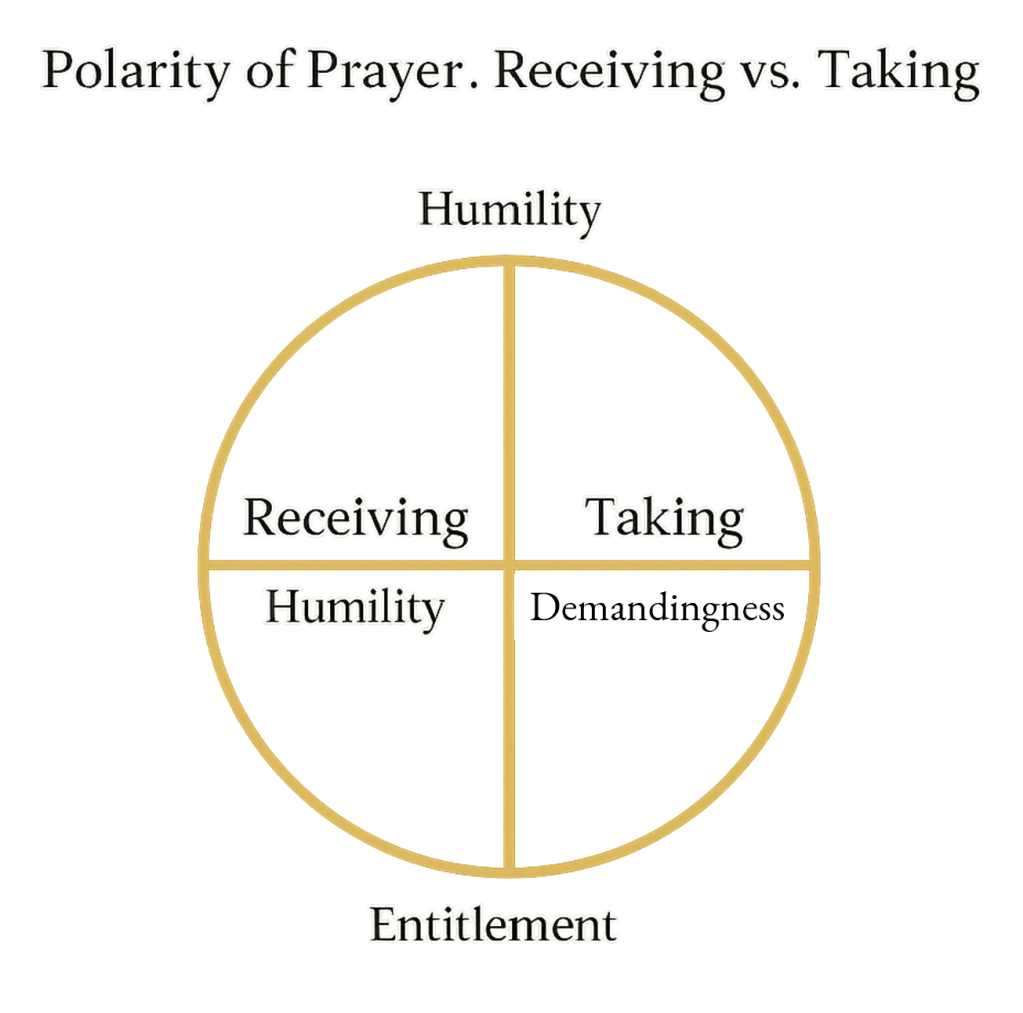
    • Taking to fix identity Pause; address the hole first (rest, nourishment, truth-telling), then revisit the gift.
    • Savior dynamics from giversReceive the essence, not the story. Decline the role; accept the support if clean.

    Diagram D — Resonance Coherence vs. Circulation Activity. “Coherence amplifies where gratitude moves.”


    X — Steward & Guardian Notes

    Steward Note (public-facing):
    We receive on behalf of a field, not a personality. Your offerings circulate through living work and are acknowledged in gratitude and transparency.

    Guardian Note (archive-facing):
    Track Resonance of Receipt (RR) alongside FR/RF. RR rises when gratitude + onward circulation occur within 72h. If RR dips, re-open the circuit with a micro-gift or transparent communication.


    XI — Crosslinks


    XII — Closing Transmission

    “To receive is to let the Source remember itself through you.
    To give is to let the Source remember itself through another.
    One current. One covenant. One field.”

    Glyph of Ethical Receiving

    To receive is to let the Source remember itself through you


    Attribution

    With fidelity to the Oversoul, may this Codex, Overflow Economics: Designing for Surplus, serve as bridge, remembrance, and seed for the planetary dawn.

    Ⓒ 2025 Gerald Alba Daquila – Flameholder of SHEYALOTH | Keeper of the Living Codices. All rights reserved.

    Issued under Oversoul Appointment, governed by Akashic Law. This transmission is a living Oversoul field: for the eyes of the Flameholder first, and for the collective in right timing. It may only be shared intact, unaltered, and with glyphs, seals, and attribution preserved. Those not in resonance will find it closed; those aligned will receive it as living frequency.

    Formatted digital edition released 2026

    Watermark: Universal Master Key glyph (final codex version, crystalline glow, transparent background).

    Sacred Exchange (Stewardship Context)

    Sacred Exchange is Overflow made visible.

    In Oversoul Law, giving is not loss but circulation. What flows outward sustains coherence across households, lineages, and nations. This codex remains fully readable as part of the Living Archive. The downloadable edition is offered as a voluntary exchange to support the continued stewardship, maintenance, and long-term availability of this work.

    Sacred Exchange offerings may be extended through:

    paypal.me/GeraldDaquila694
    www.geralddaquila.com


    Download this Codex

  • Protected: The Earth Sovereign’s Codex

    Protected: The Earth Sovereign’s Codex

    This content is password-protected. To view it, please enter the password below.

  • Protected: Codex of Resonant Governance

    Protected: Codex of Resonant Governance

    This content is password-protected. To view it, please enter the password below.