
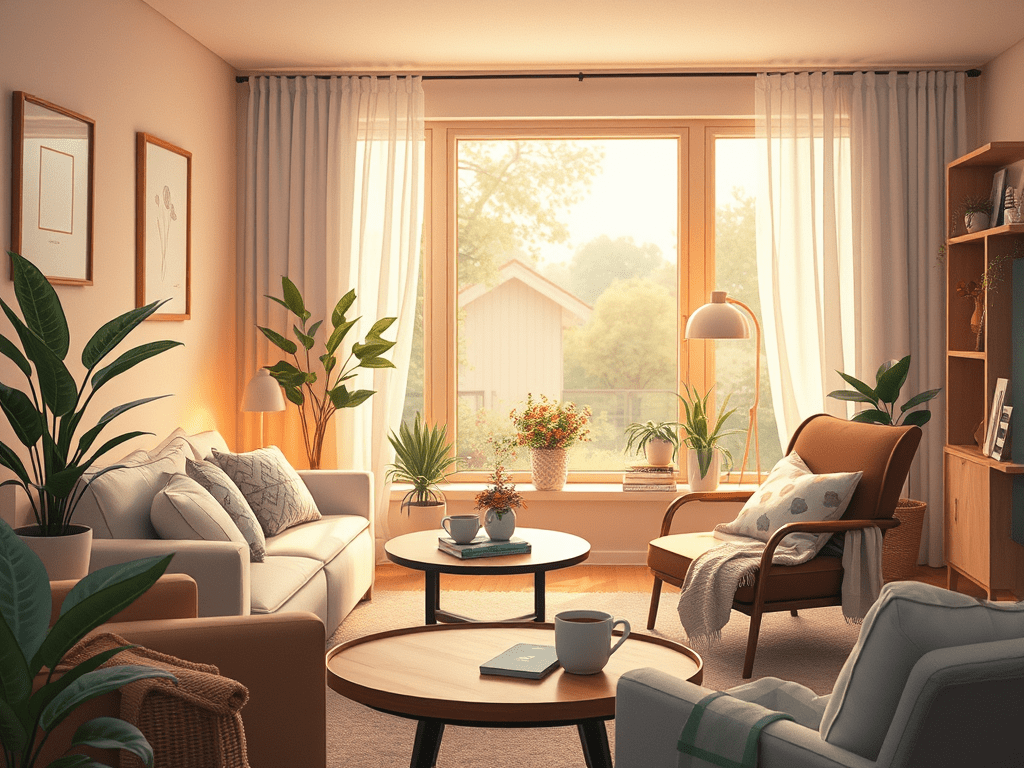
When the world feels unpredictable, the nervous system looks for one thing above all else: a place to land.
For most of us, that place is home — not as an idea, but as a lived environment made of routines, relationships, sounds, spaces, and unspoken emotional currents.
You do not need to fix the world to feel more stable.
You do not need to resolve every relationship or plan your future perfectly.
Often, the most powerful place to begin is simply where you live.
Your Home Is Not Just a Location
A home is not only walls and furniture.
It is a daily emotional climate.
Even small shifts in how a home feels can have outsized effects on:
- emotional regulation
- clarity of thought
- conflict patterns
- the ability to rest and recover
When the outside world becomes volatile, the home quietly becomes the nervous system’s first line of support — or strain.
Stability does not require perfection.
It requires enough coherence to breathe, rest, and think clearly.
Start with Rhythm, Not Control
Many people respond to uncertainty by trying to control more.
But stability is often restored through rhythm, not rigidity.
Simple anchors help:
- consistent waking and sleeping times
- shared meals, even if brief
- predictable moments of quiet
- small daily routines that signal safety
These rhythms tell the body:
Something here is steady, even if everything else is shifting.
You don’t need to add more rules.
You need reliable signals.
Reduce Noise Before You Solve Problems
When tension is high, the instinct is to talk things through immediately.
But many households are overloaded not by unresolved issues, but by too much stimulation.
Before problem-solving, consider:
- reducing background noise
- limiting constant news exposure
- creating device-free windows
- allowing silence without filling it
Calm is not created by agreement alone.
It is created by lowering the volume enough for nervous systems to settle.
Stability Grows Through Small Agreements
You don’t need everyone in your household to be on the same page about everything.
But a few shared agreements can change the entire tone of a space.
Examples:
- how conflict is paused when emotions escalate
- when rest is protected
- what times are kept low-stimulation
- how personal space is respected
These agreements are not about control.
They are about predictability, which the nervous system reads as safety.
Care Begins with Self-Regulation
One of the quiet truths of household stability is this:
You cannot regulate a shared space if you are constantly dysregulated within it.
This does not mean you must always be calm.
It means noticing when you need to:
- pause instead of react
- step away instead of escalate
- rest instead of push through
Self-regulation is not withdrawal.
It is what prevents small stresses from becoming relational storms.
Conflict Does Not Mean Failure
Every home has friction, especially during uncertain times.
Stability is not the absence of conflict.
It is the presence of repair.
Repair can be simple:
- acknowledging tension without blame
- returning to a conversation later
- apologizing without self-erasure
- choosing reconnection over being right
A home becomes steadier not because conflict never happens, but because it does not linger unresolved or unnamed.
Your Home Does Not Have to Carry Everything
It’s important to say this clearly:
Your home does not need to be a sanctuary at all times.
Sometimes it is simply a place to eat, sleep, and recover.
That is enough.
Trying to make a home carry spiritual ideals, emotional perfection, or constant harmony can quietly create pressure instead of peace.
Stability comes from realistic care, not idealized expectations.
A Gentle Reframe
In times of uncertainty, the world may feel too large to hold.
But your home is a scale your system can work with.
Small choices made consistently — quieter evenings, clearer boundaries, gentler communication, predictable rhythms — create a foundation your nervous system can trust.
You don’t need to do everything.
You don’t need to do it all at once.
Begin where you live.
Stability grows outward from there.
You may also wish to explore:
- You Are Allowed to Move at the Speed of Safety – on pacing change in a way your system can hold
- Caring Without Losing Yourself – learning to give without self-erasure
- Emotional Coherence – steadying your inner world during times of change
About the author
Gerry explores themes of change, emotional awareness, and inner coherence through reflective writing. His work is shaped by lived experience during times of transition and is offered as an invitation to pause, notice, and reflect.
If you’re curious about the broader personal and spiritual context behind these reflections, you can read a longer note here.
 Life.Understood.
What stirred your remembrance? Share your reflection below—we’re weaving the New Earth together, one soul voice at a time.