
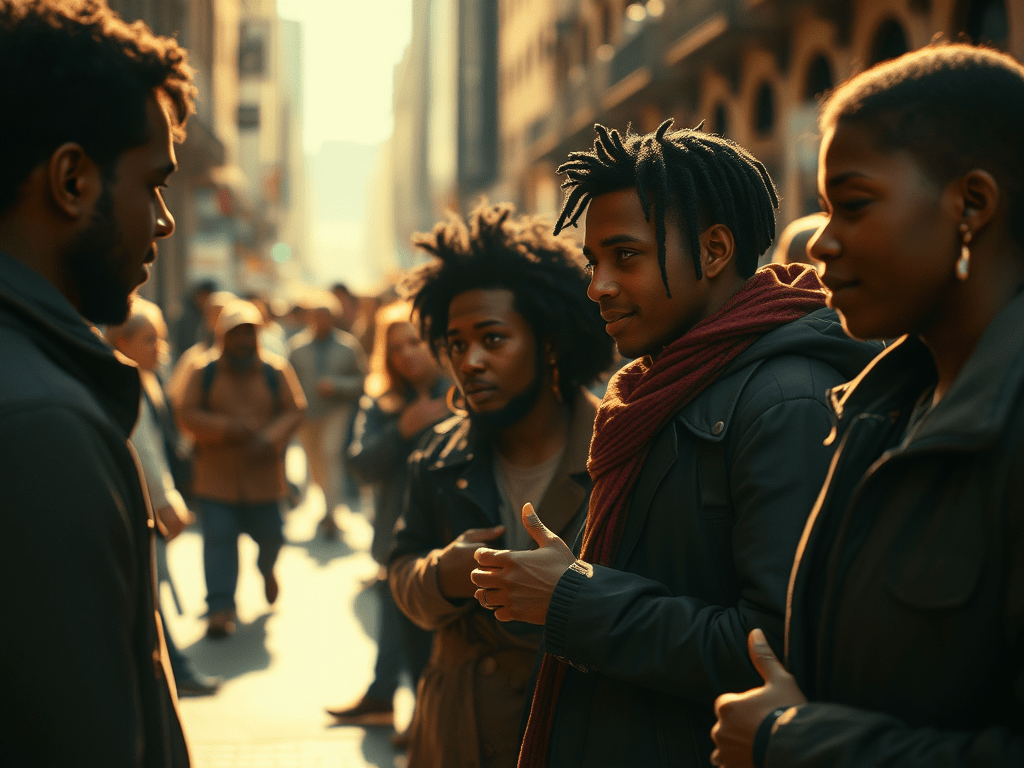
On Staying Human Inside Divisive Systems
“Love thy neighbor as thyself” sounds simple. Gentle. Obvious, even.
Until you start seeing how much of the world is organized in the opposite direction.
After awakening, one of the most jarring realizations is how deeply division is built into our systems. Not just socially or politically, but economically, culturally, and psychologically. Competition is normalized. Scarcity is emphasized. Differences are amplified. Threat is highlighted.
Fear becomes the background atmosphere.
And when fear dominates, people don’t see neighbors. They see rivals. Strangers. Potential threats. Categories instead of humans.
Trying to live from love in that environment can feel not just difficult — but unsafe.
Why Love Can Feel Like a Risk
When systems reward defensiveness and self-protection, opening your heart can feel like lowering your guard in a battlefield.
Your nervous system might say:
“If I soften, I’ll be taken advantage of.”
“If I trust, I’ll get hurt.”
“If I see everyone as human, I’ll miss real danger.”
This isn’t irrational. Many people have been harmed when they ignored their instincts or overrode their boundaries in the name of kindness.
So the challenge after awakening is not just to “be more loving.” It’s to discover a form of love that does not require self-betrayal.
Love Is Not the Same as Lack of Boundaries
One of the biggest confusions in this territory is believing that love means tolerating everything.
It doesn’t.
Loving your neighbor as yourself includes the as yourself part. It means:
- You do not dehumanize others
- But you also do not abandon yourself
- You can say no without hatred
- You can walk away without cruelty
- You can protect yourself without turning someone else into a villain
This kind of love is not soft in the sense of being unguarded. It is soft in the sense of not hardening into dehumanization.
Boundaries are not the opposite of love. They are what make love sustainable.
How Fear Turns People Into Enemies
Fear narrows perception. When we are afraid, our nervous system scans for threat, not connection. We start sorting people into categories:
Safe or unsafe
With me or against me
Like me or not like me
This is a survival response. But when it becomes a permanent worldview, it erodes our ability to see complexity.
One of the dangers after awakening is replacing one “enemy story” with another:
“They are the problem.”
“They are asleep.”
“They are corrupt.”
This still runs on the same fear circuitry — just pointed in a different direction.
Staying in love doesn’t mean denying harm or injustice. It means refusing to collapse other humans into flat caricatures, even when you oppose their actions or beliefs.
Love as a Regulated Stance, Not Just a Feeling
In a fear-driven world, love cannot just be an emotion that comes and goes. It becomes a stance you return to when you are regulated enough to choose.
That might look like:
- Pausing before reacting in anger
- Listening long enough to understand, even when you disagree
- Choosing firmness without humiliation
- Refusing to join in mockery or dehumanization
This is not passive. It requires self-awareness, nervous system regulation, and courage. It means not letting fear dictate your behavior, even when fear is contagious around you.
Love, in this sense, is strength. It is the ability to stay human under pressure.
How Love Actually Shifts Environments
It’s easy to feel that love is too small to matter against large, entrenched systems. But systems are made of patterns — and patterns are made of repeated human behaviors.
Every time you:
- Choose fairness when you could exploit
- Offer dignity when humiliation is easier
- Listen across difference instead of escalating division
- Repair instead of retaliate
you are interrupting fear-based patterns at the human scale.
These acts may seem small, but they create pockets of safety and trust. Over time, clusters of these interactions form microcultures. And enough microcultures can shift the emotional norms of larger environments.
Love does not usually overthrow systems dramatically. It erodes them quietly by modeling a different way of relating.
The Middle Path Between Naïveté and Hardness
Without integration, people often swing between two extremes:
Overexposed openness
Trusting too quickly, ignoring red flags, getting repeatedly hurt
Defensive hardness
Closing down empathy, assuming the worst, living in constant guardedness
Neither is sustainable.
The middle path is open-hearted and clear-eyed. You see the risks and the distortions, but you don’t let them turn you into someone who can no longer feel or care.
You stay discerning. You choose where to open. You choose where to step back. But you do not give fear the final say over who you are.
Staying Human Is the Work
You may not be able to dismantle fear-based systems overnight. But you can decide, again and again, not to let those systems define your nervous system or your character.
You can practice:
Seeing people as more than their roles
Holding boundaries without hatred
Choosing connection where it is safe and possible
Walking away where it is not
This is not a grand gesture. It is daily, quiet, relational work.
Loving your neighbor as yourself does not mean pretending the world is safer than it is. It means refusing to let a fearful world turn you into someone who can no longer recognize shared humanity.
That is not weakness. It is a form of moral and psychological courage.
And while it may not make headlines, it is one of the ways the emotional climate of a culture slowly, steadily changes.
You may also resonate with:
- “When You Can’t Unsee” (on the shock of seeing systemic distortion)
- “After You See, Then What?” (on integrating awakening without burnout)
- “When Inner Change Wants to Be Seen” (on the stress of sharing personal transformation)
- “Grief for a Self That Worked Hard”
- Pieces on nervous system stabilization during deep internal transition
These reflections often travel together as perception, identity, and participation in the world reorganize from the inside out.
About the author
Gerry explores themes of change, emotional awareness, and inner coherence through reflective writing. His work is shaped by lived experience during times of transition and is offered as an invitation to pause, notice, and reflect.
If you’re curious about the broader personal and spiritual context behind these reflections, you can read a longer note here.
 Life.Understood.
What stirred your remembrance? Share your reflection below—we’re weaving the New Earth together, one soul voice at a time.