
A Multidisciplinary Exploration of Human Flourishing in Turbulent Times
Prepared by: Gerald A. Daquila, PhD. Candidate
ABSTRACT
In an era marked by political polarization, economic uncertainty, environmental crises, and social unrest, the pursuit of human flourishing faces unprecedented challenges. This dissertation synthesizes recent global news and research literature to identify key threats to well-being, including societal division, mental health struggles, and existential uncertainty. Drawing from psychology, sociology, philosophy, and spirituality, it offers a multidisciplinary framework for meaning-making that fosters resilience without succumbing to chaos. Practical strategies—grounded in empirical research—are provided to help individuals “steady their boat” through mindfulness, community engagement, and purposeful action. The analysis emphasizes accessible, evidence-based approaches to cultivate hope and stability in turbulent times.
Introduction: Navigating the Storm
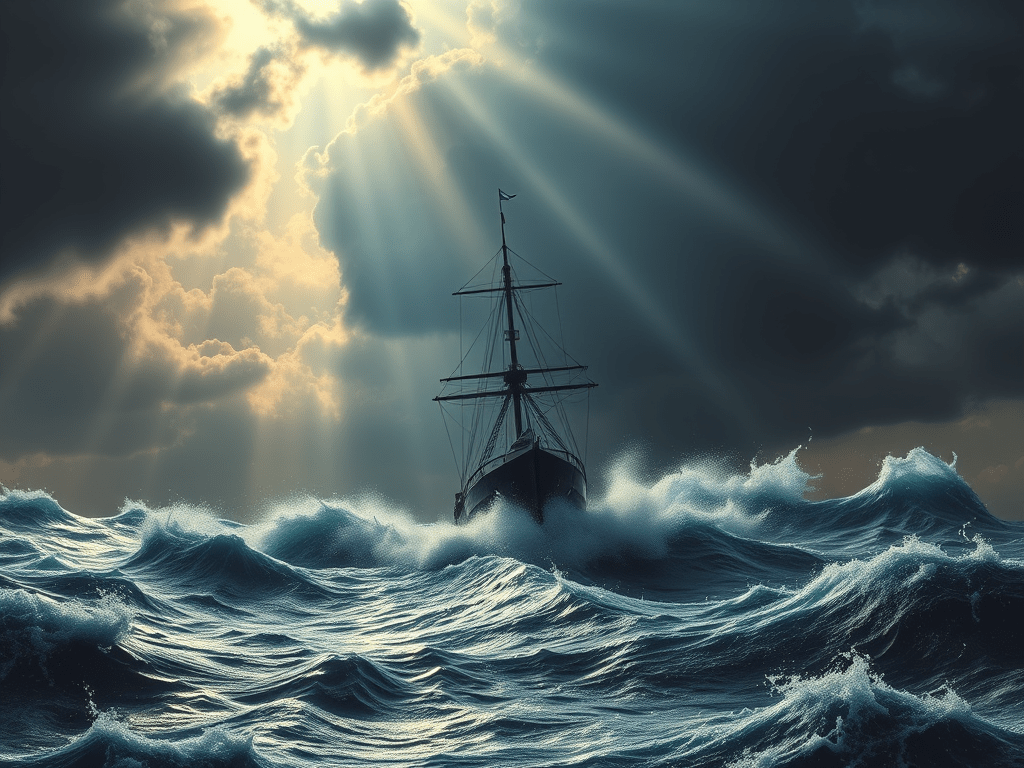
The world today feels like a ship tossed in a storm. From political upheavals and economic downturns to environmental crises and social fragmentation, global news paints a picture of chaos that threatens human flourishing—the state of thriving across physical, mental, social, and spiritual dimensions (VanderWeele, 2017). Yet, amidst this turbulence, individuals seek ways to make sense of the world and maintain personal stability.
This dissertation explores common themes in recent global news that undermine well-being, integrates multidisciplinary research to interpret these challenges, and offers practical strategies to foster resilience and meaning. The central question is: How do we steady our boat amidst the storm without being swept away?

Glyph of the Gridkeeper
The One Who Holds the Lattice of Light
Common Themes in Global News Threatening Human Flourishing
Recent global news highlights several interconnected threats to human flourishing, drawn from sources like the Global Flourishing Study and reports on social, economic, and political trends. Below are the dominant themes:
- Political Polarization and Social Division
Political tensions and ideological divides are escalating worldwide. The Global Flourishing Study (GFS), conducted by Harvard and Baylor Universities, notes that polarization undermines community cohesion, a key pillar of well-being (VanderWeele et al., 2025). For example, protests in Türkiye and backlash against public figures like Elon Musk reflect deep societal rifts (Travel And Tour World, 2025; Bloomberg, 2025). These divisions erode trust, foster isolation, and hinder collective flourishing. - Mental Health Crisis Among Young Adults
The GFS reports that young adults are grappling with significant mental health challenges, driven by economic pressures, social media, and uncertainty about the future (Regent University, 2025). This crisis threatens the dimension of flourishing tied to psychological well-being, as anxiety and depression rise globally. - Economic Instability and Inequality
Economic challenges, such as Tesla’s 13% sales drop and warnings of global economic downturns, signal financial insecurity (Bloomberg, 2025; ZeroHedge, 2024). These conditions exacerbate stress and limit access to resources essential for flourishing, like health care and education. - Environmental and Geopolitical Crises
Climate change and geopolitical conflicts, such as unrest in Türkiye and missile exchanges in Ukraine, create a sense of existential threat (Travel And Tour World, 2025; ZeroHedge, 2024). These crises disrupt the stability needed for individuals to pursue meaningful lives. - Erosion of Meaning and Purpose
A pervasive sense of disconnection fuels a “silent hunger” for meaning, as noted by Thomas (2025). The noise of modern life—amplified by rapid information flows and competing narratives—makes it harder to find purpose, a core component of flourishing.
Multidisciplinary Meaning-Making: Understanding the Chaos
To make sense of these challenges without being consumed, we turn to a multidisciplinary lens, integrating insights from psychology, sociology, philosophy, and spirituality. Each offers tools to interpret and navigate the storm.
- Psychology: Cultivating Resilience Through Mindfulness
Psychological research emphasizes resilience—the ability to adapt to adversity—as key to flourishing. Seligman’s (2011) PERMA model (Positive Emotion, Engagement, Relationships, Meaning, Accomplishment) suggests that practices like mindfulness meditation can regulate emotions and foster engagement. Studies show mindfulness reduces anxiety and enhances well-being even in chaotic environments (Kabat-Zinn, 2013). By focusing on the present, individuals can anchor themselves against the storm of external uncertainties. - Sociology: Rebuilding Community Cohesion
Sociological perspectives highlight the role of social bonds in flourishing. Putnam (2000) argues that social capital—networks of trust and reciprocity—buffers against societal chaos. The GFS findings underscore that religious engagement fosters community cohesion, even in secular societies (VanderWeele et al., 2025). Participating in local groups or shared rituals can counteract polarization and rebuild connections. - Philosophy: Finding Meaning in Absurdity
Existential philosophy, particularly Camus’ (1955) concept of embracing the absurd, offers a framework for meaning-making in a chaotic world. Camus suggests that accepting life’s lack of inherent meaning frees us to create our own purpose through acts of rebellion, passion, and solidarity. This perspective encourages individuals to find purpose in small, intentional actions, even amidst global turmoil. - Spirituality: Anchoring in Transcendence
Spiritual traditions, both religious and secular, emphasize transcendence—connecting to something larger than oneself—as a source of stability. The GFS notes that religious engagement enhances well-being across cultures (Regent University, 2025). Practices like prayer, meditation, or service can provide a sense of purpose and calm, grounding individuals in turbulent times.
Steadying the Boat: Practical Strategies for Resilience
How do we apply these insights to steady our personal ship? Below are evidence-based strategies, accessible to a broad audience, to foster flourishing amidst chaos:
- Practice Mindfulness Daily
Dedicate 10–15 minutes to mindfulness practices like deep breathing or guided meditation. Apps like Headspace or Calm make this accessible. Research shows that regular mindfulness reduces stress and enhances emotional regulation (Kabat-Zinn, 2013). - Engage in Community
Join a local group—whether a book club, volunteer organization, or faith community—to build social bonds. The GFS highlights that community involvement boosts well-being (VanderWeele et al., 2025). Even small interactions, like chatting with neighbors, can counter isolation. - Create Personal Meaning
Reflect on your values and set small, achievable goals aligned with them. Journaling about what gives your life purpose—whether family, creativity, or service—can anchor you. Camus’ (1955) philosophy suggests that meaning emerges from intentional action, no matter how small. - Limit Information Overload
Curate your media consumption to avoid being overwhelmed by chaotic news. Set boundaries, like checking news once daily, and focus on reliable sources. Psychological studies link excessive media exposure to anxiety (Holman et al., 2014). - Embrace Spiritual or Reflective Practices
Engage in practices that connect you to a larger purpose, such as prayer, meditation, or nature walks. These activities foster a sense of transcendence and calm, supported by the GFS findings on spirituality’s role in flourishing (Regent University, 2025).
Conclusion: Charting a Course Forward
The storms of 2025—polarization, mental health crises, economic instability, and existential threats—challenge human flourishing but do not define it. By integrating psychological resilience, sociological connection, philosophical meaning-making, and spiritual grounding, we can navigate chaos without being consumed. These disciplines remind us that flourishing is not the absence of storms but the courage to sail through them. By practicing mindfulness, building community, creating purpose, managing information, and embracing transcendence, we steady our boats and chart a course toward a meaningful life.
Resonant Crosslinks
- Burning Out, Rising Up: Understanding Burnout and Resilience in the Philippines
Personal burnout mirrors collective chaos; resilience rises when inner fires are tended wisely. - Codex of Overflow Breathwork
Breath is the anchor in the storm, restoring calm waters when external waves grow fierce. - The Void and the Light: A Neurospiritual Path Through Suicidal Ideation Toward Unity
Even the darkest global storms conceal light; surrendering to the void reveals hidden unity. - Codex of Sovereignty: The Soul’s Inalienable Freedom
Amid chaos, sovereignty is the ballast that keeps the ship upright—freedom within disorder. - Planetary Stewardship Blueprint
Global storms are planetary contractions; steadying the ship requires remembering Earth’s larger purpose. - Codex of Master Builders of the New Earth
Resilience is not only survival—it is constructing new vessels strong enough for the seas of tomorrow. - Universal Master Key
The UMK is the compass of resilience, guiding ships of light through uncharted and turbulent waters.
Glossary
- Human Flourishing: A state of optimal well-being encompassing physical, mental, social, spiritual, and civic dimensions, characterized by purpose, meaning, and fulfillment (VanderWeele, 2017).
- Resilience: The ability to adapt and thrive in the face of adversity (Seligman, 2011).
- Social Capital: Networks of trust and reciprocity that enhance community cohesion (Putnam, 2000).
- Eudaimonia: A philosophical concept of human flourishing, emphasizing a life of virtue and purpose (Thomas, 2025).
- Mindfulness: The practice of being present and aware, often through meditation, to regulate emotions (Kabat-Zinn, 2013).
Bibliography
Bloomberg. (2025, April 2). Tesla (TSLA) sales slump to lowest since 2022 amid anti-Musk backlash. Bloomberg.
Camus, A. (1955). The myth of Sisyphus and other essays. Vintage Books.
Holman, E. A., Garfin, D. R., & Silver, R. C. (2014). Media’s role in broadcasting acute stress following the Boston Marathon bombings. Proceedings of the National Academy of Sciences, 111(1), 93–98. https://doi.org/10.1073/pnas.1316265110
Kabat-Zinn, J. (2013). Full catastrophe living: Using the wisdom of your body and mind to face stress, pain, and illness (2nd ed.). Bantam Books.
Putnam, R. D. (2000). Bowling alone: The collapse and revival of American community. Simon & Schuster.
Regent University. (2025, May 6). First wave of findings released from the highly anticipated Global Flourishing Study. Regent.edu.
Seligman, M. E. P. (2011). Flourish: A visionary new understanding of happiness and well-being. Free Press.
Thomas, K. (2025, January 11). The eudaimonia pandemic: A manifesto for human flourishing. Medium.
Travel And Tour World. (2025, March 23). Urgent Türkiye travel advisory update: Terror warnings, Istanbul unrest, and border chaos impact global tourism in 2025. Travelandtourworld.com.
VanderWeele, T. J. (2017). On the promotion of human flourishing. Proceedings of the National Academy of Sciences, 114(31), 8148–8156. https://doi.org/10.1073/pnas.1702996114
VanderWeele, T. J., Johnson, B. R., & Gallup. (2025). The Global Flourishing Study: An interim report for policymakers. Faith and Law.
ZeroHedge. (2024, December 20). A year of chaos: Does a shocking magazine cover reveal what the global elite have planned for 2025? ZeroHedge.com.
Attribution
This writing is offered in attunement with the Akashic Records and in service to planetary remembrance. It is carried through the Oversoul stream of SHEYALOTH and anchored within the Living Archives of the New Earth. May it serve as a bridge for seekers, guiding them from the first stirrings of awakening toward the higher codices of sovereignty, stewardship, and overflow.
© 2025 by Gerald Alba Daquila. Sole Flameholder of the SHEYALOTH Oversoul Stream.

 Life.Understood.